


More news on this day
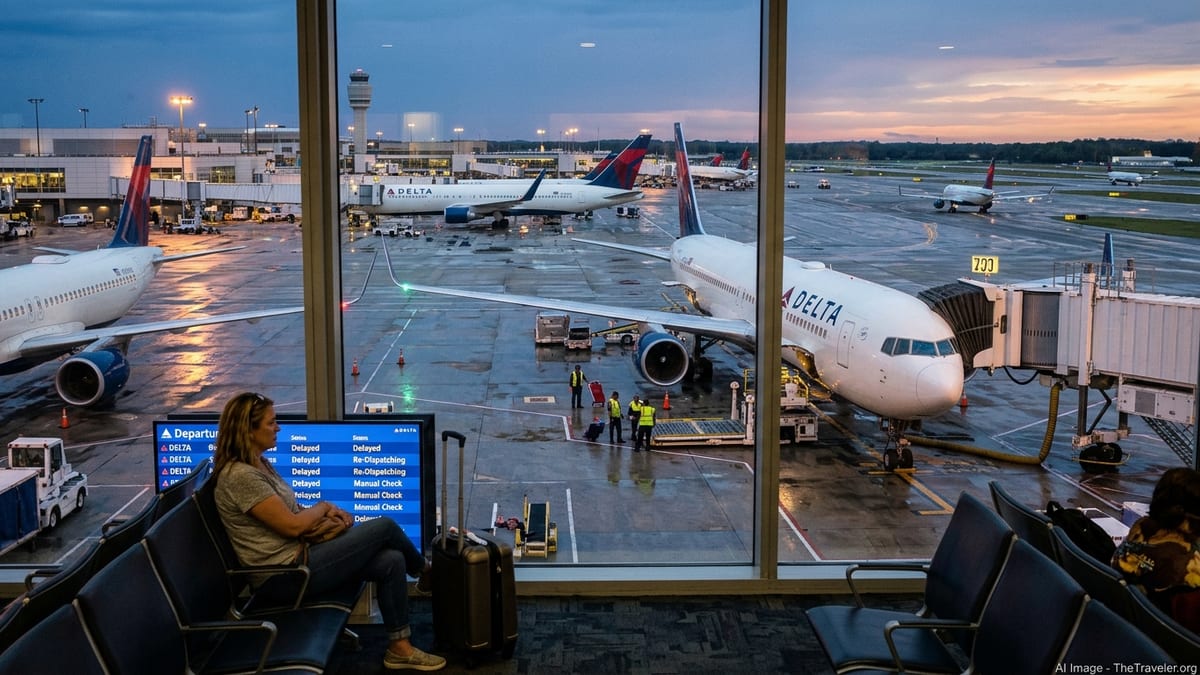
Delta Air Lines suffered widespread delays on Sunday, November 22, 2026, after an outage in its automated weight-and-balance system slowed departures at its Atlanta hub and across the United States during one of the busiest travel weeks of the year.
Get the latest news straight to your inbox!
What happened to Delta’s automation system
Delta said on Sunday that a problem with its automated system for calculating aircraft weight and balance prevented normal processing of departing flights, forcing staff to switch to manual procedures while engineers worked to restore the program. The system is used to ensure each aircraft’s total weight and its distribution between passengers, baggage, cargo and fuel stay within certified safety limits before takeoff, and is embedded in Delta’s normal dispatch workflow.
The airline did not publicly specify the root cause of the malfunction, describing it as an automation or equipment issue affecting weight-and-balance calculations. The disruption was first reported during the morning of November 22 and hit operations at Hartsfield-Jackson Atlanta International Airport, Delta’s primary hub, before its effects rippled across the carrier’s domestic network. According to multiple statements that day, Delta’s internal teams implemented “manual workarounds” to keep flights moving while software specialists attempted to bring the automated tools back online.
By Sunday afternoon and evening, Delta said the affected system had been restored and was again supporting departing flight calculations. However, airline and airport updates indicated that schedules were still far from normal, as aircraft and crews were out of position and many departures faced knock-on delays from the morning’s disruption. Local media in Atlanta reported that operations were closer to normal on Monday, November 23, though some residual delays and isolated manual processing continued while the airline fully reset its schedule.
Scale of the disruption at Atlanta and nationwide
Real-time data from flight-tracking service FlightAware on Sunday showed the scale of the outage’s impact on Delta and its Atlanta hub. By early Sunday evening, more than 1,000 Delta flights across the network were delayed, accounting for roughly 58 percent of the carrier’s schedule that day. Only a small share of flights were cancelled outright, with one snapshot from FlightAware indicating around 3 percent of Delta services did not operate, suggesting the airline prioritized keeping flights running, albeit late, rather than trimming the schedule heavily.
The effect was particularly acute in Atlanta. FlightAware figures cited by national and local outlets indicated that about 58 percent of departures from Hartsfield-Jackson Atlanta International Airport were delayed on Sunday, along with around half of all arrivals. While other airlines also experienced some knock-on congestion into Atlanta, Delta operates the majority of flights at the airport, and the data suggest that most of the disruption was concentrated on its operation. Some regional and outstation airports reported holds or extended ground times for Delta departures bound for Atlanta while weight-and-balance clearances were processed.
Separate reporting from local media in Atlanta on Monday, November 23, cited airport and airline information showing that more than 1,000 Delta-operated flights to, from or through Atlanta were delayed and around 140 were cancelled over the course of Sunday. By Monday afternoon, those numbers had dropped substantially, with only residual delays and a handful of cancellations remaining as operations stabilized. The improved figures support Delta’s statement that the core automation system had been restored, though full network recovery required additional time as aircraft and crews were realigned with their intended rotations.
FAA actions and safety context for weight-and-balance checks
The Federal Aviation Administration (FAA) played a limited but visible role during the disruption. On Sunday morning, the agency issued a short ground stop for some flights bound for Atlanta, pausing certain arrivals while the scope of the problem and its impact on airport operations became clearer. That measure was in place for roughly an hour before being downgraded to a ground delay program and more targeted flow management, according to FAA communications and air traffic advisories.
In a public update on X, the FAA emphasized that the delays were not related to any FAA air traffic control or navigation systems. That clarification followed close behind a separate, unrelated nationwide air traffic network malfunction earlier in November that had prompted the longest U.S. ground stop in more than two decades. By distinguishing the Delta automation outage from its own systems, the FAA signaled that the root cause was within the airline’s operational technology rather than the national airspace infrastructure.
Weight-and-balance calculations sit at the heart of the safety case for every commercial flight. FAA guidance notes that operating above an aircraft’s certified maximum takeoff weight or with its center of gravity outside allowed limits can compromise structural integrity and handling characteristics, potentially affecting takeoff performance, climb capability and controllability, particularly in abnormal conditions. Airlines therefore rely on a combination of standardized passenger weight assumptions, actual baggage and cargo loads, and fuel data to compute each flight’s weight and center-of-gravity position.
While these calculations can be performed manually using load sheets and performance tables, major carriers such as Delta typically embed them in automated dispatch tools that integrate with check-in, baggage handling and flight planning systems. Automation reduces the risk of arithmetic or transcription errors and allows large hubs like Atlanta to process thousands of passengers efficiently. When such tools fail, dispatchers and flight crews can revert to manual methods, but the process is slower and more labor intensive, which helps explain the scale of Sunday’s delays even though the underlying safety procedures remained in place.
Timing amid a month of aviation technology problems
The Delta outage arrived at a sensitive moment for U.S. aviation, just days before the peak of the Thanksgiving travel period and less than two weeks after a major FAA network malfunction triggered a nationwide ground stop. That earlier problem, unrelated to airlines’ internal systems, disrupted flights across the United States for more than four hours and led to thousands of cancellations and delays as carriers struggled to reset their schedules. The incident reignited debate over the resilience and modernization of critical air traffic infrastructure.
Within roughly the same window, United Airlines experienced its own system outage that forced a halt to many departures while the carrier resolved a technology failure, as publicly acknowledged by United and reported by multiple outlets. Against that backdrop, the Delta weight-and-balance disruption added to a perception among travelers that aviation technology issues have become more visible, even though comprehensive long-term data on system reliability and outage frequency across the industry remain limited.
Transportation and aviation officials have generally cautioned against linking these separate events as evidence of a single overarching cause, emphasizing that the November FAA ground stop, United’s outage and Delta’s automation failure involved different systems under different operators. Public statements from the FAA and other authorities have indicated no evidence that the incidents were connected or related to cyberattacks, but thorough technical investigations typically take time and detailed findings are not always released to the public. For travelers, however, the result has been a series of high-profile disruptions during a period of strong demand for air travel and elevated ticket prices around the holidays.
Sunday’s Delta delays coincided with what the Transportation Security Administration and industry forecasts had already characterized as one of the busiest Thanksgiving travel seasons in years, with U.S. airlines scheduling tens of thousands of daily flights and passenger volumes expected to surpass pre-pandemic levels on peak days. That context magnified the practical impact of a technology outage that, on an ordinary weekend, might have been easier to absorb through schedule padding and rebookings.
How Delta responded and what travelers should do next
Delta’s customer-facing response focused on keeping as much of its schedule intact as possible while offering support to those whose plans were heavily disrupted. Throughout Sunday, the airline said it was rebooking affected passengers on later flights, providing hotel rooms and meal vouchers where overnight stays or long waits were unavoidable, and issuing refunds to customers whose flights were cancelled. Several major news outlets reported that by mid-afternoon Sunday, Delta was proactively apologizing for the delays and reiterating that the automation system had been restored even as crews continued to work through the backlog.
Local coverage from Atlanta and reports from other major Delta stations indicated that many passengers ultimately completed their journeys the same day, albeit several hours behind schedule, while some overnight disruptions carried into the early hours of Monday. By Monday afternoon, November 23, Delta operations in Atlanta were described as “returning to normal,” with significantly fewer delays and cancellations and no new reports of automation outages, although at least some flights were still using manual or hybrid procedures while the airline confirmed system stability.
For travelers with upcoming Delta bookings in the days following the incident, there are currently no indications from the airline, the airport or regulators of ongoing systemic problems with weight-and-balance automation. However, given the residual effects that large-scale disruptions can have on aircraft and crew positioning, passengers flying through Atlanta or on heavily trafficked routes around the Thanksgiving peak may still encounter occasional delays unrelated to the original outage. Delta’s general policy in such situations is to update estimated departure times in its app and on airport displays as new information becomes available.
Passengers preparing to travel with Delta in the days ahead should monitor their flight status closely on the day of departure, allow extra time at the airport, and watch for any travel advisories or flexible change policies the airline may publish if further operational challenges emerge. Those who experienced significant delays or cancellations during the November 22 disruption and have outstanding questions about refunds, reimbursements or duty-of-care expenses should review Delta’s current customer commitments and, if necessary, contact the airline with receipts and booking references. As of now, Delta and the FAA both characterize the weight-and-balance automation outage as a concluded event, with normal operations resumed but traveler vigilance still advisable during this exceptionally busy holiday travel period.