


More news on this day
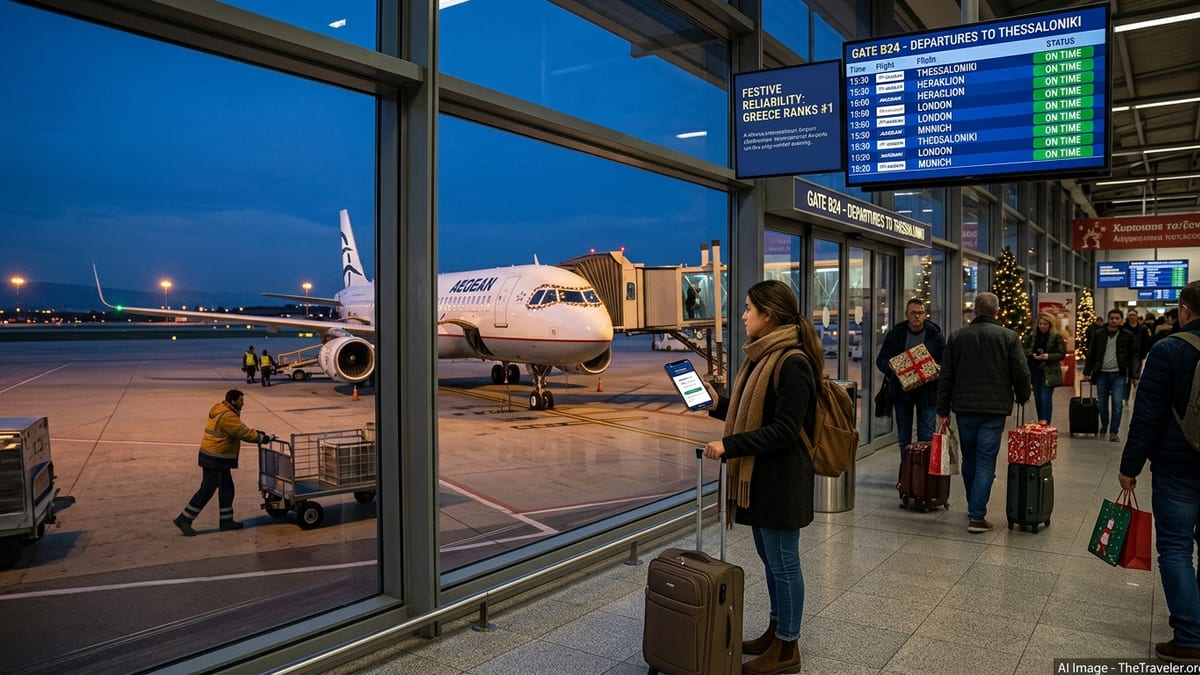
Greece, which only months ago was among Europe’s most delay-prone summer aviation markets, now emerges as the continent’s most reliable country to fly to and from over Christmas, according to newly compiled data that compares on-time performance and cancellations across major European holiday destinations.
Get the latest news straight to your inbox!
What the new festive reliability ranking actually measures
The Omio Festive Flight Reliability Index, compiled from historical aviation operations data for the main Christmas travel period, ranks European countries on a 100-point scale using three core indicators: the share of flights departing and arriving on time, the average length of delays, and the proportion of flights that are cancelled or not operated. The index is based on completed past holiday seasons rather than forecasts, which means it reflects performance already observed around Christmas and New Year rather than predictions for the upcoming winter.
To make results comparable between countries of very different sizes, the index looks at averages rather than absolute numbers of flights. It distinguishes between departures and arrivals and treats cancellations as a separate, heavily weighted category, since a cancelled service generally has a much greater impact on passengers than a short delay. The figures refer to scheduled commercial flights and do not include diverted or repositioning movements. While Omio has not published the full raw database, the summary table shows consistent methodology across the ten featured countries, which include large markets such as Spain, Italy and Germany alongside smaller systems such as Slovenia.
Eurocontrol’s network-wide December 2023 reporting confirms that punctuality across Europe during the Christmas period varies substantially by state and airport, influenced by local weather patterns, air traffic management capacity and traffic volumes. In that context the Omio index is broadly aligned with wider official observations that reliability can differ sharply between neighbouring countries and from one holiday to the next, reinforcing the value of country-level comparisons when planning peak-season journeys.
Greece’s turnaround: from troubled summers to calm Christmas skies
In the Omio index, Greece records an overall festive reliability score of 86.76 out of 100, the highest among the ten ranked countries. The dataset shows an average of 448 daily departures and the same number of arrivals across the Christmas period, with about 79.8 percent of outbound flights and 79.4 percent of inbound flights operating on time. Average delays are reported at 11 minutes in each direction. Most striking is the cancellation rate: only 1.93 percent of Greek flights in the index period were cancelled or not operated, the lowest figure in the top ten despite the country’s relatively busy winter schedule compared with smaller markets.
This performance contrasts with previous summers, when several analyses identified Greece as one of Europe’s more disrupted markets. A Flightright assessment of the 2023 summer peak, for example, cited Greece alongside Serbia and Malta as among the countries where passengers most frequently encountered delays and cancellations. Separate reporting based on Eurocontrol performance data for 2024 and 2025 also pointed to above-average delay minutes per flight in Greek airspace during busy summer months, attributing problems to structural issues such as air traffic control staffing and system limitations combined with strong tourism demand.
The Omio festive figures suggest that when traffic levels are lower and weather conditions more stable than in the peak July and August season, Greece’s aviation system performs significantly better. With less pressure on congested island airports and on the country’s main hubs in Athens and Thessaloniki, reactionary delays ease and cancellation rates fall sharply. For travelers, that means that routes which might be risky to rely on for tight summer connections can be more dependable around Christmas, particularly on key pre-holiday travel days where Omio identifies Greece as the calmest market in Europe.
How other European countries compare, and the hidden impact of cancellations
Denmark ranks second in the Omio festive reliability table with a score of 82.93. Its departure punctuality, at 83.04 percent, is the highest among the top ten, and average delays are around ten minutes, slightly better than Greece. However, 3.93 percent of Danish flights are recorded as cancelled or not operated, roughly double the Greek rate. For passengers, that difference matters because even an efficient rebooking can mean missing time-sensitive events at the destination, and in some cases overnight stays near hub airports during one of the busiest periods of the year.
Sweden, in third place with a score of 78.40, looks similar to Greece on punctuality, with just under 80 percent of departures on time and an average delay of 11 minutes. Its cancellation rate of 4.23 percent is still relatively moderate but notably higher than those of Greece and Slovenia. Austria and Norway, in sixth and seventh place respectively, also show a pattern of reasonable on-time performance with mid-range cancellation rates around 3.4 to 4.5 percent. In all of these markets, the practical risk to travelers is less about long routine delays and more about the possibility that a small but meaningful share of flights will not operate at all during the peak festive period.
Spain and Italy, ranked fourth and fifth, stand out for different reasons. Spain handles far more flights than the Nordic states during Christmas, and the Omio data places its departure punctuality at 73.01 percent with an average delay of 15 minutes and a cancellation rate of 5.27 percent. Italy’s punctuality is similar, at 72.24 percent on-time departures and 15-minute average delays, but the share of cancelled or non-operated flights is lower at 3.24 percent. Travelers using these large Mediterranean markets should therefore expect a higher likelihood of moderate delays compared with Scandinavian countries, but not an exceptional level of outright cancellations by European standards.
Germany and Türkiye illustrate why a place in the top ten does not necessarily imply low risk. Germany, eighth in the index with a score of 66.55, has the worst on-time departure rate among the ranked countries at 69.03 percent and an average delay of 16 minutes, reflecting the strain on its major hubs. Türkiye, ninth with a score of 66.20, shows reasonably strong punctuality at 76.11 percent on-time departures but an elevated cancellation rate of 8.93 percent, around one flight in eleven. For travelers using Istanbul as a long-haul connection point, that higher probability of a cancellation can be more disruptive than a slightly longer average delay elsewhere.
Day-by-day patterns: Christmas Eve, Christmas Day and Boxing Day risks
The Omio index also disaggregates performance by specific key dates. For Christmas Eve, Spain emerges as the most reliable European country in the dataset, with a score of 91.3 despite handling around 2,250 departures and 2,280 arrivals on 24 December. Around 87.5 percent of those departures and 90.4 percent of arrivals operated on time, and average delays were short, at approximately eight minutes for departures and six minutes for arrivals. Ireland, Norway, Portugal and Poland follow as the next most reliable Christmas Eve markets, all with index scores above 78.
At the other end of the scale, the index identifies Croatia and Montenegro as the most disrupted countries on Christmas Eve, with very low scores of 12.5 and 14.6. Cyprus, a popular destination for winter-sun holidays, records the most striking single-day figure: around 37 percent of its flights on 24 December in the reference year were cancelled or not operated, meaning more than one in three services did not take place. While this likely reflects a relatively small total number of flights combined with local operational issues, it underlines the importance of checking not just average national performance but also the specific risk profile for a chosen day of travel.
On Christmas Day itself, Spain again ranks first with an index score of 89.2. Portugal is close behind at 88.15, with the Omio data suggesting that 91.7 percent of its departures on 25 December were on time and only 2.6 percent were cancelled. These figures align with Eurocontrol’s general observation that traffic volumes across much of Europe dip on Christmas Day, which can ease congestion and improve punctuality, particularly in countries where weather is relatively mild compared with northern hubs.
The United Kingdom’s performance on Christmas Day, however, shows how national averages can mask uncomfortable details. While the UK appears in the upper part of the index table with a strong overall score, Omio’s breakdown indicates that about 11.5 percent of flights involving UK airports on 25 December were cancelled or not operated, more than one in nine. For passengers planning to route through London or other British hubs on Christmas Day, the elevated cancellation risk may outweigh the benefits of the country’s generally robust aviation infrastructure on less constrained days.
Iceland stands out in the Omio analysis as the most disrupted country on Christmas Day in the reference period. According to the index summary, average arrival delays were about three hours and ten minutes, and just over half of the small number of flights scheduled that day were cancelled. While the dataset does not attribute causes, contemporaneous reporting about severe winter storms and temporary closures at Keflavik International Airport around previous Christmas periods indicates that weather can quickly overwhelm limited capacity in such a small market. For travelers attracted by the prospect of a snowy festive break and the northern lights, these figures highlight a significant operational risk if they schedule travel exactly on Christmas Day rather than allowing more buffer either side of the holiday.
Implications for transatlantic travelers and how to use the data
The Omio index covers flights within and involving Europe, but for travelers from North America the transatlantic segment introduces an additional layer of risk. Long-haul services to hubs such as London Heathrow, Frankfurt, Amsterdam, Madrid, Istanbul and Athens are affected by airline-specific operational reliability, US-side weather and infrastructure constraints, and peak-season scheduling patterns that are not captured in the country-level European averages. Analyses of recent US holiday seasons show that major storms, IT outages and air traffic control restrictions can significantly disrupt departure flows, sometimes cascading into missed connections in Europe even when European operations themselves are relatively stable.
Because of these separate sources of disruption, the Omio rankings are best understood as a guide to how reliably a given European country is likely to operate once passengers are already in the region. For example, a traveler flying from New York to Athens and then on to a Greek island may face one set of risks on the transatlantic leg and a different, generally lower set of risks on the domestic Greek flight, according to the index. Similarly, someone routing via Istanbul, where Türkiye’s festive cancellation rate approaches 9 percent in the Omio dataset, may want to incorporate additional buffer time or consider alternative routings even if US departure conditions look favourable at booking time.
The day-specific findings also offer concrete planning options. Greece’s strong performance on 18, 20 and 22 December in the Omio index suggests that travelers who can arrive in Europe a few days before Christmas have a better chance of avoiding the operational pinch points of Christmas Eve and Boxing Day. Conversely, those who must travel on 24 or 25 December may find Spain or Portugal offer a comparatively lower risk of disruption, so long as they are prepared for fuller flights and the usual holiday congestion at major airports.
At the same time, Eurocontrol’s own delay statistics for December 2023 and broader reporting for 2024 and 2025 show that Europe-wide punctuality has been under strain, with reactionary delays, airline-related issues and capacity bottlenecks combining to produce some of the worst average delay minutes per flight in two decades. That context underscores the need to view even the better-performing festive markets as relatively, rather than absolutely, reliable: an 80 to 90 percent on-time rate still implies a meaningful probability of a delay, especially during a period when many journeys are tied to fixed events.
What travelers should check now for upcoming Christmas trips
Because the Omio Festive Flight Reliability Index is built on historical data, it does not account for future events such as strikes, new air traffic control restrictions, airline restructurings or unseasonal weather patterns that could affect the next Christmas period. Before booking, travelers should therefore look at a combination of this kind of historical country-level analysis and more immediate indicators, such as current schedules filed in airline reservation systems, any announced industrial action in the aviation sector, and updates from national air traffic management bodies and major airports.
For itineraries already booked, one practical step is to scrutinize connections involving countries with higher recorded festive cancellation rates in the Omio table, notably Türkiye and the United Kingdom on certain days, and to consider whether more generous minimum connection times are advisable. Where possible, booking all sectors on a single through-ticket with one airline group can simplify rebooking rights if a delay or cancellation disrupts the journey, particularly when the connection is within the European Union and therefore also covered by EU261 passenger protection rules.
Travelers should also verify their insurance coverage for missed connections, cancellations and weather-related disruption well in advance of departure. In recent European winters, storms and prolonged low-visibility conditions have occasionally led to large numbers of cancellations at individual hubs, and while such events are not predictable in detail they are frequent enough that financial protection can be valuable. Keeping boarding passes, receipts and any written communication from airlines can help if compensation or reimbursement claims need to be made after the trip.
Finally, because conditions can change rapidly in the weeks before Christmas, it is advisable to monitor airline notifications and airport operational updates closely in the days leading up to travel. The Omio index indicates that Greece, Spain, Portugal and several Nordic countries have historically provided comparatively reliable operations over the festive period, but upcoming seasons will be shaped by the specific mix of weather, demand and staffing conditions present at the time. Using the historical rankings as one input, alongside live information from carriers and regulators, can help travelers decide whether to adjust travel dates, routing or connection times as the holiday approaches.