


More news on this day
Thanksgiving week air travel in the United States has been disrupted by a combination of staffing shortfalls at Chicago O’Hare International Airport and a major technology failure at Delta Air Lines, triggering ground restrictions, knock-on delays and scattered cancellations just as passenger volumes approach holiday peaks.
Get the latest news straight to your inbox!
What happened in Chicago and how long it lasted
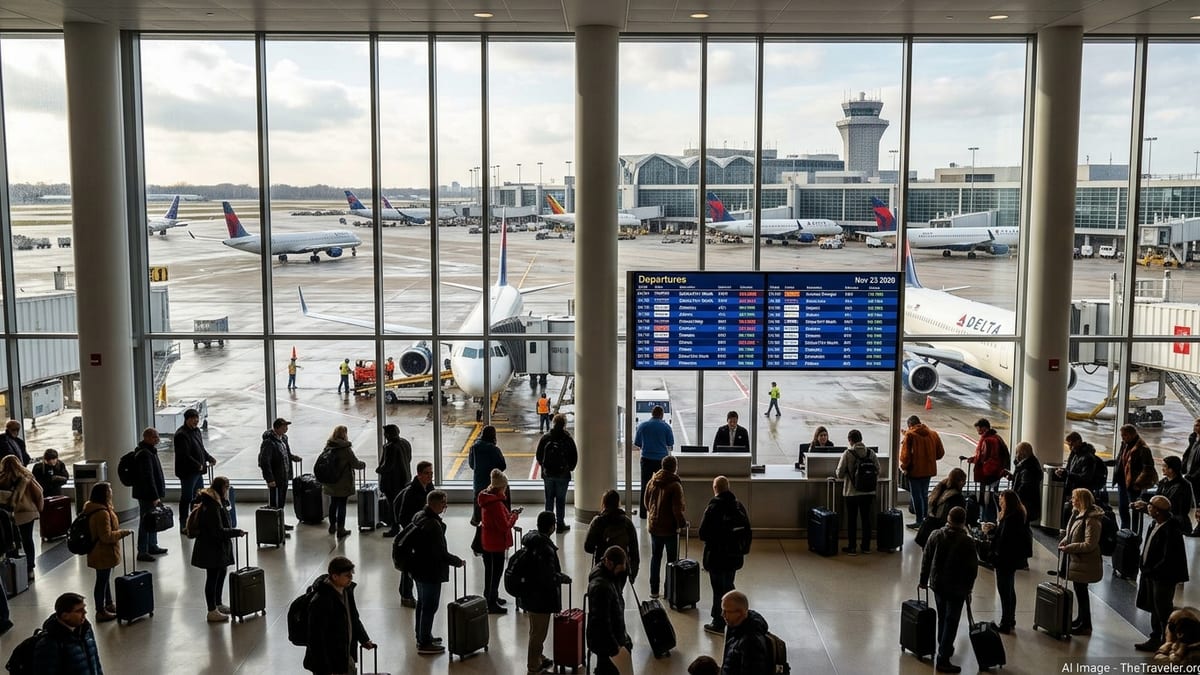
The Federal Aviation Administration briefly halted some flights to Chicago O’Hare International Airport on Monday 23 November 2026 because of air traffic control staffing constraints, affecting operations at one of the country’s busiest hubs as the Thanksgiving travel period began in earnest. The ground stop applied to arriving aircraft and lasted around an hour to an hour and a half before being lifted once staffing levels stabilized, according to local and national reports that cited FAA information.
By Monday evening, conditions at O’Hare had largely improved, with average delays reported at under 15 minutes despite the earlier disruption. Flight tracking data compiled that day indicated that the majority of affected flights were delayed rather than canceled, and that the worst impacts were concentrated in the late morning and early afternoon window when the ground stop was in place. The FAA’s program logs for November show the O’Hare staffing issue as a short-lived event compared with longer weather-related delay programs at other airports.
Chicago Midway did not experience an FAA ground stop during the same timeframe, although it was subject to typical volume-related delays as the holiday rush began. For travelers, this meant that connections routed through O’Hare were more likely to see schedule adjustments than point-to-point flights into Midway or other Midwest airports on that particular day, even under clear local weather conditions.
Delta’s automation failure and nationwide ripple effects
The more extensive disruption for Thanksgiving travelers originated on Sunday 22 November 2026, when Delta Air Lines experienced a problem with its automated weight and balance system used for calculating aircraft loading. The issue led to an hours-long ground delay program centered on Hartsfield–Jackson Atlanta International Airport, Delta’s largest hub, and caused delays across the carrier’s domestic and international network. Delta has said that about 70 percent of the schedule changes it made that day were attributable to the system problem, with the remainder linked to adverse weather on parts of its route map.
Flight tracking services recorded more than 1,600 delayed Delta flights on the Sunday of the outage and roughly 140 cancellations, making the carrier the primary source of US flight disruption that day. The Federal Aviation Administration implemented arrival and departure spacing measures into Atlanta while the underlying technology issue was addressed, which meant aircraft were held at origin airports or kept on the ground locally until their release times. The computer system was brought back into service later on Sunday, and by Monday morning Delta described its operation as stable, although the airline continued to work through residual delays.
The knock-on effects of the outage were visible at other major airports where Delta has a significant presence, including New York LaGuardia, Los Angeles and Detroit. At LaGuardia, for example, Delta-operated flights accounted for a disproportionate share of morning and midday delays on Monday 23 November as crews and aircraft rotated back into their planned positions. Other US airlines were not directly affected by Delta’s automation problem, but some passengers on connecting itineraries faced missed onward flights on different carriers when inbound Delta legs ran late.
How these problems intersect with a busy Thanksgiving travel period
The staffing-related ground stop at O’Hare and the Delta technology outage came on top of already elevated pressure on the US aviation system as Thanksgiving travel ramped up. Forecasts from travel organizations and federal agencies ahead of the holiday indicated that tens of millions of Americans would travel at least 50 miles from home between Tuesday 24 November and Monday 30 November 2026, with a significant share using commercial air services. Airports such as Dallas–Fort Worth, Atlanta, Denver, Los Angeles and Chicago expected some of their busiest days of the year from Wednesday through the Sunday after Thanksgiving.
Weather has added another layer of complexity in parts of the country. Heavy rain, strong winds and local flooding affected both coasts during the holiday week, prompting air traffic control programs and de-icing operations that further slowed some departures and arrivals. When combined with staffing gaps at specific facilities and the lingering network imbalance caused by Delta’s automation failure, these conditions contributed to a national picture in which many flights still operated but a meaningful minority ran behind schedule.
Federal data released in November, covering performance up to September 2026, show that late-arriving aircraft are a major factor in airline delays generally, accounting for a substantial share of delay minutes systemwide. That pattern helps explain the cascading nature of recent disruptions: when one major hub experiences a ground stop or a carrier faces a system outage, aircraft and crews can end up in the wrong place at the wrong time for subsequent flights, including those scheduled on normally quiet midweek days.
Impact on travelers at key hubs such as Dallas–Fort Worth
At Dallas–Fort Worth International Airport, one of the country’s largest connecting hubs, the Thanksgiving travel surge coincided with the national issues but did not see a comparable single-point failure. Local authorities there projected over 120,000 passengers a day on the peak days of Wednesday 25 November, Saturday 28 November and Sunday 29 November. Most disruptions in North Texas were tied to aircraft arriving late from other parts of the network or to broader weather-related flow restrictions rather than to technology problems or local staffing shortfalls.
Travelers connecting through Dallas, Atlanta, Chicago and other major hubs have nonetheless encountered longer-than-usual lines at check-in, security and boarding, as well as a higher probability of moderate delays. In many cases, flights have departed and arrived within an hour of schedule, but that variance has been enough to cause missed connections where minimum transfer times were tight. Airports and airlines have repeatedly advised passengers to monitor their flight status in real time via apps and websites and to allow additional time both for ground transportation to the airport and for processing once there.
For passengers directly affected by Delta’s Sunday outage, the airline has said it provided hotel and meal assistance where overnight stays were unavoidable and has encouraged customers to rebook through its digital channels or airport agents when flights were significantly disrupted. Specific compensation policies vary depending on the cause of a delay or cancellation and on whether the disruption is under the airline’s control. The US Department of Transportation maintains a comparative dashboard of airline commitments, but any reimbursement or voucher decisions in this episode ultimately rest on Delta’s contract of carriage and goodwill policies rather than a blanket federal mandate.
What travelers should do next and what to watch for
As of the morning of Thursday 26 November 2026, FAA status boards indicated that Chicago O’Hare was no longer subject to a ground stop or formal ground delay program, and arrivals were flowing normally aside from routine congestion. Delta reported that its operations had stabilized in the days since the Sunday automation failure, with schedules progressively returning to planned levels even though scattered delays persist as the system absorbs the earlier disruption. Other carriers have not announced comparable technology problems since the Atlanta event, although routine weather and volume-related constraints continue to affect certain airports.
Travelers flying over the remainder of the Thanksgiving period should be prepared for further localized delays tied primarily to high traffic volumes and changing weather rather than to a single known fault. Industry and government forecasts highlight the Sunday after Thanksgiving as a particular pressure point, with seat occupancy expected to be high and room for reaccommodation limited if fresh disruptions occur. Passengers with tight connections or complex itineraries may wish to explore options to build in longer layovers or to travel at off-peak times where their plans allow.
Before heading to the airport, passengers are strongly advised to check the latest status of their flights directly with their airline’s app or website and to pay attention to any travel waivers that carriers might publish if conditions deteriorate. These waivers, when issued, usually allow free changes within certain date and routing windows and can provide flexibility to shift away from the most congested time slots. Given the recent combination of staffing challenges, technology vulnerabilities and unsettled weather, travelers who remain flexible and informed are best positioned to navigate the rest of the holiday travel period with fewer surprises.