


More news on this day
A powerful Thanksgiving storm system sweeping across the United States on Thursday, November 26, 2026, is disrupting one of the year’s busiest travel periods, with heavy rain, high winds and coastal flooding triggering widespread power outages, transport interruptions and mounting flight delays and cancellations, particularly along the East Coast and parts of the Midwest.
Get the latest news straight to your inbox!
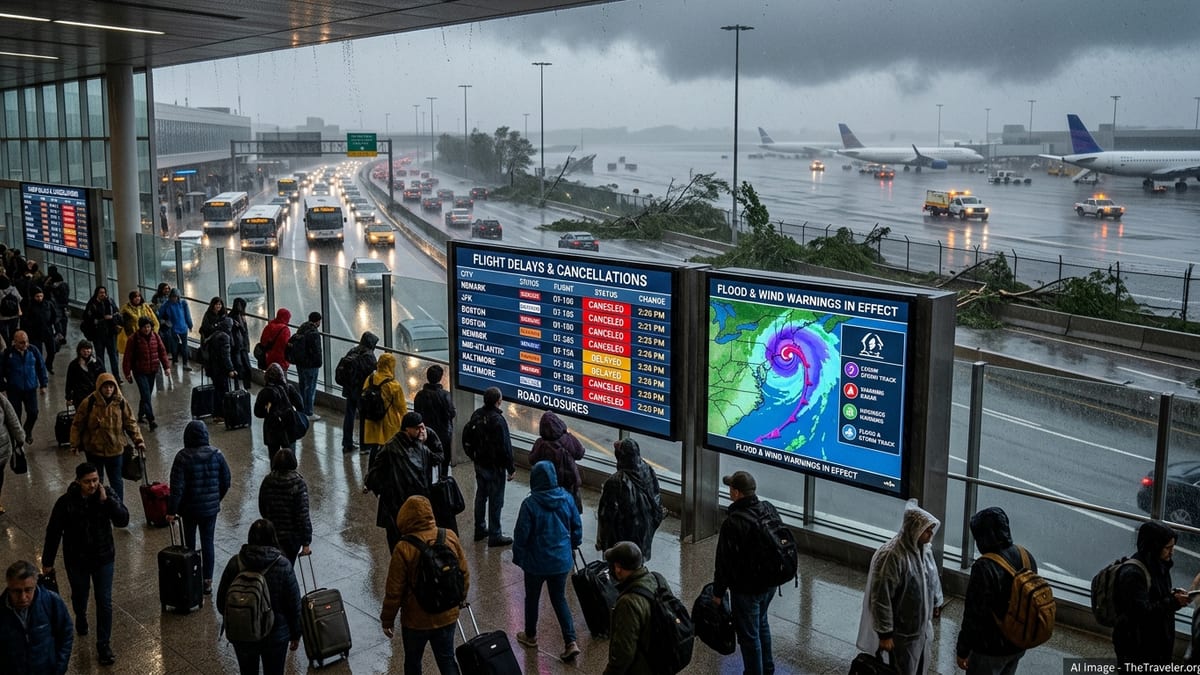
Storm track, warnings and the areas hit hardest so far
The current weather pattern is the result of a deep low-pressure system that strengthened as it moved from the central United States into the Mid-Atlantic and Northeast in the days leading up to Thanksgiving. Forecast centers had flagged the risk of a “potent” coastal storm earlier in the week, warning that rain, snow and strong winds would coincide with peak holiday travel between Tuesday, November 24, and Sunday, November 29.
By Thanksgiving Day, the storm was hammering the Eastern Seaboard from Virginia to New England with periods of driving rain and wind gusts commonly in the 40 to 60 mph range, alongside pockets of heavier snow and mixed precipitation in interior parts of the Midwest and Northeast. Coastal flood warnings and advisories were in place for large stretches of shoreline where strong onshore winds, already-elevated tides and low pressure combined to push water into bays and estuaries. Officials in New Jersey, New York and several New England states highlighted particular concern for low-lying neighborhoods, barrier islands and areas behind sea walls that have flooded in previous nor’easters.
Impacts have not been limited to the East Coast. Earlier in the week, the same broader pattern drove heavy precipitation and strong winds across portions of the Midwest and interior Northeast, making road conditions hazardous at times and setting the stage for saturated soils and tree damage once the strongest winds arrived. On the West Coast, a separate Pacific system interacting with exceptionally high “king tides” created coastal flooding concerns in parts of California and the Pacific Northwest, prompting some beach closures and local travel advisories, although skies at major West Coast airports were generally calmer than in the East for much of Thursday.
Power outages and local transport impacts
The combination of saturated ground and prolonged high winds has led to widespread tree damage and downed power lines. By Thursday morning, utilities were reporting more than a million customers without electricity nationwide, with the largest concentrations in mid-Atlantic and Northeast states where onshore winds were strongest. Outages have been particularly disruptive in coastal and wooded communities, where access roads are limited and crews face difficult conditions reaching damaged infrastructure.
Local transport networks have also faced strain. Flooded underpasses and coastal roads have been closed at times in several states, including sections of shoreline routes in New Jersey, New York, Delaware and parts of New England. Urban transit agencies along the I‑95 corridor reported slower services or temporary suspensions on some commuter rail and bus lines where tracks or roadways were affected by standing water, debris or precautionary speed restrictions due to strong crosswinds. In California, coastal flooding linked to the combination of king tides, El Niño–enhanced sea levels and a separate Pacific storm has prompted temporary closures of some seaside roads, car parks and paths, with authorities urging drivers to avoid low-lying coastal routes around high tide.
For travelers already at their destinations, power cuts are affecting some Thanksgiving gatherings, with local authorities opening a limited number of warming centers in areas experiencing longer-duration outages. However, emergency managers in several states have emphasized that they currently expect most outages to be restored within hours to a couple of days, depending on location and the evolution of wind speeds overnight into Friday.
Flight delays, cancellations and where airports are most affected
For air travelers, the most immediate impact of the storm is being felt in the form of mounting delays and cancellations across the national flight network. By late morning on Thursday, data from aviation tracking services showed hundreds of flights canceled and many more delayed, with disruption concentrated along the Eastern Seaboard but echoing to hubs across the country as aircraft and crews fell out of position.
Airports serving the Baltimore–Washington region, New York City and Boston emerged among the hardest hit, reflecting both the severity of local weather and the density of schedules on the Northeast corridor. A significant share of departures and arrivals at Baltimore/Washington International, John F. Kennedy International, LaGuardia and Newark Liberty faced either cancellation or delay as low clouds, heavy rain and crosswinds reduced arrival and departure rates. The Federal Aviation Administration used ground delay programs and, at times, short ground stops to manage traffic flows into the most affected fields, which in turn caused knock-on delays at connecting airports where aircraft were waiting for arrival slots in the Northeast.
While Thursday is traditionally lighter for departures than the Wednesday before Thanksgiving, this year’s pattern of rolling storms and earlier technical issues at major carriers has compounded the disruption. In the two weeks before the holiday, U.S. aviation had already experienced a nationwide ground stop related to a technology outage, followed by separate system problems affecting at least two large airlines. Combined with the current storm, that background has left little slack in aircraft and crew rotations. Even airports under clear skies on Thanksgiving have reported schedule pressures where their operations depend on aircraft arriving from weather-affected hubs.
Parade postponement, travel waivers and passenger options
Beyond airports and roads, the storm has altered high-profile holiday traditions. In New York City, officials postponed the 100th Macy’s Thanksgiving Day Parade for the first time in the event’s history because of safety concerns related to high winds and heavy rain, rescheduling the march for Saturday, November 28. The decision followed days of monitoring forecast gusts near or above thresholds set for safely flying the parade’s large balloons, as well as worries about slippery streets and potential debris in strong winds.
Airlines serving the Northeast and other storm-affected regions have issued weather waivers to give passengers more flexibility to adjust their plans. Carriers including United and several competitors introduced change-fee waivers covering travel dates around November 26 for itineraries touching key East Coast airports, allowing customers to move their trips within a defined window without paying the usual change penalties, provided they rebook into the same cabin and origin–destination pair. Some airlines have also allowed limited re-routing to alternative airports where capacity permits, although any fare difference still applies in many cases.
For travelers whose flights are canceled, rebooking options vary depending on airline policy, route and seat availability. In general, U.S. regulations require carriers to offer a refund if a flight is canceled and the passenger chooses not to travel, but they do not mandate compensation for weather-driven disruption. Travelers who must go ahead with their trip typically have the choices of accepting the next available seat on their original carrier, asking about interline rebooking to another airline where agreements exist, or exploring ground alternatives such as long-distance buses and trains on the most heavily traveled corridors.
What travelers should do next as the storm evolves
Forecasters expect the coastal storm affecting the East Coast to weaken gradually as it moves away into the North Atlantic late Friday into Saturday, with winds easing first along the mid-Atlantic coast before relaxing further north. However, residual impacts are likely to persist into the weekend in the form of lingering flight delays, residual power outages in some communities and pockets of coastal flooding along vulnerable shorelines. Travelers returning home on Friday, November 27, and Sunday, November 29, should be prepared for residual congestion and potential schedule adjustments even if local weather has improved.
Passengers with flights scheduled in the next 48 to 72 hours are advised to check their airline’s app or website repeatedly on the day of travel rather than relying only on the original confirmation email. Gate and departure-time changes have been frequent at large hubs, and some airlines have proactively trimmed schedules to create recovery space, particularly on routes with multiple daily frequencies. Where a weather waiver is in effect, travelers who have flexibility may find that voluntarily shifting to a later date or a different time of day reduces the risk of extended airport waits.
Those planning road trips should review local forecasts and real-time traffic information for each state they will cross, paying close attention to coastal flood advisories, wind advisories and any remaining winter weather alerts in the Midwest and interior Northeast. In regions experiencing power outages, it is prudent to confirm hotel reservations directly with the property to ensure that it is operating normally and to ask whether any services, such as elevators or heating, are affected. For rail and intercity bus passengers, operators are generally running on normal Thanksgiving schedules, but delays are possible where lines intersect flooded or wind-exposed areas, so checking service alerts on the day of departure remains important.
Looking slightly further ahead, national forecasters note that this Thanksgiving storm is part of a broader pattern linked to an ongoing strong El Niño, which can tilt seasonal odds toward wetter and stormier episodes in parts of the southern and eastern United States. While individual events cannot be predicted far in advance, travelers planning trips later in the winter may wish to prioritize flexible tickets, consider itineraries with additional connection time, and verify refund and change rules before booking. For now, the focus remains on safely navigating the remainder of this holiday weekend as conditions slowly improve across the storm-affected regions.