


More news on this day
A FedEx cargo jet overran a runway at Miami International Airport on the evening of November 25, 2026, temporarily closing most of the airfield and contributing to wider flight disruption at the start of the U.S. Thanksgiving travel period, with knock-on effects for travelers heading to Orlando and Walt Disney World.
Get the latest news straight to your inbox!
What Happened At Miami International Airport
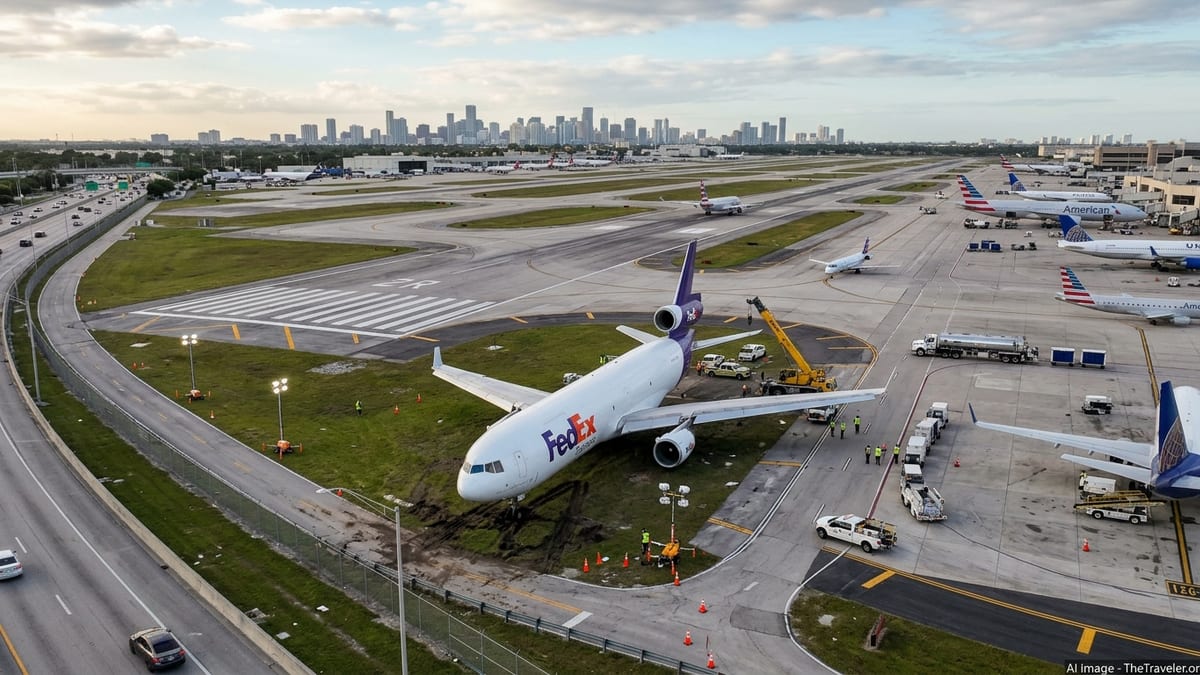
On Wednesday, November 25, a FedEx Express McDonnell Douglas MD-11 freighter arriving from Memphis landed on runway 26R at Miami International Airport and rolled beyond the end of the paved surface. The aircraft came to rest in the grassy area near the airport perimeter fence. There were no injuries reported among the three crew members and no post-incident fire, according to initial accounts from airport officials and federal authorities.
The runway excursion left the aircraft disabled off the end of runway 26R, and emergency responders as well as investigators were dispatched to the scene. Photographs and video from the airfield on Thursday showed the purple-and-orange FedEx jet in the grass with its nose gear close to the perimeter fence while heavy equipment and emergency vehicles worked around it. Cargo operations involving this aircraft were suspended while the investigation and recovery process began.
The Federal Aviation Administration opened an investigation into the incident, which is standard procedure following a runway overrun. The National Transportation Safety Board has also indicated it will review data from the flight, including weather, braking performance and touchdown point, but as of November 26 no preliminary cause or contributing factors have been released. Officials have confirmed only that conditions at the time included periods of heavy rain and thunderstorms in the Miami area.
How The Runway Incident Affected Flights In And Out Of Miami
Because the FedEx jet came to rest beyond runway 26R, Miami International Airport temporarily lost the use of three of its four runways on Wednesday night while emergency crews secured the scene and ensured there was no further risk to operations. The FAA briefly ordered a ground stop for flights destined for Miami, meaning aircraft around the country were held at their departure airports instead of taking off for South Florida until the situation was stabilized.
The ground stop was lifted later in the evening once Miami could resume limited operations, but schedules remained disrupted into Thanksgiving Day. With one runway unavailable and others operating at reduced capacity for part of the night, airlines faced a backlog of arrivals and departures. Carriers responded by delaying flights, rerouting some services and, in a smaller number of cases, canceling flights altogether when aircraft and crews could not be repositioned in time.
By Thursday morning, November 26, federal status pages for Miami showed the airport operating again with general arrival and departure delays in the range of 15 minutes or less. That airport-wide snapshot, however, did not capture the full impact on individual flights. Some services that were scheduled to land late Wednesday or very early Thursday either arrived hours behind schedule, diverted to alternate airports or were canceled outright, particularly during the window when the ground stop and runway closures were in effect.
Thanksgiving Flight Disruption: What The Numbers Show
The Miami incident occurred as millions of passengers moved through U.S. airports for the Thanksgiving holiday period, a time when airline and air traffic systems are already operating near capacity. Separate from the ground stop in South Florida, low-pressure systems and heavy rain affected travel across several regions on Thursday, contributing to delays and cancellations at major hubs away from Florida.
By midday on November 26, data from national flight-tracking services indicated that more than 1,700 flights within, into or out of the United States had been delayed and over 400 had been canceled, largely due to a combination of weather and residual operational challenges from earlier in the week. Those figures reflect the cumulative picture across all carriers and airports, not just flights touching Miami.
In this context, the FedEx runway overrun was one of several stress points in the system rather than the sole cause of disruption. The immediate effect in South Florida was the temporary suspension of Miami-bound traffic and reduced runway capacity during a busy evening. The wider knock-on effects came as airlines worked through aircraft rotations and crew schedules that had been thrown off track, sometimes leading to delays on routes with no direct connection to Miami.
Implications For Orlando And Disney World Travelers
For travelers heading to Orlando International Airport and Walt Disney World, the timing of the Miami incident raises particular concerns about missed park time and prepaid experiences. Many itineraries into Central Florida involve connections at major hubs such as Miami, Atlanta or Charlotte, especially for international visitors. If a connecting flight into Miami on Wednesday night was delayed, diverted or canceled, passengers could miss their onward flight to Orlando or face an overnight stay away from their intended destination.
As of late Thursday morning, Orlando International itself was reporting relatively smooth operations, with average arrival and departure delays of 15 minutes or less and no FAA ground stop or significant flow programs in place. In other words, the Orlando airport has not experienced the same kind of direct operational constraint that Miami saw when the FedEx aircraft overran the runway. However, individual flights into Orlando can still be delayed if they rely on aircraft or crews that were caught up in the Miami disruption or in broader weather-related delays elsewhere.
For Disney World guests with tightly planned schedules, a late arrival in Orlando can have concrete financial implications. Walt Disney World’s published dining reservation policy states that most restaurants apply a fee of 10 dollars per person if a reservation is canceled less than two hours before the scheduled time or if the party fails to check in. For a family of four, that can mean a 40 dollar charge for a missed meal. Signature experiences such as Cinderella’s Royal Table or other prepaid dining events may charge the full cost per guest for late cancellations or no-shows, so a disruption of just a few hours sometimes results in significantly higher forfeited amounts.
What Travelers Should Do If Their Flight Is Delayed Or Canceled
For those still traveling over the Thanksgiving weekend, the most important step is to monitor flight status directly with the airline. Airlines update departure and arrival times more quickly in their apps and on their own websites than third-party services, and they often allow customers to accept alternative itineraries or request changes without speaking to an agent when irregular operations occur. Connecting passengers who see a delay that threatens a tight connection involving Miami or another hub should check for alternative same-day routings or ask to be rebooked before they reach the first airport.
Travelers who know they will arrive in Orlando several hours late should review their upcoming plans in the My Disney Experience app or website. If a delay makes it impossible to reach a dining reservation or prepaid activity on time, it is generally advisable to cancel or modify as soon as it becomes clear that the original booking cannot be met, even if that still falls within the penalty window. Guests can also contact Disney reservations or their travel agent to discuss options. In some cases, frontline cast members may be able to assist with rebooking missed experiences later in the trip, although published policies do not guarantee that fees will be waived.
If a flight is canceled and a suitable alternative is not available, U.S. Department of Transportation guidance states that passengers are entitled to a refund of the unused portion of their ticket if they choose not to travel on the rebooked itinerary. This right applies when the airline cancels a flight or makes a significant schedule change and the traveler declines the alternative offered. It does not automatically extend to other components of a vacation, such as hotel stays, park tickets or ground transportation. For those costs, the options depend on the specific cancellation terms of each booking and any travel insurance purchased.
Looking Ahead: Conditions For The Remainder Of The Holiday Period
By the afternoon of November 26, federal air traffic status information indicated that no major U.S. airport, including Miami and Orlando, was under a ground stop, large-scale delay program or closure. Miami continued to handle traffic with some weather-related and volume-related delays, while Orlando operated close to normal holiday levels. The FedEx jet remained off the end of runway 26R as investigators collected evidence and technicians prepared a plan to move the aircraft without damaging critical navigation equipment or airport infrastructure.
For the remainder of the Thanksgiving period, the primary risks to air travel are expected to come from routine holiday congestion and episodes of unsettled weather affecting different parts of the country. Historically, the Sunday after Thanksgiving is one of the busiest and most delay-prone days of the year in the United States, as large numbers of travelers return home over a compressed window. Even without a new operational shock like a ground stop, delays on that day can propagate through airline networks and affect flights to and from Florida.
Travelers headed to Walt Disney World or other Florida destinations in the coming days should continue to confirm their flights directly with their airline before leaving for the airport, build extra time into connections where possible and review any nonrefundable reservations on arrival days. While the immediate impact of the Miami runway overrun has eased, the wider holiday travel environment remains sensitive to weather and operational disruptions, and plans may still need to be adjusted at short notice.