


More news on this day
France and Portugal are emerging as pivotal players in Europe’s latest high-speed rail drive, with new infrastructure plans and EU regulations promising faster, lower-carbon journeys for tourists moving between Lisbon, Madrid, Paris and beyond.
Get the latest news straight to your inbox!
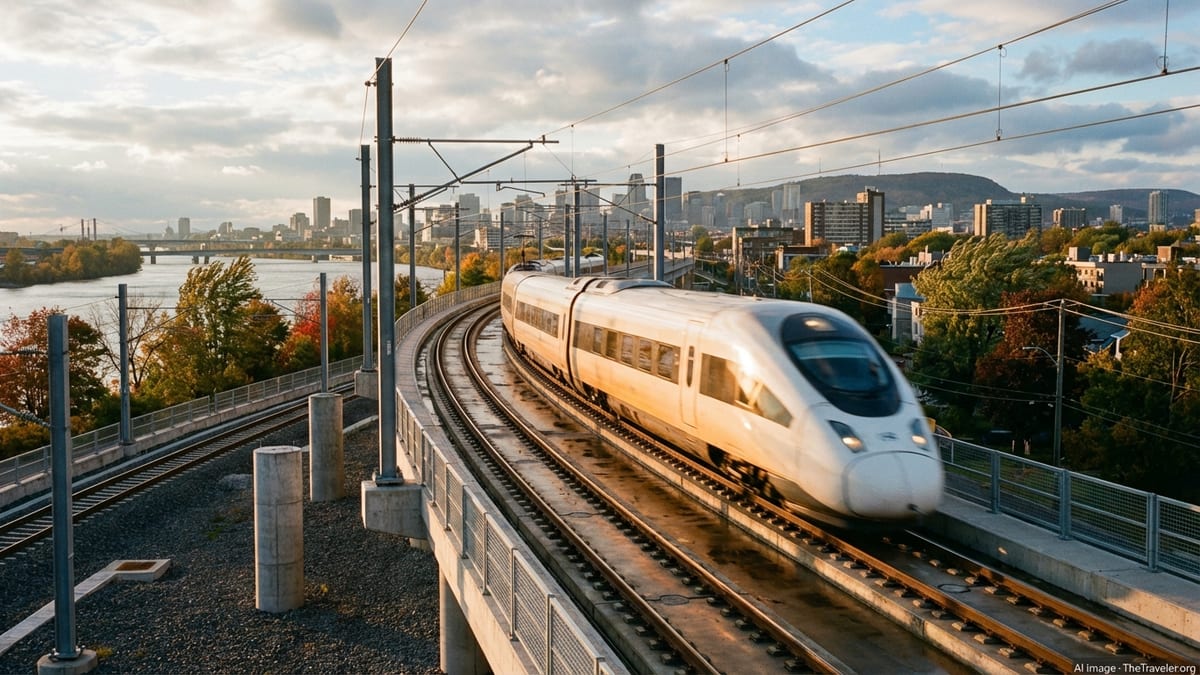
EU Rail Strategy Puts Paris and Lisbon on the Same High-Speed Map
Recent policy moves in Brussels are reshaping the way travellers will cross Europe, with France and Portugal central to a new web of high-speed links. An action plan presented in late 2025 set out to accelerate trains running at 200 kilometres per hour and above across the bloc, highlighting future direct high-speed options between Paris, Madrid and Lisbon as emblematic of this shift toward rail-based tourism.
The strategy builds on the Trans-European Transport Network, which identifies the Atlantic corridor as a priority route linking Lisbon, Madrid and Paris via high-speed and upgraded conventional lines. Publicly available information describes this corridor as a diagonal spine between the Iberian Peninsula and France and Germany, designed to give passengers and tourists a continuous rail experience from Portugal into the heart of continental Europe.
For visitors, the emerging network promises shorter journey times, easier cross-border ticketing and more opportunities to choose rail instead of short-haul flights. Published material from European institutions indicates that improvements to booking systems and common technical standards are intended to make it as simple to plan a multi-country rail itinerary as it is to book a single airline ticket today.
Travel industry observers see France and Portugal’s positions at either end of this high-speed axis as especially significant. Paris remains one of Europe’s busiest hubs for international arrivals, while Lisbon has rapidly grown as a city-break and digital-nomad destination. Faster, more frequent trains between and through these gateways are expected to unlock new multi-country holiday patterns.
Lisbon–Madrid High-Speed Link Targets Tourists and Time Savings
The most visible piece of the puzzle for Portugal is the long-discussed high-speed rail line between Lisbon and Madrid, which has now been given a detailed delivery plan at EU level. Commission documents adopted in late 2025 set a requirement for a completed core high-speed connection by 2030, with further performance improvements to follow, explicitly citing the line’s role in connecting Portugal and Spain to the wider French and European high-speed grid.
According to this plan, construction on key Portuguese sections, including double tracking between Poceirão and Bombel and upgrades toward the border at Caia, is scheduled to progress through the second half of the decade. On the Spanish side, the link will tie into the existing high-speed network around Badajoz and further on to Madrid, creating a continuous corridor that can later be extended in service patterns toward Barcelona and, via existing cross-border infrastructure, to France.
For tourists, the impact is expected to be dramatic. Presently, journeys between Lisbon and Madrid often involve lengthy daytime rail itineraries or flights. When the high-speed link is fully operational, published projections suggest travel times could eventually fall to around three hours with later upgrades, turning the two capitals into feasible same-day hops for leisure travellers and opening the door to twin-city breaks that combine Portuguese Atlantic culture with Spain’s inland attractions.
Tourism boards and rail operators are already signalling interest in themed routes that could string together Lisbon, Madrid and French destinations on a single ticket, ranging from gastronomy-focused itineraries to cultural circuits tracing shared Iberian and European heritage. As rolling stock orders and station upgrades advance, the Lisbon–Madrid corridor is being positioned as a flagship example of rail’s potential to reshape tourism flows.
France’s High-Speed Backbone Anchors New Cross-Border Tourism Flows
France provides much of the backbone that will carry tourist traffic generated by Iberia’s new lines into the broader European network. Decades of investment have created an extensive domestic high-speed system, and current EU corridor planning places French territory at the junction of routes heading north toward Belgium and Germany and south and west toward Spain and, ultimately, Portugal.
European corridor descriptions highlight the Atlantic Core Network Corridor, which threads from Lisbon and Madrid through to Paris and on to cities such as Strasbourg and Mannheim. This alignment is designed to ensure that a future traveller boarding in Lisbon or Porto could, with one or two changes, reach major French and German cities entirely by rail, tapping into France’s existing high-speed capacity.
France is also the site of technical and environmental innovation that is helping to justify further tourism-oriented rail expansion. Recent life-cycle assessments of high-speed infrastructure, such as the analysis carried out on the Tours–Bordeaux line, point to significant long-term emissions advantages for rail compared with air and car travel when lines are well used. Such findings are frequently cited in arguments that directing tourist demand onto high-speed tracks can be a powerful climate tool.
Meanwhile, projects on adjacent corridors, including work on cross-border lines in the southwest linking Spain’s Basque Country with France, are expected to create more options for holidaymakers combining French Atlantic destinations with northern Spain. The more these pieces interconnect, the more attractive rail becomes as the default mode for slow, multi-stop journeys through western Europe.
New EU Capacity Rules Aim to Make Cross-Border Trips Seamless
Infrastructure is only one part of the story. In June 2026, new EU rules on the use of railway infrastructure capacity entered into force, with the stated goal of improving cross-border traffic and optimising how tracks are allocated between different services. Publicly available information on the regulation describes it as a replacement for older freight-focused corridor rules, widening the scope to all trains and aiming to reduce bottlenecks, especially on busy international routes.
The regulation is designed to support the high-speed action plan by making it easier to schedule long-distance and cross-border passenger services, including new offerings that may run from Portugal through Spain into France. By coordinating timetables and capacity planning more closely at European level, the rules seek to avoid fragmented service patterns that leave passengers facing long waits or awkward connections at borders.
For tourists, these behind-the-scenes changes could translate into more through services, fewer forced transfers and better-timed connections between national high-speed networks. The measures also interact with efforts to improve integrated ticketing, where travellers would be able to buy one ticket covering multiple operators and countries, a feature that is seen as particularly important for drawing visitors away from point-to-point air travel.
Rail advocates argue that capacity optimisation and digital tools are critical if the large sums being invested in high-speed tracks in France, Portugal and neighbouring countries are to deliver on their tourism potential. As new rules roll out over the next few years, industry attention is likely to focus on whether they result in noticeable improvements in reliability and convenience for cross-border leisure travel.
Tourism Industry Eyes High-Speed Rail as a Sustainability Asset
The growing integration of French and Portuguese high-speed rail into Europe’s wider mobility plans is taking place against a backdrop of rising concern over aviation emissions and pressure to curb short-haul flights where rail alternatives exist. Academic work comparing modes on routes such as Paris–Bordeaux has reinforced the view that high-speed trains can offer substantial emissions savings over planes, particularly when powered by increasingly decarbonised electricity grids.
Travel companies and destination marketing bodies are responding by repositioning rail journeys themselves as part of the tourism product. Multi-day itineraries that once defaulted to low-cost flights between city breaks are being redesigned to feature high-speed segments, with the slower pace framed as an opportunity to discover secondary cities and landscapes along the way.
For France and Portugal, which both bank heavily on tourism revenue, this shift aligns commercial interests with climate objectives. Portugal’s planned high-speed spine linking Lisbon, Porto and the Spanish border, combined with France’s extensive TGV network and its connections onward to neighbouring countries, offers a fertile testing ground for packages that promise lower-carbon holidays without sacrificing comfort or convenience.
As construction milestones approach on the Lisbon–Madrid line and EU-level rules start to reshape how cross-border tracks are used, analysts expect to see a new generation of rail-oriented tourism products emerge. If these efforts succeed, future travellers may experience the route from Portugal’s Atlantic shores to the boulevards of Paris not just as a way of getting from A to B, but as a seamless, sustainable journey across some of Europe’s most visited regions.