


More news on this day
France is bracing for some of its biggest protests in years as a nationwide strike over wages, living costs and public services disrupts travel on Thursday, with hundreds of thousands of people expected to march in cities across the country.
Get the latest news straight to your inbox!
Unions escalate after weeks of unrest
The latest day of action marks an escalation in a protest wave that has built steadily since September, beginning with student demonstrations over staff shortages at a high school southeast of Paris and spreading into a broader movement over purchasing power and public spending. Reports indicate that major union confederations, including the CGT, CFDT and FO, jointly called the 5 November mobilisation and filed more than a thousand strike notices covering sectors from transport to education.
Publicly available information shows that hundreds of thousands of demonstrators are expected nationwide, with more than 200 rallies and marches planned in cities including Paris, Lyon, Marseille, Nantes, Toulouse and Lille. Organisers have signalled that they are seeking turnout on a scale comparable to the 2023 pension reform protests, when over a million people took to the streets on peak days.
The protests come after several weekends of large marches and sporadic rioting, particularly in October, which left parts of central Paris and other cities under curfew and prompted a heavy security deployment. Published coverage indicates that the government has stepped up talks with union leaders in recent days in an effort to prevent a repeat of the worst unrest, even as it insists that budgetary constraints limit room for major new spending commitments.
The political stakes are high. The nationwide strike unfolds less than six months before France’s 2027 presidential election campaign formally begins, with far right and hard left contenders both seeking to channel anger over inflation, austerity measures and the state of public services.
Rail, metro and air travel face disruption
Travel inside France is bearing the brunt of the strike. According to timetables and notices published by national rail operator SNCF, regional TER and Intercités services are operating on a reduced schedule, with many routes seeing only around one in two trains running at peak times and additional cancellations on lightly used lines. High-speed TGV and Ouigo services on core axes such as Paris to Lyon and Paris to Lille are less affected but still subject to delays and last-minute changes.
In the Paris region, the RATP transport authority has announced reduced frequencies on several metro lines and parts of the RER suburban network. Some older metro lines are operating at weekend-level service during rush hour, while outlying RER branches have gaps of 20 to 30 minutes between trains. Travellers are being advised via public information channels to allow extra time, avoid unnecessary trips at peak hours and check real-time journey planners before departing.
Long-distance coach operators are attempting to absorb some displaced demand, but seat availability is tight on popular intercity corridors, including Paris to Normandy, Brittany and the southeast. Published travel advisories indicate that traffic congestion is heavier than usual on ring roads around major cities as commuters turn to cars and ride-hailing services to bypass disrupted public transport.
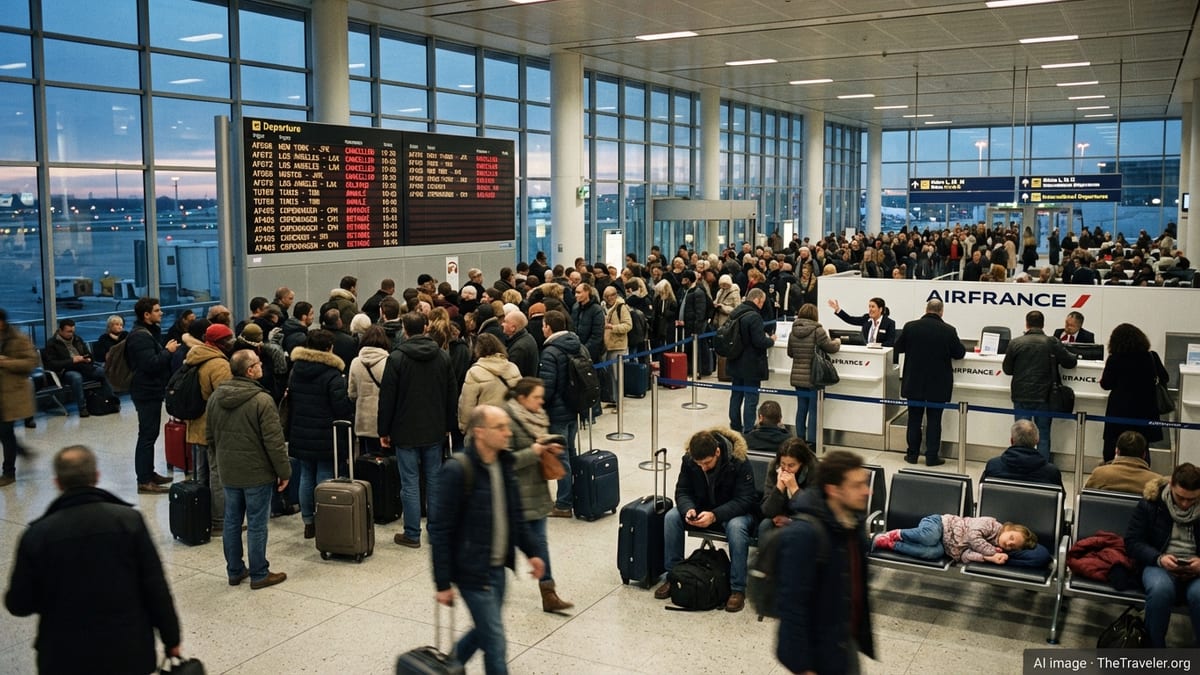
Air travel is less severely affected than during some previous French strike waves, but airport services are not entirely spared. Information from airport operators shows that ground handling and security staff at several regional airports have filed strike notices, which may result in longer queues at peak periods. So far, flight schedules at Paris Charles de Gaulle and Orly are largely intact, although passengers are being warned of possible knock-on delays if rail links to the airports are disrupted.
What travelers in France should expect today
For visitors already in France, the most immediate impact is on day-to-day mobility. Urban transport in large cities is running, but with reduced frequencies and occasional line closures where staff participation in the strike is high. In Paris, maps published by local media highlight planned protest routes that cut through central districts, particularly around the Place de la République, Bastille and Nation, which may lead to rolling traffic restrictions and metro station closures for safety reasons.
Most museums, major attractions and restaurants are expected to remain open, but travellers may encounter shorter opening hours at some publicly run sites and delayed entry at venues near demonstration routes. Publicly available information from education authorities indicates that roughly one in six teachers have joined the strike, so families may also see school groups reschedule or cancel planned visits to major cultural institutions.
Intercity travel is possible but requires flexibility. Same-day seat availability on remaining TGV and TER services is limited on several routes, with booking platforms showing higher-than-usual occupancy rates and fewer discounted fares. Travellers who have no urgent need to move between regions are being encouraged by local outlets to postpone non-essential long-distance journeys until after the peak of the strike.
Regional bus networks and private shuttle services are generally operating, but some drivers are also participating in the mobilisation, especially in areas where unions have strong representation. In rural and suburban zones with limited alternatives, this may leave residents and visitors temporarily reliant on taxis or private vehicles.
Economic and political backdrop to the strike
The nationwide mobilisation is rooted in a combination of economic pressure and political uncertainty. France is grappling with persistent inflation in areas such as food, housing and transport, even as headline energy prices have moderated from their 2022 peaks. Unions argue, in published statements, that wage growth is lagging behind living costs, particularly for public sector workers and low-paid private sector employees.
At the same time, the government is pursuing spending restraint as it seeks to rein in the budget deficit and comply with European fiscal rules. Draft 2027 budget measures under discussion include cuts or slower growth in some public service budgets and reforms to unemployment insurance, which unions contend would hit precarious workers hardest. Reports in French and international media describe union leaders positioning the November 5 strike as a warning shot against what they see as a broader rollback of social protections.
The protests also intersect with concerns over the state of France’s education system. Weeks of student-led demonstrations over staffing shortages, overcrowded classrooms and facility conditions have drawn support from teachers’ unions, which view the nationwide strike as an opportunity to push education funding higher up the political agenda.
With President Emmanuel Macron constitutionally barred from seeking another term, the landscape ahead of the 2027 election is unsettled. Polling cited in public coverage indicates strong support for far right candidate Marine Le Pen, while left-wing figures such as Jean-Luc Mélenchon are working to unify dissatisfied voters on the other end of the spectrum. The size and tone of the November 5 protests are widely seen as an indicator of how volatile the coming political season may be.
How long the disruption could last
For now, most strike calls formally cover only the single day of November 5. However, joint union statements and comments reported in French media suggest that organisers are prepared to extend or repeat industrial action if they judge that the government’s response is insufficient. Some groups have already floated the idea of a rolling strike in sectors such as education, public transport and ports.
Travel-focused outlets note that follow-up protests and blockades are planned by some activist networks, including Yellow Vest groups, over the coming weekend. While these actions are separate from the national union strike, they could cause localised disruption, particularly on access roads to fuel depots, logistics hubs and major shopping areas.
For travellers with itineraries in France over the next week, publicly available information advises monitoring official transport feeds and local news closely, as the picture can change quickly once unions and the government draw conclusions from the turnout and impact of the current mobilisation. Experience from previous French protest waves suggests that, even if large-scale strikes ease, scattered demonstrations and short-notice walkouts may continue to affect certain lines or services.
In the absence of firm commitments from either side, analysts cited in recent coverage expect a period of on-and-off disruption rather than an immediate return to normal schedules. Visitors who build extra time into their journeys, keep plans flexible and stay updated via reliable information channels are likely to navigate the situation more smoothly as France works through its latest test of social and political tensions.