


Leave the neon glare of Atlantic City behind, cross a single bridge, and in about 15 minutes you arrive somewhere that feels surprisingly different. Brigantine, a barrier island just north of the casinos, is close enough for a quick side trip yet distant enough in mood and landscape to feel like another world entirely. That short drive is one of the most revealing contrasts on the New Jersey coast.
Get the latest updates straight to your inbox!
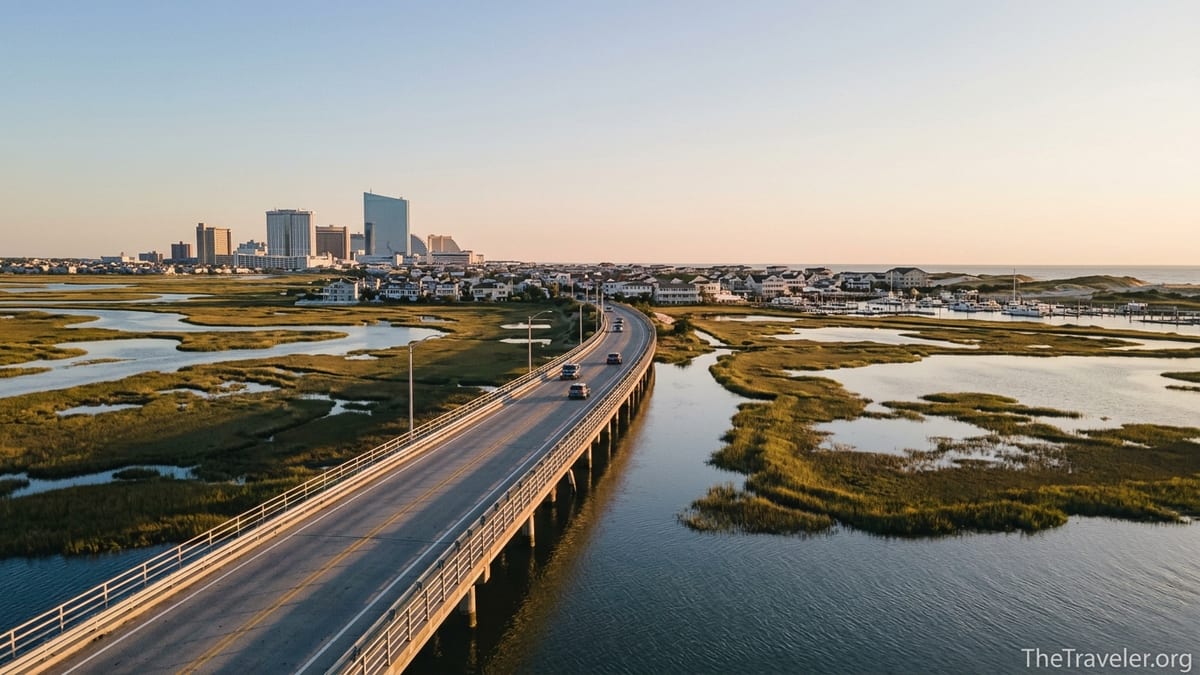
Leaving the Casinos Behind
The transition begins the moment you pull away from the Atlantic City Boardwalk. In the city’s northeast corner, near major properties like Hard Rock Hotel & Casino and Ocean Casino Resort, the soundtrack is a mix of slot machines, live music and Boardwalk barkers. Parking garages, valet stands, and a blur of rides, arcades and bars dominate the edge of the sand. Even on a weekday outside peak season, you can expect a background hum of traffic and the glow of digital billboards long after midnight.
Within a few blocks, though, the high-rises thin out and the scenery shifts. Route 87 leads you past the back side of the marina district, with boat slips, fuel docks and low, functional buildings replacing the themed casino facades. Streetlights stretch out in a clean line toward the water, and the sky feels bigger. On summer weekends, you might still hit a red light behind a parade of SUVs and pickup trucks loaded with coolers and beach chairs, but the energy is already quieter and more local.
Atlantic City’s reputation as a 24-hour playground is deserved, yet it is also what makes the contrast with Brigantine so striking. In the space of a handful of traffic lights you go from valet attendants ushering partygoers inside for concerts and gaming, to families towing small boats and kayaks, heading for a very different kind of shoreline.
Crossing the Brigantine Bridge
The true sense of crossing into another world happens on the Brigantine Bridge, the span that carries Route 87 over the water between Atlantic City and Brigantine. The bridge is the only road connection to Brigantine Island, and as you rise over Absecon Inlet the city suddenly falls away in the rearview mirror. To the south, the glass towers of Ocean and Hard Rock stack up neatly against the horizon. To the north and east, the view opens onto broad marshes, tidal creeks and the pale line of ocean dunes.
On clear mornings, the light here is almost shockingly bright as it bounces off the water pooled in the marsh grass. In late afternoon, especially in shoulder seasons like May or October, the sky tends to soften into pastel blues and pinks that reflect off the flats. Travelers who take this drive in winter find the marsh a patchwork of gold and steely gray, with migrating waterfowl dotting the channels. Whatever the season, the bridge offers one of the best quick glimpses of coastal wetlands anywhere near a major American casino strip.
The drive across only takes a few minutes, and there is no toll for passenger vehicles, making it an easy impulse trip if you have a car in Atlantic City. Many visitors base themselves at a Boardwalk hotel for the shows and restaurants, then carve out a half day to see what lies across the water. That low barrier to entry turns Brigantine from a place you might have vaguely heard of into a spontaneous side adventure.
First Impressions of Brigantine’s Island Life
Once you roll off the bridge into Brigantine, the atmosphere changes immediately. Instead of casino towers, you are greeted by low-rise condos, modest beach houses and a small commercial strip with pizza places, coffee shops, surf gear and ice cream stands. There are no neon arches announcing mega-resorts, no limo lines, and very little in the way of chain storefronts. The speed limit drops, and so does the volume.
Most streets here run either longwise along the island or short blocks toward the ocean or bay, and it is hard to drive more than a few minutes without catching a glimpse of water. Parking is typically a matter of pulling into angled bays near the beach access points or along side streets, quite a shift from the stacked garages and valet tickets of Atlantic City. During peak summer weekends it can still be busy, but the congestion is lower key and more residential in feel.
One of the first things many visitors notice is how dark Brigantine feels after sunset compared to the city. Street lighting is deliberately limited in some neighborhoods to protect wildlife and preserve the night sky, so when you step out of a car at a rental home or small inn, the soundtrack is more likely to be wind and distant surf than nightclub bass lines. For travelers who enjoy the buzz of Atlantic City but want to sleep somewhere calmer, this balance can be ideal.
From Boardwalk Crowds to Almost-Empty Beaches
Atlantic City’s beaches are broad, backed by the famous wooden Boardwalk with its rolling chairs, arcades, pier rides and beach bars. You can rent lounge chairs and umbrellas, grab a slice of pizza, and be back at the gaming tables within minutes. In summer, especially around events and concert weekends, the sand fills with a chatty mix of day-trippers, bachelor and bachelorette parties, and families staking out big shaded camps close to the waterline.
Brigantine’s shoreline, by contrast, feels more like a neighborhood beach that happens to stretch for miles. The island is roughly seven miles long, and the bulk of its oceanfront lies in front of homes, low-rise condos and a modest commercial core rather than resorts. Beach tags are required in peak season during lifeguard hours, with day badges typically priced in the range of a casual lunch in town, and seasonal tags available for frequent visitors. Travelers commonly purchase them at the town’s beach fee office or from beach inspectors who walk the sand.
Even on busy summer afternoons, you can usually walk a few minutes north or south to find space to spread out. The further you go toward the ends of the island, the more the crowds thin. Families carry coolers and pop-up tents, anglers set up sand spikes for striped bass and bluefish, and surfers wait at known breaks that local shops will happily point out. On cool spring or fall days, it is common to see only a handful of dog walkers, bundled locals and birders pacing the waterline.
For travelers used to the constant motion of the Atlantic City Boardwalk, a day on Brigantine’s sand can feel almost meditative. There are no rides humming behind you and many stretches without any buildings directly on the dune line, just the steady shush of waves and the occasional call of gulls and terns overhead.
The Wild North: Natural Area and Overlook
The sense of entering another world reaches its peak at Brigantine’s northern tip. Here, the North Brigantine Natural Area protects a wide sweep of beach, dunes and inlet shoreline. Development drops away, leaving an unmanicured, shell-strewn strand with views across the inlet to the marshes and open ocean. It is one of the longest stretches of undeveloped barrier island beach on New Jersey’s coast, and it feels worlds removed from slot machines and showrooms.
A two-story viewing platform at the north end offers an elevated vantage point over the dunes and inlet. Birders bring binoculars and spotting scopes here in spring and fall to scan for sea ducks, loons and migrating raptors. Even casual visitors appreciate the simple pleasure of leaning on the railing and watching small fishing boats drift past on the tide. The wind can be brisk, especially outside midsummer, so packing a light jacket can make the experience more comfortable.
Access rules in this area change seasonally to protect nesting shorebirds, including species such as piping plovers and least terns that depend on open beach habitat. From roughly early April through late summer, sections of sand are roped off and marked with signs, and visitors are asked to stay closer to the waterline or on designated paths. These restrictions are not designed to keep travelers away but to ensure that the wild character that makes this place special remains intact.
For anglers, the north end is also a favorite spot when conditions are right. Surfcasters wade into the wash targeting striped bass and bluefish, especially in shoulder seasons, while others fish the inlet channels on a rising or falling tide. It is not uncommon to see a mix of serious gear setups and casual visitors trying their luck with rented rods, all sharing a section of sand that feels far from the bright lights just across the bay.
Brigantine’s Everyday Rhythm
Beyond the beach, Brigantine’s everyday rhythm is shaped less by tourism and more by people who treat the island as home. There is a modest downtown strip with a grocery store, delis, bagel shops and local restaurants that range from casual seafood houses to family pizza joints. Breakfast might be a bacon-egg-and-cheese on a hard roll from a corner shop, eaten on a front porch while watching cyclists pedal toward the seawall.
Afternoons are often given over to low-key activities: paddleboarding on the calmer bay side, launching small boats from municipal ramps, or riding bikes up and down Brigantine Avenue. Unlike Atlantic City, where the Boardwalk serves as a central gathering spine, Brigantine’s social life diffuses across smaller pockets: the dog park, the public tennis and pickleball courts, the kid-friendly bayside parks with swings and benches facing the water.
Short-term renters and second-home owners slot easily into this routine. One common pattern is to spend Friday night in Atlantic City enjoying a show or dinner at a resort restaurant, then retreat across the bridge to sleep with windows open to the sound of waves. Saturday might be dedicated to Brigantine’s beach, with an afternoon break for ice cream and an early seafood dinner, before deciding whether the city’s nightlife is worth another short drive.
This blend of options is part of what makes the 15-minute connection between the two places so valuable for travelers. You can lean into the Atlantic City experience as much as you like, secure in the knowledge that calm streets, quieter skies and a darker, star-pricked horizon are close at hand.
Wildlife, Marshes and the Wider Coastal Landscape
Atlantic City and Brigantine sit within a larger mosaic of protected wetlands and barrier islands that make this section of the Jersey Shore rich in wildlife. Just across the bay, the Brigantine Division of the Edwin B. Forsythe National Wildlife Refuge protects thousands of acres of salt marsh, mudflats and coastal habitat. Portions of the refuge are visible from Brigantine’s north end and from the bridge, especially at low tide when winding channels gleam through the marsh grass.
Travelers with a car and a few extra hours can drive a short distance inland to the refuge’s popular wildlife drive, a self-guided loop through tidal impoundments where wading birds, shorebirds and waterfowl gather. The road is typically open from sunrise to sunset, with a modest vehicle entrance fee that supports refuge maintenance and habitat work. Binoculars are helpful but not essential; even with the naked eye you can appreciate flocks of egrets and herons stalking the shallows and, in cooler months, rafts of ducks floating in sheltered pools.
Back on Brigantine itself, everyday wildlife encounters are common. Ospreys nest on platforms along the bay, often visible from roadside pull-offs or while walking the seawall. Pods of dolphins occasionally arc offshore in summer, drawing quiet crowds of beachgoers who stand with hands shading their eyes, tracking the movement along the breakers. Even in peak season, it is possible to stand at the water’s edge and hear more birds than human voices, particularly in the early morning.
For travelers who associate the Jersey Shore primarily with boardwalk games and crowded souvenir shops, these marshes and undeveloped dunes can come as a surprise. The short drive from Atlantic City to Brigantine effectively acts as a gateway, making it easy to experience both the built and wild sides of this coastline in a single day.
Planning Your 15-Minute Detour
Logistically, adding Brigantine to an Atlantic City trip is straightforward. If you are staying at a Boardwalk hotel, you can retrieve your car from the garage or valet and be on Route 87 in a matter of minutes. The drive over the Brigantine Bridge generally takes about 10 to 15 minutes in light traffic, with a little extra time on peak summer weekends or during holiday events. Rideshare services and taxis also operate between the two, though having a car provides more flexibility to explore various beach access points and the north-end overlook.
Parking in Brigantine typically involves a mix of free and permit-based options near the beach. In high season, the town sells daily and seasonal beach tags, which beach staff may check during lifeguard hours. Buying a tag for the day is usually as simple as carrying some cash or a card and purchasing from an inspector who walks the sand, though many visitors prefer to stop at the beach fee office earlier in their stay. Exact prices change periodically, so it is sensible to confirm current rates with the city before arriving.
A practical way to shape a day: start with coffee and breakfast in Atlantic City, then head over the bridge by late morning as the Boardwalk crowds build. Spend midday on Brigantine’s sand, move to the north-end natural area for a late-afternoon walk or viewpoint stop, and return to the city for dinner and a show. Alternatively, base yourself in a Brigantine rental or small hotel and treat Atlantic City as the side trip for nightlife and dining.
What makes this short drive especially worthwhile is how little effort it requires relative to the payoff. You are not committing to a long highway trek or a full itinerary change. Instead, you are simply allowing yourself to see how dramatically a landscape and atmosphere can shift over the span of a single causeway.
The Takeaway
The 15-minute drive from Atlantic City to Brigantine is more than a convenient connection between a casino town and a beach community. It is a compact journey through contrasting visions of the Jersey Shore: one defined by neon, entertainment and constant motion, the other by long stretches of sand, modest neighborhoods and protected dunes and marshes.
For travelers, that contrast is an opportunity. It makes it possible to enjoy a concert or a big-name restaurant in Atlantic City at night, then stand under a quiet sky on Brigantine’s north end the next afternoon, watching birds wheel over the inlet. It turns a typical beach-and-casino weekend into a richer exploration of this barrier island landscape.
If your plans already include Atlantic City, treating Brigantine as a simple, 15-minute detour can transform your understanding of the area. With a single short drive across the Brigantine Bridge, another world of the Jersey Shore opens up, waiting just beyond the glow of the Boardwalk lights.
FAQ
Q1. How long does it actually take to drive from Atlantic City to Brigantine?
In normal traffic it usually takes about 10 to 15 minutes by car from the Atlantic City Boardwalk area to central Brigantine via Route 87 and the Brigantine Bridge.
Q2. Do I need to pay a toll or special fee to cross the Brigantine Bridge?
There is currently no toll for standard passenger vehicles using the Brigantine Bridge, so you can drive between Atlantic City and Brigantine without an extra road fee.
Q3. Are Brigantine’s beaches less crowded than Atlantic City’s?
In general Brigantine’s beaches feel less crowded and more spread out, especially as you walk away from main access points and toward the ends of the island.
Q4. Do I need a beach tag to use Brigantine Beach?
During peak summer season and lifeguard hours, Brigantine typically requires beach tags, sold as daily and seasonal badges by the town and on the sand.
Q5. Can I visit Brigantine without a car if I am staying in Atlantic City?
Yes, taxis and rideshares operate between Atlantic City and Brigantine, though having your own car or rental makes it easier to access different beach areas and the north-end overlook.
Q6. Is Brigantine a good place for wildlife and birdwatching?
Yes, especially around the North Brigantine Natural Area and the nearby Edwin B. Forsythe National Wildlife Refuge, where marshes and dunes attract many coastal bird species.
Q7. What is the main difference in atmosphere between Atlantic City and Brigantine?
Atlantic City is busy and entertainment-focused, with casinos and a lively Boardwalk, while Brigantine feels more residential, low rise and nature-oriented.
Q8. Are there restaurants and services in Brigantine, or is it mostly residential?
Brigantine has a modest but complete selection of services, including grocery stores, delis, pizza places, seafood spots and casual cafes that support both residents and visitors.
Q9. Is the North Brigantine Natural Area open year-round?
The natural area is generally accessible year-round, but some sections of beach may be seasonally closed or limited to protect nesting shorebirds, particularly in spring and summer.
Q10. Can I realistically visit both Atlantic City and Brigantine in one day?
Yes, many travelers spend part of the day on Brigantine’s beaches or at the north-end overlook and then return to Atlantic City in the evening for dining, shows or gaming.