


For travelers who want to skip crowded terminals and fly point to point across Europe, GlobeAir has become a familiar name. The Austrian operator focuses on a single aircraft type and a tightly optimized network, promising short-notice departures, fast boarding and direct access to smaller airports that scheduled airlines often skip. Understanding what you actually get when you charter with GlobeAir starts with understanding its fleet.
Get the latest updates straight to your inbox!
How GlobeAir’s Fleet Is Structured Today
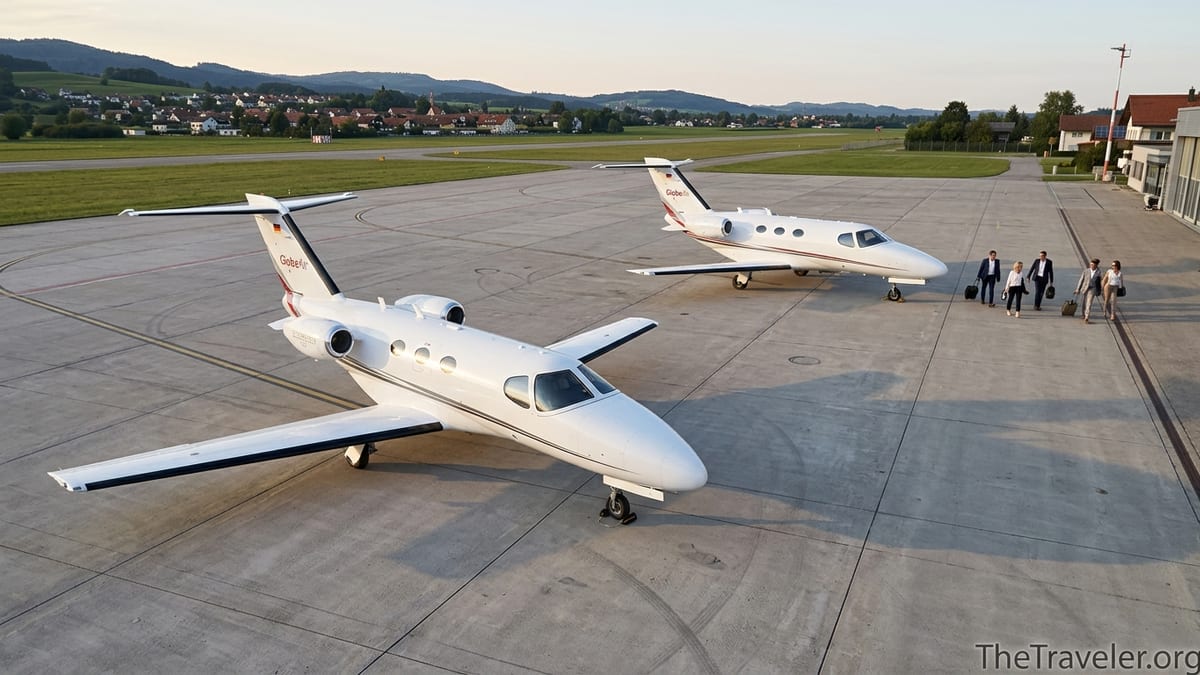
GlobeAir operates a focused, single-type fleet built entirely around the Cessna Citation Mustang, a very light jet designed for short European hops. Public fleet data services such as Flightradar24 and Plane Finder list 17 active aircraft under the GlobeAir code, all of them C510 Mustangs, which aligns with the company’s own description of operating the world’s largest Citation Mustang fleet in Europe. Over the years the figure reported by GlobeAir has varied between about 17 and 20 aircraft as jets are added, sold or undergo maintenance, but the key point for travelers is that every own-operated GlobeAir tail number is the same basic model.
This fleet strategy is unusual in an industry where many charter operators spread their resources across several light, midsize and heavy jet types. For GlobeAir, relying on just one aircraft simplifies crew training, maintenance and scheduling. Pilots type-rated on the Mustang can fly any jet in the fleet, and standardized interiors mean that whether you board an aircraft registered as OE-FZA in Milan or OE-FCM in Zurich, the cabin layout and experience will feel very familiar.
For travelers, a single-type fleet translates into more predictable service. Cabin dimensions, baggage space, noise levels and in-flight amenities are consistent from aircraft to aircraft. A business traveler booking a late-afternoon Vienna to Geneva flight after a morning meeting knows that the seat, work surface and power options will be the same setup they used on their previous trip to Nice or Munich. That consistency can matter more than variety when you fly several times per month.
Where GlobeAir does introduce variety is not in the aircraft model but in cabin refurbishments and design packages. The operator has promoted new cabin designs handcrafted in Florence, with updated leathers and finishes across its Mustang fleet. In practice, this means that a regular passenger might notice subtle differences in upholstery or mood lighting between aircraft, but the overall feeling is of a unified, recognizable GlobeAir interior.
The Cessna Citation Mustang: Backbone of the Fleet
The Cessna Citation Mustang is a twin-engine very light jet that typically seats four passengers in the main cabin, plus two pilots in the cockpit. Developed in the early 2000s as an entry-level business jet, it was certified in 2006 and produced until 2017. GlobeAir adopted the type early and built its business model around its strengths: short-field performance, relatively low operating costs and the ability to use smaller airports close to city centers or resort areas.
Performance figures vary slightly by configuration, but in broad terms a Mustang cruises at around 630 to 650 kilometers per hour at altitude, with a practical range in the region of 1,150 to 1,300 nautical miles with four passengers, depending on payload and weather. In real-world charter terms that makes nonstop routes such as Paris Le Bourget to Ibiza, Zurich to London City or Rome Ciampino to Cannes straightforward, with typical flight times around 1 hour 30 minutes to 2 hours on many popular city pairs.
The Mustang is powered by a pair of Pratt & Whitney Canada PW615F turbofan engines mounted at the rear of the fuselage. These allow the aircraft to climb above most weather to a maximum cruising altitude of about 40,000 feet. For passengers, that translates into smoother rides over the Alps in winter and fewer diversions around storms. The aircraft is certified for flight into known icing conditions and is designed with the safety redundancies you would expect from a modern business jet, which is one reason operators like GlobeAir favor it for year-round European operations.
Although it sits at the small end of the private jet spectrum, the Mustang’s performance envelope covers a surprising amount of ground. A traveler could depart Munich in the morning for a meeting in Amsterdam, continue to a second engagement in Geneva and return to Munich in the evening, all within the aircraft’s comfort zone. That flexibility, paired with GlobeAir’s ability to offer 15-minute boarding at many private terminals, turns the Mustang into a practical tool for high-frequency business travel rather than a purely aspirational luxury.
Cabin Experience on a GlobeAir Mustang
Step inside a GlobeAir Mustang and the first impression is of a compact but well-finished cabin optimized for up to four travelers. The typical configuration features two pairs of facing club seats along a central aisle. Each seat is usually finished in light leather with adjustable headrests, armrests and fold-out tables that allow passengers to work on a laptop or enjoy a meal. While you will not find the stand-up headroom or full-length divans of larger jets, the Mustang’s seating layout makes it practical for small teams or families traveling together.
The cabin height is roughly 1.37 meters and width about 1.40 meters, which means most adults will be seated for the duration of the flight rather than moving around. For journeys of 60 to 90 minutes between cities like Milan and Vienna or Hamburg and Munich, most travelers find this entirely comfortable, especially given the advantage of flying closer to their final destination. Soft lighting, large windows and carefully chosen materials help the space feel more open than the raw measurements might suggest.
GlobeAir’s refurbished interiors emphasize a boutique-hotel aesthetic, with Italian-crafted leathers, stitched sidewalls and coordinated carpets. Small details contribute to the sense of occasion: noise-reducing headsets available on request, cup holders integrated into the side ledges and accessible storage for personal items. Operators like GlobeAir also typically provide bottled water, soft drinks and light snacks as standard, with bespoke catering available on request for more elaborate in-flight meals.
From a practical standpoint, travelers will find that the Mustang offers power outlets for devices in many cabins, though you should always confirm the specific aircraft’s configuration when booking if you rely on charging during flight. There is not usually a fully enclosed lavatory in the sense you might find on a midsize jet, but Mustangs are equipped with a compact aft lavatory solution behind a privacy curtain. For 1 to 2 hour flights, this arrangement is common in the very light jet category and generally adequate for most passengers.
Baggage Capacity and Seating: What Fits and What Does Not
One of the most important practical questions when considering a GlobeAir charter is baggage. The Citation Mustang’s total external and internal baggage capacity is around 1.4 cubic meters, with a maximum weight that typically falls in the range of 250 to 300 kilograms, subject to exact loading and performance requirements. In practice, this usually supports four soft-sided cabin-size cases plus a few garment bags or smaller items, but it is not designed for large sports teams or groups with extensive equipment.
As a rule of thumb, a family of four flying from Vienna to Olbia for a Mediterranean holiday can bring a cabin trolley and soft duffel each without trouble, provided skis, golf clubs or bulky hard cases are checked in advance with GlobeAir’s operations team. However, if the same group wants to bring two full-size golf bags and several rigid suitcases, the operator may recommend either shipping some luggage separately or switching to a larger charter aircraft sourced through GlobeAir’s brokerage partners.
The four-passenger seating capacity is another key limitation to consider. The Mustang is perfect for one or two executives shuttling between Frankfurt and Geneva or a couple traveling from London City to Venice, but less ideal for a party of six heading to a wedding in Mallorca. GlobeAir acknowledges this in its own booking interface, which offers to broker larger private jets for groups exceeding four passengers or for those needing an especially generous baggage allowance.
Weight and balance calculations also mean that on hot summer days or when departing shorter runways at high altitudes, the captain may advise reducing either passenger count or baggage to stay within performance margins. This is standard practice in aviation and one reason why providing accurate passenger weights and luggage estimates during booking is vital. Professional operators like GlobeAir will walk you through these constraints before confirming your itinerary, especially if you are planning flights to airports such as Samedan near St. Moritz or Lugano, where runway length and elevation add complexity.
Where You Can Fly: Airports and Typical Routes
GlobeAir markets its ability to reach more than 900 European destinations, capitalizing on the Mustang’s strong short-field performance and low noise footprint. In everyday terms, that means you can often operate into secondary airports much closer to the places you actually want to be. Instead of flying a commercial airline into Zurich and then driving two hours to St. Moritz, for example, a GlobeAir Mustang can land at Samedan Airport near the resort, shaving significant time off a winter ski trip.
Likewise, the aircraft can serve airports like London City, which has a short runway and steep approach path, or smaller regional fields around the Mediterranean. Common summer pairings include city-to-beach itineraries such as Geneva to Olbia, Paris Le Bourget to Palma de Mallorca and Munich to Dubrovnik. For business travelers, weekday flows often connect financial hubs like London, Frankfurt, Zurich and Milan with smaller industrial cities that lack frequent scheduled service.
In terms of range, the Mustang comfortably covers most of Western and Central Europe in one hop. A typical non-technical routing might be Vienna to Madrid or Hamburg to Nice, subject to payload and weather. Routes stretching to the edges of the aircraft’s range envelope, such as Dublin to Athens, may require fuel stops or careful load planning, which GlobeAir’s dispatch team would flag during the quoting process. For many travelers, the time saved at departure and arrival more than compensates for the occasional extra stop on longer sectors.
GlobeAir also emphasizes short-notice availability, often within 72 hours of booking, leveraging its fully owned fleet without the need for individual owner approvals. That can be especially useful for last-minute corporate roadshows, urgent site visits or time-sensitive leisure trips. For example, a small legal team based in Brussels might secure a same-week charter to attend emergency hearings in Milan and then return the same day, something that would be challenging to arrange on scheduled airlines at convenient times.
Chartering Costs and Real-World Use Cases
Pricing for a GlobeAir charter on a Citation Mustang varies with route, season, notice period and positioning requirements, but public examples on the company’s own platform provide a sense of scale. Limited offers on selected routes have been advertised in the region of 6,900 to 7,400 euros for one-way flights such as Linz to Hamburg or Hamburg to Munich booked within a specific advance window. These figures are indicative rather than fixed, yet they help frame expectations for typical 60 to 90 minute legs.
In everyday terms, that means a group of four colleagues sharing a 7,000 euro flight from Zurich to Amsterdam is effectively paying around 1,750 euros each, in exchange for a private cabin, tailored departure time and direct access to business aviation terminals. For some corporate budgets, especially when time saved and additional meetings enabled are factored in, this can be a defensible trade-off compared with premium cabin fares and overnight stays on commercial airlines.
Leisure travelers tend to use GlobeAir’s Mustangs for special-occasion trips rather than weekly commuting. A couple flying from London City to Courchevel via Chambéry for a ski weekend might value the ability to leave after work on Friday, arrive late evening closer to the resort and return on Sunday evening, all while avoiding main terminals and crowded security lanes. Families heading to smaller islands or coastal towns with limited airline service, such as Olbia for Sardinia villas or Figari for Corsica, make similar calculations when pooling costs with friends.
Another use case involves multi-stop itineraries that would be awkward on traditional carriers. A start-up founder could begin in Barcelona, visit potential investors in Zurich and Munich, and be back in Barcelona by midnight, using the cabin time to work between meetings. In such scenarios the Mustang’s combination of relatively low operating cost among jets, decent cruising speed and access to secondary airports becomes particularly compelling.
Beyond the Mustang: Larger Jets via GlobeAir’s Network
Although GlobeAir’s own fleet consists solely of Citation Mustangs, the company also positions itself as a gateway to larger aircraft when clients need more seats, range or baggage capacity. Its booking channels make clear that if your party exceeds four passengers or if you want to reach destinations beyond the Mustang’s comfortable range envelope, GlobeAir can arrange charters on light, midsize or large-cabin jets operated by partner airlines.
In practice, this means that a group of eight executives planning a nonstop flight from Vienna to Dubai or a large family planning a villa holiday in the Canary Islands might still request a quote through GlobeAir. The operator would then source appropriate aircraft such as a Cessna Citation XLS, Bombardier Challenger 350 or similar types from its network of certified partners. Although these aircraft are not part of GlobeAir’s owned fleet, the company oversees the charter process and coordinates ground services in a similar way.
This hybrid model, common among European charter specialists, lets GlobeAir retain its operational focus on the Mustang while still fulfilling more complex client requests. From a traveler’s perspective, it can simplify trip planning: your contact point, payment and concierge services remain with GlobeAir even if the actual flight is performed by another operator. It is important, however, to clarify at the quotation stage which flights are on GlobeAir’s own Mustangs and which are on partner aircraft, as cabin layouts, baggage allowances and inflight amenities will differ.
For regular Mustang users, this network access can be a useful safety valve. A business traveler who normally flies solo or with one colleague between European capitals might once a year need to move a full project team, support staff and presentation equipment. Being able to scale up on a one-off basis without managing a new set of relationships with another operator is part of the value proposition GlobeAir aims to offer.
The Takeaway
Meeting the GlobeAir fleet means, in effect, getting to know one aircraft in depth: the Cessna Citation Mustang. Rather than presenting a menu of radically different cabin sizes and performance profiles, GlobeAir concentrates on a single very light jet type and scales it across a double-digit fleet. For frequent travelers who value predictability, that can be an advantage. You know that a booking from Vienna to Milan or Paris to Geneva will involve the same familiar four-seat cabin, similar baggage parameters and consistent flight times.
This focused fleet matches a specific niche in the private aviation landscape: short-hop, small-group flying around Europe. The Mustang is not the right tool for every mission. If you need to carry eight people, surfboards and golf bags to the Canary Islands, or if you want nonstop flights from London to the Middle East, a midsize or large-cabin jet arranged through GlobeAir’s partners will likely be a better fit. But for two to four passengers with light to moderate luggage, connecting cities and resorts within a two-hour radius, the Mustang is efficient and surprisingly capable.
Ultimately, travelers considering GlobeAir should start by mapping their typical routes, group sizes and baggage needs, then discuss them openly with the operator’s booking team. Describe a real itinerary, such as quarterly board meetings in Zurich, a family summer escape to Sardinia or a multi-city investor roadshow. With that concrete information, GlobeAir can confirm whether its Mustang fleet is the right solution or whether a larger chartered aircraft would serve you better.
As with any private aviation provider, the value is clearest when you compare the entire journey, not just the hour in the air. If skipping lengthy security lines, using closer-in airports and tailoring your schedule around your own commitments matter more than having a cavernous cabin, then GlobeAir’s compact but capable Mustang fleet may be exactly the kind of aircraft you want to charter.
FAQ
Q1. How many aircraft are currently in the GlobeAir fleet?
GlobeAir operates a single-type fleet of Cessna Citation Mustang very light jets, with public fleet data indicating around 17 active aircraft, though the exact number can vary slightly over time as jets are added or leave service.
Q2. How many passengers can a GlobeAir Mustang carry?
The standard cabin layout on GlobeAir’s Citation Mustangs seats up to four passengers in the main cabin, plus two pilots in the cockpit, making the aircraft ideal for individuals, couples or small business teams.
Q3. What is the range of the Cessna Citation Mustang used by GlobeAir?
In typical charter configurations, the Mustang offers a practical range of roughly 1,150 to 1,300 nautical miles, enough for nonstop flights on routes such as Paris to Ibiza, Zurich to London City or Vienna to Madrid, depending on payload and weather conditions.
Q4. How much luggage can I bring on a GlobeAir flight?
The Mustang’s total baggage volume is modest, usually accommodating four soft-sided cabin-size cases along with a few smaller bags. Bulky items like skis or golf clubs may require advance coordination and, in some cases, an upgrade to a larger aircraft arranged through GlobeAir’s partner network.
Q5. Does GlobeAir offer larger jets if my group has more than four passengers?
Yes. While GlobeAir’s own fleet consists solely of Citation Mustangs, the company can broker larger light, midsize and heavy jets through partner operators for parties that exceed four passengers or have greater range or baggage needs.
Q6. Which airports can GlobeAir’s Mustangs use?
The Cessna Citation Mustang is capable of operating from many shorter runways and regional airports. GlobeAir regularly serves major business aviation hubs such as Paris Le Bourget and London City, as well as smaller fields like Samedan near St. Moritz, Lugano and numerous Mediterranean gateways.
Q7. What is the typical flight time on common GlobeAir routes?
On many popular European city pairs, such as Linz to Hamburg or Hamburg to Munich, typical flight times fall between about 1 hour and 1 hour 30 minutes. Longer routes near the edge of the Mustang’s range, such as Vienna to Madrid, can take around 2 to 3 hours depending on winds and routing.
Q8. What is the cabin experience like on a GlobeAir Mustang?
Passengers can expect a compact, four-seat leather cabin with facing club seating, fold-out tables, soft lighting and a small aft lavatory behind a privacy curtain. The interiors emphasize comfort and style within a very light jet footprint, with Italian-crafted finishes and a calm, businesslike atmosphere.
Q9. How far in advance do I need to book a GlobeAir flight?
GlobeAir markets its ability to confirm flights on relatively short notice, often within 72 hours of departure, thanks to full ownership of its fleet. Availability still depends on route, season and existing schedules, so earlier booking generally offers more choice of times and pricing.
Q10. How much does it cost to charter a GlobeAir aircraft?
Pricing varies by route, notice period and season, but example fares published by GlobeAir show one-way flights on routes like Linz to Hamburg or Hamburg to Munich in the general range of several thousand euros, sometimes around 6,900 to 7,400 euros for selected offers, with the cost shared among up to four passengers.