


Grand Cayman’s Crystal Caves have quickly become one of the island’s signature inland attractions, and they are heavily marketed as family friendly. For parents, though, the questions go beyond pretty stalactites: Is it too dark or scary for young kids? How tough is the walk in the heat? Are there toilets along the way, and will nervous or stroller-age children enjoy it enough to justify the time and cost? This guide breaks down the Crystal Caves experience from a family perspective so you can decide if it fits your kids, your itinerary and your expectations.
Get the latest updates straight to your inbox!
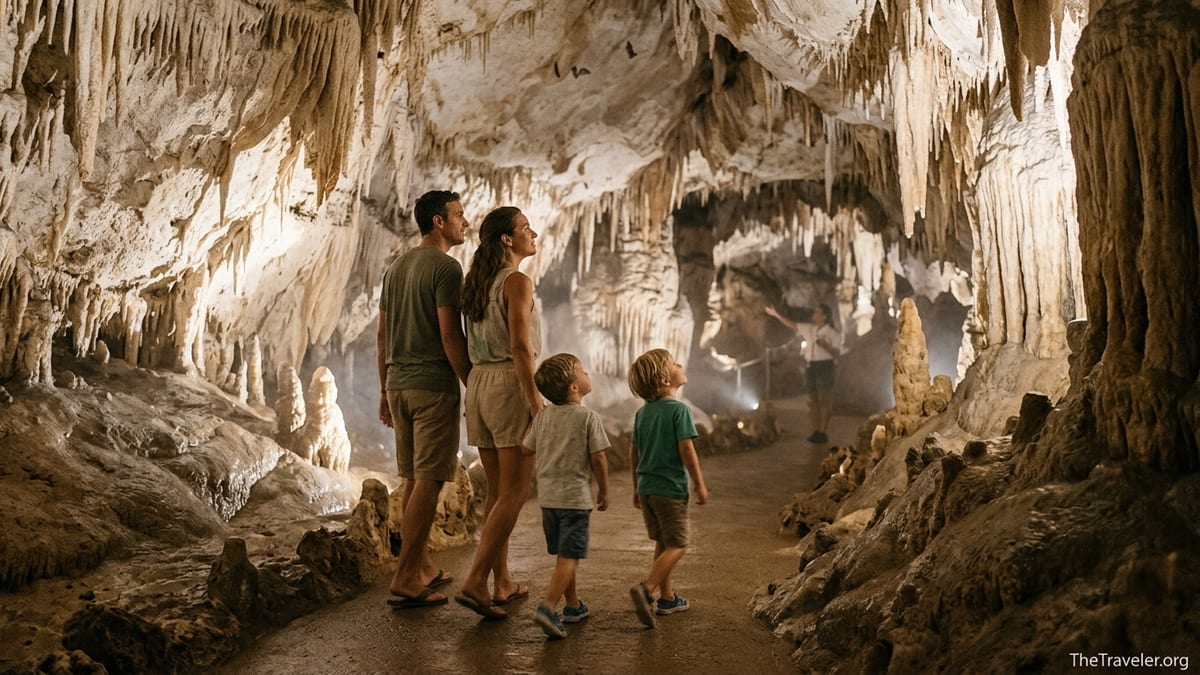
What Exactly Are the Cayman Crystal Caves?
Cayman Crystal Caves sit in the North Side district of Grand Cayman, near Old Man Bay, about a 35 to 45 minute drive from Seven Mile Beach depending on traffic. The site is a privately run attraction set in a patch of preserved tropical forest, with three main show caves and a short forest walk. Every visit is by guided tour only, typically lasting around 90 minutes from the time you leave the hilltop visitor area to when you return.
The experience begins at the ticket office and shaded treehouse area, where you check in, use the washrooms and wait for your guide. Small shuttle buses then take each group down a short paved road into the forest. From there, you follow your guide along compact dirt and gravel paths between the caves and into each chamber, stopping frequently for explanations and photos. According to the operator, the standard tour includes a forest walk and entry into three different caves, each with its own feel and level of darkness, plus plenty of chances to see bats and crystal formations up close.
This is important context for families: you are not briefly ducking into a single cavern and coming back out to a playground or beach. The caves are the main event, and children will be underground, in semi-darkness and humid air, for much of the 90 minutes. That can be magical for some kids, but tiring or overwhelming for others if expectations are not managed in advance.
Age Suitability and What Kids Actually Enjoy
The caves market themselves as a family friendly attraction and allow children of all ages on the regular guided tour. Children under 4 are free of charge, which tells you that toddlers and preschoolers are common on site. In practice, however, most parents report that the sweet spot for enjoyment is around ages 5 to 12, when kids can walk independently, follow simple safety instructions and appreciate the novelty of exploring underground chambers while spotting bats, roots and rock formations.
School-age children who enjoy science, nature or even fantasy stories often latch onto the experience. A 7 year old might proudly point out stalactites that “look like icicles,” while a 9 year old might pepper the guide with questions about how long the formations took to grow. Guides are used to families and tend to include age appropriate explanations, like comparing stalagmites to “growing upside-down candles” and talking about bats as friendly insect eaters rather than something to fear.
Very young children can still have a good time, but their fun often hinges on their temperament and the level of supervision. A confident 3 year old who is used to hiking and enjoys flashlights may love walking with a parent and seeing “sparkly rocks.” A more cautious preschooler might cling to you in the darkest sections or get tired halfway through and simply want to be carried. Since strollers are not allowed, you need to be prepared to carry toddlers for short stretches or let them sit out moments on a parent’s hip or shoulders.
Walking Conditions, Heat and Footwear
A typical Crystal Caves tour involves about 1.5 hours of combined walking, standing and stair climbing. According to the operator, the route includes a guided walk through the tropical forest plus visits to three caves, all reached via short paths with some steps and handrails where needed. Surfaces are mostly compacted dirt and fine gravel outside, and concrete or rock steps with handrails in many sections inside the caves. The paths are not long, but they are uneven in places. Families should think of it as an easy hike rather than a flat museum corridor.
The Cayman climate is hot and humid for much of the year, and you will feel that in the forest sections. The company itself recommends light clothing and bringing a refillable water bottle to top up at the water cooler in the seating area before or after your tour. Inside the caves, the temperature usually feels slightly cooler than outside but still humid. Kids may emerge sweaty, especially if they spend time climbing short staircases or rushing ahead, so breathable clothes and a small towel or spare shirt for younger kids are helpful.
Footwear is critical. The attraction explicitly advises against strollers, wheelchairs, walking aids and crutches on the tour because the terrain is not suited to wheels or unstable supports. That means everyone in your group needs to be able to walk independently on uneven ground and manage modest staircases. Closed toe shoes or sturdy sport sandals with a good grip are strongly recommended. In practice, many visitors wear sneakers or lightweight hiking shoes; flip-flops are common on the island, but they are much more slippery on damp rock and can make parents nervous on stairs while carrying a child.
If you are used to easy family hikes, you will probably find the walking straightforward. If you have a family member with balance issues, knee problems or difficulty with stairs, this may not be the ideal excursion. The tour is guided at a relaxed pace, but there is no way to skip the steps into and out of each cave.
Darkness, Bats and Nervous Children
By design, Crystal Caves feels like a real cave environment, which means there are sections of limited natural light and a resident bat population. The caves are not pitch black throughout; they are equipped with electrical lighting along the paths and on key formations, and your guide controls additional spotlights to show off particularly dramatic features. That said, some transitions, corners and ceiling areas are dim, and children who are sensitive to the dark may feel uneasy at first.
Bats are part of the experience. Guides often highlight them as one of the stars of the tour, pointing out where they roost and explaining their role in the local ecosystem as insect eaters and pollinators. On some tours, especially near dusk or at the entrance to certain chambers, you may see bats flying overhead. The attraction even offers an evening “Dusk to Dark” bat focused experience that emphasizes watching the bats fly out at night. For many kids this is a memorable highlight: parents report children excitedly counting bats or giggling when one swoops by the group at a safe distance.
For nervous children, advance framing helps enormously. Explaining that the bats are small, shy “fruit and bug eaters” that do not want to touch people can reduce fear. It is also useful to tell children that the guide never turns off all the lights on the main family tour. You can point out that there will always be at least pathway lights on so they can see where they are going. Some parents bring a small child friendly flashlight, although you should follow any instructions from your guide about when it is appropriate to use extra lights.
If you know your child has a strong fear of the dark or of bats, consider practicing with smaller experiences before committing to the tour. Walking through a dim aquarium tunnel or a planetarium show at home can help you gauge reactions. Once at Crystal Caves, keep your child close, offer to stand at the back or front of the group where they feel most secure, and let the guide know discreetly if you have a particularly anxious kid so they can tailor explanations.
Facilities, Toilets and Practical Logistics
All of the main facilities at Cayman Crystal Caves are clustered around the hilltop entrance area. Here you will find ticketing, a shaded waiting and seating area, gift shop and the Treehouse Restaurant, plus restrooms. It is important for families to understand that there are no toilets along the forest paths or inside the caves themselves. The entire guided portion lasts around 90 minutes, so you should make using the bathroom a non negotiable stop for all kids and adults before boarding the shuttle down to the cave area.
The Treehouse Restaurant offers casual meals and drinks in an elevated, open air space, and there is a small shop selling souvenirs and, typically, cold drinks and basic snacks. Many families time their visit so that they have lunch or a snack either before or after the tour, using the restaurant as a bribe or reward for younger children. Because of the length and focus of the tour, Crystal Caves pairs well with a half day itinerary: for example, combining a morning cave visit with an afternoon swim at nearby Rum Point or a stop at the Queen Elizabeth II Botanic Park, which is about a 10 to 15 minute drive away.
In terms of logistics, the caves operate tours daily, generally on the hour from mid morning through the afternoon, with some seasonal variations. Prebooking is strongly recommended, especially if you are visiting during high season, staying on Seven Mile Beach or arriving as a cruise passenger. Families driving from resort areas should allow extra time for North Side traffic and for the short check in and shuttle process once on site. Many parents find that a mid morning slot works well, beating the peak heat of the day and leaving the afternoon open for beach time or naps back at the hotel.
Strollers, Supervision and Safety Expectations
The attraction explicitly does not allow strollers, wheelchairs, walking aids or crutches on the tour. The reason is a combination of uneven ground, tight spaces and steps that make wheeled devices impractical and potentially unsafe. For families with infants or toddlers who cannot reliably walk the full duration, this means you will either need to use a soft carrier or backpack style child carrier or plan to carry your child in your arms for parts of the tour. Front carriers work well for small babies, but keep in mind the heat and humidity; for older toddlers, a framed backpack carrier can be more comfortable for both child and adult.
Supervision is hands on rather than relaxed. Paths are not dangerously narrow, but there are occasional edges, slick spots and low ceilings. Guides will usually ask families to keep children close and not to allow running, climbing on railings or touching the formations. Most parents find that a one to one or one to two adult to child ratio makes the experience more enjoyable. If you are traveling as a multi generational group, it can help to assign each child a designated adult buddy before the tour starts.
From a safety standpoint, the caves are designed to be accessible to ordinary visitors, not extreme cavers. Lighting is installed, steps are cut into steeper slopes, and there are handrails in the most significant stair sections. The guided format means you are rarely alone or out of sight of the group. Still, because of the nature of caves, families should prepare kids to walk carefully, hold rails on stairs and follow instructions quickly. Closed toe shoes, a refillable water bottle and, if anyone in your group is sensitive to humidity or has mild asthma, any necessary medication, are practical precautions.
If someone in your family has serious mobility, balance or respiratory issues, consider whether a different Grand Cayman activity, such as the Cayman Turtle Centre, the National Gallery or a glass bottom boat tour, might be a better match. Crystal Caves is a rewarding outing, but it is not a low effort, fully accessible attraction.
Educational Value and Making the Most of the Experience
For many families, the biggest surprise at Crystal Caves is how educational the tour feels without being dull. Guides typically start with a short history of how the caves were discovered and developed, then weave in simple geology lessons as you move from chamber to chamber. Kids learn how stalactites and stalagmites form from dripping mineral rich water, why some formations look like draperies or soda straws, and how the island’s limestone bedrock allowed these voids to form over thousands of years.
The surrounding forest walk adds another layer of learning. The operator highlights the presence of strangler balsam trees, air plants, parrots and bats in its own description of the site, and many guides point out specific trees whose roots now dangle into the caves or explain how air plants live without soil. Children who are used to the beaches of Seven Mile are often fascinated to discover that Grand Cayman also has this dense, tangled interior forest ecosystem.
To maximize the educational value, consider preparing your kids with a simple pre trip activity. This might be watching a short child friendly video about how caves form, reading a picture book about bats or even bringing a small nature journal so older children can sketch formations during the tour or afterwards at the restaurant. Some families tie the visit to school projects, asking children to write a short report on what they saw or to compare the cave environment with the coral reefs they snorkel later in the week.
Because tours are guided, you do not need to plan a separate curriculum, but you can definitely encourage your children to ask questions. Guides often respond enthusiastically to engaged kids, and having a child ask how old a particular stalagmite is or why bats hang upside down adds to the sense of discovery for the whole group.
Will Younger Children Enjoy It, or Be Overwhelmed?
Whether very young kids enjoy Crystal Caves depends more on personality and preparation than on age alone. Parents who report positive experiences with toddlers and preschoolers tend to emphasize a few common strategies. They present the outing ahead of time as a “real cave adventure” where the child will need to be a helper, walking carefully and holding hands. They choose a morning slot when their child is usually rested and fed, bring a snack to offer in the waiting area beforehand, and keep a small comfort item like a soft toy in a backpack in case of wobbly moments.
Once on the tour, these parents focus on the sensory fun rather than on the educational content. They encourage children to look for shapes in the rocks, count steps, listen for water drips and see if they can spot bats or roots. They are also realistic about the likelihood of needing to carry the child for short stretches, particularly on stairs or when the group moves more quickly between chambers.
Families who find the experience less successful with younger kids often describe misaligned expectations: arriving during nap time, having a child who is already hot and cranky from other activities, or underestimating how much the combination of darkness, unfamiliar noises and other people’s voices would overwhelm a sensitive child. For these families, alternative low stress outings such as a gentle morning at Cemetery Beach, a visit to the Cayman Turtle Centre’s shallow pools or a shaded playground in Camana Bay may have been a better fit for that stage of childhood.
If you have one child who is cave ready and a younger sibling who might not be, consider splitting your group. One adult could take the older child to Crystal Caves while another enjoys a quieter activity with the toddler, then swap on another day for a different excursion. That way, each child gets an age appropriate highlight rather than one sibling’s dream activity turning into another’s meltdown.
The Takeaway
Cayman Crystal Caves offers a memorable counterpoint to the beach and boat heavy experiences that define many Grand Cayman trips. For families with school age children who are curious about nature, comfortable walking and open to a bit of darkness and bat watching, the caves can be a genuine highlight, combining education with adventure in a manageable half day outing. The guided format, well defined paths and presence of a knowledgeable local guide make it feel structured and safe even for those new to caves.
At the same time, the experience is not right for every family. The ban on strollers, the need for steady walking on uneven ground, the absence of toilets along the route and the presence of bats and dimly lit spaces all make it better suited to children who can follow directions and manage mild physical exertion. Younger or more anxious children can still enjoy it with careful planning, realistic expectations and close supervision, but parents should be honest about their child’s temperament and energy levels.
If you decide to go, prioritize good footwear, early in the day scheduling, bathroom breaks before the tour and a calm pre trip explanation for kids about what they will see. Combine the caves with a cooling swim or relaxed lunch afterward, and you will likely remember the outing as one of the more distinctive and surprising chapters of your family’s Grand Cayman story.
FAQ
Q1. What is the minimum age recommended for visiting Cayman Crystal Caves with kids?
The caves allow children of all ages and do not set a strict minimum for the standard guided tour, with under 4s typically entering free. In practice, children around 5 and older tend to get the most out of the experience because they can walk independently, manage the stairs and appreciate the explanations, while younger toddlers may need to be carried and may tire more quickly.
Q2. How difficult is the walk inside the caves for children and older relatives?
The walking is generally rated as easy to moderate, with short forest paths, some uneven ground and several sets of stairs with handrails. Most healthy school age children and reasonably fit grandparents manage it without trouble, but it can be challenging for anyone with balance problems, knee pain or difficulty climbing stairs. There are no long climbs, yet you will be on your feet for about 90 minutes.
Q3. Are strollers or baby carriers allowed on the Crystal Caves tour?
Strollers and wheeled devices are not allowed on the tour because the terrain includes steps, narrow paths and uneven surfaces that make them unsafe. Soft front carriers or backpack style child carriers are generally acceptable and are the most practical way to bring infants or toddlers who cannot walk the entire route. Parents should be prepared for the heat and plan for breaks when using carriers.
Q4. Will my child be scared of the dark or of the bats?
Many children are surprised by how comfortable they feel once they see that the caves are lit and that the bats keep their distance. The tour uses pathway lights and spotlights, so it is never completely dark on the family route. Bats usually roost quietly on ceilings or flutter overhead briefly. Children who are very sensitive to darkness or animals may feel nervous at first, but clear explanations beforehand and staying close to a parent usually help them adjust.
Q5. Are there toilets available during the tour?
All restroom facilities are located at the main visitor area near the ticket office and restaurant. There are no toilets on the forest paths or inside the caves themselves. Because the guided portion lasts about 90 minutes from shuttle departure to return, families should make sure everyone uses the bathroom just before their tour time, especially younger children.
Q6. What should kids wear and bring for a Crystal Caves visit?
Children should wear light, breathable clothing suitable for Grand Cayman’s heat, along with closed toe shoes or sturdy sport sandals that grip well on damp rock and gravel. A refillable water bottle, a small towel or spare shirt for very young kids, and optionally a child friendly flashlight or a simple notebook for sketching can be useful. Hats and sunglasses are helpful for the forest and waiting areas but can be removed once inside the caves.
Q7. Is the tour suitable for children with mobility or sensory issues?
The tour is not designed as a fully accessible experience. Uneven paths, multiple short staircases and the ban on wheelchairs, walkers and strollers make it unsuitable for many visitors with significant mobility challenges. For children with sensory sensitivities, the combination of darkness, echoes, group voices and humid air may be overwhelming. Parents of such children should carefully consider their child’s specific needs and possibly consult their healthcare provider or contact the attraction directly before booking.
Q8. How close do you get to the bats, and is it safe?
On a typical tour, bats are seen hanging from ceilings or occasionally flying overhead but not interacting with visitors. Guides explain that bats are shy and prefer to keep their distance, and there is no touching or handling of animals. Families are instructed not to reach toward the bats or shine bright lights directly at them. Under these conditions, observing the bats is considered safe for healthy visitors and often becomes a favorite memory for kids.
Q9. How can we make the experience more educational for our children?
To deepen the educational value, you can introduce simple concepts about caves, limestone and bats before your visit, then encourage kids to ask the guide questions during the tour. Bringing a small notebook or sketchpad allows older children to draw interesting formations or jot down facts they learn. Afterward, you can connect the cave environment to other parts of your trip, such as comparing stalactites to coral structures seen while snorkeling or discussing how bats help control insects on the island.
Q10. When is the best time of day to visit Crystal Caves with kids?
For most families, a morning tour works best. Temperatures are slightly cooler, young children are usually more rested and crowds can be lighter, which makes it easier to hear the guide and keep kids focused. Booking a mid morning slot also leaves the afternoon free for a swim, nap or quieter activity, helping balance the more intense sensory experience of the caves with relaxing downtime.