


Thessaloniki is one of Greece’s most vibrant city breaks, but in summer many visitors are surprised to discover that the real swimming beaches lie just outside town. The good news is that with a little planning you can be in waist-deep, clear water within an hour, using nothing more complicated than a city bus, a waterbus, or a KTEL coach. This guide explains how the beach system around Thessaloniki works in practice, what to expect from Perea, Agia Triada and Epanomi, when it is worth going all the way to Halkidiki, and how to get to each area without wasting half your holiday in transit.
Get the latest updates straight to your inbox!
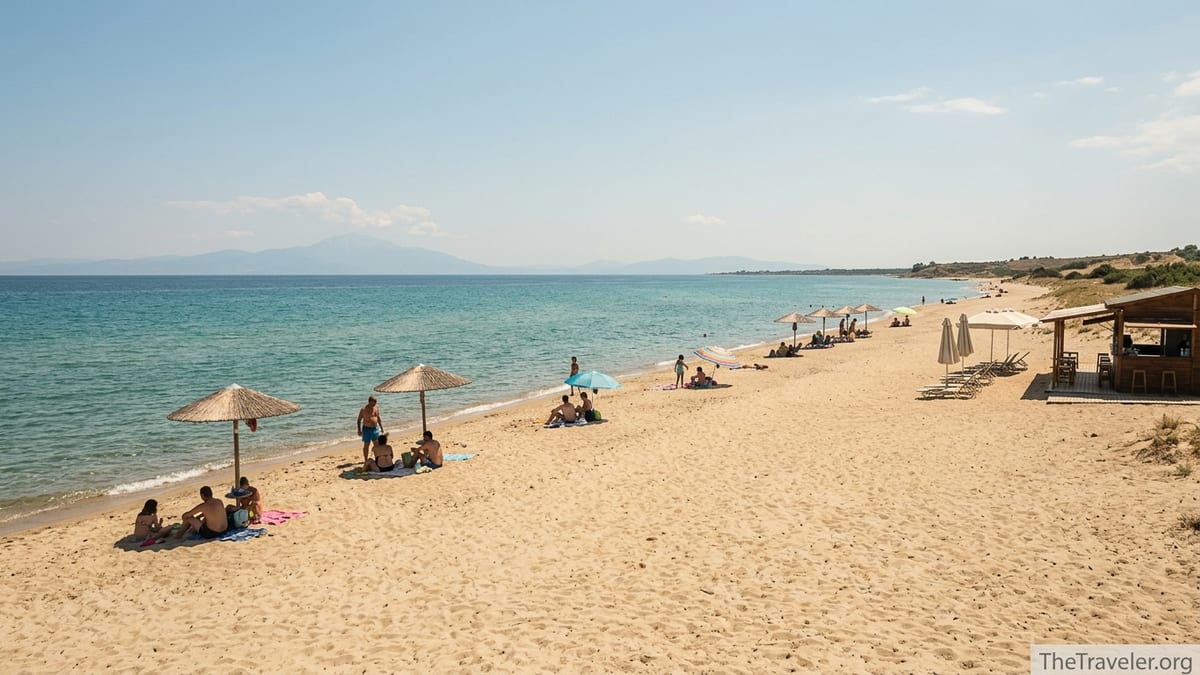
Does Thessaloniki Have City Beaches?
On the map, Thessaloniki curls around the Thermaic Gulf, and the long seafront promenade between the port and the concert hall looks made for a quick dip. In reality, there is no proper city beach in the historic center. The waterfront here is for strolling, cycling and sunset drinks, not swimming. Locals treat it as their urban living room, then leave town when they want a real beach day.
The closest true swimming beaches belong to the wider metropolitan area, especially the municipality of Thermaikos on the southeastern side of the gulf. Urban beaches such as Perea, Neoi Epivates and Agia Triada are considered part of “Greater Thessaloniki” rather than separate resort worlds. Many of them regularly receive Blue Flag recognition for clean water and organized facilities, and they are popular with commuters who head straight from the office to the sea on hot evenings.
For a visitor staying near Aristotelous Square or the White Tower, that means you should not waste time hunting for a secret central beach. Instead, think of Thessaloniki as a base with layers of coastline radiating outwards. The first layer is Perea and Agia Triada, reachable by city bus or waterbus. The second is Epanomi, slightly wilder but still accessible on public transport. The third is Halkidiki, the famous triple-peninsula beach region roughly one to two hours south.
If your time in Thessaloniki is short and your main focus is culture and food, one or two quick trips to the “first layer” beaches will be enough to cool off. If you are visiting between late June and early September and care about postcard-perfect turquoise water, planning at least one full day in Halkidiki is usually worth the effort.
Perea and Agia Triada: Thessaloniki’s Everyday Beaches
Perea is the default beach escape for most Thessalonians. It stretches along the eastern shore of the Thermaic Gulf, roughly 20 kilometers from the city center as the crow flies. The sand is light brown and fine, the sea is shallow for a long way out, and the promenade backing the beach is lined with cafés, gyros shops and simple fish tavernas. This is not a wild or remote experience; it feels like an extension of the city, complete with kids on scooters and locals carrying folding chairs from their apartments down to the sand.
Agia Triada, a little farther down the same strip of coast, is similar but slightly quieter. Here you will find a mix of older family-run hotels, a few beach bars that rent sunbeds, and long sections of free beach where you can simply put down your towel. Water quality in this whole urban bay is usually good enough for swimming and has improved over the years, though it can be less transparent than on open-sea coasts. On still, hot days the water can feel almost like a warm lake, which many families with young children appreciate.
Prices in Perea and Agia Triada are relatively modest by Greek summer standards. It is common to find sunbed and umbrella sets where you pay only for what you consume, for example a coffee and bottle of water for around the cost of a simple café visit in the city. A grilled fish meal at a seafront taverna might cost a bit less than in the touristy streets around Aristotelous, especially if you follow the locals to places a block or two back from the water. These areas are also convenient for anyone with a late flight from Thessaloniki airport, since Perea sits only a short taxi ride away from the terminal.
On the downside, Perea and Agia Triada share the conditions of a semi-enclosed gulf. After storms or strong winds, seaweed and floating debris can collect along the shore. The beaches fill quickly on Sundays in July and August, especially near the waterbus pier and bus stops. If you arrive after 11:00, expect to share your swim with half of Thessaloniki and aim for the quieter stretches at the edges of town.
Getting to Perea and Agia Triada: Bus and Waterbus
Reaching Perea or Agia Triada from central Thessaloniki is reasonably straightforward once you understand the local transport logic. The most common low-cost option is to take an OASTH city bus toward the airport side of town, then continue along the bay. Visitors staying near the White Tower often use the 3K bus that runs along Tsimiski Avenue and close to the seafront before heading east. Another option from central streets like Egnatia is the 2K. Both routes continue past the IKEA area, then down into the Thermaikos municipality, with stops in Perea and beyond.
These buses use standard urban tickets, so the cost is similar to any ride across town. You buy a ticket from a kiosk or on board from the machine and validate it once. In practice, journey time can vary a lot with traffic. On a quiet weekday morning you might reach Perea in around 45 minutes from the center; on a Saturday afternoon in August the same route might take well over an hour. Air conditioning on buses is not always strong, so bring water and do not plan this as a last-minute dash to catch a flight.
In summer, one of the most pleasant ways to reach the beach is the Thessaloniki waterbus, known locally as Karavakia. Small passenger boats shuttle between the city waterfront and the piers at Perea and Neoi Epivates, usually several times a day in high season. The crossing takes roughly one hour to an hour and a half, depending on the route, and costs more than a bus ticket but less than a taxi. Many travelers treat the ride as a mini-cruise: you sail out past the White Tower, watch the city skyline recede and arrive directly at the beach promenade, steps from cafés and sunbeds.
The waterbus is weather dependent and its timetable can shift between seasons, so it is wise to check departure boards or ask at the ticket booth on the seafront a day or two before you plan to go. On very windy days, sailings may be reduced. If you are traveling in July or August and want to catch one of the last boats back at sunset, arrive at the pier a bit early; departures can be busy with both locals and visitors who have lingered over dinner on the beach.
Epanomi and Potamos: Wild Sand and Shipwreck Views
South of Agia Triada and Nea Michaniona, the coastline becomes more open and the water clearer. Epanomi and its long Potamos beach sit at the mouth of a protected wetland area, with dunes, shallow sandbars and a famous semi-submerged shipwreck offshore. Photos from the area show water that is noticeably more turquoise than the inner Thermaic beaches, and on calm days visibility can be excellent.
Potamos itself is a wide ribbon of light sand with a relatively undeveloped feel. There are a few organized beach bars that rent sunbeds and serve snacks, but large sections remain free, so many locals bring their own umbrellas and coolers. Walking away from the main access road, you quickly find quiet spots where you can hear only the wind and the waves. The water stays shallow for a long distance, which is ideal for children and for adults who like to wade far from shore. The nearby shipwreck, clearly visible above the surface, creates a distinctive horizon line and is a popular swim or paddleboard goal for confident swimmers.
Compared with Perea, the atmosphere at Epanomi is more “day off in nature” than “suburban seafront.” There are fewer concrete buildings, more sand tracks and scrub, and at peak season more cars parked along the access roads, since many Thessalonians drive down on weekends. Facilities are more limited too. You can usually find simple food and drinks, but not the continuous promenade of cafés and kiosks that you see in Perea. For many visitors that is precisely the appeal.
Water quality here generally benefits from being closer to the open Aegean. Locals often recommend Epanomi to visitors who want something better than the urban bay but who do not have the time or budget to go as far as Halkidiki. If your priority is clear water within an hour and a half of the city, and you are willing to accept fewer amenities, Epanomi is a strong candidate.
How to Reach Epanomi on Public Transport
Getting to Epanomi without a car takes a bit more effort than reaching Perea, but it is still feasible for a committed beach day, especially in summer when services are more frequent. The key is that most buses go first to Epanomi town, not directly to the beach. From Thessaloniki, you typically start by taking a city bus toward the east of the metropolitan area, often connecting at major hubs such as IKEA or the main railway station, depending on the route you choose.
Certain regional lines, operated in cooperation with KTEL, continue beyond the urban boundary all the way to Epanomi and sometimes to beach stops during the summer period. Some routes are express, which means that once you board in Thessaloniki you will not get off until the end of the line, often close to the sea. In other cases, you may need a short taxi ride from Epanomi town down to Potamos beach. Local taxis are used to this pattern and usually offer fixed approximate prices for the short hop, especially on busy summer weekends.
Travelers report that a typical public transport journey from the city center to the sand at Epanomi can take between 60 and 90 minutes each way, depending on connections and traffic. Because schedules can shift seasonally and vary by day of the week, it is worth asking staff at your accommodation to check the current timetable or using a live transit app the evening before you go. Aim for an early start; if you catch a morning bus out of Thessaloniki around 08:00 or 09:00, you can claim a quieter patch of sand before the midday heat and the main crowds arrive.
If you are staying several days in Thessaloniki and foresee more than one trip to Epanomi or other outlying beaches, consider renting a car for a single day. Rental desks at Thessaloniki airport and around Vardaris in the city often have compact cars at daily rates that, when shared between two or three people, end up only slightly more expensive than multiple coach tickets. The drive to Epanomi is straightforward and mostly on main roads, though parking near the dunes fills quickly on high-season Sundays.
When Is It Worth Going All the Way to Halkidiki?
For many Greeks, the phrase “going to the beach from Thessaloniki” simply means going to Halkidiki. This three-pronged peninsula south of the city has dozens of Blue Flag beaches, pine forests that come right down to the sand, and famously clear turquoise water. The closest resorts on the first peninsula of Kassandra, such as Nea Kallikrateia or Nea Flogita, can be reached in roughly an hour by car from the city outskirts. More distant spots on Sithonia, such as Nikiti or Vourvourou, require closer to two hours each way.
If you have only one full day in Thessaloniki in the middle of a city-heavy itinerary, it may not be worth the long round trip to Halkidiki. You would likely spend almost as much time in buses as on the sand, and you risk returning tired just as the city’s nightlife wakes up. In that case, Perea or Epanomi give you a taste of the sea without derailing your urban plans.
However, if you have at least three full days in Thessaloniki, ideally not all in shoulder season, budgeting one of them for Halkidiki can deliver a very different experience. A typical no-car day trip might look like this: you take an early morning bus from Thessaloniki to the KTEL Halkidikis coach station on the eastern edge of the city, then board a regional coach to a beach town like Nikiti or Kallithea. You reach the coast by late morning, spend five or six hours swimming and eating, then catch a late afternoon or early evening coach back, arriving in Thessaloniki in time for a late dinner.
The main payoff for the extra travel is water clarity and scenery. On popular Kassandra beaches such as Kallithea and on parts of Sithonia you can expect markedly more transparent water than in the Thermaic Gulf, with pale sand and pine trees behind the shore. Snorkeling becomes more rewarding, and even simple wading feels different. If your mental picture of a Greek beach holiday involves bright, almost Caribbean blue sea, Halkidiki will feel like the real thing.
Halkidiki Day Trips by Bus, Tour and Car
Reaching Halkidiki by public transport starts with understanding that it has its own coach terminal, KTEL Halkidikis, separate from the main KTEL Makedonia station used for routes like Athens and Meteora. KTEL Halkidikis lies on the eastern side of Thessaloniki, near the main road that leads out toward the peninsulas. From the city center, you can reach it with local bus services that connect to the eastern suburbs, or by taxi in roughly 20 to 30 minutes depending on traffic.
From KTEL Halkidikis, frequent regional coaches run to the larger beach towns on Kassandra and Sithonia, especially in high season. For example, there are usually multiple daily departures to Nea Kallikrateia, Nikiti and Kallithea during summer. Tickets are typically purchased at the station counter shortly before departure, and prices are moderate compared with long-distance European coach routes. Many visitors simply arrive at the station early and choose from the morning departures based on availability and their preferred beach town.
For travelers who prefer a more packaged experience, several operators based in Thessaloniki offer organized day trips to Halkidiki. These can include round-trip transport by minibus, a visit to one or more beaches, sometimes a short boat cruise or a stop in a village for lunch. Prices are higher than doing it yourself by KTEL but still accessible for many visitors, especially if you value not having to deal with timetables in Greek. These tours are easy to find through hotel desks and major booking platforms, and can be attractive during peak season when public buses are crowded.
Driving remains the most flexible option. If you rent a car in Thessaloniki, you can leave the city early, choose a less crowded beach, and adjust your schedule based on conditions. A typical loop might be: depart the city before 08:00, reach Nikiti by 09:30, spend the day between one of the beaches along the Sithonia coast, then have an early seafood dinner and return after sunset once traffic has eased. Fuel and toll costs are reasonable when shared between passengers. The main caution is to avoid driving back late on Sunday evenings in August, when half of Thessaloniki appears to be returning from weekend houses and traffic can slow dramatically.
When to Choose Each Beach Area
Choosing between Perea, Agia Triada, Epanomi and Halkidiki is mostly about balancing time, water quality and atmosphere. If you have just a spare afternoon or evening and want a quick dip with minimal logistics, Perea is usually the best choice. You can hop on a city bus or waterbus, swim for a couple of hours, have a seafood dinner on the promenade and be back in your hotel by late evening. This suits travelers who treat Thessaloniki as a cultural city break but still want to say they swam in the sea.
If you have a full day and value a slightly wilder setting with clearer water but do not want the long haul to Halkidiki, Epanomi is worth the extra effort. You will trade some convenience and amenities for more space and a more natural feel, especially if you walk away from the main organized sections of Potamos beach. This is a good compromise for repeat visitors to Thessaloniki who have already seen Perea and are curious about what lies just beyond.
Halkidiki makes most sense when the beach is a central priority rather than an add-on. If you are in the region for a week in July, for example, you might spend three nights in central Thessaloniki enjoying its food and nightlife, then move for three or four nights to Nikiti or Kallithea in Halkidiki. Alternatively, if you prefer to keep a single base in the city, plan at least one full day trip by coach or tour, making sure to choose an early departure so you get real time on the sand. Families with small children often appreciate Halkidiki’s gently shelving beaches and calmer water, while couples and solo travelers may enjoy the mix of beach bars and quiet coves.
Season also matters. From late May to late September, almost all beach options are fully operational, with water warm enough for most swimmers and transport frequent. In April and October, Perea and Agia Triada are still accessible by bus but may feel quiet and breezy, with limited facilities open. Halkidiki is more seasonal still; outside of the main summer months some beach bars close, and public transport timetables thin out. In those shoulder-season weeks, a day trip to Epanomi or the urban beaches may feel more practical than trying to coordinate long coach journeys for a chilly swim.
FAQ
Q1. Can I swim anywhere along Thessaloniki’s central waterfront?
Swimming is not recommended along the main central promenade. The area is for walking and views. For proper swimming beaches you should head to Perea, Agia Triada, Epanomi or Halkidiki.
Q2. How long does it take to reach Perea beach from central Thessaloniki?
By city bus it typically takes around 45 to 70 minutes each way, depending on traffic and the exact stop. By waterbus the journey is usually around one hour to an hour and a half.
Q3. Is the water at Perea and Agia Triada clean enough for swimming?
Yes, these urban beaches generally have acceptable water quality for swimming and are popular with locals. The water is less crystal clear than on open-sea coasts, but still suitable for everyday beach use.
Q4. Do I need a car to visit Epanomi and Potamos beach?
You can reach Epanomi without a car using regional buses from Thessaloniki, sometimes combined with a short taxi ride from the town to the beach. A car makes the trip faster and more flexible but is not strictly essential.
Q5. What is the main advantage of going to Halkidiki instead of staying near Thessaloniki?
The main advantages are clearer turquoise water, more scenic beaches with pine trees and sand, and a wider choice of seaside villages and coves. The trade-off is longer travel time and more planning.
Q6. How do I get to the KTEL Halkidikis station for buses to Halkidiki?
KTEL Halkidikis is on the eastern side of Thessaloniki. You can reach it by local bus from the center or by taxi in roughly 20 to 30 minutes, then transfer to regional coaches for specific beach towns.
Q7. Are there organized day tours from Thessaloniki to Halkidiki beaches?
Yes, several operators run day trips that include round-trip transport and time on one or more Halkidiki beaches, sometimes combined with a short boat cruise or village visit.
Q8. When is the best time of year to plan beach days from Thessaloniki?
The most reliable beach season runs from late May to late September. July and August offer the warmest water and most frequent transport, but also the largest crowds and hottest midday sun.
Q9. Can I combine a late flight from Thessaloniki airport with a beach visit?
Yes, many travelers spend their last day at Perea or Agia Triada, which are close to the airport. They swim, shower at a beach bar or hotel, then take a short taxi ride to catch an evening flight.
Q10. Which beach should I choose if I have only one free afternoon?
If time is short, Perea is usually the simplest choice. It is easy to reach by city bus or waterbus, offers plenty of cafés and facilities, and lets you enjoy a few relaxed hours by the sea without complex planning.