


Guayama does not work like a compact resort town where you stroll from cathedral to beach to nightlife in a few blocks. Its appeal is spread across distinct zones: a small historic core, the seafood and fishing communities along PR-7710 and Pozuelo, the mangroves and estuary of Jobos Bay and Aguirre, and the cooler highlands toward the Carite area. This itinerary framework is designed around that real geography so you can plan one, two or three days in Guayama without wasting time backtracking in the tropical heat or stuck in traffic on PR-3.
Get the latest updates straight to your inbox!
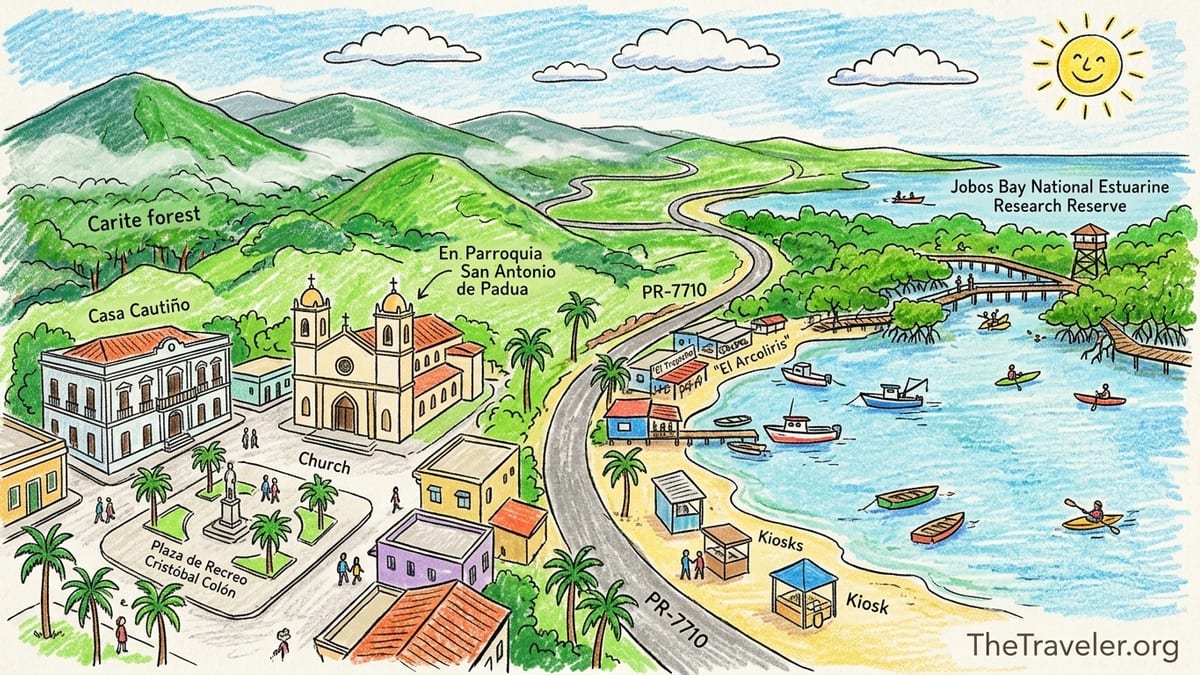
Understand Guayama’s Four Travel Zones Before You Plan
Before deciding how many days to spend in Guayama, it helps to picture the municipality as four different trip zones. First is the historic urban core around Plaza de Recreo Cristóbal Colón. Here you find Casa Cautiño, a late 19th century mansion turned house museum, the municipal buildings, church, local bakeries and casual lunch spots. This area is walkable in under 15 minutes from end to end, which makes it ideal for a half-day of history, architecture and food.
Second is the PR-7710 and Pozuelo coastal strip southeast of town. PR-7710 runs through the fishing barrio of Pozuelo and ends at the nautical clubs on the edge of Jobos Bay. Along this road you find clusters of seafood restaurants like El Arcoiris, El Trapiche, Villa Pesquera Punta Pozuelo and El Náutico, plus simple beachside kiosks and public access to the bay. This is Guayama’s best zone for long lunches, sunset drinks and watching fishermen bring in the day’s catch.
Third is the Jobos Bay and Aguirre environment. The Jobos Bay National Estuarine Research Reserve extends between Salinas and Guayama and connects with the Aguirre State Forest mangroves. The reserve has signed trails, boardwalks and a visitor center area in Aguirre, while the wider bay is accessed via small marinas and boat ramps in Pozuelo and nearby communities. Trails and a marked kayak route are open to the public, but operational details change, so you should verify specific access and any required permits directly with the reserve staff or the Department of Natural and Environmental Resources before you go.
Finally, the Carite and mountain side to the north offers a different climate and scenery. As you gain elevation you leave the coastal heat for cooler, mistier hills with river valleys and forested areas. While Guayama’s mountain offerings are more low-key than famous rainforest destinations, they are worthwhile if you have a car, enjoy scenic driving and want to balance a coastal day with a quieter, green escape.
How Many Days in Guayama: 1, 2 or 3 With No Backtracking
Choosing between one, two or three days in Guayama is less about the number of attractions and more about how you like to travel. The historic center can be visited in a single morning or afternoon. The coast and Jobos Bay deserve at least another half-day for food and nature. The mountains and any golf or extended ecological excursions are bonuses if you have extra time and a car. This section frames realistic combinations that avoid zig-zagging between zones.
With one full day, your best move is to split the time between the urban core and the PR-7710 coast, so you see Guayama’s strongest contrasts in a single sweep. Start with Casa Cautiño and the plaza while the light is softer and end with a long seafood lunch and bay views in Pozuelo. You will spend more time enjoying the two different atmospheres than in the car.
With two days, you can dedicate one day to history and food in town plus Pozuelo, then reserve a second day for Jobos Bay and the Aguirre environment with perhaps a short hike, mangrove view or water activity. This greatly reduces backtracking: each day has a clear geographic focus, and you can adjust timing based on restaurant hours, tides or weather without feeling rushed.
With three days, you can add the mountain side or optional extras like a local golf session or a longer ecological excursion in the bay area, or even use Guayama as a base for a slow south-coast road trip toward Salinas, Santa Isabel, Coamo or Guánica. The key is not to pretend Guayama itself has endless conventional attractions; instead, use it as a comfortable pivot between historic town life, coastal food culture and less crowded nature.
One-Day Framework: Historic Core Plus Coastal Food & Nature
If you have just one day, focus on Guayama’s biggest contrasts: the traditional plaza area and the working waterfront on PR-7710. In the morning, park near Plaza de Recreo Cristóbal Colón and walk the historic streets. The standout stop is Casa Cautiño, a restored mansion with carved wood, original tile work and period furniture that illustrates how sugar wealth shaped Guayama in the late 1800s. Before your trip, you should confirm the latest opening days and hours with the municipality or cultural authorities, since small museums in Puerto Rico sometimes adjust schedules after storms, holidays or funding changes.
After the museum and a stroll past the church and historic facades, pick an early lunch or coffee in the town center. Small bakeries and cafeterias around the plaza often offer daily specials like stewed beans, roast pork or asopao at prices that are easier on the budget than coastal restaurants. If you are visiting on a weekday, this can be the quietest and most local-feeling part of your day.
In the afternoon, drive the short distance out to PR-7710 and the Pozuelo coast. Traffic is usually manageable, but give yourself time because the road narrows and passes through residential neighborhoods. Once on 7710 you will see different dining options. Villa Pesquera Punta Pozuelo combines a fisheries atmosphere with a restaurant where fishermen bring fresh product that can be cooked on site. Some recent visitors report prices in the range of roughly 10 to 20 US dollars per person for fried fish plates, seafood empanadillas and similar dishes, but you should expect variation depending on catch and preparation.
Nearby, El Arcoiris, El Trapiche and El Náutico focus on mofongo with shrimp, fried fish, octopus salad and other Puerto Rican coastal dishes. For example, a shared seafood platter at El Trapiche has been listed around the mid-teens in dollars for two people, which can be good value if you share appetizers and add a couple of cold drinks. La Terraza del Náutico has public posts advertising weekday lunch plates around ten dollars plus tax for items like pork in mushroom sauce or chicharrones de pollo with side dishes, again illustrating the general price band on this strip. You should not plan a rigid schedule here. Instead, leave your afternoon open to linger over food, watch small boats move around the bay, and, if time and conditions allow, walk near the water or visit the local villa pesquera area for simple views of Jobos Bay and the surrounding mountains.
Two-Day Framework: Separate History & Food From Jobos Bay Nature
With two days you can prevent the main time waster in Guayama: trying to fit Jobos Bay exploration into the same tight schedule as a museum visit and a leisurely seafood meal. For the first day, keep the shape of the one-day plan: half a day around Casa Cautiño and the plaza, then the afternoon and early evening along PR-7710 in Pozuelo. Use this day to try more than one restaurant or to revisit a spot you liked for sunset drinks or dessert.
On the second day, make the Jobos Bay and Aguirre area your focus. The Jobos Bay National Estuarine Research Reserve is managed by the Department of Natural and Environmental Resources and is part of the US National Estuarine Research Reserve System. The reserve includes mangroves, seagrass beds and cays between Salinas and Guayama, plus a visitor center and boardwalk-style infrastructure in the Aguirre area. Official information from the reserve notes that trails and a kayak route are open to the public. However, specific details about which sections are accessible, whether staff-led activities are running and what days the visitor center is open can change on short notice.
Because of this, one of your key planning tasks for a two-day stay should be to contact the reserve or check the latest communications from the Department of Natural and Environmental Resources shortly before your trip. Ask about current opening days and hours for the visitor center, which trails are open, whether observation towers or platforms are in use and whether any guided kayak or educational activities are scheduled. Also confirm if there are any restrictions after recent storms, droughts or restoration projects that affect public access. This will help you avoid arriving to find a closed gate or limited facilities.
If formal guided tours are limited, you can still shape a nature-focused day around driving into the Aguirre and Jobos surroundings, walking any open trails, birdwatching near mangrove edges and combining the outing with a meal back along PR-7710 or in Salinas. For water activities, small operators sometimes offer kayak or boat excursions in the area, but availability fluctuates. Rather than assuming there is a tour every day, you should verify current operators, departure points and prices a week or two before arrival through up-to-date local sources, and be ready to adjust your plans if wind, swell or conservation rules lead to cancellations.
Ending your second day, you might return to Guayama’s plaza for an evening stroll or street food if your energy allows. The town center will feel different after a day of mangroves and low boardwalks, and this contrast between urban and estuarine environments is part of what makes a two-day stay satisfying.
Three-Day Framework: Add Mountains, Golf or a Slow South-Coast Loop
With three days, Guayama becomes a practical base for exploring its mountain side and the quieter stretches of the south and southeast coast, not just the bay. This is where you should think less in terms of “sights” and more about experiences: a cooler morning in the hills, a casual round of golf in the plains near town, or a slow drive linking Guayama with neighboring municipalities such as Salinas, Coamo or Santa Isabel.
For the mountain component, head inland toward the Carite area. Even modest elevation brings a noticeable drop in temperature compared with the coastal strip. Roads in this direction can be winding, with narrower shoulders and occasional potholes or washouts after heavy rain, so give yourself time and avoid driving aggressively. The payoff is scenic views over the coastal plain, patches of misty forest and small local food spots where you can try soups, roast pork or hot chocolate with a view. Before you drive, it is wise to check road conditions with your accommodation or recent local reports, especially in the rainy season.
If you are interested in golf, research current options in and around Guayama and the wider south coast while planning your trip. Some courses in Puerto Rico have adjusted operations in recent years due to hurricane impacts, redevelopment or management changes. Instead of relying on older listings, verify directly with the golf course or resort for open status, visitor tee times, approximate green fees and rental club availability. This prevents wasting part of a precious day driving to a shuttered clubhouse.
You can also use your third day for a slow road trip along the south coast. From Guayama it is straightforward to drive west toward Salinas and then beyond, linking roadside lechonerías, small beaches and coastal lookouts. Alternatively, you can swing inland to Coamo for its thermal baths, then loop back to Guayama. This type of day is less about ticking off must-see attractions and more about enjoying the rhythm of the region. Just remember that many small restaurants and kiosks outside major towns close on Mondays or early in the week, so you should always verify opening days for any specific place you hope to visit.
Essential Logistics: Transport, Weather, Safety and Museum Hours
Guayama works best with a rental car. Public transportation within the municipality is limited, especially to the PR-7710 coast, Aguirre, Jobos Bay access points and the mountain side. Distances are not huge, but waiting for intermittent shared vans or taxis can easily double your travel time and undermine the whole goal of not wasting your days. When you rent a car, choose something with reasonable clearance rather than a very low sports model, since some side roads and parking areas along the bay or in the hills can be uneven.
Weather on the south coast of Puerto Rico is generally hot, humid and sunnier than the northern side, with a pronounced rainy and hurricane season. For a one- or two-day stay, this means you should plan indoor or shaded activities like Casa Cautiño and café stops for the peak midday heat, and leave exposed walks or bay views for mornings and late afternoons. Always monitor the latest weather forecasts in the days before your trip, particularly from August through October when heavy rains and storms can affect road access, trails and water activities.
For history and culture stops, Casa Cautiño is the key example of why current checks matter. Although it is an established museum property, small institutions in Puerto Rico can temporarily close for maintenance, staff shortages or storm repairs. Before you center your day around a visit, confirm the latest opening days and hours directly with municipal cultural offices or any official museum contact you find through current channels. Apply the same approach to other small museums or galleries you might discover in your research.
For nature, you must check current conditions at Jobos Bay and any associated trails in Aguirre or the Aguirre State Forest. While general descriptions state that trails and the kayak route are open all the time, in practice things like boardwalk repairs, coastal erosion, dredging work or conservation projects can restrict access to parts of the reserve. Check for any recent advisories from the Department of Natural and Environmental Resources and do a last-minute confirmation with reserve contacts a few days before visiting. This will help you know which trails are open, if you need closed shoes for muddy sections, and whether any guided activities or educational tours are running during your dates.
Planning Around Food: When PR-7710 & Pozuelo Come First
Food is one of Guayama’s main reasons to visit, and it often shapes the best itineraries more than individual sights. If coastal seafood is a big priority for you, build your schedule around the opening hours of key restaurants along PR-7710 and Pozuelo, then plug in history and nature around those meal times rather than the other way around.
Recent information indicates that La Terraza del Náutico, at the nautical club end of PR-7710, keeps daytime hours earlier in the week and extends into the evening from Thursday to Sunday, with closing times often around 10 p.m. on peak days. El Trapiche advertises hours from late morning to early evening from Friday through Sunday. Villa Pesquera Punta Pozuelo and similar establishments sometimes open Thursday through Sunday from mid-morning to early evening. These patterns mean that a midweek visitor who arrives on a Tuesday might find fewer options open along the strip, while a weekend visitor can plan a late afternoon seafood session followed by live music or karaoke at some venues.
Because schedules and owners change, you should confirm opening days and approximate kitchen hours for at least one or two target restaurants in Pozuelo a few days before you go. Call or check their most recent public updates. This will prevent you from driving the length of PR-7710 only to find your preferred spot closed. Also be aware that some places stop serving full meals earlier than their posted closing time, especially on quieter nights, so arrive with enough margin.
In the town center, food is more focused on cafeterias, panaderías and simple sit-down restaurants with daily specials. These are excellent options for breakfast or a budget-friendly lunch on your history-focused day. A smart approach is to have at least one big coastal meal and one more modest but very local town meal in your itinerary, both to balance costs and to experience two sides of Guayama’s food culture.
Three Traveler Profiles: History & Food, Nature Lovers, Slow Road-Trippers
Guayama rewards different styles of travel in different ways. Instead of a single “perfect” itinerary, think about which of these three profiles sounds most like you, then adapt the 1–3 day framework accordingly. The first profile is the history and food traveler. If this is you, allocate one strong half-day to the historic core, with Casa Cautiño as a central stop once you have confirmed its hours. Walk the streets around the plaza, photograph architectural details, and have a town-center lunch with dishes like stewed beans, rice and roasted meats. Then spend one or more relaxed sessions on PR-7710, trying places like Villa Pesquera Punta Pozuelo or El Arcoiris for fried fish and seafood plates.
The second profile is the nature-focused traveler. Your priority is Jobos Bay, the Aguirre State Forest environment and perhaps a taste of the mountain side. In your plan, the Jobos Bay National Estuarine Research Reserve visitor area and trails should get a full morning or more. Contact the reserve ahead of time to ask about trail status, visitor center operations, any available guided kayak or educational activities and what you need to bring. Combine this with a brief historic core visit and a single seafood meal rather than trying to sample every restaurant.
The third profile is the slow south-coast road-trip traveler. Guayama is one node in a wider circuit that might include Patillas and Maunabo to the east or Salinas, Coamo and Santa Isabel to the west and northwest. For you, Guayama works well as an overnight base for one or two nights: one afternoon and evening for Casa Cautiño and PR-7710, and one day to link Jobos Bay and Aguirre with neighboring coastal communities. You might then continue on to thermal baths in Coamo or drier coastal landscapes farther west. This style of travel benefits from flexibility; you avoid over-scheduling and instead respond to weather, restaurant openings and local recommendations along the way.
Whichever profile fits you best, the planning logic remains the same. Treat the urban core, PR-7710 and Pozuelo coast, Jobos Bay and the Aguirre environment, and the Carite mountain side as separate zones. Group activities in the same zone on the same day, verify current hours, trail conditions and any guided water activities shortly before arrival, and leave white space in your schedule for the slow conversations and long lunches that often become the most memorable part of a Guayama trip.
FAQ
Q1. Is one full day enough to see Guayama without feeling rushed?
One well planned day is enough to experience Guayama’s strongest contrast between the historic core and the seafood coast, as long as you focus on Casa Cautiño, the plaza area and a long meal on PR-7710 in Pozuelo rather than trying to add Jobos Bay trails and mountain drives to the same limited schedule.
Q2. How should I divide my time if I have two days in Guayama?
With two days, dedicate one day to the town center plus PR-7710 for history and food, then use the second day for Jobos Bay and the Aguirre environment, confirming reserve access, any open trails and possible kayak or educational activities with the Jobos Bay National Estuarine Research Reserve or the Department of Natural and Environmental Resources before you go.
Q3. Are Casa Cautiño and other museums in Guayama open daily?
No, small museums like Casa Cautiño usually keep limited opening days and may change hours after maintenance, holidays or storms, so you should always verify the latest schedule directly with municipal cultural offices or any official museum contact shortly before your visit rather than relying on outdated listings.
Q4. Do I need a car to follow this Guayama itinerary?
Yes, a rental car is the most practical way to follow this framework, because public transportation to key zones like PR-7710 and Pozuelo, the Aguirre and Jobos Bay area and the mountain side is limited and irregular, and depending on shared vans or taxis can add significant delays or make some areas effectively inaccessible.
Q5. How do I check current access and conditions at Jobos Bay?
To avoid surprises, you should consult the latest information from the Jobos Bay National Estuarine Research Reserve and the Department of Natural and Environmental Resources, asking specifically about visitor center opening days, which trails and boardwalks are open, any temporary closures in the Aguirre State Forest sector and whether guided kayak or educational activities are running during your dates.
Q6. What are typical prices for seafood meals along PR-7710 in Pozuelo?
Recent visitor reports and sample menus suggest that many seafood plates and platters along PR-7710 fall in a broad range from about 10 to 20 US dollars per person for items like fried fish, seafood empanadillas and mofongo with shrimp, with some shared platters and specialty dishes priced higher, so you should check current menus and be prepared for variation based on catch and preparation.
Q7. Is the Aguirre State Forest worth visiting on a short trip?
If you have only one day, you are better off focusing on the town center and PR-7710 coast, but if you have two or three days and enjoy quieter nature areas, combining open sections of the Aguirre State Forest environment with Jobos Bay trails can be rewarding, as long as you confirm which areas are accessible and manage expectations for simple infrastructure.
Q8. When is the best time of year to visit Guayama?
Weather on the south coast is warm year-round, but visits outside the peak hurricane months of late August to early October reduce the risk of storm-related closures; regardless of month, you should check short-term forecasts and any local advisories affecting roads, trails or water conditions in the week before your trip.
Q9. Can I play golf as part of a Guayama stay?
Golf options in and around Guayama have shifted over time due to changes in facilities and storm impacts, so if golf is important to you, research current courses on the south coast before booking, then confirm directly with the course for open status, visitor tee times, approximate green fees and rental equipment to avoid wasting part of a day on a closed facility.
Q10. How does Guayama fit into a longer south-coast road trip?
Guayama works well as a one or two night stop on a broader south or southeast coast loop, giving you a base to combine its historic core, Pozuelo seafood strip and access to Jobos Bay with side trips toward Salinas, Coamo or other nearby municipalities, as long as you group activities by zone and keep your schedule flexible for weather and opening hours.