


San Francisco International Airport can feel overwhelming on a first visit, especially if you are arriving from overseas or trying to make a tight connection. Yet once you understand the layout of the terminals, how the AirTrain works, and where to find transport into the city, SFO becomes one of the easier large U.S. airports to navigate. This guide walks you step by step through arriving, departing, changing terminals, finding hotels and parking, using public transit, and making the most of your time at SFO.
Get the latest updates straight to your inbox!
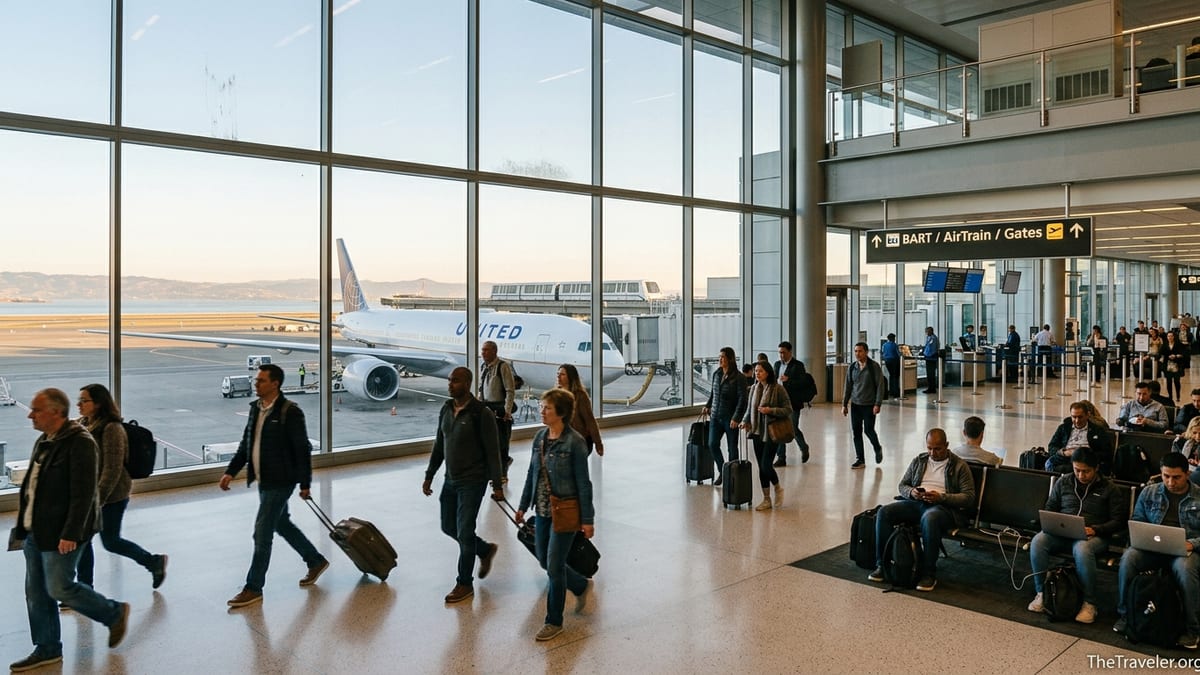
Understanding SFO’s Layout and Terminals
San Francisco International Airport has four main terminals: Terminal 1, Terminal 2, Terminal 3, and the Dianne Feinstein International Terminal, often simply called the International Terminal. All terminals are connected on the secure side in pairs and on the public side via walkways and the AirTrain people mover, so even if you land in a different terminal than you depart from, you rarely need to exit the airport complex. Domestic flights are handled mostly in Terminals 1, 2, and 3, while international flights use the International Terminal’s A and G boarding areas.
Terminal 1, branded as Harvey Milk Terminal 1, primarily serves domestic carriers such as Southwest Airlines, JetBlue, Frontier, and some Alaska Airlines flights. It has been undergoing a multi-year modernization program, so facilities feel relatively new, with higher ceilings, more natural light, and expanded seating near gates compared to older U.S. terminals. If you are flying a low-cost or West Coast carrier on a domestic route, there is a good chance you will pass through Terminal 1.
Terminal 2 is home to Alaska Airlines and some Delta Air Lines operations, and is known among frequent flyers for better-than-average food and design. Terminal 3 is United Airlines territory for domestic and some Hawaii flights, while United’s long-haul international departures typically use the International Terminal’s G gates. Other international airlines such as Lufthansa, ANA, EVA Air, and Air France usually depart from A or G gates in the International Terminal. Always double-check your terminal and gate on your airline’s app on the day of travel, since SFO sometimes reassigns flights between terminals.
All terminals are linked by AirTrain, a free 24-hour automated people mover that runs two lines: the Red Line connecting all terminals, garages, the Grand Hyatt at SFO, and the BART station in about nine minutes, and the Blue Line adding the Rental Car Center and Long-Term Parking with a full loop of about 25 minutes. Trains generally arrive every 4 minutes at peak, so if you land in Terminal 1 and need to catch a BART train from the International Terminal, it is usually quicker to follow signs to AirTrain Red Line than to walk the whole way with luggage.
Arrivals: From Plane Door to Curb
On arrival, most first-time visitors notice that SFO’s signage is clear, but the distances can be long, especially if you land at a far international gate. After exiting your aircraft, follow the yellow “Baggage Claim” signs. If you arrive on a domestic flight into Terminal 2 or 3, you will pass through wide concourses with restrooms, water bottle refill stations, and local food outlets like local coffee chains and sandwich spots before reaching escalators down to baggage claim. Baggage claim areas are on the lower level, with carousels clearly numbered and airline names shown on overhead monitors.
For international arrivals into the International Terminal, all passengers deplane into a secured corridor that leads to passport control and customs. Wait times depend on arrival patterns, but they typically range from 15 minutes to over an hour in the evening bank of transpacific flights. U.S. and Canadian citizens can use automated passport kiosks in most cases, while many visitors with approved ESTA can use separate e-gates. After immigration, you collect checked bags, pass through customs, and either exit into the public arrivals hall or follow signs to “Connecting Flights” to re-check bags and pass through security again.
Once you are in the public arrivals area, ground transportation options are grouped by type. Rideshare and app-based pickups like Uber and Lyft typically use designated pickup zones at the Departures or Arrivals level depending on terminal and time of day; overhead screens and curbside staff direct you to the correct island. Taxis queue at clearly marked taxi stands. Shared shuttles, hotel shuttles, and charter buses use separate islands a short walk from the doors. If you are connecting to BART, follow signs for “AirTrain / BART” and take any AirTrain that serves the Garage G / BART station stop to reach the rail station in the International Terminal.
Customs and baggage re-check can feel confusing if you are transiting SFO from one international flight to another. In most cases, you must collect your bag, clear customs, then drop it off at a transfer belt near the exit from customs if you are continuing on the same ticket. If your next flight is on a separate ticket, you may need to bring bags upstairs and re-check at the airline’s normal check-in counters. Allow at least two to three hours for international-to-domestic connections to account for immigration queues, baggage delays, and a second security screening.
Departures: Check-in, Security, and Time-Saving Tips
For departures, the most important step is confirming your terminal and check-in area before you arrive at SFO. For example, United domestic flights usually depart from Terminal 3, while many United international flights leave from G gates in the International Terminal, even though check-in might still be in Terminal 3. Alaska Airlines uses Terminal 2 for most departures, and Southwest operates from Terminal 1. Your airline app or confirmation email will note both terminal and flight number; checking this before you leave for the airport can prevent a stressful last-minute sprint between terminals.
Check-in areas at SFO are on the upper level in each terminal. Most major airlines offer a mix of staffed counters and self-service kiosks for printing boarding passes and tagging checked bags. During early morning and late-night waves, lines can stretch across the hall, particularly for large international carriers weighing and tagging multiple bags per passenger. If you are traveling with only carry-on luggage and already checked in online, you can typically bypass the full counters and go straight to the security checkpoint at the far end of the hall.
Security screening at SFO follows standard Transportation Security Administration procedures, with separate lanes for TSA PreCheck, CLEAR members where available, and standard screening. Wait times vary significantly by time of day and terminal, but in practical terms you should plan to arrive at least two hours before a domestic flight and three hours before an international departure. For instance, a 9 p.m. flight to Europe from the International Terminal can see long security queues as multiple wide-body departures overlap. On the other hand, a mid-morning domestic flight from Terminal 2 may find you through security in 10 to 20 minutes.
Once through security, you will find gate areas with power outlets, water refill stations, and a mix of local and national dining brands. Prices for sit-down meals are similar to other major U.S. airports, with a casual airport restaurant meal often running around 20 to 30 dollars per person before tip. Many passengers choose to pick up grab-and-go salads, sandwiches, or sushi from market-style outlets to eat at the gate. Free Wi-Fi is available throughout the terminals, and most passengers can connect simply by selecting the airport network and accepting terms, without needing to create an account.
Ground Transportation: BART, Rideshare, and Beyond
Public transit is one of SFO’s main strengths. The Bay Area Rapid Transit rail system, or BART, connects the airport directly with downtown San Francisco, downtown Oakland, and several East Bay cities. The BART station is located in the International Terminal, accessible by walking from the check-in level or by taking the AirTrain to the Garage G / BART station stop. Trains generally run every 10 to 20 minutes depending on the time of day, and the ride to central San Francisco stations typically takes about half an hour, making BART a strong option for solo travelers or couples staying near Market Street.
Paying for BART has become easier in recent years. The fare gates now accept contactless bank cards, Apple Pay, and Google Pay, so you can simply tap your phone or card at the gate rather than buying a separate ticket. Each rider over age five must have their own card or device, so one contactless card cannot be shared by tapping in multiple people. Fares depend on destination but are typically in the range that is competitive with a shared airport shuttle and often significantly cheaper than a taxi, especially to downtown San Francisco.
Rideshare services such as Uber and Lyft operate heavily at SFO and are convenient for groups, late-night arrivals, or travelers staying in neighborhoods not directly served by BART. Prices fluctuate with demand, but a typical ride to central San Francisco might cost roughly what you would pay for two or three BART tickets combined, making rideshare cost-effective for families or groups of three or four. The apps will direct you to a specific pickup zone at your terminal, and you may need to cross to an island in the middle of the roadway. Be prepared for short wait times during peak hours as drivers navigate congestion on the pickup loop.
Other transport options include airport shuttles to nearby hotels, regional bus services to cities on the Peninsula, and Caltrain connections via a short BART or shuttle ride to Millbrae station. Taxis remain available and are regulated with metered rates posted at the stands. First-time visitors should also consider time of day: during weekday evening rush hours, heavy traffic on Highway 101 can double driving times into the city. If you are landing between 4 p.m. and 7 p.m., BART is often the more predictable option.
Parking, Car Rentals, and Airport Hotels
SFO offers several parking options with different price levels and convenience. The terminal garages, connected directly to each terminal, provide the shortest walk but usually charge the highest daily rates. These garages are ideal if you are taking a quick one- or two-day trip and value being able to walk from your parked car to the check-in counters in just a few minutes. You can access them via clearly marked ramps as you approach the terminals, and the airport posts approximate capacity levels on electronic signs along the entry roads.
For longer trips, the Long-Term Parking garage is often more economical. It is located away from the terminals and connected by the AirTrain Blue Line, which usually takes around 10 to 15 minutes from the terminal stops including waiting time. Many Bay Area residents book long-term parking online through the airport in advance to lock in predictable daily rates, which is particularly useful during summer and holiday travel periods when drive-up lots can fill. Off-airport private parking lots around South San Francisco and Burlingame can sometimes offer slightly lower prices and run their own shuttles every 15 to 30 minutes.
The Rental Car Center at SFO houses most major brands, including Avis, Hertz, Enterprise, National, Alamo, Thrifty, and Budget. It is reached via the AirTrain Blue Line, clearly marked “Rental Car Center” on train signage. Once inside, rental counters and garage floors are stacked across multiple levels, so budget a few extra minutes to find your specific company. Returning your car near the end of your trip is straightforward: follow roadside signs for “Rental Car Return,” then walk or take an elevator back to the AirTrain platform to return to your terminal.
Airport-area hotels cluster primarily to the south of SFO along Bayshore Highway in Burlingame and around Millbrae. Many mid-range chains, including major brands in the three- and four-star range, operate frequent free shuttles to and from the terminals, typically running every 15 to 30 minutes during the day and slightly less often overnight. For travelers with very early flights or tight overnight layovers, the on-airport Grand Hyatt at SFO connects directly to the AirTrain Red Line, allowing you to roll your luggage straight from hotel lobby to terminal without relying on a shuttle. Other travelers opt for park-and-fly packages at nearby hotels, which bundle a night’s stay with a week or more of parking for a combined rate that can be attractive compared with on-airport long-term parking alone.
Lounges, Food, and Amenities
Lounges at SFO are concentrated in Terminal 1, Terminal 2, Terminal 3, and the International Terminal, with offerings from both individual airlines and independent operators. United operates several United Club locations in Terminal 3 and the International Terminal for its premium and Star Alliance elite passengers. American Airlines runs an Admirals Club in Terminal 1, and international carriers like Air France and Air Canada have branded lounges in the International Terminal. Access rules vary by ticket type, frequent flyer status, and lounge program membership, so it is worth checking your eligibility in advance if you are hoping to shower or work in a quieter space before a long flight.
Priority Pass members have access to selected independent lounges and sometimes to credit at certain airport restaurants, but access can be restricted during peak hours. At busy times in the afternoon and evening, some lounges limit entry to passengers flying on their own airline or to those with premium cabin tickets, temporarily turning away day-pass holders. If lounge access is important on a long layover, try to arrive at the lounge shortly after it opens for the day or outside peak evening departure waves, when capacity is under less pressure.
Dining at SFO is notably better than average for a U.S. airport and includes a mix of local Bay Area brands and national chains. In Terminals 2 and 3, you will find outlets serving sourdough bread, local coffee roasters, and fast-casual options offering salads, bowls, and burritos. The International Terminal features a number of full-service restaurants, sushi counters, noodle bars, and wine bars. Expect to pay airport premiums: a sit-down meal with a main and a drink might be in the 25 to 40 dollar range per person, while a quick grab-and-go sandwich and bottled drink could be around 15 to 20 dollars.
SFO also invests heavily in non-food amenities. Rotating art exhibits and permanent installations appear throughout the terminals, curated by the airport’s own museum program, which includes everything from vintage aviation artifacts to contemporary local art. There are also yoga rooms in some terminals, multiple nursing rooms, and designated children’s play areas that can be a welcome break for families on long journeys. Free Wi-Fi, plentiful charging outlets, and bottle-filling stations make it easier to stay connected and comfortable while you wait.
First-Time SFO Tips and Common Mistakes to Avoid
For first-time visitors, one of the easiest mistakes at SFO is misjudging how long it takes to move between terminals. Although the terminals are physically close, security checkpoints and construction projects can slow your progress. As a rule of thumb, plan at least 15 to 20 minutes to transfer between any two terminals using AirTrain, including walking and waiting time, and more if you must re-clear security. For example, if you land in Terminal 1 at 4 p.m. and have a 5:15 p.m. flight from the International Terminal, that 75-minute connection may be tight once you factor in taxi time, deplaning, and a possible security queue.
Another common pitfall is underestimating evening traffic into the city. Arriving flights between 4 p.m. and 7 p.m. often coincide with peak congestion on Highway 101. A rideshare to Union Square that might take 25 minutes at mid-day can easily stretch to 45 minutes or more during rush hour. In those windows, taking BART from the International Terminal into downtown can save time and stress, even if you ultimately need a short rideshare or taxi from the station to your hotel.
Money and payments are generally straightforward at SFO. Most vendors accept major credit cards and mobile wallet payments, and contactless payment is standard for BART and many parking machines. That said, having a small amount of U.S. cash on hand can help with tipping shuttle drivers or paying for small purchases at older newsstands. Currency exchange desks exist in the International Terminal but rates are usually less favorable than using an ATM from a major bank network.
Last, build some buffer time into your plans, especially if you are unfamiliar with the airport. If your transpacific flight home departs at 10:30 p.m. and you are staying in the city, consider getting to SFO by 7:30 p.m. rather than 8:30 p.m. That extra hour gives you room for a delayed rideshare, a longer-than-expected security line, or a quick sit-down meal before boarding. Many seasoned Bay Area travelers aim to be inside the terminal at least three hours before international departures and relax at a lounge or restaurant if everything runs smoothly.
FAQ
Q1. How early should I arrive at SFO before my flight?
For domestic flights, plan to arrive at least two hours before departure. For international flights, three hours is safer, especially in the evening when security lines and check-in areas are busiest.
Q2. What is the easiest way to get from SFO to downtown San Francisco?
The most predictable option is BART, which runs directly from the International Terminal to central city stations in about 30 minutes. Rideshare and taxis are more flexible but can be slower and more expensive during rush hour.
Q3. Can I walk between SFO terminals after security?
Some terminals are connected airside, particularly United’s areas between Terminal 3 and the International Terminal. In other cases you may need to exit and re-clear security or use the AirTrain outside the secure zone. Signs in each terminal indicate available post-security connections.
Q4. Is Wi-Fi free at SFO?
Yes, SFO offers complimentary Wi-Fi in all terminals. You simply select the airport network on your device, accept the terms, and connect without needing to register an account.
Q5. Where do I catch the AirTrain at SFO?
AirTrain stations are located just outside each terminal, usually reached by taking an escalator or elevator up from the departures or arrivals level and following signs marked AirTrain. You can use either the Red or Blue Line depending on whether you are going to another terminal, the BART station, the Rental Car Center, Long-Term Parking, or the Grand Hyatt at SFO.
Q6. Are there 24-hour food options at SFO?
Most restaurants and cafes follow terminal operating hours, but some coffee stands and grab-and-go markets open very early and close late to serve early morning and late-night flights. Truly 24-hour options can be limited, so if you are arriving in the middle of the night it is wise to bring a snack.
Q7. Which terminal does United Airlines use at SFO?
United operates most domestic flights from Terminal 3 and many international flights from the International Terminal’s G gates. Check your booking or the airline app on the day of travel, because some flights check in at Terminal 3 but depart from the International Terminal.
Q8. How do I get to the Rental Car Center from my terminal?
Take the AirTrain Blue Line, which is clearly labeled for the Rental Car Center. Trains run frequently, and the ride from most terminals takes around 10 to 15 minutes including waiting time.
Q9. Are there showers available at SFO?
Showers are not widely available in the general terminal areas but can be found in some airline lounges in the International Terminal and select premium lounges in other terminals. Access typically requires a business or first-class ticket, elite status, or paid lounge membership.
Q10. Is it worth staying at an airport hotel for an early morning flight?
If your flight leaves before 8 a.m. or you are connecting after a late-night arrival, an airport hotel can reduce stress. Properties near SFO usually offer free shuttles, and the on-airport Grand Hyatt at SFO connects directly to the AirTrain, letting you reach your terminal in minutes.