


The first time I dropped off the rim of Cedar Mesa into Grand Gulch, it felt less like starting a hike and more like stepping through a doorway in time. One moment I was crunching over sagebrush and slickrock above Utah’s high desert, the next I was descending into a cool stone corridor lined with juniper shadows and the faint imprint of lives lived here more than seven centuries ago. Grand Gulch is not just a canyon. It is a living archive. Hiking through it can feel like wandering through a museum with no walls, where every bend in the canyon reveals another fragment of the past.
Get the latest updates straight to your inbox!
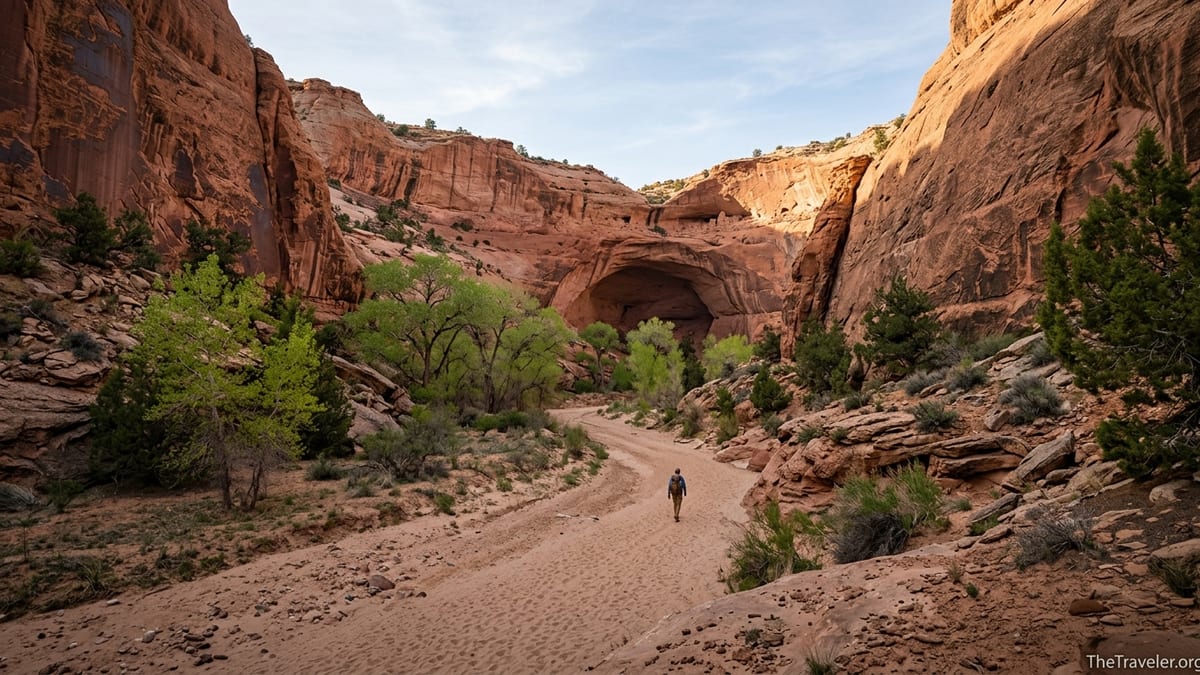
Entering a Canyon of Echoes
The journey into Grand Gulch usually begins at the Kane Gulch Ranger Station, a modest building off Utah State Route 261 that serves as both gateway and guardrail to this fragile landscape. Inside, rangers and displays set the tone: this is not a playground, but one of the densest concentrations of ancestral Puebloan sites in the American Southwest. A short orientation video, often required when you pick up your permit, emphasizes what will quickly become obvious on the trail. Every wall, alcove, and ledge may hold something irreplaceable.
From the trailhead just beyond the station, the path drops steadily from the pinyon and juniper-dotted mesa into the sandstone folds of Kane Gulch, a tributary of Grand Gulch. Within the first hour, modern noise fades until the loudest sounds are your own footsteps in the sand and the rasp of ravens circling above the rim. Even in good weather, this transition is striking. On a cool April morning, with thin clouds diffusing the sun, the canyon feels hushed, like a library where the books have been replaced by cliff faces.
As the walls rise and the sky narrows to a ribbon, the sense of stepping away from the present intensifies. You notice hand-hewn stone steps in the slickrock, faint but clearly intentional. A shard of pottery half-buried in the path catches the eye, its painted pattern still visible under the dust. These are the first clues that Grand Gulch is inhabited, not empty, even if its residents have been gone for hundreds of years.
Archaeological Sites That Rewrite Your Sense of Time
The moment many hikers realize just how old this place is often comes at Junction Ruin, near the confluence of Kane Gulch and Grand Gulch proper. Here, tucked into a broad alcove, low stone rooms and kivas occupy a natural ledge that overlooks the canyon floor. The masonry, built by ancestral Puebloan people in the 1200s, is dry-laid but remarkably intact. Corn cobs still lie in protected corners. In the quiet, it is easy to imagine fires burning in these rooms during long winter nights, the same walls lit by torchlight instead of headlamps.
Further downstream, Grand Gulch becomes an unfolding gallery of rock art and cliff dwellings. Panels like Turkey Pen ruin and the Green Mask site in nearby Sheiks Canyon are well known among experienced hikers. Their figures and symbols, painted in red and white pigments, cling to vertical sandstone in a style archaeologists attribute to both Basketmaker and later Puebloan periods. Many of these images were created more than 800 years ago, some perhaps older. Seeing them in situ, rather than behind glass, is a shock. The lines are delicate, the handprints impossibly personal.
Along the canyon, you may pass granaries clever little storage rooms built high into alcoves to keep corn and seeds cool and dry. In some, the original mud plaster still clings to the stone. Elsewhere, you might spot a series of small, carefully placed stones forming footholds up a vertical wall, a reminder that the people who lived here moved through this landscape with the confidence most of us only feel on sidewalks. Each site is its own chapter, and taken together they compress centuries into an afternoon’s walk.
Trail Realities: Permits, Distances, and Logistics
For all its sense of timelessness, hiking Grand Gulch takes very modern planning. The canyon lies within Bears Ears National Monument and is managed by the Bureau of Land Management as part of the Cedar Mesa Special Recreation Management Area. Day hiking into the canyons of Cedar Mesa, including Grand Gulch, requires a paid day-use pass, while overnight backpacking requires a separate permit that you must carry with you. According to recent guidance, overnight permits for Grand Gulch typically cost around 15 dollars per person per trip and are limited in number to protect both resources and solitude.
Most backpackers tackle Grand Gulch as a multi-day route, often combining the Kane Gulch trailhead with exit routes such as Bullet Canyon, Collins Canyon, or Government Trail. A popular itinerary is the Kane to Bullet loop, a demanding 3 day trip that covers roughly 23 to 26 miles depending on detours to side canyons and ruins. Others opt for a through-hike from Kane Gulch to Collins Canyon, around 25 to 30 miles that allow more time to linger at sites. Shuttles are not formally operated here, so many parties stage two vehicles or hire local outfitters from towns like Blanding or Bluff who, for a fee that might run from 150 to 250 dollars per vehicle, will move a car between trailheads while you hike.
Grand Gulch is considered a primitive hiking area. Trails are often just sandy washes punctuated by cairns and faint footpaths. Distances on maps can be deceptive, because the canyon snakes and meanders, adding small but cumulative detours around pour-offs and boulder gardens. Water sources are seasonal. Springs and seeps such as those near Todie Canyon, Sheiks Canyon, and Polly’s Canyon can be reliable in spring but may shrink to green pools by late May in a dry year. Hikers planning a 3 to 4 day trip typically leave the trailhead carrying 3 to 4 liters of water each and rely on updated information from rangers about which pools are currently flowing.
How Grand Gulch Feels Like Time Travel
Walking through Grand Gulch, the sensation of traveling back thousands of years is not just about seeing ancient walls. It is about how the physical environment encourages you to think the way its former residents might have thought. The canyon’s serpentine shape blocks long-distance views, so you navigate by listening and by reading the rock. Morning light creeps down one wall and illuminates a series of handprints just when you are wondering where to stop for a snack. An alcove that looks like a simple overhang reveals, on closer inspection, faint petroglyphs carved into a patina that took millennia to form.
There are long stretches where you see no other people. In shoulder seasons like late March or October, it is entirely possible to walk for hours without spotting another hiker, especially between lesser-used access points such as Government Trail and the lower canyon near Collins. In those hours of solitude, you become acutely aware of small details: the change in sand color as you cross an old flood deposit, the way cottonwood leaves shimmer secretly in a breeze you cannot yet feel. These are the same signals people here once relied on to predict weather, locate water, and decide where to plant fields on the mesa above.
Night intensifies the time-slip. Backpackers camp away from archaeological sites, often on benches of sand beneath piñon pines. Without city lights, the sky turns dense with stars. On a clear April night, the Milky Way arches directly over the canyon, and the faint glow on distant canyon rims could easily be mistaken for ancient signal fires rather than the scattered lights of modern ranches and highways. It is in these moments, listening to a canyon wren’s descending call echo off the walls at dusk, that Grand Gulch feels less like a destination and more like a visitation.
Respecting a Living Cultural Landscape
However powerful the time-travel feeling may be, it is important to remember that Grand Gulch is not abandoned ground. The rock art, dwellings, and pottery you see are the heritage of living Native nations including Navajo, Hopi, Ute, and Pueblo communities whose descendants maintain cultural and spiritual ties to this landscape today. The establishment and restoration of Bears Ears National Monument were driven in large part by these tribes, who view places like Grand Gulch as part of a much larger story that stretches well beyond the canyon walls.
This living connection shapes how visitors are asked to behave. At the Kane Gulch Ranger Station, staff emphasize that you should never touch rock art or walls, never sit or lean inside rooms, and never move or collect artifacts, even small ones. Footprints on a kiva wall or fingerprints on a painted figure are not just signs of carelessness. Oils from skin can accelerate decay, and shifting stones can destabilize structures that have survived centuries of weather. Several sites now show clear damage from unintentional contact. Standing below a rock art panel and imagining someone’s hand hovering inches away is enough to make you grateful for the rules.
Travelers are also encouraged to treat Grand Gulch as part of a whole cultural landscape, not just a series of Instagram stops. This can mean choosing to skip overcrowded ruins when a ranger warns that they are under stress, or taking time after your hike to visit institutions like Edge of the Cedars State Park Museum in Blanding, where artifacts from Cedar Mesa are curated with tribal input. Supporting local Native-owned businesses in nearby communities, whether that is buying food and fuel or guided cultural tours, is another tangible way to show respect for the people whose ancestors built the rooms and painted the walls you admired on the hike.
When to Go, What It Costs, and What It Really Feels Like
Most hikers aim for spring or fall, roughly from late March through early May and from late September into October. In these windows, daytime temperatures in the canyons often range from the 60s to 70s Fahrenheit, comfortable for carrying a pack, while nights cool into the 30s or 40s. Summer visits are possible but punishing, with temperatures frequently climbing well above 90 degrees on the canyon floor and little shade at midday. Winter brings more solitude but can add ice and snow on the mesa tops and upper canyon sections.
Costs for a Grand Gulch trip are modest compared with many national park backcountry permits but should still be part of your planning. Day hiking passes for Cedar Mesa are typically around 5 dollars per person per day. Overnight backpacking permits, as noted, run in the mid-teens per person per trip. Camping before and after your hike at nearby developed sites like Comb Wash and Sand Island is often around 15 dollars per night for a basic, first-come first-served site, while primitive dispersed camping along dirt roads outside fee areas remains free but is limited to previously disturbed spots.
On the ground, the experience is a mix of effort and revelation. A typical 3 day trip might involve hiking 7 to 9 miles on the first day from Kane Gulch to a campsite downstream of Junction Ruin, with a full pack, stopping often to explore side alcoves. The second day might be shorter in distance but richer in discovery, detouring into a side canyon such as Sheiks to visit rock art panels and granaries before returning to the main canyon. The final day, climbing out via Bullet Canyon, can be the most strenuous, with steep sections of slickrock and loose rubble testing tired legs. By the time you reach your car, dusted in red sand and sun-creased, the modern world feels oddly fast and loud.
Practical Tips to Preserve the Illusion of Time Travel
Hiking Grand Gulch safely and responsibly comes down to a handful of practical habits that keep both you and the canyon’s stories intact. Water is first among them. Reliable sources vary by season, so you should confirm current conditions with Kane Gulch rangers shortly before your trip. Treat all water with a filter or purification tablets, and plan conservative daily mileages so you are not forced to push on in the heat searching for the next pool.
Gear choices also shape the experience. Because temperatures can swing sharply between sunlit slickrock and shaded alcoves, layered clothing is more useful than a single heavy jacket. Many backpackers favor breathable long sleeves and pants to deflect the sun and protect against brush, paired with a wide-brimmed hat. Footwear with good traction for sand and rock is essential. A lightweight mesh food bag reinforced with metal, like a steel mesh ratsack, is often recommended for Cedar Mesa because rodents and ringtails, not bears, are the main food raiders in this environment.
Finally, go in with the mindset that your presence should be almost invisible. Camp at least 200 feet from archaeological sites and water sources. Cook on a small stove rather than building fires in the canyon, where charcoal scars can linger for decades on sandstone. Stick to durable surfaces and existing paths where they are obvious, even if a faint social trail to a ruin looks tempting. The more your camp fades without a trace when you leave, the more the canyon can continue to feel like a place suspended outside the usual rush of time.
The Takeaway
In an era when so many wild places feel crowded and hurried, Grand Gulch still invites a slower, older way of moving through the world. Its sandstone corridors are not simply scenic. They are lined with the everyday architecture of people who adapted to this environment long before paved roads and digital maps. To walk here is to share, briefly, the same light, shade, and stone that framed their lives.
Hiking through Grand Gulch felt like traveling back thousands of years in time because the past is not abstract here. It is under your boots and over your head, in the brushstrokes of a spiral painted high on a cliff and in the careful curve of a masonry wall. With a permit from Kane Gulch tucked in your pocket and modern gear on your back, you are still a visitor in someone else’s home, moving through a story that began long before you arrived and will, with care, continue long after you are gone.
FAQ
Q1. Do I need a permit to hike in Grand Gulch?
Yes. Day hiking in the Cedar Mesa canyons, including Grand Gulch, requires a day-use pass, and overnight backpacking requires a separate backcountry permit that you must carry while on your trip.
Q2. How many days do I need to hike Grand Gulch?
Most backpackers spend 2 to 4 days in Grand Gulch, often hiking routes like Kane Gulch to Bullet Canyon or Kane Gulch to Collins Canyon, which cover roughly 20 to 30 miles.
Q3. When is the best time of year to visit Grand Gulch?
Spring and fall are ideal, typically late March to early May and late September through October, when daytime temperatures are moderate and water sources are more reliable.
Q4. How difficult is the hiking in Grand Gulch?
Grand Gulch is considered moderately strenuous. Trails are primitive, with sandy washes, occasional boulder hops, and steep exits like Bullet or Government Trail that require good fitness and balance.
Q5. Are there reliable water sources in Grand Gulch?
Water is seasonal. Springs and pools exist in places like Todie Canyon and Sheiks Canyon, but conditions change year to year, so you must check with rangers shortly before your trip and carry enough to bridge dry stretches.
Q6. Can I camp anywhere in the canyon?
Backcountry camping is allowed in Grand Gulch with an overnight permit, but you must camp away from archaeological sites and water sources, use previously impacted areas when possible, and follow all Leave No Trace practices.
Q7. Are pets allowed in Grand Gulch?
Pets are generally not allowed in the Cedar Mesa canyons that include Grand Gulch, in part to protect sensitive cultural sites and wildlife. Confirm current regulations before you travel.
Q8. How do I arrange transportation between trailheads?
Many hikers stage two vehicles, leaving one at their exit trailhead. Others hire local shuttle services from nearby towns like Blanding or Bluff, which, for a fee, move a vehicle while you are on the trail.
Q9. What should I pack for a multi-day Grand Gulch trip?
Plan on usual desert-backpacking essentials: 3 to 4 liters of water capacity per person, a reliable filter, sun protection, layered clothing, sturdy footwear, a lightweight stove, and a rodent-resistant food bag.
Q10. How can I visit respectfully given the cultural significance of Grand Gulch?
Stay on durable surfaces, never touch or enter ruins, do not disturb or collect artifacts, camp and eat away from sites, follow ranger guidance, and consider supporting local Native communities and museums that help steward this landscape.