


Tan Son Nhat International Airport in Ho Chi Minh City is Vietnam’s busiest gateway, and its three-terminal setup can be confusing, especially since the newest Terminal 3 only recently began full-scale domestic operations. Many travelers still show up at the wrong building, miss flights, or waste money on unnecessary taxis between terminals. This guide explains, in practical terms, which terminal you actually need, how the airlines are split, what the new T3 does, and how to recover quickly if you find yourself at the wrong place.
Get the latest updates straight to your inbox!
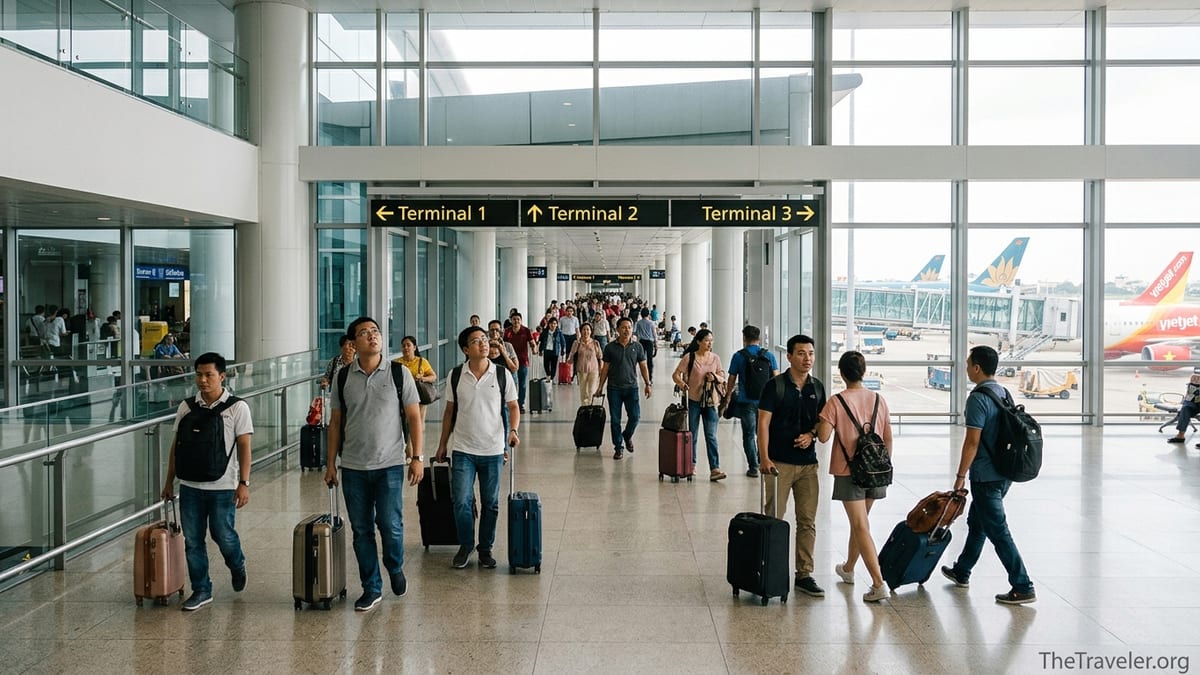
Understanding Tan Son Nhat’s Three-Terminal Layout
Tan Son Nhat International Airport (code SGN) currently operates three passenger terminals: Terminal 1 and Terminal 3 for domestic flights, and Terminal 2 for international flights. All three buildings sit on the same airport campus in the Tan Binh district of Ho Chi Minh City, roughly 20 minutes to 1 hour from District 1 by taxi depending on traffic. Although they are close to each other, each terminal has its own check in halls, security screening and boarding gates, so being at the right building is essential.
Terminal 1 is the older domestic terminal and was, for years, the default departure point for almost every domestic flight out of Ho Chi Minh City. Today it mainly serves low cost and some smaller carriers on routes within Vietnam. Terminal 2 is the international terminal and handles all international departures and arrivals, from full service airlines such as Singapore Airlines and Emirates to low cost carriers like VietJet’s international services.
Terminal 3 is the new domestic terminal, located on the same side of the field as Terminal 2. It opened to commercial traffic in 2025 and was designed to ease chronic congestion in Terminal 1. Vietnam Airlines has progressively moved its domestic operations to T3, and other airlines may follow over time. For travelers, this split means that two people flying domestic on the same day from Ho Chi Minh City can depart from completely different buildings, depending on airline and route.
In practice, you can think of the airport as: Terminal 2 for all international flights, Terminal 3 for most Vietnam Airlines domestic flights, and Terminal 1 for most VietJet and other domestic carriers. This is a simplification and there are exceptions, which is why checking your booking confirmation and boarding pass for the exact terminal label remains critical.
Terminal 1: The Legacy Domestic Terminal
Terminal 1 remains very busy because low cost carriers, especially VietJet, continue to operate their domestic network from here. If you are flying from Ho Chi Minh City to Da Nang, Hue, Nha Trang, Phu Quoc or Hanoi on VietJet, your check in will almost certainly be at Terminal 1. VietJet has recently expanded its check in areas in Hall A of T1 to cope with high passenger volumes, so you may find long but fast moving lines in the early morning and late evening peaks.
The building itself is functional rather than pretty. The ground floor is mainly used for arrivals and baggage claim, while the upper floor is for departures, check in, security screening and the gate area. Inside departures you will find familiar Vietnamese chains such as Highlands Coffee and Pho 24, simple convenience stores and a handful of fast food options. Prices are a little higher than in the city but still reasonable by international airport standards. For example, a coffee might run 45,000 to 60,000 VND, and a bowl of pho around 90,000 to 120,000 VND.
Because Terminal 1 serves a large domestic low cost crowd, it can feel crowded and noisy, especially around Vietnam’s holiday seasons and long weekends. Locals often arrive just 60 to 75 minutes before departure for domestic flights on VietJet, but foreign visitors are safer aiming for at least 90 minutes, and two hours if checking bags. Security queues can back up unexpectedly. There are a few small lounges, often accessed via premium bank cards or paid entry, but they are more basic than those in Terminal 2 or 3.
Real world mistakes at Terminal 1 usually stem from airline confusion. One common scenario involves a traveler who assumes their Ho Chi Minh City to Hanoi flight on Vietnam Airlines leaves from T1 because “it’s domestic,” only to find at the check in monitors that their flight number begins with VN but is actually departing from T3. They then need to race across the airport at rush hour. Understanding that T1 is no longer the default domestic terminal is the first step to avoiding this.
Terminal 2: International Flights Only
Terminal 2 is the international terminal at Tan Son Nhat and handles all flights to and from other countries. If your boarding pass shows a destination such as Singapore, Bangkok, Tokyo, Seoul, Sydney, Paris or San Francisco, your flight will depart from T2 regardless of whether the airline is Vietnam Airlines, VietJet, Bamboo Airways or a foreign carrier. This terminal is also where almost all foreign passengers first encounter Vietnam, as immigration and customs are located here for international arrivals.
T2 offers a more modern layout than T1, with a large check in hall, separate immigration areas for departures and arrivals, and a selection of duty free stores and international food brands airside. You will find typical airport offerings such as perfume and cosmetics, liquor, chocolate, electronics accessories and Vietnamese handicrafts. Lounge options are better than in T1, including the Vietnam Airlines international lounge and several contract lounges used by other airlines and credit card programs.
A typical scenario: a traveler arrives from Europe or North America early in the morning into Terminal 2, clears immigration, collects bags, and then continues on a separate ticket with VietJet to a domestic destination such as Nha Trang. They must exit customs into the public arrivals hall of T2, then walk or take a short taxi ride to the domestic terminal used by their next carrier. If that onward flight is on VietJet, it will almost certainly be from Terminal 1, not Terminal 3, which can be surprising for those expecting a “domestic area” inside T2.
Walking between T2 and T1 typically takes about 10 to 15 minutes at a moderate pace in dry weather, with sidewalks and crosswalks but often heavy traffic in front of the terminals. With checked baggage, families or in hot season, many travelers prefer to spend 50,000 to 80,000 VND on a metered taxi or booked car between terminals instead of walking, even though the physical distance is quite short. Allow extra time if you have to check in again, drop bags and clear domestic security after your walk or ride.
Terminal 3: The New Domestic Home of Vietnam Airlines
Terminal 3 is the newest building at Tan Son Nhat and was built specifically to handle growing domestic traffic. Trial flights started in April 2025 and Vietnam Airlines then progressively moved its domestic operations from Terminal 1 to T3. By mid 2025, the carrier had relocated essentially all of its domestic departures and arrivals in Ho Chi Minh City to this new terminal, with only occasional exceptions on specific routes during the transition period. Today, most Vietnam Airlines domestic passengers should plan on using T3 as their default.
Architecturally, T3 is brighter and more spacious than T1, with larger security areas, newer baggage systems and more modern retail and dining options. Check in halls are designed to handle significant peak hour volumes, and there are dedicated zones for self service kiosks and bag drops on Vietnam Airlines. Domestic lounges have also been upgraded here, giving frequent flyers and business class passengers a more comfortable experience than in the old terminal. Travelers arriving from other Vietnamese cities into T3 will find clearer signage, faster baggage claim and better connections to ground transportation.
However, T3’s existence also introduces new ways to get confused. A frequent error occurs when someone books a domestic ticket on Vietnam Airlines, sees “Tan Son Nhat” but no terminal indicated on an older email, and instinctively goes to Terminal 1 because friends told them “domestic is T1.” They arrive, discover only VietJet counters, and a staff member tells them to go to T3 instead. At that point, they may have less than an hour before departure and need to cross to the far side of the airport campus, re-enter security and clear boarding.
In concrete terms, if your flight number begins with VN and you are traveling between Ho Chi Minh City and major domestic cities such as Hanoi, Da Nang, Hue, Nha Trang or Phu Quoc, you should expect to depart and arrive at Terminal 3. The simplest rule of thumb for 2026 is: Vietnam Airlines domestic equals T3, unless your ticket or the airline’s latest notification explicitly says otherwise. If you are connecting from an incoming Vietnam Airlines international flight in T2 to a domestic Vietnam Airlines service, the airline often arranges dedicated shuttles airside or curbside between T2 and T3, so listen carefully to staff instructions on arrival.
Vietnam Airlines vs VietJet: Which Terminal Do They Use?
The biggest source of terminal confusion in Ho Chi Minh City is the different ways Vietnam’s two most visible carriers use the three buildings. Vietnam Airlines is the national flag carrier and leans toward Terminal 3 for domestic and Terminal 2 for international. VietJet is the dominant low cost airline and generally uses Terminal 1 for domestic and Terminal 2 for international, although boarding gate clusters within T2 can differ by airline.
For Vietnam Airlines, a typical domestic routing such as Ho Chi Minh City to Hanoi, Hue or Da Nang will now operate entirely out of Terminal 3, with check in, security and gates in the new building. International routes such as Ho Chi Minh City to Singapore, Tokyo or Seoul will check in and depart from Terminal 2. If you are connecting on a single through ticket, for example Sydney to Hanoi via Ho Chi Minh City on Vietnam Airlines, your bags are usually tagged to final destination and airline staff direct you between terminals as needed, sometimes by dedicated shuttle bus.
VietJet, on the other hand, continues to operate its significant domestic network from Terminal 1. A budget traveler flying Ho Chi Minh City to Phu Quoc, Nha Trang, Da Nang or Can Tho on VietJet should plan to check in at T1, often in Hall A, and then proceed to domestic security and gates on the upper level. When that same traveler returns from an overseas trip on VietJet, for example from Bangkok or Singapore, their outbound and inbound international segments will use Terminal 2, like every other international carrier at the airport.
A simple real world comparison helps: imagine two friends flying from Ho Chi Minh City to Da Nang on the same day. One booked Vietnam Airlines and the other chose VietJet to save money. The Vietnam Airlines passenger must go to Terminal 3, while the VietJet passenger must go to Terminal 1. Both flights appear as “domestic” in travel apps, and both show “SGN to DAD,” but they leave from entirely different sides of the airport campus. Checking the airline as well as the terminal line on your confirmation can save an expensive dash between terminals just before boarding closes.
Transfers, Shuttles and Walking Between Terminals
Moving between terminals at Tan Son Nhat is not difficult but it can be time consuming in hot, humid weather or heavy rain. Terminals 1 and 2 are relatively close, with a walking time of roughly 10 to 15 minutes at an average pace. You exit the arrival hall of one terminal, follow sidewalk signs toward the other, and cross internal roads using marked pedestrian crossings. Many budget travelers make this walk with rolling suitcases, especially during cooler evening hours.
Terminal 3 is positioned nearer Terminal 2 than Terminal 1, and the route involves crossing busy airport roads or using designated paths. Some passengers prefer to summon a taxi or app based car between T1 and T3 because of the extra distance and exposure to the elements. A short taxi ride between terminals might typically cost the equivalent of a few US dollars on an honest meter, but careless or rushed visitors have reported paying 300,000 VND or more when they jumped into an unmetered cab without confirming the fare first. Always verify the company name and insist on the meter or agree a price before you get in.
The airport and airlines run shuttle options that reduce the stress of terminal transfers, especially for passengers on a single Vietnam Airlines ticket connecting between international and domestic flights. Dedicated buses may run from the arrivals area of Terminal 2 directly to Terminal 3 for Vietnam Airlines domestic connections, with staff holding signs just after customs. These shuttles generally operate airside or on controlled routes and are not intended for passengers on separate tickets with other carriers. If you are, for example, arriving on VietJet and connecting to a Vietnam Airlines domestic ticket purchased separately, you will most likely need to handle your own ground transfer between terminals.
When planning your itinerary, it is wise to allow at least two and a half to three hours between an international arrival in Terminal 2 and a separate domestic departure in Terminal 1 or 3, especially if you must collect and recheck baggage. This buffer covers potential queues at immigration, delays in baggage delivery, walking or riding to the next terminal, check in, bag drop and domestic security. Many seasoned travelers in Vietnam consider four hours of connection time a comfortable margin when using two different airlines on separate tickets, particularly during peak holiday seasons.
Common Wrong Terminal Mistakes and How To Fix Them
Despite clearer signage and more online information about Terminal 3, wrong terminal mistakes remain common at Tan Son Nhat. One of the most frequent errors occurs when travelers equate “domestic” with “Terminal 1” without considering the airline. Someone flying Ho Chi Minh City to Hanoi on Vietnam Airlines might tell their taxi driver simply “domestic terminal,” only to be dropped at T1 and then discover at the information desk that their VN flight is leaving from T3. In rush hour traffic, the ride from T1 around the airport perimeter to T3 can take 15 to 25 minutes, especially if you must navigate crowded pickup lanes.
Another typical mistake involves confusion between VietJet’s domestic and international operations. A traveler connecting from a VietJet international flight arriving at Terminal 2 to a VietJet domestic departure may assume that they can remain in the same building airside. In reality, they must clear immigration and customs, then move to Terminal 1 for domestic check in, even though both segments are on the same airline. Passengers who only allow 90 minutes for this entire process often find themselves sprinting between terminals with luggage.
If you discover you are at the wrong terminal, the best immediate reaction is to stay calm, check the current time and then choose the fastest available option rather than the cheapest. If you have more than 90 minutes before departure, walking between T1 and T2 or taking a reasonably priced taxi between any pair of terminals is usually fine. If you are within an hour of departure, head straight for an official taxi rank or vetted app based car, confirm your terminal with the driver and explain that your flight is soon. Upon arrival at the correct terminal, go directly to your airline’s check in counters and explain that you were sent to the wrong place earlier; staff may prioritize you if check in is still open.
In extreme cases where you arrive after check in has closed, it may still be worth speaking politely with airline staff and showing that you were at the airport but misdirected. Although airlines are not required to rebook you for free if you went to the wrong terminal, some have been known to offer a reduced change fee or place passengers on the next available flight on a standby basis, particularly on busy domestic routes where multiple daily departures operate. Having travel insurance that covers missed connections caused by misdirection can also help recover some costs.
The Takeaway
The key to navigating Ho Chi Minh City’s Tan Son Nhat Airport smoothly is understanding that terminal assignments are driven primarily by airline and route, not just by whether your flight is labeled domestic or international. Terminal 2 handles all international flights, Terminal 3 has become the main base for Vietnam Airlines domestic operations, and Terminal 1 continues to serve VietJet and other domestic carriers, often in very high volumes.
Before you leave your hotel or connect from another flight, double check your email confirmation, app booking and boarding pass for the terminal designation. Tell your taxi or car specifically “Terminal 1,” “Terminal 2,” or “Terminal 3,” not just “domestic” or “international.” Build realistic connection times into your itinerary, especially when switching terminals or airlines, and be prepared to use a short taxi ride rather than a long walk if you are tight on time or traveling with heavy bags.
With a little planning and awareness of how the three terminals operate, you can avoid the most common wrong terminal mistakes, simplify transfers and start or finish your time in Ho Chi Minh City on a much calmer note. For most visitors, Tan Son Nhat becomes manageable after their first experience; by your second or third visit, you will likely be the one explaining to other passengers in the taxi queue which terminal they really need.
FAQ
Q1. How do I know which terminal my flight uses at Ho Chi Minh City?
Check the terminal line on your booking confirmation, airline app or boarding pass, and note your airline. In general, Terminal 2 is for all international flights, Terminal 3 is for most Vietnam Airlines domestic flights, and Terminal 1 is for most VietJet and other domestic carriers, but your specific ticket should always be treated as the final authority.
Q2. I am flying Vietnam Airlines from Ho Chi Minh City to Hanoi. Which terminal should I go to?
As of 2026, almost all Vietnam Airlines domestic flights, including the busy Ho Chi Minh City to Hanoi route, depart from Terminal 3. You should plan to check in at T3 unless your booking or a recent notification from the airline clearly lists a different terminal for your specific flight.
Q3. My VietJet flight from Ho Chi Minh City to Da Nang is domestic. Is it in Terminal 1 or Terminal 3?
VietJet domestic flights from Ho Chi Minh City, such as to Da Nang, typically operate from Terminal 1. You should expect to check in at T1, usually in Hall A, then proceed through domestic security and to the gate area on the upper floor.
Q4. How long does it take to walk between Terminal 1 and Terminal 2?
Walking between Terminal 1 and Terminal 2 generally takes about 10 to 15 minutes at a moderate pace, using sidewalks and crosswalks in front of the terminals. Allow extra time if you are carrying heavy luggage, traveling with children, or during periods of intense heat or rain.
Q5. What is the best way to transfer from Terminal 2 to Terminal 3?
For passengers connecting on Vietnam Airlines between an international arrival in Terminal 2 and a domestic departure in Terminal 3 on a single ticket, airline staff often direct you to a dedicated shuttle or clearly signposted transfer route. If you are on separate tickets or a different airline, taking an official taxi or app based car between the two buildings is usually the simplest and quickest option.
Q6. How much should a taxi between terminals at Tan Son Nhat cost?
A short metered taxi ride between terminals typically costs the equivalent of just a few US dollars, depending on traffic and waiting time. You should confirm that the driver is using the meter or agree a clear fare before departing, as some travelers have reported paying much higher amounts when they accepted unmetered rides in a rush.
Q7. How much time should I allow to connect from an international flight to a separate domestic flight?
If you are on separate tickets and need to clear immigration, collect baggage, move between terminals and recheck for a domestic flight, it is sensible to allow at least two and a half to three hours. Many seasoned travelers prefer a four hour buffer at busy times of year to account for potential delays at immigration or security.
Q8. Can I stay airside when transferring from an international VietJet flight to a domestic VietJet flight?
No. Even when both flights are on VietJet, you must clear immigration and customs upon international arrival, then move to the domestic terminal used by your onward flight. In practice, this means exiting Terminal 2’s arrivals area and going to Terminal 1 for domestic check in, then passing through domestic security again.
Q9. What should I do if I arrive at the wrong terminal and my flight is soon?
Stay calm, check the current time and go straight to an official taxi rank or trusted app based car for the quickest transfer to the correct terminal. On arrival, head immediately to your airline’s check in counters, explain that you were misdirected and ask staff whether check in is still possible or if they can assist with rebooking options.
Q10. Is there a single domestic terminal at Ho Chi Minh City like some airports have?
No. Domestic operations at Tan Son Nhat are split mainly between Terminal 1 and Terminal 3, with different airlines using different buildings. Vietnam Airlines focuses its domestic network on Terminal 3, while VietJet and several other carriers use Terminal 1. Because of this split, always check your airline and terminal information rather than assuming that all domestic flights share the same building.