


Istanbul Airport has rapidly evolved from a new mega‑hub on the edge of Europe into one of the world’s busiest crossroads between East and West. For many travelers planning a multi‑stop itinerary, the real question today is not simply whether Istanbul works as a gateway, but how it compares in practice with Europe’s classic giants such as London Heathrow, Paris Charles de Gaulle, Amsterdam Schiphol, Frankfurt and others. This article looks at the latest data and real‑world traveler experience to help you decide when Istanbul Airport is your best option and when another European hub might serve you better.
Get the latest updates straight to your inbox!
Where Istanbul Airport Stands Among Europe’s Busiest Hubs
By 2025, Istanbul Airport was handling more than 80 million passengers a year, putting it firmly in the same league as London Heathrow and Paris Charles de Gaulle in overall scale. Official figures and industry analyses show Heathrow at around 79 million passengers in 2023, while Istanbul reached the mid‑70 million range that same year and continued to grow strongly through 2024 and early 2025. In several years it has also ranked among Europe’s top two or three airports in terms of daily flights, underlining its role as a major connecting hub.
For travelers, this matters because an airport’s size and traffic volume directly influence route choice, fares and the likelihood of finding a convenient connection. At Istanbul, the sheer volume of transfer traffic between Europe, the Middle East and Asia means that you can often find one‑stop itineraries from secondary European cities to places like Bangkok, Singapore, Mumbai or Nairobi, while passengers routing via smaller European airports might need two or even three connections to reach the same destinations.
The flip side of rapid growth is that Istanbul, like Heathrow or Schiphol, can feel extremely busy at peak times. Early‑morning and late‑night banks of long‑haul departures can bring thousands of transfer passengers into the terminal at once. If you are connecting between, for example, Manchester and Kuala Lumpur in winter, you will likely pass through Istanbul’s busiest overnight wave, where security and passport queues can swell even though the airport was built for high capacity.
Compared with older hubs such as Frankfurt or Charles de Gaulle, Istanbul’s short history also means some statistics are still catching up with its physical capacity. The master plan allows for multiple runways and a theoretical capacity well above 100 million passengers per year. By contrast, London Heathrow effectively runs at or near its two‑runway capacity most days, which is why minor weather disruptions can ripple through the schedule for hours. In practical terms, this gives Istanbul a bit more breathing room to grow.
Route Networks and Connectivity: When Istanbul Works Best
Istanbul Airport is particularly strong for journeys that bridge Europe and Asia, as well as Europe and parts of Africa. Turkish Airlines uses Istanbul as its primary hub, operating an expansive network that reaches deep into secondary cities in Central Asia, the Caucasus, North and East Africa and the Middle East. For instance, travelers from Barcelona can often reach destinations such as Dar es Salaam, Tbilisi or Bishkek with a single, fairly short connection in Istanbul, whereas using a Western European hub might mean backtracking or longer layovers.
By comparison, London Heathrow and Paris Charles de Gaulle remain better gateways for North America and the high‑yield business markets of Western Europe. If you are flying from New York or Toronto to major European capitals like London, Paris, Brussels or Geneva, nonstop options are far more plentiful via Heathrow, Charles de Gaulle or Frankfurt than via Istanbul. You may still route via Istanbul for price reasons, but it would typically add flight time and distance.
Schiphol and Frankfurt serve as strong alternatives for intra‑European and transatlantic connections, but offer fewer direct links into Central Asia or secondary African cities than Istanbul. For example, a traveler going from Lisbon to Zanzibar in high season might see competitive one‑stop itineraries via both Istanbul and Doha, but relatively fewer simple one‑stop options through Amsterdam or Frankfurt. In this type of itinerary, Istanbul often occupies a “sweet spot” between distance flown and flight frequency.
One nuance is that Istanbul’s geographic advantage is most pronounced for travelers starting or ending in Eastern and Southern Europe. Passengers from Athens, Sofia, Bucharest or Belgrade often find that Istanbul gives them a more direct arc to destinations in the Gulf, India or Southeast Asia than a connection via Paris or London would. For someone starting in Dublin or Reykjavik, however, Istanbul’s location is less convenient; in those cases, routing through Heathrow, Amsterdam or even a US East Coast hub can save several hours.
Terminal Design, Navigation and Passenger Flow
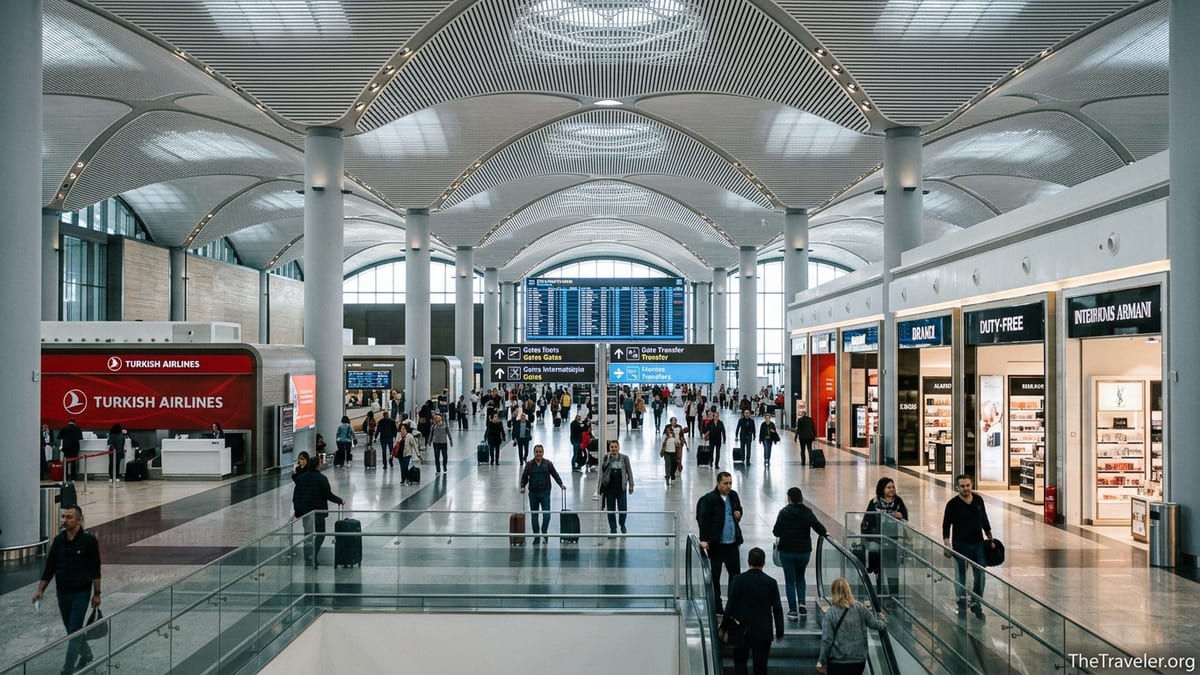
Istanbul’s main terminal is a single massive structure, designed with long, straight concourses that fan out from a central hall. This layout reduces the need for inter‑terminal transfers, a frequent pain point at other large airports. A traveler arriving from Berlin and connecting onward to Tokyo, for instance, is likely to stay within the same building, following clear signage for international transfers without changing terminals. For many passengers this feels simpler than navigating multi‑terminal complexes such as Paris Charles de Gaulle or London Heathrow.
The downside is walking distance. Istanbul Airport’s piers are long, and it is not uncommon to walk 15 to 20 minutes between a distant gate and the central security area, especially for non‑Schengen to non‑Schengen connections. Moving walkways ease some of the effort, but travelers with reduced mobility or families with small children should factor in extra time and, if needed, request assistance in advance.
Among European comparators, Amsterdam Schiphol is often praised for its intuitive single‑terminal design, while Heathrow and Charles de Gaulle can feel more fragmented. At Heathrow, a traveler connecting from a domestic UK flight in Terminal 5 to an international departure in Terminal 3 must take a bus and pass through multiple security checks, adding both time and uncertainty. Istanbul’s single‑terminal configuration tends to make such transfers more predictable, though security queues can swell during peak transfer waves just as they do at other mega‑hubs.
Istanbul’s signage is generally clear, with English widely used alongside Turkish and other languages. That said, first‑time visitors may still find the sheer scale and crowds disorienting. By contrast, Zurich or Munich, which handle fewer total passengers, can feel calmer and more compact at ground level, even if their route networks are less extensive. Travelers who prioritize an easy, low‑stress transfer may prefer these smaller hubs for European point‑to‑point journeys.
Lounge Quality, Food, Shopping and Overall Comfort
One of Istanbul Airport’s standout features is its flagship Turkish Airlines Business Lounge. Spanning a large footprint with high ceilings and natural light, it offers multiple buffet stations serving Turkish and international cuisine, shower suites, quiet areas and family zones. Travelers on a business‑class ticket from, say, London to Singapore via Istanbul often highlight the lounge as a key perk, particularly when connecting overnight and needing a proper meal and shower.
Heathrow and Frankfurt counter with an extensive variety of airline‑branded and independent lounges, from British Airways’ Galleries lounges to premium paid‑entry spaces run by third‑party operators. However, lounge access at these airports can be tightly controlled by airline status and cabin class. Istanbul also operates pay‑per‑use lounges in both international and domestic areas, making it relatively easy for economy‑class travelers to purchase access if they have a long layover.
In terms of food and shopping, Istanbul’s central concourse offers a broad mix of global fast‑food chains, mid‑range restaurants and Turkish specialties such as pide, baklava and traditional kebabs. Luxury brands occupy much of the duty‑free area, similar to Heathrow’s Terminal 5 or Paris’s main international terminals. Price levels, particularly for international chains and luxury goods, are broadly in line with other major European hubs, though local snacks and simple meals can be slightly more affordable than in London or Zurich.
Comfort also extends to seating, quiet areas and design. Istanbul’s gate areas generally offer plentiful seating with power outlets, but at peak times seats can still be hard to find. Natural light and high ceilings give the building an airy feel, comparable to newer terminals in Munich or Vienna. Families will appreciate dedicated play spaces and baby‑care rooms. On the other hand, older European airports that have undergone multiple refurbishments, such as Frankfurt’s Terminal 1, can feel more segmented, with some zones modern and others noticeably dated.
Immigration, Security and Transit Experience
For international arrivals, Istanbul Airport’s immigration hall can be a mixed experience. When several long‑haul flights arrive together from Asia and the Middle East, queues for passport control sometimes stretch to 30 minutes or more for travelers who require a visa check. Citizens of countries that benefit from e‑gates or simplified entry procedures often pass through more quickly. This is broadly comparable to peak‑hour experiences at Heathrow, where non‑EU arrivals can face similar wait times, particularly during busy holiday periods.
Security for connecting passengers is centralized and usually efficient, but like any hub, it is vulnerable to surges. For example, during the late‑night departure bank to East Asia, lines at transfer security can briefly lengthen as hundreds of passengers from European feeder flights converge. Travelers with short connections of less than 60 minutes should be prepared to move briskly between gates and may wish to sit near the front of the aircraft on their inbound flight to clear queues faster.
By contrast, some smaller European hubs such as Zurich or Copenhagen often deliver a smoother, quieter arrival experience simply because they handle fewer wide‑body flights at once. A traveler landing from Montreal into Zurich in the morning may walk from gate to immigration and out to the train platform within 20 minutes, something that is harder to guarantee at mega‑hubs like Istanbul, Heathrow or Charles de Gaulle.
Transit formalities also vary by passport. Many nationalities can remain airside at Istanbul without a Turkish visa when connecting between international flights, but rules are subject to change and should always be checked before travel. For example, a traveler from South Africa connecting from Johannesburg to Amsterdam via Istanbul generally does not need to clear Turkish immigration if remaining in the transit area, while the same traveler entering Turkey for a hotel stopover might require an e‑visa purchased in advance.
On‑the‑Ground Access and Stopover Potential
Located on the European side of Istanbul, the airport sits roughly 35 to 40 kilometers from the historic Sultanahmet district and central Beyoğlu. Travel time to the city varies by mode. In typical daytime traffic, a taxi or app‑based ride can take 40 to 60 minutes and cost roughly what you might pay for a similar distance in other European capitals, often less than a comparable journey from Heathrow into central London. Bus services offer cheaper, fixed‑price connections to key districts, though journey times can stretch beyond an hour during rush hour.
As rail links expand, access is improving, but for now many travelers still rely on road transport. This compares with well‑established direct express trains such as the Heathrow Express in London, the CDG‑to‑Gare du Nord rail link in Paris, or the high‑frequency train service between Schiphol and Amsterdam Centraal. Travelers who value predictable, rail‑based access may find Western European hubs more appealing, especially if they are staying only one night.
Where Istanbul shines is as a stopover destination. Turkish Airlines has for several years promoted stopover and layover programs that allow passengers on long‑haul itineraries to spend a night or two in the city, sometimes with discounted or sponsored hotel stays for eligible passengers. A traveler flying from Nairobi to Stockholm, for example, can choose an itinerary with a 24‑hour layover in Istanbul, using that time to visit the Grand Bazaar, Hagia Sophia and the Bosphorus before continuing onward.
Other European hubs also promote stopovers, but often with a different flavor. Finnair uses Helsinki as a gateway for travelers between Europe and East Asia, highlighting quick transfers and access to Nordic nature. Icelandair has long marketed Reykjavik stopovers on transatlantic routes. Compared with these, Istanbul’s proposition is urban and historical: a high‑energy city with world‑class food, dense heritage sites and a very different cultural feel from Western Europe, all within an hour of the airport.
Pricing, Airlines and Value for Money
From a pricing perspective, Istanbul Airport often offers attractive fares on long‑haul itineraries, especially in economy and premium economy. Turkish Airlines competes aggressively on routes linking Europe with Asia and Africa, which can translate into lower prices than equivalent journeys via London, Frankfurt or Paris. For example, a round‑trip economy ticket from Rome to Bangkok in shoulder season may be noticeably cheaper via Istanbul than on a nonstop or via a Western European hub, even after adding the cost of a meal or lounge access during the layover.
On the other hand, low‑cost carriers still play a larger role at airports such as London Gatwick, Milan Bergamo, Barcelona or Berlin, where airlines like easyJet, Ryanair and Wizz Air drive intense fare competition for intra‑European routes. Istanbul has its own low‑cost offerings, including AnadoluJet and Pegasus at the city’s second airport, but within the main Istanbul Airport, the mix is more tilted toward full‑service carriers and long‑haul traffic.
Business‑class pricing also varies. Turkish Airlines often undercuts legacy Western European carriers on premium cabins to long‑haul destinations, making Istanbul an appealing choice for travelers who value lie‑flat seats and lounge access but want to avoid the very highest fares typically seen on direct flights out of London or Zurich. However, corporate travelers tied to specific airline alliances may still find Heathrow or Frankfurt more convenient because of alliance hubs for British Airways, Lufthansa, Air France and others.
Value for money also includes ancillary costs in the terminal. Coffee, snacks and mid‑range meals at Istanbul generally price slightly below London and Zurich but near levels seen in Madrid or Rome. Duty‑free alcohol and cosmetics, heavily promoted in the central concourse, are usually comparable in price to other EU and non‑EU hubs, with occasional regional variations depending on taxation and currency movements.
Choosing Between Istanbul and Other European Airports
For many itineraries, the choice between Istanbul and another European hub comes down to a few core questions: where you are starting, where you are going, how much time you have, and what kind of airport experience you prefer. If you are traveling from a secondary European city to a destination in Asia, the Middle East or Africa, and you prioritize price and route simplicity over the shortest possible flying time, Istanbul is often a strong contender.
If, instead, you are flying between North America and Western Europe, or you need the maximum number of daily frequencies on a key business route, classic hubs like Heathrow, Charles de Gaulle, Frankfurt and Amsterdam typically win on nonstop options and schedule flexibility. A business traveler commuting between New York and London, for example, would almost never route via Istanbul; they benefit much more from the many daily nonstops and well‑established premium services on that corridor.
Travelers who are sensitive to airport stress levels may also weigh Istanbul’s crowds and walking distances against smaller, more compact hubs. Zurich, Copenhagen, Vienna and Munich are frequently ranked highly for passenger satisfaction and operational reliability. Choosing one of these airports as a transfer point can sometimes mean a less intense experience, even if your ticket costs slightly more or requires a less direct routing.
Ultimately, Istanbul should be thought of as one of several major options rather than an automatic default. For a family traveling from Barcelona to Bali, a competitively priced itinerary via Istanbul with a manageable layover might be ideal. For a short‑haul weekend break from Dublin to Paris, routing through any large hub, including Istanbul, would be unnecessary complexity compared with a simple nonstop flight.
The Takeaway
Istanbul Airport has completed its transformation from ambitious new project to one of Europe’s heavyweight hubs. It competes directly with London Heathrow, Paris Charles de Gaulle, Frankfurt and Amsterdam on overall scale and surpasses many of them in its connectivity to Asia, the Middle East and parts of Africa. Its vast, modern terminal and strong flagship lounge product make it particularly attractive for long‑haul travelers willing to trade a longer routing for better fares or a convenient stopover in one of the world’s most compelling cities.
At the same time, Istanbul is not necessarily the best choice for every journey. For North Atlantic routes, Western European business corridors and travelers who insist on the shortest possible flight times, traditional hubs closer to the Atlantic still hold a clear edge. Smaller European airports excel in calm, compact transfers that mega‑hubs, Istanbul included, sometimes struggle to match at peak times.
For travelers planning complex multi‑stop itineraries, the smartest strategy is to treat Istanbul as one of several powerful tools. Check fares and schedules via Istanbul alongside those via Heathrow, Charles de Gaulle, Frankfurt, Amsterdam and smaller hubs. Consider whether a stopover in Istanbul adds something meaningful to your trip. By making a conscious choice rather than defaulting to the nearest familiar airport, you can often save money, reduce hassle and even enrich your journey along the way.
FAQ
Q1. Is Istanbul Airport bigger than major European airports like Heathrow or Charles de Gaulle?
Istanbul Airport’s terminal and runway system were built with very high future capacity in mind, and the terminal footprint is among the largest in Europe. In current passenger numbers it sits in the same top tier as Heathrow and Charles de Gaulle, though in some recent years Heathrow has processed slightly more passengers overall.
Q2. Is it easy to transfer through Istanbul Airport compared with other European hubs?
Transfers at Istanbul Airport are generally straightforward because most international flights use the same large terminal, reducing the need for inter‑terminal transfers. However, walking distances can be long, and security queues may swell during peak banking periods, much like at Heathrow or Frankfurt.
Q3. How reliable are flights in and out of Istanbul compared with airports in Western Europe?
Istanbul experiences the same mix of delays and on‑time performance as other mega‑hubs, with occasional disruption due to weather, congestion or airspace restrictions. Because the airport still has room to grow in runway capacity, it can sometimes recover more quickly from disruptions than hubs that operate near saturation.
Q4. Is food and shopping cheaper at Istanbul Airport than at other European airports?
Basic meals, coffee and local snacks at Istanbul often cost slightly less than at premium‑priced airports such as Heathrow or Zurich, but international brands and luxury goods are broadly similar in price to other major European hubs. Travelers on a budget can still expect to pay more than in the city itself.
Q5. Is Istanbul a good airport for long layovers with children?
Yes. Istanbul Airport offers play areas, family rooms, wide concourses and several casual dining options that work well for families. That said, the terminal can be crowded and walking distances can be long, so parents should allow extra time between gates and consider booking lounge access for quieter space during very long layovers.
Q6. How does immigration time at Istanbul compare with airports like Paris or Frankfurt?
Immigration at Istanbul can range from relatively quick to 30 minutes or more at busy times, which is comparable to peak‑hour experiences at Paris Charles de Gaulle or Frankfurt. E‑gates and dedicated lanes help some travelers move faster, but passengers who need visa checks may face longer queues.
Q7. Is Istanbul Airport safe and convenient for solo travelers connecting at night?
Inside the terminal, Istanbul Airport is staffed and monitored around the clock, with shops and cafes open during major transfer waves. Many solo travelers comfortably connect overnight, though, as in any large airport, it is wise to keep valuables secure and stay in well‑lit, populated areas.
Q8. How does Istanbul compare with Doha or Dubai as a hub between Europe and Asia?
Istanbul, Doha and Dubai all function as major East‑West connectors. Istanbul often offers more convenient routings for travelers starting in Europe’s southeast or Balkans and can be price‑competitive. Doha and Dubai sometimes provide shorter overall flight times or more frequencies on certain long‑haul routes, especially from Western Europe.
Q9. Are there good public transport options from Istanbul Airport into the city?
Yes, but they are still evolving. Buses and taxis provide widespread coverage and are reasonably priced by European capital standards, though travel times can lengthen in heavy traffic. Rail links are expanding, but many visitors still rely on road transport, unlike the fully mature express train connections at Heathrow or Schiphol.
Q10. When should I deliberately choose another European airport instead of Istanbul?
You might prefer another hub when you want a nonstop transatlantic flight, the shortest possible routing between North America and Western Europe, or a quieter transfer experience in a compact airport such as Zurich or Copenhagen. In those cases, Istanbul’s strengths in long‑haul connectivity and stopover potential may not offset the extra distance or complexity.