


No cruise line can guarantee that your ship will reach a specific distance from Hubbard Glacier. On every visit, the captain must weigh an evolving mix of ice distribution, visibility, maneuvering room, vessel performance, operational constraints and wildlife protection guidelines before deciding how far into Disenchantment Bay it is safe and responsible to go. That is why passengers on different dates, ships and even the same itinerary often report dramatically different experiences.
Get the latest updates straight to your inbox!
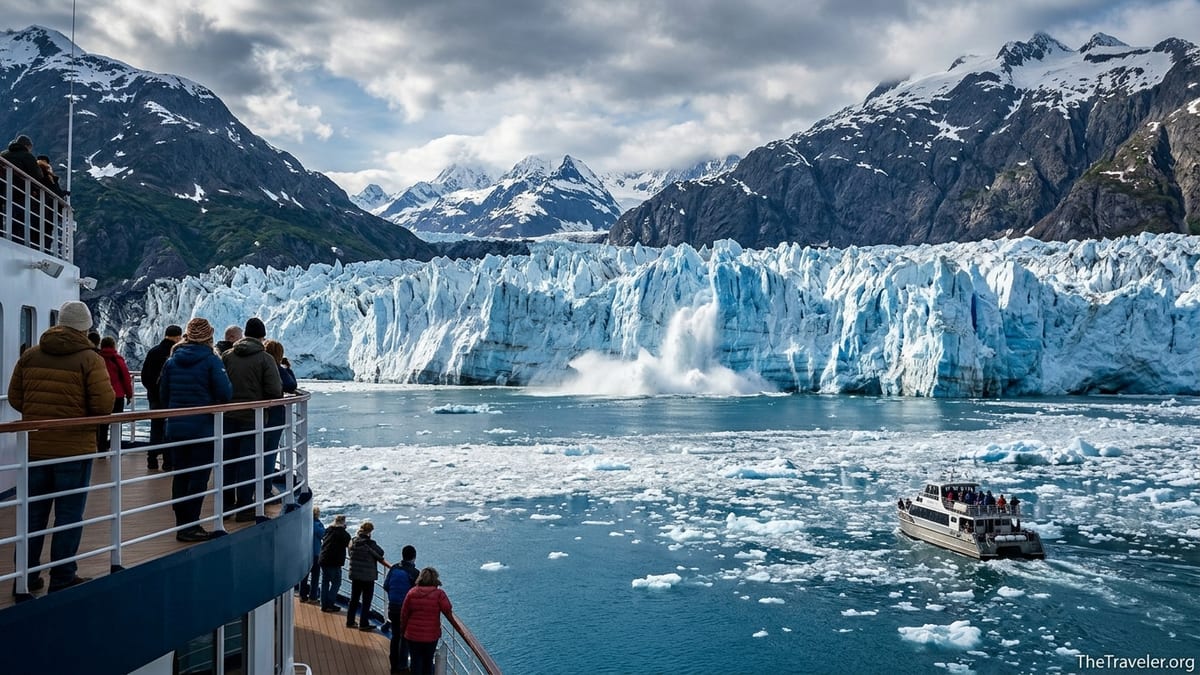
Understanding the Layout of Yakutat Bay, Disenchantment Bay and Hubbard Glacier
To understand approach distances, it helps to picture the geography. Large cruise ships enter from the Gulf of Alaska into Yakutat Bay, a broad body of water on Alaska’s remote Gulf coast. From there they swing north toward the narrower Disenchantment Bay, which stretches roughly 10 miles from its southern entrance near Point Latouche to the head of the bay at Hubbard Glacier’s towering ice front.
Hubbard itself is enormous. The calving face that cruise visitors see is roughly 6 miles wide where the glacier meets the sea, with ice cliffs often 200 to 400 feet high. The glacier is one of the few in Alaska that has been generally advancing in recent decades, periodically pushing into Russell Fiord and even damming it in 1986 and 2002, events that underscored how dynamic and powerful this ice river can be.
Disenchantment Bay is not a straight hallway with a flat floor. It has side inlets, underwater shoals, and a constantly changing pattern of floating ice that drifts with wind and tide. Cruise ships typically follow a deep central channel and then slow to maneuver among loose ice as conditions allow. The apparent distance in photos can be deceptive because of the bay’s scale: a ship a mile or two away from the face can still seem quite close against the backdrop of the glacier’s vast wall of ice.
Between the main glacier and visiting ships lie fields of brash ice, growlers and small icebergs. These scattered chunks of ice are both the attraction and the main navigational challenge. The bay’s geography funnels this ice into and out of the approach route, creating daily and even hourly variations that no itinerary can fully predict months in advance.
How Close Can Cruise Ships Get in Practice?
There is no single published minimum or maximum distance that applies to all cruise ships at Hubbard Glacier. Approach distance is a judgment call made in real time by the ship’s master and bridge team, advised by pilots familiar with Yakutat and Disenchantment bays. On clear days with limited floating ice and light winds, captains of large ships have at times brought vessels to within roughly half a mile to a mile of the ice face, according to passenger logs, cruise-line marketing descriptions and bridge commentary recorded on recent sailings.
On the other end of the spectrum, there are credible reports from 2025 and 2026 of large ships holding position several miles from the glacier. One 2025 video diary from a repositioning cruise described the ship staying about 5 miles back because the inner bay was clogged with seasonal ice. In August 2025, a passenger on Caribbean Princess wrote that the ship “could not get anywhere near” Hubbard, with distant views and no dramatic close-up of the calving front. These accounts align with the known phenomenon of “ice choke,” when wind and tide compact loose ice into dense bands that are unsafe to penetrate with a large vessel.
There are also more optimistic anecdotes. In May 2026, a traveler on Celebrity Solstice reported that the ship was able to work in among sparse ice and get “crazy close,” estimating the distance as perhaps a few hundred yards. That number is almost certainly a rough visual guess rather than a measured range, but it does reflect that in some spring conditions, with cooperative tides and good visibility, a modern cruise ship can safely approach to within well under a mile of the face.
It is important to treat almost all passenger distance figures as anecdotal. Most ships do not routinely announce exact ranges in nautical miles, and human perception over snow and ice is notoriously unreliable. Still, the pattern is clear: recent seasons have seen everything from impressive close-up views under a mile to conservative approaches several miles away, with conditions on the day dictating the result.
Why Experiences Differ: Ice, Weather, Maneuvering Room and Safety
The most immediate constraint is ice. Hubbard Glacier is extremely active, calving a near-constant stream of icebergs and smaller chunks. In calm weather, this ice can spread out and thin as it drifts away from the face. After strong onshore winds or an overnight tide change, the same area can be filled with a consolidated belt of ice several ship lengths thick. Captains must assess not only what the ship can push through, but whether there will be enough clear water to turn and retreat if conditions worsen or engines suffer a fault.
Underwater ice is another concern. Growlers and bergy bits may ride low in the water and be difficult to see, especially in choppy seas or flat light. The 2022 incident in which a large cruise ship struck a piece of submerged ice near Hubbard in foggy conditions is a reminder that close approaches carry genuine risk to hull and propulsion systems. Modern radar and ice-detection tools help, but they do not remove the need for conservative seamanship in an environment full of hard, mobile obstacles.
Visibility, wind and sea state all influence how close is prudent. In thick fog, the bridge team loses visual reference to both ice concentrations and to the glacier face itself, making it harder to judge distance and maneuvering room. Strong crosswinds can push a high-sided vessel sideways toward ice floes or shoal areas faster than thrusters and rudders can compensate. Steep chop can mask small ice pieces and strain stabilizers. On such days, a captain may elect to hold position well down-bay, even though passengers can see glossy marketing images of other ships that appear nose-to-face with the glacier.
Mechanical and operational factors also play a role. If a ship is operating with one engine or thruster out of service, or if company policy demands extra caution following a recent ice incident, the approach plan may be more conservative. Schedules matter too. A captain facing tidal deadlines for reaching the open Gulf or a fixed arrival slot at the next port cannot always spend hours slowly probing ice fields for a marginally closer view.
Small Expedition Vessels, Excursion Catamarans and Big Ships
Travelers often assume that smaller vessels can simply nose right up to Hubbard Glacier at will. The reality is more nuanced. Small expedition ships, such as 200-passenger coastal vessels operated by lines like UnCruise Adventures or Lindblad Expeditions, do benefit from shallower draft and greater maneuverability. They can weave more easily among loose ice and may safely operate in narrower lanes than a 3,000-passenger megaship. However, they are still subject to the same basic constraints of underwater hazards, calving risk and wildlife guidelines, and their captains answer to insurers and regulators that expect cautious operations.
Excursion catamarans offer a different experience. Companies working with major lines, including Allen Marine Tours, operate fast, twin-hulled sightseeing boats that rendezvous with cruise ships in Yakutat Bay on Hubbard days. Passengers who book these premium add-on excursions transfer to the catamaran to continue deeper into Disenchantment Bay while the main cruise ship holds farther back. Recent marketing descriptions and passenger reviews from 2025 and 2026 indicate that these catamarans can often reach the inner part of the bay and linger closer to the ice than the cruise ships do, sometimes remaining in sight of active calving for 30 to 60 minutes when conditions allow.
Local operators based in Yakutat, such as Yakutat Charter Boat Company and Yakutat Charters, also run Hubbard Glacier day trips for independent travelers. These smaller boats may carry only a handful of guests and can feel very intimate compared with a large cruise ship. Yet they, too, must respect ice conditions, visibility and marine mammal guidance. On days when the inner bay is choked with dense ice or seal numbers are high, they may turn around well short of the closest distances they have achieved on previous trips.
The key point is that vessel size expands or limits possibilities, but it never guarantees access. A nimble catamaran may indeed get substantially closer than a large ship on a clear June afternoon with scattered ice. On a foggy morning following a night of heavy calving, that same catamaran might prudently keep several ship lengths farther back than passengers expect.
Harbor Seals, NOAA’s Disenchantment Bay Guidelines and Legal Protections
Hubbard Glacier is not only a tourist attraction; it is also vital harbor seal habitat. Each spring and early summer, thousands of seals haul out on ice floes in Disenchantment Bay to give birth and nurse pups. Research by NOAA Fisheries has documented that this glacial bay supports one of the largest seasonal aggregations of harbor seals in the region, with mothers and pups heavily using the ice-covered waters near Hubbard’s face during the pupping season.
To reduce disturbance to seals in glacial fjords, NOAA Fisheries has issued voluntary harbor seal approach guidelines for Alaska’s tidewater glacier bays. The general code of conduct advises vessels to remain roughly 500 yards away from seal concentrations on ice when possible, reduce speed in seal-rich areas and limit viewing time. For Disenchantment Bay specifically, NOAA’s recommendations for the pupping period from approximately May 15 to June 30 advise vessels to remain more than about 1.5 miles from Hubbard Glacier and to favor routes along the eastern side of the bay, where seal densities are lower, while avoiding dense nursery areas closer to the face.
These Disenchantment Bay measures are recommendations rather than hard-and-fast legal lines on the water. They are intended to help tour operators, charter captains and independent boaters choose routes that minimize flushing seals from ice floes or separating mothers and pups. They sit alongside broader federal protections under the Marine Mammal Protection Act, which makes it illegal to harass or disturb seals and other marine mammals, and alongside general navigation rules that already obligate captains to avoid collisions and operate at safe speeds.
In practice, many responsible operators treat the NOAA guidelines as quasi-standard operating procedure. Maintaining more than 1.5 miles from the glacier face during peak pupping, sticking to the recommended transit corridors and slowing down near ice floes all reduce the risk of pups entering the water prematurely, becoming separated from mothers or suffering stress that can affect survival. Because enforcement focuses on the underlying prohibition on harassment rather than on the suggested distances, cautious operators often choose even wider buffers than the minimums in marginal conditions.
This means that if your cruise approaches Hubbard in late May or June and the ship seems to linger well down-bay, distance decisions may be influenced as much by conservation as by navigation. Even if visibility is good and the ice looks manageable from a passenger’s perspective, the bridge team may be balancing a desire for dramatic views with a professional commitment to minimizing disturbance to nursing seals in the nursery area ahead.
Why Ice-Covered Water Matters for Seal Pups
From a traveler’s viewpoint, the field of drifting ice between ship and glacier is scenic foreground. For harbor seals, it is essential nursery habitat. Pups are born on the ice, which offers refuge from some predators, a stable platform for nursing and resting, and proximity to productive feeding waters. The broken, jumbled floes near Hubbard’s face provide an archipelago of safe haul-out spots for mothers and pups spread across the bay.
When a large vessel passes too close or moves rapidly through these floes, seals may flush into the water en masse. Adult animals can usually recover from such events, but for young pups still building strength and thermal resilience, unnecessary entries into near-freezing water can increase energy expenditure and the risk of hypothermia. Repeated disturbances may disrupt nursing schedules and maternal care. Long-term research in Alaskan glacial fjords, including Disenchantment Bay, has linked high vessel traffic and close approaches to measurable changes in how and where seals use the ice.
This is why NOAA’s fjord-specific guidance emphasizes routing and separation from ice floe concentrations rather than only a fixed buffer around the glacier face. For captains, the question on a seal-rich June morning is not simply “How close can we get to the ice wall?” but “Can we thread a path that gives passengers a meaningful view without pushing a moving wall of disturbance through a nursery?” Often that leads to a decision to hold off at a respectful distance, even if charts and sonar show enough depth to continue.
For passengers, recognizing that the quieter, more distant viewpoint they experience in peak pupping season is part of a deliberate conservation choice can change perceptions. What feels like a missed opportunity for an extreme close-up is, in many cases, a practical compromise that allows both glacier viewing and protection of a sensitive wildlife spectacle unfolding out of sight among the floes.
Recent Passenger Reports: 2025 and 2026 Approaches
Firsthand accounts from recent seasons illustrate how varied Hubbard Glacier experiences can be. In mid-2025, travelers on several mainstream lines reported in public reviews that their ships remained multiple miles from the ice, with one Carnival passenger estimating a distance of around 5 miles based on information said to be relayed from the bridge. A Princess guest on an August 2025 northbound cruise noted that the ship “could not get anywhere near it,” with the captain citing ice conditions over the public address system.
By contrast, reports from late May and early June 2026 describe significantly closer approaches for some sailings. One passenger aboard Celebrity Solstice recounted that the ship was able to work through scattered ice and approach to what felt like only a few ship lengths from the face, guesstimated at perhaps a few hundred feet. While such estimates are almost certainly rough and should be treated as anecdotal rather than precise, they do confirm that under favorable early-season conditions, large ships sometimes achieve very close vantage points.
Excursion catamarans and small-boat tours in 2025 and 2026 also show a spread of outcomes. Several cruise vloggers have documented catamaran excursions in which the smaller vessel stopped much nearer the calving face than the parent ship, at ranges where the sound of exploding ice and splash plumes dominated the experience. Others, including guests who paid premium prices in 2026 for special Hubbard add-ons, have expressed frustration when dense ice or fog limited how close the excursion boat could safely proceed, even as marketing materials depicted ideal scenarios.
Because neither cruise lines nor local operators publicly publish a log of exact approach distances for each date, most of these passenger figures should be seen as narrative color rather than measurement. Still, taken together, they confirm a pattern that matches what captains and NOAA scientists describe: over the last two seasons, travelers have seen everything from distant, weather-constrained views to near-face encounters, with no itinerary able to promise a specific range in advance.
What You See and Hear From Afar: Calving, Optics and Perception
Even from several miles away, Hubbard Glacier is undeniably impressive. The sheer width of the ice front and the stark contrast between white cliffs and dark mountains give passengers a powerful sense of scale. However, the experiential difference between viewing from 4 or 5 miles and being inside a mile is significant. At closer distances, the brittle crack of breaking ice and the delayed boom of larger calving events become audible over the ship’s decks, and smaller cascades that would be invisible at range can be seen tumbling down the blue-tinged wall.
Optics play a major role in shaping expectations. Modern smartphones with ultra-wide lenses can make even relatively close viewpoints look distant and flat in photos. Conversely, tightly cropped telephoto shots shared on social media can give the impression that a ship is nose-to-ice when, in reality, there may still be a great deal of water and ice floes in between. Passengers with binoculars or cameras in the 200 to 400 millimeter range typically report much more satisfying views of individual crevasses, seracs and calving events than those relying on the naked eye alone, especially when the ship must remain over a mile out.
Sound travels in complex ways over cold water. On still days, passengers sometimes report hearing a faint rumble or sharp cracks even from several miles away, particularly during major calving events. On windy days, deck chatter and wind noise can mask all but the largest collapses until the ship is quite close. This can feed into the perception that a captain who stops at 2 miles has delivered a muted or “quiet” glacier experience compared with a day when another ship reached within a mile and the bay was still enough to carry every crack and splash.
For travelers, this means that bringing simple tools such as compact binoculars can do more to improve a Hubbard viewing experience than obsessing over whether your specific sailing is likely to reach a published distance. A voyage that tops out 2 or 3 miles from the face can still offer dramatic visuals and occasional audible calving with the right expectations and equipment.
Seasonal Patterns, Approach Routes and Small-Boat Options
Season has a clear influence on approach possibilities, although it does not dictate outcomes on its own. Early-season cruises in late April and May may face lingering winter ice in Yakutat and Disenchantment bays, along with variable spring storms. However, cooler water temperatures can sometimes keep the immediate approach area less choked with melting brash ice than in midsummer, and several May 2025 and May 2026 accounts describe ships and catamarans making impressively close approaches under clear skies.
From mid-May to the end of June, peak harbor seal pupping coincides with the expansion of seasonal ice in the inner bay. During this window, NOAA’s Disenchantment Bay recommendations encourage vessels to remain at least about 1.5 miles from Hubbard’s face and to favor routes along the eastern side of the bay to avoid dense seal rookeries. Captains must balance these conservation guidelines with guest expectations and ice navigation. The net effect, based on recent bridge commentary and passenger reports, is that many visits in this period involve moderate but not extreme approach distances, with more frequent decisions to hold well short of the closest ranges seen earlier or later in the season.
July and August often bring warmer temperatures, increased calving and, at times, heavy brash ice bands that can limit maneuvering space near the face. Some of the most distant approach reports over the last two years come from late-summer cruises during spells of thick ice or persistent fog. On the other hand, when winds cooperate and the bay has flushed clean, late-summer small-boat excursions have documented spectacular, close-in sessions parked near tidal cracks in the glacier.
Small-boat options remain the best way to increase your odds of a nearer view, but even they cannot promise it. On major lines, Hubbard Glacier catamaran excursions have recently been priced in the ballpark of several hundred dollars per person, with some 2026 forum posts mentioning prices approaching or exceeding 400 dollars per guest and special charters running higher. Independent Yakutat-based charters can vary widely in price and availability and usually require more complex travel logistics. Travelers considering these options should be clear-eyed: the premium pays for flexibility and a higher probability of closer access, not for a contractually guaranteed distance from the glacier.
Key Factors That Affect How Close You Get
Approach decisions at Hubbard Glacier reflect a matrix of environmental, operational and regulatory considerations rather than a single rule. Ice distribution across Disenchantment Bay is one of the most critical factors. If satellite imagery, pilot reports and direct observation show consolidated ice bands between the ship and the glacier, the captain may decide that pushing farther risks entrapment or damage, even when the weather is fine.
Visibility from fog, low clouds or driving rain can quickly curtail a hopeful approach. Mechanical status is another underappreciated element: a ship operating with a thruster issue, reduced propulsion redundancy or other technical limitations may receive a more cautious ice navigation envelope from its fleet operations center, regardless of what other vessels appear to do on social media. Finally, during May and June, the presence and distribution of harbor seals on the ice directly influence routing if the bridge intends to adhere to NOAA’s pupping-season guidelines.
In simplified form, the distance you ultimately experience will be shaped by how these factors interact on the day of your visit rather than by ship brand alone. Two identical vessels on the same itinerary, one visiting in clear May weather on a day when ice is dispersed and seals are concentrated off the recommended route, and another arriving during a foggy June morning with thick ice bands and seals near the face, will likely offer their passengers very different stories about “how close we got.”
Travelers should also understand that the bay approach itself is part of the experience. Even when a conservative stopping point is chosen, the hours spent sailing up Yakutat and into Disenchantment Bay offer extensive views of mountains, side glaciers and ice-filled waters. On some days, wildlife sightings of whales, otters and distant bears along shorelines become as memorable as the glacier itself, softening the impact of a more distant final position.
Practical Advice, Choosing a Cruise and What to Expect
For travelers who prioritize maximizing their odds of a closer Hubbard Glacier encounter, a few practical guidelines emerge. Itineraries that include a dedicated Hubbard viewing day with no competing scenic cruising commitments elsewhere in Alaska generally allow captains a bit more time to probe the ice and adjust position. Ships working with established catamaran partners give guests a small-boat option that, in recent seasons, has often resulted in nearer views than those available from the main vessel. Booking in the shoulder seasons of late May or late August may offer a balance between manageable ice and reasonable weather, though there are no guarantees.
When evaluating cruises, it can be useful to look at recent, line-specific commentary about how captains have handled Hubbard approaches, but treat this information with caution. Policies can change after a single close call or wildlife incident, and one captain’s comfort level is not necessarily shared across an entire fleet. Instead of expecting a certain number of yards, frame Hubbard as a high-variability scenic highlight where any safe access into Disenchantment Bay is a privilege, and where added-cost small-boat excursions offer an expanded but not absolute chance of intimacy with the ice.
Once onboard, listening carefully to the bridge commentary on approach day can clarify what is happening. Captains who announce that thick ice, fog or seal concentrations are limiting progress are not making excuses; they are sharing a professional risk assessment shaped by regulations, corporate safety culture and real-time observations. If your ship holds several miles off the glacier while a catamaran or local charter presses farther in, the difference reflects not favoritism but the much smaller footprint, draft and momentum of the excursion vessel.
Passengers rarely need to worry when their vessel remains farther away than anticipated. A conservative position usually means that navigation, engineering and wildlife teams have collectively decided that the risks of moving closer outweigh the visual benefits. Glacier viewing in Alaska is always subject to cancellation or modification, just like port calls impacted by storms. Seeing the glacier from a distance, or watching it vanish into a bank of fog while the ship turns away, is frustrating but not a sign of negligence; it is often a sign that safety and conservation are being given priority over spectacle.
Realistic Expectations and Common Questions
Travelers often ask what the “closest possible” approach is at Hubbard Glacier. In theory, a nimble small boat on a calm, clear day with minimal ice and no seal concentrations could maneuver quite near the ice face, holding outside the immediate collapse zone while giving guests towering views of the blue wall. In reality, most mainstream cruise guests will experience viewing distances measured in fractions of a mile to several miles, with the tighter end of that spectrum relatively uncommon and heavily dependent on conditions.
Another frequent question concerns legal limits. Outside of specific closures such as those that exist in Glacier Bay National Park for other inlets, there is no universal statute that states “all ships must remain X miles from Hubbard Glacier.” Instead, captains and operators must obey broad federal navigation rules, the Marine Mammal Protection Act’s prohibition on harassment and, for many, voluntary NOAA guidance such as the harbor seal recommendations for Disenchantment Bay. Company policies, insurance requirements and the professional judgment of the bridge team then fill in the details.
Passengers also sometimes worry that rotating the ship or limiting time near the face means they are being shortchanged. In fact, slow 360-degree rotations are standard practice when conditions permit, giving balconies on both sides of the vessel a chance for good views. Time limits may reflect a desire to reduce noise and disturbance in seal habitat, to stay on schedule for tides and port arrivals, or to maintain a safe margin before weather changes. If an advertised “Hubbard Glacier” visit is canceled entirely, travelers can reasonably expect the line to explain whether the cause was weather, mechanical issues or other safety concerns, but not to second-guess the captain’s specific ice-navigation choices from the vantage point of the upper decks.
In the end, approaching Hubbard Glacier is less like driving to a fixed overlook and more like piloting an airliner through dynamic weather. Routes, altitudes and holding patterns change from day to day for reasons that may not be clear to passengers in the cabin. Understanding the geography of Yakutat and Disenchantment bays, the ecological importance of the ice-covered waters to harbor seals, and the genuine navigational challenges involved can turn a variable, sometimes distant encounter with Hubbard into a more informed and satisfying chapter of an Alaska journey, rather than a simple contest over who got closest.