


Hubbard Glacier is one of the showpiece sights of an Alaska cruise, a five-mile-wide wall of ice that calves thunderously into Disenchantment Bay on the edge of the Gulf of Alaska. Yet the warmest summer month is not automatically the best time to see it. From May through September, shifting weather, wildlife protections, floating ice and cruise demand all affect how close your ship can get and how likely you are to enjoy a clear, memorable view. This guide uses NOAA climate data near Yakutat, official harbor seal guidelines and real 2027 cruise examples to help you decide when to go.
Get the latest updates straight to your inbox!
Understanding Hubbard Glacier’s Setting and Seasonal Tradeoffs
Hubbard Glacier meets the sea at the head of Disenchantment Bay, north of Yakutat and exposed to the Gulf of Alaska. That location means your experience depends on two different environments. First are the broader regional conditions along the Gulf, where NOAA climate normals for Yakutat show cool, moist maritime summers with average daily highs only in the low to mid 50s Fahrenheit from May through September, peaking in July around the mid 50s. Second are the micro-conditions inside Disenchantment Bay itself, where towering ice, sheltered water and dense floating ice can make it feel colder and limit how closely large ships can safely approach the face.
Yakutat’s climate records for 1991 to 2020 illustrate that even in July, average high temperatures hover in the low to mid 50s Fahrenheit, with frequent cloud cover and significant precipitation. Nearby Gulf locations such as Kodiak and the northern coastal strip show similar summer patterns: relatively small temperature swings, high humidity and frequent low clouds rather than clear blue skies every day. These figures represent regional averages; they are not a guarantee of the specific conditions on the day your ship enters Disenchantment Bay. A July afternoon can be cold, windy and foggy, while a late May morning can be bright and calm.
Inside Disenchantment Bay, most of the factors that shape your viewing are dynamic rather than seasonal averages. Harbor seal pupping affects where vessels are encouraged to travel in late spring. Floating bergs and brash ice from Hubbard’s active terminus can create natural barriers that prevent big cruise ships from closing the distance, even on a sunny day. Wind direction and strength control the distribution of ice and the ease of maneuvering. For travelers choosing a month, the key is recognizing that warmer air in July or August does not inherently mean closer access or clearer views than May or September.
Across the 2027 season, major cruise lines such as Princess, Holland America, Celebrity and Norwegian list Hubbard Glacier scenic cruising days from late May through mid-September on one-way Vancouver to Whittier or Seward itineraries and on selected roundtrip Vancouver and Seattle sailings. Comparing the same or similar itineraries in May, June, July, August and September shows how fares climb and fall over the season, even though the glacier itself remains a powerful presence throughout.
NOAA Climate Patterns Near Yakutat vs. Disenchantment Bay
Yakutat State Airport provides the closest long-term NOAA climate record to Hubbard Glacier. Normals for 1991 to 2020 show average daily highs rising from the upper 40s Fahrenheit in May to the mid 50s in July and then easing back into the low 50s by September. Typical overnight lows warm from the upper 30s to low 40s in May into the high 40s in July, then slide back toward the low to mid 40s by September. Historical summaries also show heavy annual precipitation, with May one of the drier late-spring months, June and July relatively moist but not at their peak, and September turning substantially wetter again as the Gulf’s autumn storm pattern returns.
Yakutat’s hourly sky-cover normals indicate that fully clear days are relatively uncommon at any point in the cruise season. Broken and overcast conditions dominate, with low cloud and mist frequent along the Gulf Coast. That helps explain why many cruise travelers who visited Hubbard Glacier in recent summers report everything from brilliant crystalline mornings to solid gray ceilings with light drizzle, sometimes within the same week. Climate normals describe the probability landscape, not your specific outcome.
Disenchantment Bay, however, behaves as a smaller, semi-sheltered fjord environment. The steep rock walls and the immense ice face create their own localized airflow. Katabatic winds can spill off the glacier, making the air feel much colder than Yakutat’s airport readings. On calm days, though, the bay can be relatively glassy, with barely a ripple except for calving waves. NOAA’s public climate datasets do not provide separate temperature, wind or cloud normals for the bay itself, so any monthly characterization here needs cautious language. The essential point is that even if Yakutat records a mild 55-degree cloudy afternoon, you may still experience windchill near freezing on your balcony or the open observation deck.
Similar caution applies to fog and low cloud. Along the Gulf of Alaska, marine layers can form any time from May through early autumn. Local forecasters sometimes note increased frequency of coastal fog during late summer and early autumn as sea surface and air temperature contrasts shift, but these patterns are variable and change from year to year. That variability is why it is not possible to assign precise monthly visibility percentages for Hubbard Glacier; instead, travelers should expect a real chance of overcast conditions in every month, but also the possibility of dramatic clearing at almost any time.
Wildlife Protections: May 15 to June 30 Harbor Seal Guidelines
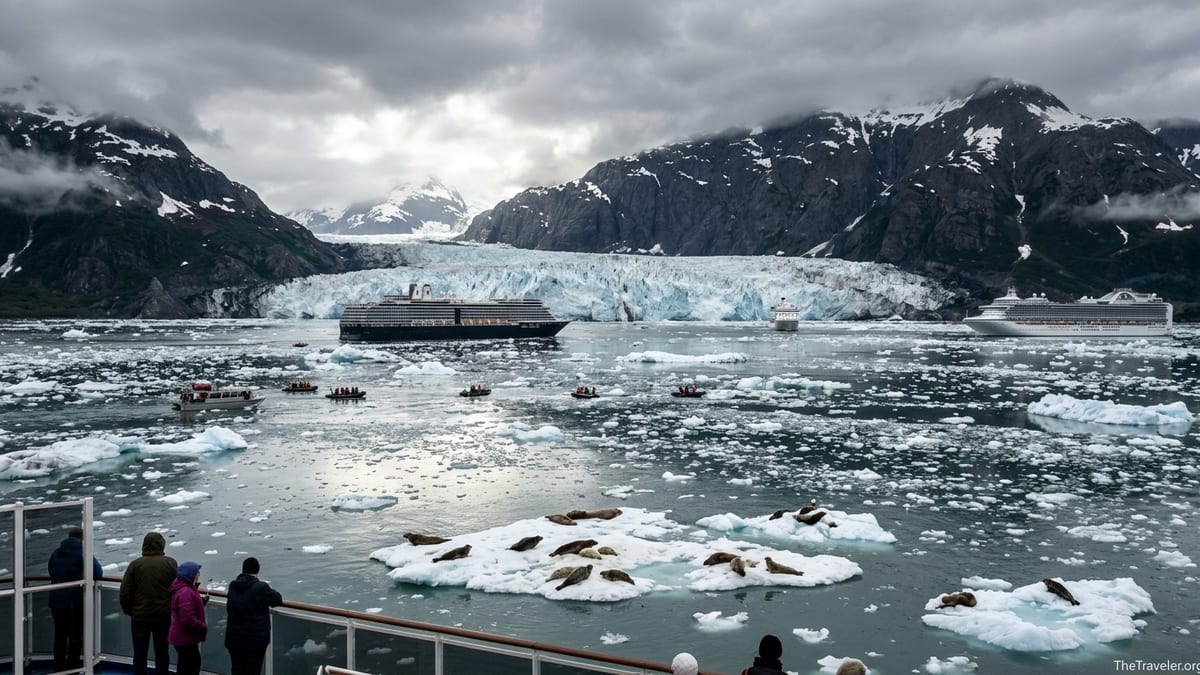
Harbor seals haul out on the floating ice in front of Hubbard Glacier in high numbers during late spring, when females give birth and nurse their pups. NOAA Fisheries has issued Alaska Harbor Seal Approach Guidelines in Glacial Fjords that include site-specific recommendations for Disenchantment Bay between May 15 and June 30. For that period, NOAA strongly encourages all vessels, from kayaks to cruise ships, to reduce disturbance in high-density nursery areas used by mothers and pups. Guidance includes staying well away from heavy concentrations of seals on ice floes and moderating speed to reduce wake that could wash pups from the ice.
These harbor seal measures are framed as voluntary approach guidelines rather than blanket enforceable exclusions for large cruise ships under all circumstances. However, NOAA makes clear that the Marine Mammal Protection Act still applies, and disturbing seals can violate federal law. In practice, major cruise operators integrate the guidance into their navigation policies and pilotage instructions. For example, during the recommended pupping window, cruise captains are typically briefed to avoid penetrating dense seal ice fields directly in front of the glacier, even if an ice-free lane seems technically passable. Instead, they may hold position farther back or work the edges of the bay where seal concentrations are lower.
These recommendations do not close Disenchantment Bay to cruise traffic but they can influence how close a vessel feels comfortable approaching, particularly in late May and June when seal pups are most vulnerable. Smaller tour boats that transfer guests from the main ship may be given their own routing guidance within the bay. For travelers, the takeaway is that late May and June offer strong chances to see harbor seals and pups on ice, but those same conservation considerations may limit how near the bow gets to the most active part of the ice face, especially if a thick field of nursery ice lies in the ship’s direct path.
Because NOAA’s guidance is advisory rather than a simple yes-or-no rule, results differ by day. If ice and seals are spread out, a ship may thread in relatively close without obvious disturbance. On another day in the same week, a compact mat of seals and floating ice might lead the bridge team to stop significantly farther back. That nuance underscores why no month can be labeled “best for closest approaches” solely by temperature or calendar date.
Month-by-Month Hubbard Glacier Experience: May Through September
May cruises to Hubbard Glacier sit at the shoulder of the season. Regional climate normals around Yakutat show average daily highs in the upper 40s to around 50 degrees Fahrenheit, with relatively lower rainfall than early autumn and a mix of clear and cloudy days. Peaks around the bay are often still snow-covered, giving photographers crisp contrast between blue ice, white mountains and dark rock. 2027 one-way itineraries in late May on mainstream lines such as Princess and Holland America commonly show starting balcony-category fares several hundred dollars lower than high-summer equivalents on the same route, reflecting softer early-season demand. On a late May sailing from Vancouver to Whittier, for example, a balcony cabin might price in the low to mid 1,200 US dollar range per person before taxes and fees, compared with significantly higher midseason departures on a similar ship.
June brings longer days, with southern coastal Alaska approaching the maximum daylight of the year. Sunrise can come very early, and twilight lingers late into the evening, which helps with glacier viewing even if your scenic cruising window falls outside midday. Yakutat’s average highs nudge into the low 50s, while overnight lows typically sit in the mid 40s. Rainfall and cloud cover stay frequent but not yet at their autumn peak. In 2027, June sailings that feature Hubbard Glacier often show balcony fares that have risen from May levels yet still undercut prime July dates. A seven-night Vancouver roundtrip with Hubbard Glacier scenic cruising in mid-June on a premium line may list balcony cabins starting around 1,400 to 1,700 dollars per person, depending on promotions.
July and August deliver classic summer-vacation timing. School holidays in North America drive demand, and many families target these months for their once-in-a-lifetime Alaska cruise. Yakutat’s average highs reach the seasonal ceiling, around the mid 50s Fahrenheit, and overnight lows hover near 50. That is pleasantly cool in theory, though wind off the glacier still encourages serious layering on deck. Historical climate data show these months remain quite humid with recurring overcast and showers, not a dry Mediterranean-style summer. On 2027 itineraries that include Hubbard, balcony fares in July can climb into the 2,000 to 2,500 dollar range per person on popular ships and dates, especially during holiday weeks, while late August may soften slightly but still sit well above May rates for comparable cabins on similar itineraries.
September marks the late-season shoulder. Average temperatures at Yakutat slide back toward the low 50s for daytime highs and low 40s for nights, but the more important change is atmospheric: the Gulf coast heads into a wetter period and low-pressure systems become more frequent. Cruise schedules still list Hubbard Glacier calls through mid or late September, but operators also plan with an eye on stronger frontal systems and potential sea-state issues along the open Gulf segments. As demand falls after school resumes, 2027 balcony fares for Hubbard-inclusive itineraries in early to mid September often return to something like late May pricing, sometimes with additional promotions that include onboard credit or included gratuities. Daylight reduces noticeably compared with June or July, which can affect how bright your glacier viewing window feels, but the softer prices appeal to budget-minded travelers who can accept more changeable weather.
Floating Ice, Calving Behavior and Approach Distance
Hubbard Glacier is known as one of the most active tidewater glaciers in Alaska, with a long-term record of advance and frequent calving events. However, scientific observations and operator experience both caution against assuming that warmer air temperatures later in summer automatically deliver more spectacular icefalls or closer approaches. The main controls on ship access are the volume and distribution of floating ice in Disenchantment Bay on a given day and the dynamics at the glacier’s terminus, not the regional monthly average temperature alone.
On some cool, early-season May visits, a strong tide and offshore winds can clear a relatively open lane through the ice, allowing large cruise vessels to move comfortably within a practical viewing distance of the five-mile-wide face. On other days in the same month, a surge of calving combined with currents may produce a packed belt of large bergs and densely clustered brash ice that forms an effective wall several kilometers from the glacier. Captains must balance guest experience with hull safety, and many lines adopt conservative internal standards that limit how far they will push into thick ice, regardless of whether the sun is shining.
As summer progresses into June and July, the mixture of harbor seal nursery ice and calved glacier ice can at times increase the density of floes in certain zones of the bay. NOAA’s pupping guidance from May 15 to June 30, combined with company wildlife policies, can lead bridge teams to avoid directly penetrating tight rafts of ice where seals are resting. Even when pups disperse later in July and August, patterns of melting, refreezing and calving can rearrange the ice into bands and clusters that either open or close navigational paths. Calving itself does not follow a simple temperature switch. There can be dramatic collapses during cool, overcast weather and relative lulls during warm afternoons.
Because access is so condition-dependent, cruise lines generally avoid promising specific approach distances months in advance. Pre-cruise documentation for 2027 sailings that list “Hubbard Glacier scenic cruising” typically emphasize that the ship will spend several hours in Disenchantment Bay and maneuver as closely as safety permits, with the bridge team making real-time decisions. The variation is evident in recent traveler reports, which describe everything from ships holding roughly a mile off the face with thick intervening ice to closer positions that feel almost at the edge of the towering wall. Any month between May and September can produce either scenario; no month is guaranteed “best for closeness” independent of daily ice and wildlife conditions.
Wildlife and Crowds by Month: Seals, Whales and Seabirds
Wildlife is a major draw of Hubbard Glacier cruises, but different species favor different habitats. Harbor seals are the most closely associated with the ice in front of the glacier, especially during pupping season from mid May through late June, when mothers and pups rest on floes scattered across Disenchantment Bay. Travelers in those weeks often report seeing dozens or hundreds of seals on the ice as the ship slowly navigates the bay, though actual numbers in view depend on the route chosen in response to NOAA guidance and daily conditions.
Whales and porpoises are present across the broader Gulf of Alaska and Inside Passage region throughout the cruise season, but they are not guaranteed near the glacier itself. Humpback whales frequently forage in nutrient-rich zones along the Gulf and in channels near Icy Strait or Chatham Strait, which are commonly visited on Hubbard-inclusive itineraries, especially on one-way routes between Vancouver and Whittier or Seward. This means that while you may well see humpbacks during your overall cruise in June, July or August, your closest encounters are more likely in open water or near other ports rather than during the precise hours in Disenchantment Bay.
Seabirds, including kittiwakes and other gull species, often gather around the glacier front to feed on small fish and invertebrates stirred up by calving events. These birds can be present in significant numbers throughout the May to September window as long as open water and food are available. Photographers who value bird-in-landscape compositions will find opportunities in all months, though wind and spray in rougher late-season conditions can make shooting more challenging from exposed decks.
Crowding on board and in popular observation areas also shifts by month. May and September sailings, while they can still sell out, often feel slightly less dominated by large family groups because school in many regions is still in session or has restarted. June, July and August departures, especially around major holidays, see more multigenerational family groups and higher occupancy of triple and quad cabins. Practical examples from 2027 pricing show that July sailings including Hubbard often see balcony cabins and family staterooms either sold out or priced significantly above May and September, reflecting that demand pattern. For travelers who prioritize quieter observation decks and easier access to rail space during glacier viewing, late May, early June and mid September can be appealing compromises.
Real 2027 Cruise Examples and Relative Pricing
Looking at specific 2027 departures helps clarify how the calendar affects pricing. For instance, a seven-night Vancouver roundtrip on a premium line that includes Hubbard Glacier scenic cruising might list a late May 2027 balcony cabin around the low to mid 1,200 dollar range per person before taxes, fees and airfare. The same ship and route in mid July could be posted closer to 2,000 dollars or more for the same category, especially for prime-school-holiday weeks. A similar route in early September could drop back toward the upper 1,200 to 1,500 dollar band as demand eases, sometimes accompanied by promotional extras like onboard credit or included beverage packages instead of raw fare cuts.
One-way 2027 itineraries between Vancouver and Whittier or Seward that include both Glacier Bay and Hubbard Glacier often price at a premium relative to simpler roundtrip Inside Passage routes, because they add more glacier time and access to Alaska’s interior by rail or coach. However, even among these, season matters. Brochures and digital planners from major brands show early June and early September departures on these one-way routes typically offering starting veranda fares several hundred dollars below prime mid July dates. In practical terms, a traveler might choose between a 1,700 dollar balcony in early June and a 2,300 dollar balcony in late July on essentially the same itinerary and ship.
Roundtrip Seattle sailings that reach Hubbard Glacier tend to be longer, often 9 to 10 nights, because they must traverse more open ocean on the west side of Vancouver Island. When Hubbard is included, those sailings in July and early August 2027 usually show higher lead-in prices than comparable-length itineraries in May or September that substitute Tracy Arm or Endicott Arm. For budget-conscious travelers determined to see Hubbard, late May and early September from Vancouver, or early June one-way trips, often provide the most favorable combination of fare and glacier time.
It is important to remember that posted brochure rates are only part of the story. Cruise lines frequently adjust prices with early-booking sales, resident rates, past-passenger discounts and last-minute offers if a sailing is not filling as expected. A September 2027 departure that appears only modestly cheaper than July when schedules first publish could later undercut summer prices by a wider margin if shoulder-season demand softens. Booking windows matter too: travelers locking in 12 to 18 months ahead often have their choice of cabins and promotional bundles, while those booking closer to departure may trade flexibility for lower late-breaking fares.
Comparing Months: Conditions, Wildlife and Pricing at a Glance
Between May and September, patterns emerge even though individual days vary widely. In terms of air temperature near Yakutat, May and September both tend to see daytime highs around 50 degrees Fahrenheit with cooler nights in the low 40s or upper 30s. June, July and August lift those highs into the low to mid 50s, with July usually the warmest on average by a few degrees. Daylight peaks in June, when long twilight stretches make it feel as though night never fully arrives, while late September brings noticeably shorter days and a chance that your Hubbard viewing will occur under lower-angle sunlight or more evening shadow.
Rain and cloud cover are persistent factors in every month. Historical data near Yakutat suggest that while early summer does not have a sharply defined dry period, late spring and early summer can be somewhat less dominated by heavy, prolonged rainfall than September, which is part of the coastal rainy season. Fog and low stratus can appear at any point, although anecdotal reports from mariners along the Gulf hint at more frequent marine layers later in summer as sea-air contrasts evolve. Because NOAA’s climate summaries do not break out fog frequency in Disenchantment Bay itself, all monthly comparisons must treat visibility outcomes as approximate.
Approach limitations are most strongly influenced by ice and wildlife considerations from mid May through late June, and by storminess and sea state on Gulf transits later in the season. In May and early June, harbor seal pupping guidance can lead captains to hold farther back from dense ice fields that support many pups, potentially limiting close approaches even on otherwise calm, clear days. In July and August, wildlife constraints lessen but denser belts of calved ice can still form barriers that prevent very close navigation. In September, the greater risk is itinerary disruption from stronger systems along the Gulf that might force timing changes or rare skipped scenic cruising days if conditions at the bay entrance are too rough.
On the human side, average crowding and pricing are lowest in late May and early September, moderate in June and highest in July and early August. Families tied to the school calendar cluster in mid summer, pushing up fares on ships that include marquee glaciers like Hubbard. Travelers flexible enough to sail in late May, early June or mid September usually find more competitive prices for similar balcony cabins and slightly calmer onboard atmospheres, even though no guarantee exists of fewer people at the rail during the glacier viewing window.
Who Should Sail When: Tailored Month Recommendations
Photographers often value lower-angle light, snow on peaks and a balance between wildlife and crowding. For them, late May and early June are particularly attractive. Mountain slopes around Disenchantment Bay tend to retain more snowpack, creating a layered composition of blue ice, white summits and dark evergreen forest. The long days of June also give more flexibility if the ship reaches Hubbard early or late in the schedule. September can deliver moody, dramatic skies and autumnal hues in the lower vegetation, but the higher risk of cloud and rain, plus the shorter days, make it more of a gamble for those chasing classic postcard shots.
Wildlife enthusiasts who specifically hope to see harbor seals and pups on the ice should lean toward sailings between May 15 and June 30, while understanding that the same pupping period may influence how captains navigate the innermost parts of Disenchantment Bay. Those most interested in whales should think at the itinerary scale more than the Hubbard visit alone, selecting routes that include Icy Strait Point, Juneau and open-ocean transits where humpbacks, orcas and porpoises are more reliably encountered, across all summer months. Seabird watchers will find opportunities throughout the season but may particularly enjoy June and July, when productivity along the Gulf and coastal fjords supports dense flocks.
Families bound by school calendars will naturally gravitate to late June, July and early August. Within that window, early July often combines strong daylight, relatively mild temperatures by Alaska standards and a full slate of kids’ programming on family-focused ships. However, these sailings come with higher fares and busier public spaces. Budget travelers, by contrast, will gain more by targeting late May, early June or early to mid September, comparing 2027 balcony and oceanview prices on similar itineraries across several lines. Many find that moving a trip from mid July to late May can free enough cash to upgrade from an inside to a balcony cabin while still spending less overall.
First-time Alaska cruisers who want a balanced experience of ports, glaciers and wildlife, without prioritizing one factor above all others, often find early June and late August to be sweet spots. Early June blends long days, moderate crowds and active wildlife, though harbor seal guidance may somewhat limit how close the ship gets to Hubbard. Late August often retains decent daylight and relatively stable weather, with strong chances of whale watching elsewhere on the route, while prices start to ease from peak summer. Travelers whose absolute top priority is maximizing the chance of a closer approach to the glacier face should look across the whole May to September range and prioritize itineraries that build a generous scenic-cruising window at Hubbard, recognizing that any month can deliver either an intimate or distant view depending on ice and wildlife on the day.
Conclusions, Balanced Booking Window and Key FAQs
For the most balanced combination of daylight, pricing, wildlife and potential viewing conditions at Hubbard Glacier, many travelers will find late May, early June and late August into early September to be the strongest booking window. Late May and early June offer snow-draped peaks, active wildlife and relatively lower fares, tempered by cooler temperatures and, between May 15 and June 30, harbor seal pupping guidance that can affect ship positioning in Disenchantment Bay. Late August and early September bring easing prices after the peak summer rush, continued whale opportunities along the broader route and a slightly higher risk of wetter, more unsettled weather as autumn approaches.
Across all months, the most important lesson is that Hubbard Glacier viewing is controlled by a mix of climate, daily weather, floating ice, wildlife considerations and cruise-line operating decisions. Warmer air in July does not guarantee clearer skies, more dramatic calving or a closer approach than you might experience on a crisp day in late May. NOAA climate data from Yakutat supply valuable context on typical temperatures and rainfall, but they cannot predict the exact fog bank, ice raft or harbor seal nursery pattern your captain will face on any specific 2027 date.
Can June’s harbor seal protection measures prevent my ship from seeing the glacier? No. NOAA’s guidelines from May 15 to June 30 are voluntary but strongly encouraged, focused on reducing disturbance to mothers and pups. They may influence how the vessel weaves through ice and how close it chooses to stop, yet cruise ships still routinely provide compelling glacier views in June. What about July calving? While Hubbard is often very active in mid summer, there is no solid evidence that July always delivers more spectacular calving than cooler months; dramatic events can happen anytime conditions at the terminus favor them, including in May and September.
Is August weather reliably better for visibility? August retains milder air temperatures similar to July, but cloud and rain remain common, and some mariners report more frequent low marine cloud later in the season. That said, many August 2027 sailings will still enjoy excellent Hubbard viewing; it simply cannot be guaranteed. How about September visibility and the risk of missing the glacier entirely? September cruises face a somewhat higher chance of itinerary adjustments along the Gulf due to stronger systems, yet canceling Hubbard scenic cruising outright is still uncommon. On rare occasions, heavy ice at the entrance to Disenchantment Bay, strong winds or visibility issues may force a ship to turn back or limit how far it proceeds. This possibility exists in every month. For your planning, treat a clear, close encounter with Hubbard Glacier as a high-probability highlight rather than an absolute certainty, and choose a month whose broader mix of weather, price and daylight suits the rest of your Alaska adventure.