


More news on this day
As major flight disruptions ripple across Europe and North America, rail operators and airlines are increasingly stepping in for one another, with trains providing a critical back up for thousands of stranded air passengers when the skies grind to a halt.
Get the latest news straight to your inbox!
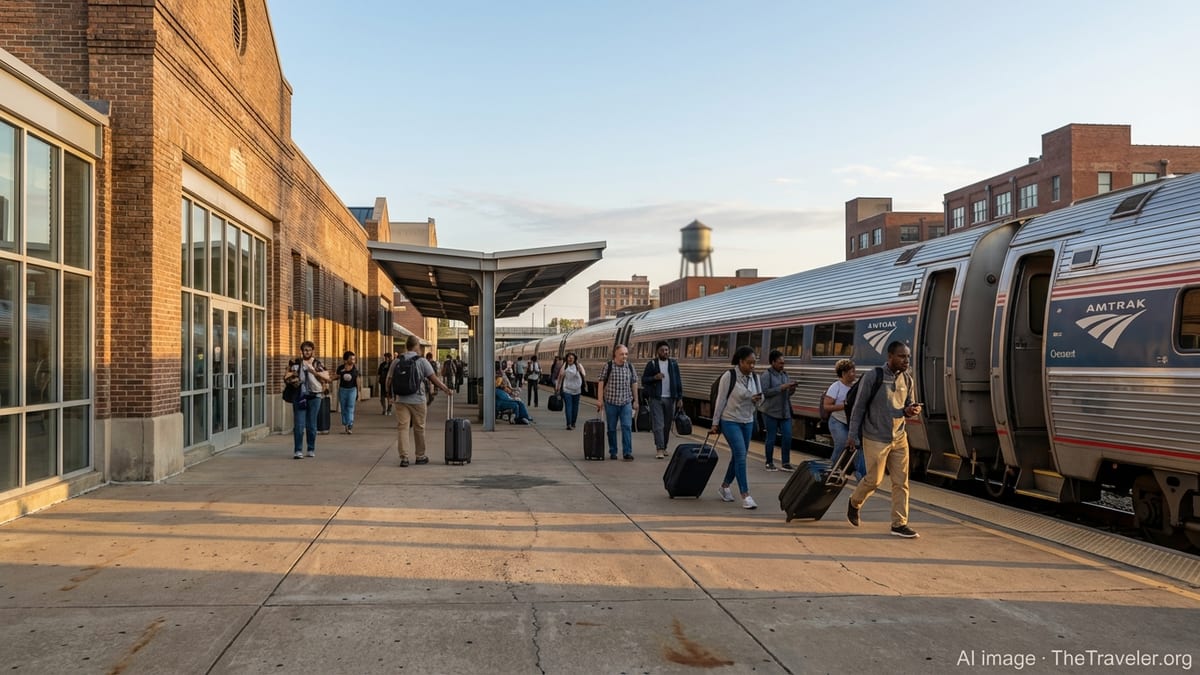
Rail as a fallback when flight schedules collapse
When large scale air disruption hits, rebooking on another flight can take days, especially during peak holiday periods. Rail networks with dense high speed connections are emerging as a practical alternative, particularly on short and medium haul routes where journey times by train remain competitive. Publicly available information from recent disruption events in Europe shows that rail services have been used to move travelers away from congested hubs and toward their final destinations when replacement flights were unavailable or heavily delayed.
Reports from recent strike related cancellations and weather disruptions in Europe describe passengers being advised to consider high speed trains on corridors such as London to Paris and Brussels, or domestic routes in Germany and France, when airlines could not rebook them quickly. In some cases, travelers have combined airline issued compensation or refunds with last minute rail tickets to complete their trips, treating the train as a de facto rescue option when air capacity was constrained.
In the United States, where long distance passenger rail is less extensive, rail has still played a role on key corridors like the Northeast, with travelers switching to Amtrak services when airlines cancel short haul flights between cities such as New York, Washington and Boston. Amtrak’s customer service commitments indicate that the company itself may also seek alternate transportation for its own passengers during major disruptions, underscoring how surface and air networks are increasingly interlinked in contingency planning.
Formal air rail products ease the handover
Beyond ad hoc decisions at the airport, a patchwork of formal air rail products is designed to link tickets across modes so that passengers are not left to improvise when things go wrong. In Germany, the long running Rail&Fly offer ties flight bookings to Deutsche Bahn tickets, allowing passengers on participating airlines and tour operators to travel between any station in the DB network and their departure airport using a through itinerary that appears in global distribution systems under a special IATA rail code. According to reference data on the program, dozens of airlines use Rail&Fly, with more than a million passengers a year benefiting from the combined arrangements.
Some carriers have gone further by branding air rail links as an integrated part of their network. Policy documents show that Lufthansa, for example, allows domestic flight segments to be exchanged for Deutsche Bahn tickets in certain disruption scenarios, converting air passengers into rail travelers at no extra cost when flights are canceled or severely affected. This kind of arrangement effectively turns intercity trains into backup aircraft on domestic German routes, providing resilience when aviation schedules falter.
Similar concepts exist elsewhere in Europe. Eurostar, positioned as a rail alternative to short haul flights between the United Kingdom and continental Europe, publishes disruption guides for travel agents that explain how to handle air related problems, including flexible exchange and refund options when connecting air services are affected. These frameworks do not eliminate the inconvenience of a canceled flight, but they give rail operators and airlines a shared structure for moving customers between modes without forcing them to purchase entirely new tickets at the last minute.
Passenger rights rules shape cooperation
Regulation in Europe is a major driver of how rail and air carriers respond when travelers are stranded. Under the European Union’s rail passenger rights regulation, companies such as Deutsche Bahn are required to provide assistance and, under certain conditions, cover reasonable onward travel and accommodation costs when trains are heavily delayed or canceled. Guidance from DB explains that passengers can seek refunds or partial compensation if they abandon or significantly delay a disrupted trip, and these payments can then be used to secure alternative transport, including flights.
For air travelers, the European Union’s well known flight compensation rules, reflected in consumer guidance from national governments, require airlines to offer rerouting, refunds and in some cases cash compensation when cancellations or long delays are within the carrier’s control. When a rail segment is sold as part of a package or as an integrated Rail&Fly style ticket, responsibility for getting the traveler to the destination can shift to the airline or tour operator, creating a financial incentive to rebook that passenger onto a train rather than wait for limited seats on a later flight.
This regulatory framework effectively encourages mode switching when it is the fastest or most cost effective way to honor passenger rights. Instead of booking hotel nights and providing meals for days while waiting for a free seat on another aircraft, airlines can sometimes resolve a disrupted itinerary with a single high speed rail ticket, particularly on routes under roughly 800 kilometers where train travel times are comparable to flying.
North American examples and limits
In the United States, publicly available data from the Department of Transportation’s airline customer service dashboard shows that most major airlines commit to rebooking passengers on their own flights at no extra cost during significant delays or cancellations, and some indicate that they will work with partner carriers to find alternatives. While formal, ticketed rail partnerships are far less common than in Europe, consumer travel coverage during major disruption events has highlighted cases where travelers used Amtrak on busy intercity corridors when airline options were exhausted.
Travel advice published around recent waves of U.S. flight cancellations has increasingly suggested that passengers compare short haul rail options when a new flight is not available for several days. On the Northeast Corridor in particular, where rail frequencies are high and major airports sit close to city rail terminals, trains can function as a practical backup to feeder flights, even if the booking and compensation mechanisms are less integrated than in Europe.
However, the limited reach of long distance passenger rail in North America means that this safety valve is concentrated in a few regions. Outside of dense corridors, travelers whose flights are canceled often have no realistic rail option and must rely on airlines to rebook them by air or arrange buses and other ground transport. Industry observers note that without a broader rail network and more formal intermodal ticketing agreements, the potential for rail to systematically relieve pressure on disrupted aviation systems in the United States remains constrained.
Growing pressure for more integrated contingency planning
With climate change contributing to more frequent extreme weather and labor disputes periodically affecting both rail and aviation, there is rising interest among policymakers and consumer advocates in strengthening connections between the two modes. Recent press coverage of severe disruptions on European high speed lines and cross Channel services has underscored that rail networks themselves are vulnerable to power failures, strikes and infrastructure bottlenecks. Yet those same reports highlight how quickly trains can move large numbers of people once service is restored, making them a powerful recovery tool in multi day disruption scenarios affecting airports.
Industry documents suggest that some rail operators are exploring closer cooperation with airlines and global distribution systems to make air rail combinations easier to search and book as a single journey, which in turn would clarify responsibility when something goes wrong. Expanded use of shared codes, integrated passenger rights handling and automated rebooking tools could all make it more common for stranded air passengers to be offered a rail alternative as a standard option rather than an improvised solution.
For travelers, the growing interplay between rail and air during disruption means it is increasingly important to understand how tickets are linked, what rights apply in each jurisdiction and which modes are viable on a given route. As railways and airlines evolve their contingency playbooks, trains are likely to feature more prominently in the plan to keep passengers moving when the skies are unexpectedly closed.
Sources for further reading:
Deutsche Bahn passenger rights