


More news on this day
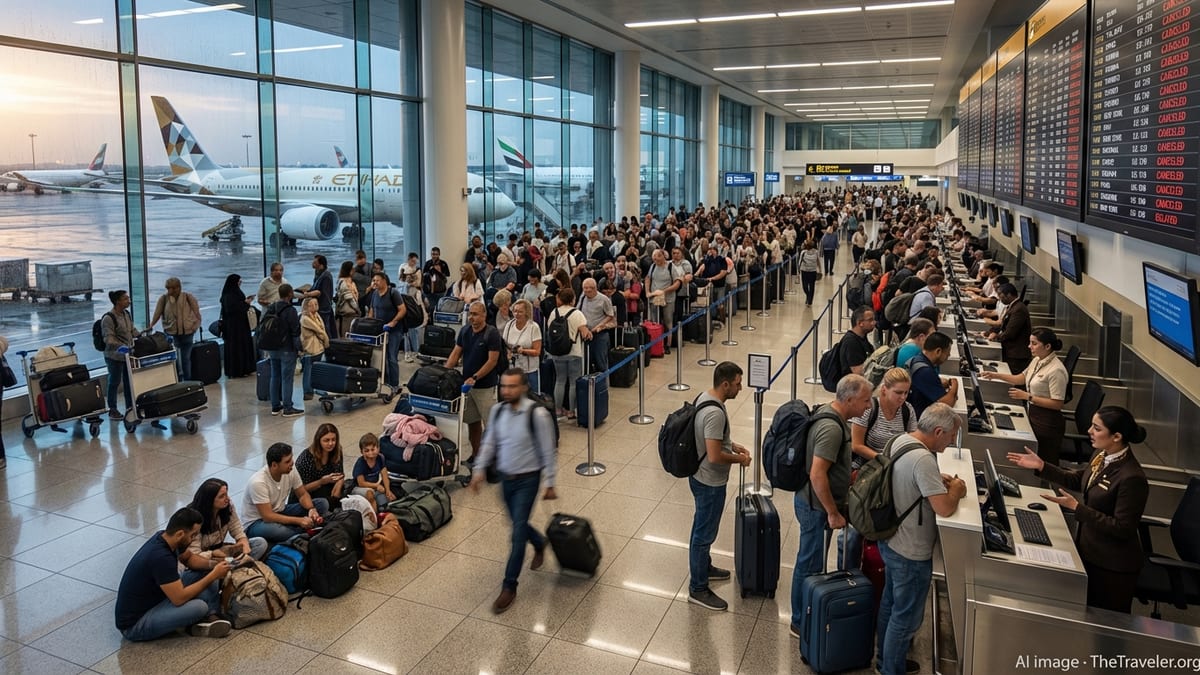
Hundreds of air travelers across the Middle East have faced widespread disruption after Dubai, Cairo, and other major hubs reported dozens of cancellations and more than 800 delays within just 24 hours, as war-related airspace risks, regional tensions, and knock-on schedule issues combined to squeeze already busy airport operations.
Get the latest news straight to your inbox!
Data Shows One-Day Spike Across Major Middle East Hubs
Disruption-tracking data for late August and early September 2026 shows how quickly flight schedules can unravel across the Middle East when large hubs come under simultaneous pressure. One 24-hour snapshot for 31 August, compiled by air passenger rights platform AirHelp, recorded 1,261 delays and 59 cancellations across the region, with Dubai International, Abu Dhabi’s Zayed International, Doha’s Hamad International, and Saudi hubs in Riyadh and Jeddah among the worst affected. Published coverage notes that the same wave of disruption produced spillover effects at Cairo International, Ben Gurion Airport near Tel Aviv, and Sharjah as aircraft and crews fell out of position.
Within those headline numbers, several data cuts point to at least 871 individual delays across Middle Eastern airports during the same period, alongside the 59 cancellations. Publicly available disruption summaries emphasize that most flights still operated, but often later than scheduled, with a mix of short, moderate, and multi-hour delays as airlines adjusted routings and turnarounds.
Separate reporting on a fresh disruption phase in the 24 hours before 3 September highlights a similar pattern. AirHelp’s Gulf-focused breakdown for that period cites 1,259 flights affected, again including 59 cancellations and more than 1,200 delays across nine airports, led once more by Dubai and Abu Dhabi and extending into Saudi Arabia, Qatar, Egypt, and Israel. Taken together, these snapshots illustrate how a single operational day can see hundreds of passengers across multiple countries dealing with missed connections, rebookings, and extended waits on the ground.
Dubai and Abu Dhabi Remain at the Center of Operational Strain
Dubai International Airport, the region’s largest global hub, has repeatedly appeared at the center of the disruption figures. Delay-performance summaries for early September show that between 2 and 8 September the airport recorded clusters of cancellations each day, with up to 14 departures scrubbed on some dates and average departure delays ranging from modest single digits to more than 20 minutes on its worst-performing day. That pattern aligns with published tallies of dozens of cancellations and hundreds of delays when conditions tighten.
On 8 and 9 September, travel advisories from UAE-focused outlets described “widespread delays and cancellations” at both Dubai International and Abu Dhabi’s Zayed International. Detailed flight-status roundups list multiple delayed and canceled Emirates and flydubai services into and out of Dubai, including long-haul routes from London, Manchester, Seattle, Rome, Geneva, and other European and Asian cities, alongside regional services to and from Jeddah, Moscow, Baku, and Almaty. In Abu Dhabi, the disruption extended to Air Arabia Abu Dhabi and Oman Air flights, with reports of late-running departures to Beirut and Cairo and at least one Muscat-bound service canceled.
Despite the volume of affected flights, the airports themselves have remained open, with operations shifting into a pattern of rolling disruption rather than full closure. Public dashboards and local coverage indicate that many services still depart within a reasonable window of their scheduled times, but concentrated spikes in delays and cancellations create unpredictable peaks of congestion at check-in, security, and transfer points. For passengers, this has translated into longer queues, tighter connection windows, and a heightened need to check live flight status before leaving for the airport.
Cairo and Other Secondary Hubs Feel the Ripple Effects
Although the initial pressure has centered on Gulf super-hubs, published data and regional coverage show that airports such as Cairo International are also being drawn into the disruption. Tracking summaries for the late August wave note that Cairo experienced both direct delays and secondary knock-on issues as aircraft arriving late from Dubai, Doha, and Saudi hubs disrupted onward rotations. In some cases, this has resulted in later departures to European and African destinations as ground teams work to turn aircraft around more quickly than originally planned.
The pattern reflects how interconnected Middle Eastern and North African aviation networks have become. A delayed Emirates or Saudia arrival can affect not only immediate connections within the same terminal, but also shared codeshare services and independent regional carriers that rely on the same pool of stands, gates, and ground resources. When multiple hubs like Dubai, Abu Dhabi, Doha, Jeddah, and Cairo experience elevated delay levels in the same 24-hour period, the cumulative effect is a spike in missed connections, overnight stays, and last-minute rebookings across the wider region.
Recent compilations on TheTraveler.org, drawing on disruption trackers and airport statistics, underline this cascading dynamic. One analysis of a single high-pressure day in early September logged more than 1,600 delays and over 70 cancellations focused on Istanbul and Cairo, on top of the earlier wave across the Gulf. In that instance, passengers connecting between Europe, the Middle East, and South Asia were particularly exposed, with late inbound flights triggering re-accommodation onto later departures or entirely different routings.
Geopolitical Tensions and Airspace Restrictions Weigh on Schedules
While operational issues, weather, and congestion are perennial causes of flight disruption, recent Middle East data suggests that geopolitics is playing an outsized role in the current pattern of delays and cancellations. Passenger rights guides summarizing the 31 August disruption explicitly link the spike in cancellations and schedule changes to war-related airspace restrictions, noting that airlines have been steering clear of certain flight paths or allowing extra time to route around higher-risk zones.
Gulf-focused aviation coverage in early September connects the latest disruption to escalating tensions between the United States and Iran, including reports of missile and drone activity in parts of the region. In response, several European and Asian carriers have temporarily suspended routes into the Gulf or adjusted their Middle East networks, while large home carriers in the UAE, Qatar, and Saudi Arabia continue to operate but with modified routings and timetables. In some cases, airlines that usually use more direct tracks across Iranian or Iraqi airspace are instead adding distance and flight time to keep aircraft on lower-risk corridors.
These strategic adjustments increase the likelihood of late arrivals, particularly on long-haul sectors into busy hubs like Dubai and Abu Dhabi. A widebody flight arriving 30 to 60 minutes behind schedule at peak connection times can quickly strain stand availability and passenger processing, especially when replicated across multiple inbound waves. The cumulative effect, visible in delay and cancellation statistics from late August into September, is an elevated baseline of disruption even on days without severe weather or local technical issues.
What the Numbers Mean for Passengers Planning to Travel
For travelers heading through Dubai, Cairo, and other Middle Eastern hubs in the coming days, the main implication of the latest data is increased schedule uncertainty rather than an expectation that flights will stop altogether. Publicly available statistics still show most services operating, but with a higher-than-usual risk of delay and localized clusters of cancellations when operational or geopolitical conditions tighten.
Passenger rights organizations note that, in cases where disruptions are linked to external security situations or airspace closures, legal compensation under regimes such as Europe’s EC 261 is often limited or not applicable. Even so, airlines typically retain obligations to provide care during extended delays, such as meals and hotel accommodation, and to offer refunds or alternative routings when flights are canceled. Recent summaries of actual cases suggest that airlines have been rebooking affected passengers on later same-carrier flights or, where necessary, routing them via alternative hubs.
Given the volume of recent cancellations and the prospect of further schedule tweaks as tensions evolve, travelers are being urged in public advisories and airline updates to monitor flight status closely on the day of departure and to allow additional time for connections through regional hubs. Those with tight onward itineraries, such as cruise departures or important events, may wish to consider arriving a day earlier than strictly necessary. With Dubai, Abu Dhabi, Cairo, Doha, and key Saudi airports all experiencing elevated disruption metrics within the same two-week window, a more cautious approach to timing could help blunt the impact of any renewed spike in delays or cancellations.
AirHelp: Middle East flight delays and cancellations, 31 August 2026
AirHelp: Dubai and Jeddah flight disruption, early September 2026
The National: UAE travel advisory on Dubai and Abu Dhabi delays
Gulf News: UAE flight delays and cancellations amid tensions
TheTraveler.org: Regional disruption analysis for early September