


The Gulf of Alaska has a reputation that worries many would-be cruisers. Trip reports mention “the rough night across the Gulf,” while message boards swing between “barely noticed it” and “half the dining room was empty.” For travelers prone to motion sickness, it can be hard to decide whether to book an itinerary that includes this exposed stretch of ocean at all. The reality is more nuanced than the horror stories, and understanding how the Gulf behaves goes a long way toward deciding if it is right for you.
Get the latest updates straight to your inbox!
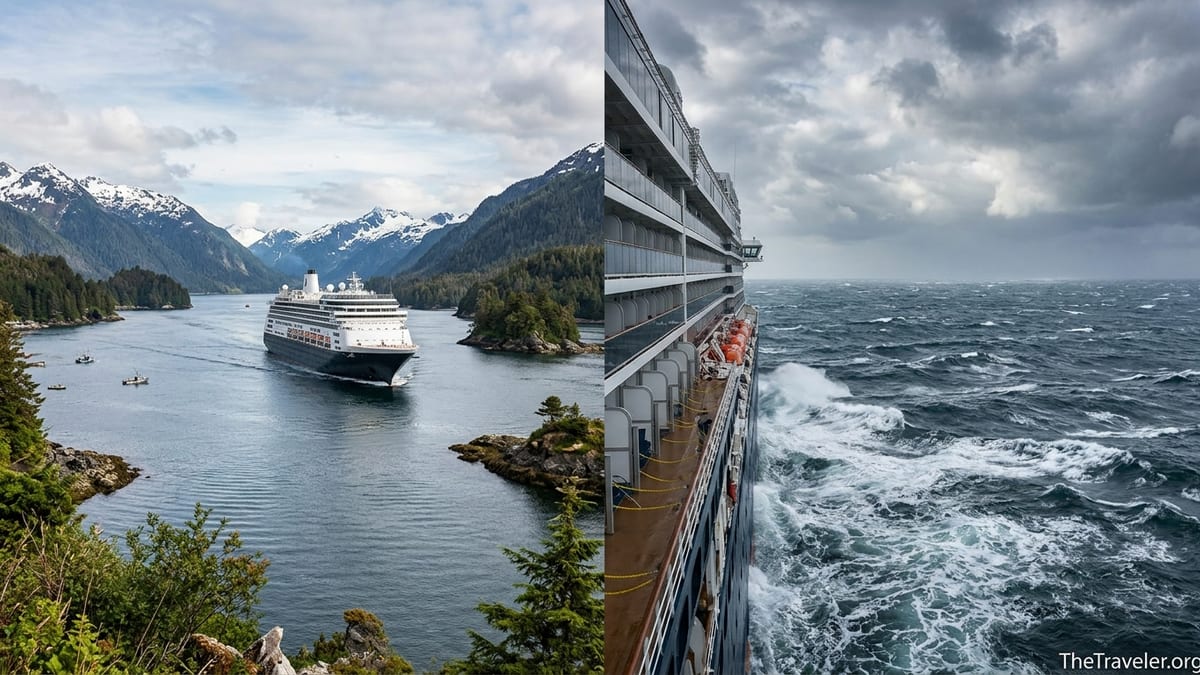
Ordinary Ship Movement vs Genuinely Rough Conditions
Every cruise ship moves, even on what the crew will call a calm day. On a typical Inside Passage day between Juneau and Ketchikan, for example, you may feel a slow, gentle rocking when the ship turns or when a passing tug creates a noticeable wake. Glasses on the bar might tremble, and you could feel a soft sway while walking, but most passengers continue their activities without thinking about the sea state. This ordinary motion is part of being on a moving vessel and is very different from conditions that disrupt sleep or close open decks.
Genuinely rough conditions are those you tend to hear about afterward. In practical cruise terms, that might mean enough motion that pools are drained, outside decks are temporarily closed, barf bags appear near stairwells, or evening shows are cancelled. In the Gulf of Alaska, these conditions are usually linked to strong low-pressure systems that produce gale-force winds and larger ocean swell, rather than to small local squalls. Passengers describe these events as “one bad night” or “a bumpy day” rather than the norm across an entire week.
It is also important to separate comfort from safety. Modern cruise ships sailing Alaska routes are built to international standards that anticipate heavy-weather operation. When seas build to levels that might be uncomfortable for passengers, bridge officers are already adjusting course and speed to keep loads within design limits. The aim is not just to keep the ship safe but to reduce motion to a point that most guests can still function, even if they decide to skip dessert.
Why the Gulf Is Rougher Than Southeast Alaska’s Sheltered Passages
The Gulf of Alaska is an open arm of the North Pacific, sweeping in a broad curve from the Alaska Peninsula past Kodiak Island and Prince William Sound to Cape Spencer near Glacier Bay. Because it faces directly into the storm track that runs across the northern Pacific, the Gulf is exposed to long fetch: the uninterrupted distance over which winds can blow across the water to build waves and swell. As a result, systems that develop far to the west can send energy into the Gulf even before their local winds arrive.
In contrast, Southeast Alaska’s Inside Passage is threaded behind a maze of islands and narrow channels. Sailings between Ketchikan, Juneau and Skagway spend most of their time within this protected maze, shielded from the full brunt of Pacific swell by Vancouver Island, the outer coast of British Columbia and Alaska’s own outer islands. Breezy days here can still bring whitecaps and choppy seas, but they rarely generate the deep, rolling swell that characterizes an open-ocean crossing.
Weather patterns matter as much as geography. The National Weather Service regularly discusses systems tracking from the Aleutians across the northern Pacific into the Gulf and Southeast Alaska, often with strong lows focusing on the southern and eastern Gulf. These lows can produce sustained gale-force winds and higher gusts over the open Gulf. While remnants of the same systems may bring rain and wind inside the passages, the complex shoreline and islands break up the fetch, limiting wave growth and making the water feel noticeably calmer compared with the open Gulf a few hundred miles offshore.
Winds, Swell, Fetch and Seasonal Patterns in the Gulf of Alaska
Across the year, the Gulf of Alaska is strongly shaped by a semi-permanent low-pressure zone often called the Aleutian Low. Deep storm systems frequently travel along this belt from west to east, especially from late fall through early spring. Research on Gulf of Alaska environmental conditions notes that the region is fully open to much of the Pacific, which allows storm-generated waves to grow to substantial heights before they reach Alaska’s southern coast. Wave energy studies using offshore buoys near Kodiak and southeast of Yakutat show that winter seas can become significantly more energetic than summer seas, reflecting this seasonal storminess.
During late spring and summer, roughly May through early August, the storm track usually weakens and shifts, and the North Pacific high-pressure system tends to build. That does not mean flat seas, but it does reduce the frequency of major lows that drive the highest waves. Marine forecasters in Anchorage and Juneau, who issue daily coastal and offshore forecasts for the Gulf, often call for lower significant wave heights in mid-summer than in October or November. However, strong low-pressure systems can still occur in summer, and there are documented crossings in July and August where passengers experienced enough motion to miss meals or medicine windows.
By September, particularly mid to late September, the pattern begins to change again. Forecast discussions more frequently mention gales or developing storms over the southern Gulf, with sustained winds that can reach 35 to 45 knots and gusts higher. This is when some southbound cruises from Seward or Whittier to Vancouver or Seattle encounter their roughest single night at sea. Yet there are also first-hand accounts from the same month describing glassy, almost calm crossings. The key takeaway is that season influences likelihood, but not certainty, of rough conditions.
Making Sense of Marine Forecasts: Wave Height and Swell Period
Marine forecasts from the National Weather Service describe seas using a concept called significant wave height. This is defined as the average height of the highest one third of waves in a given sea state, combining both locally generated wind waves and long-period swell arriving from distant storms. Training materials from NOAA explain that this measure closely matches what a trained human observer on a ship would estimate when asked about wave height, which makes it useful for both mariners and computer models.
Crucially, a forecast of “seas 8 feet” does not mean that every wave will be 8 feet high. Detailed guidance published in NOAA’s Coast Pilot for Alaska shows the relationship between significant wave height and individual waves: the most common waves are roughly half the significant height, while the highest 10 percent of waves reach around 1.3 times that value. Very occasionally, individual waves can reach nearly twice the significant height. So if the forecast says 10-foot seas, many waves might be around 5 feet, some closer to 10, and an occasional wave could approach 18 or 20 feet.
Swell period is the time between wave crests and has a big impact on comfort. Long-period swell, such as 12 to 16 seconds, tends to feel like a slow, deep rise and fall. Even if the significant height is moderate, say 8 to 10 feet, the ship may have time to respond smoothly, especially a larger vessel with stabilizers. Short-period seas of 6 to 8 seconds, often generated by strong local winds, can produce a choppier, more abrupt motion that many passengers find more upsetting, even at similar heights. Surf forecasts near Yakutat, which translate offshore buoy readings into nearshore conditions, regularly illustrate how longer-period swell produces powerful surf with smoother sets, while shorter periods create more chaotic chop.
Where and When Motion Is Most Noticeable on Gulf of Alaska Routes
On a typical one-way cruise between Southcentral Alaska and Vancouver or Seattle, the most exposed stretch is the open-Gulf segment between Prince William Sound or the Kenai Peninsula and the entrance to Southeast Alaska near Cape Spencer. Ships leaving Seward or Whittier often head south and east across the Gulf for roughly a day and a half before turning into more sheltered waters near Glacier Bay or Icy Strait. If there is going to be a “bumpy night,” it is most often mentioned somewhere on this open leg.
Approaches near Yakutat Bay sit close to offshore buoys such as those southeast of Yakutat and near Cape Edgecumbe, where wave energy data show a strong response to incoming Pacific swell. Passengers on northbound voyages sometimes report that the sea felt calmer once the ship neared Yakutat and began turning toward the coastline, even when the sky remained clear. That is because the land begins to block some of the swell, reducing the wave height and length of fetch, even before the ship fully re-enters protected passages.
Inside glacier bays such as Glacier Bay National Park or College Fjord, the experience is very different. Here, ships slow to sightseeing speeds, often 10 knots or less, and are surrounded by land on almost all sides. Water motion is more influenced by tides, currents and occasional glacier-generated waves than by open-ocean swell. Guests frequently remark that these days feel almost lake-like compared with the preceding Gulf crossing, even if outside the bay the Gulf remains lumpy. However, not every “inside” section is perfectly calm. Wider channels such as Clarence Strait or parts of Hecate Strait further south can still carry a noticeable swell, especially in strong winds.
Real-World Passenger Experiences from 2025 and 2026
Recent trip reports from 2025 and 2026 paint a varied but consistent picture. On a September 2025 sailing of Carnival Luminosa from Seattle to Alaska, one family writing on a cruise review site noted that the water was rough enough on part of the trip that several relatives, including one who rarely feels ill, experienced seasickness. They still rated the ports and scenery highly but emphasized the importance of being prepared with medication on early autumn departures.
On community forums in 2024 and 2025, several passengers discussed northbound one-way cruises that included the Gulf crossing. One traveler returning from Majestic Princess described seeing rougher conditions on the segment from Hubbard Glacier toward Seward compared with the more sheltered Inside Passage legs, though their previous Alaska cruise on another ship had been relatively smooth. Another first-time solo cruiser in September 2025, sailing on Norwegian Joy, described a “rough water” morning as an adventure rather than a nightmare, noting they were able to continue their day after taking motion-sickness medication and eating lightly.
These accounts are balanced by many reports of calm seas. A June 2024 passenger on a Princess itinerary between San Francisco and Alaska reported that seas on the coastal and Gulf segments were “really calm” throughout, with no significant disruption. Other cruisers in 2025 who were anxious about the Gulf after reading online horror stories came back saying they barely noticed motion beyond the first night out of Seattle. Taken together, these narratives suggest that uncomfortable Gulf crossings clearly happen, particularly when strong low-pressure systems pass through, but that they are not guaranteed on any given sailing.
How Ship Design, Size and Routing Affect What You Feel
The way a ship moves in the Gulf depends on more than just the waves. Length, beam (width), hull shape, stabilizers, speed and heading relative to the swell all shape the ride. Longer ships have natural motion periods that can interact with the period of incoming waves. In some conditions, a very large ship may feel exceptionally stable because its size and modern stabilizer fins counteract roll. In other conditions, especially where short, steep seas meet a particular course, even a big vessel can develop an uncomfortable rhythm.
Not all big ships are smoother than smaller ones. Most Alaska itineraries are limited by port and channel constraints, and Alaska’s own passenger vessel reporting indicates that large ships already account for nearly all cruise visitors in the region. Within that class, differences in design matter. A wide, modern ship built in the last decade with active stabilizers, like many vessels used by Princess, Royal Caribbean or Norwegian on Alaska routes, is intended to reduce roll in moderate seas. An older or narrower ship without the latest stabilizers may feel more lively on the same route, but can sometimes ride more gently in certain sea states because of hull shape and weight distribution.
Routing and speed choices are where the bridge team makes the biggest difference. Captains routinely alter speed before entering expected rough patches, slowing the ship so that its natural motion does not sync with the incoming swell period. They may also adjust heading to take waves closer to the bow or stern rather than directly on the beam, trading some pitching for a reduction in rolling. These changes can extend the time spent in the Gulf but significantly improve comfort. Passengers often notice announcements explaining a route change “to find a smoother ride” or slight delays entering a port after the ship has slowed overnight to ride out choppy seas more comfortably.
Types of Motion: Rolling, Pitching, Vibration and Cabin Location
Most passengers who feel unwell are reacting to rolling, the side-to-side motion where one side of the ship lifts while the other drops. Stabilizer fins are designed primarily to combat roll by generating lift in the opposite direction to the ship’s tilt. Pitching, the up-and-down motion of the bow and stern, is more associated with head seas and long-period swell. While pitching can feel dramatic if you are at the extreme ends of the vessel, it tends to bother fewer people than sustained rolling does. Vibration comes from engines, propellers or thrusters and is usually most noticeable at the stern; it can be annoying, particularly in older ships, but it does not cause motion sickness on its own.
Crew members and frequent cruisers commonly recommend lower-deck midship cabins for those concerned about seasickness. Being close to the ship’s center of gravity reduces both roll and pitch felt in the cabin. A balcony cabin on Deck 6 or 7 near the center, for example, will generally feel steadier than an interior cabin high on Deck 14 at the bow, even if the balcony cabin is closer to the waterline. In many 2025 trip reports, guests who felt ill noted they were staying far forward or high up, while fellow passengers on lower midship decks reported very little discomfort on the same sailing.
That does not mean you must avoid balconies or higher decks entirely. Some travelers strongly prefer higher decks for the views in Alaska, and many manage motion well with medication and habits like focusing on the horizon. However, if you already know you are sensitive, prioritizing deck and location over view can pay off. If you want a balcony, consider one that is still relatively low and central rather than a forward-facing or aft-wrap design on the very top decks.
Evidence-Based Seasickness Preparation and What Actually Helps
Preparation is often the difference between a mildly wobbly evening and a miserable night in bed. For many travelers, over-the-counter antihistamines like meclizine or dimenhydrinate, sold under well-known brands in the United States, can substantially reduce motion sickness symptoms. Physicians and pharmacists usually advise taking these preventively, beginning several hours before entering potentially rough water or at the start of your cruise, rather than waiting until nausea is severe. Common side effects include drowsiness and dry mouth, which is why it is wise to test a dose at home before traveling.
For people with a history of severe motion sickness or those combining the cruise with other medications, a consultation with a doctor before departure is important. Prescription scopolamine patches, placed behind the ear and changed on a set schedule, are widely used among cruisers and can be highly effective when used correctly. They also carry potential side effects such as dry mouth, blurred vision and, in some cases, confusion in older adults, so they are best used under medical guidance rather than picked up casually at the last minute.
Non-drug options such as ginger capsules, ginger candies and acupressure wristbands are very popular, and many passengers in recent online reports say they feel these remedies help, especially for mild nausea. Scientific evidence is mixed. Some controlled studies suggest ginger can modestly reduce nausea in motion and pregnancy, while others show little difference from placebo. Acupressure bands have similar mixed results. The safest approach is to treat these as supplements to, not replacements for, proven medications. Regardless of what you choose, staying hydrated, avoiding heavy or greasy meals before a Gulf crossing, getting enough sleep and spending time on deck in cool, fresh air all have solid practical support from experienced cruisers and crew.
On a rough-weather day, simple behavior changes go a long way. Eating small, bland snacks, choosing a central public room on a lower deck and sitting where you can see the horizon usually feel better than staying in a dark, forward cabin. Many passengers find the covered promenade or an indoor lounge with large windows midship to be the most comfortable place to ride out a lumpy evening. Crew will often quietly recommend these locations if you ask at guest services or in the medical center.
How to Read a Gulf of Alaska Marine Forecast Before You Sail
A week or two before your cruise, you can start checking National Weather Service marine forecasts for the Gulf of Alaska zones that match your route. Offshore forecasts for the eastern and northern Gulf list expected winds and seas in feet and sometimes describe swell direction and period. For example, a mid-summer forecast might read “South winds 15 kt. Seas 5 ft, mainly southwest swell,” which would usually translate to noticeable but modest motion on a modern cruise ship. A fall forecast reading “Gale warning. Southeast winds 35 kt. Seas building to 12 ft” signals a higher chance of a bumpy ride if your ship’s schedule places it in that area at the same time.
It is important to remember that forecasts become more reliable only in the short term. Seasonal outlooks can say that late September tends to be stormier than June, but they cannot tell you whether your sailing three months from now will enjoy an unusual calm spell or meet one of the first strong autumn storms. Checking the marine forecast five days out gives a rough guide, while the 24 to 48 hour window before departure is where details become clearer. Your cruise line and the ship’s officers will be following even more detailed products, including wave height analyses and satellite data, and may alter departure times or speeds as those forecasts evolve.
When you read seas heights, combine them with wind direction, wind speed and swell period to get a sense of how it might feel. Ten-foot seas on a long, 14-second period from behind the ship can be surprisingly gentle, while eight-foot, short-period seas on the beam in strong winds may generate a sharper side-to-side motion. If you feel anxious, you can bring your questions to the ship’s guest services or even attend any navigation or weather talks on board, where officers often explain how they interpret these same forecasts in day-to-day decisions.
Choosing Cabins, Planning for Rough Days and Comparing Itineraries
For cabin selection, location usually matters more than exact size or category when it comes to motion. In general, the most comfortable cabins in rough seas are lower-deck staterooms near the middle of the ship, while the most movement is experienced in high, forward or far-aft cabins. Many Alaska-bound travelers who booked centrally located balcony cabins on Deck 6 or 7 in 2025 and 2026 later reported that they felt some gentle motion but were not significantly affected even on nights when others were ill. Those in forward suites on the highest passenger decks, by contrast, tended to notice every wave.
For practical planning, think through a rough-weather day much as you would a long flight with turbulence. Prepare medications and take them in advance, keep water and light snacks in your cabin, and schedule activities in central, lower-deck venues such as the main dining room or midship lounges if you are prone to motion sickness. If the crew announces that swell will increase overnight, consider requesting breakfast in a central restaurant instead of room service to a forward cabin, and ask your steward where the nearest midship staircase or elevator is in case you feel unsteady.
If you are deciding between itineraries, Inside Passage round-trips from Vancouver that do not cross the Gulf at all usually offer the calmest rides, because they stay within the protected channels behind Vancouver Island and the outer islands of Southeast Alaska. Round-trips from Seattle, which must cross the open water of the Strait of Juan de Fuca and the outer coast before ducking back into shelter near Vancouver Island, have a modestly higher chance of a rough first or last night. One-way northbound or southbound cruises that include Seward or Whittier almost always involve an open-Gulf leg. These itineraries offer standout glacier days and broader scenery, but also the highest chance of at least one noticeably moving night, especially outside the heart of summer.
Is the Gulf of Alaska Dangerous, and Who Should Consider Crossing It?
For most cruise passengers, the Gulf of Alaska is uncomfortable more often than it is dangerous. Cruise ships that ply this route are designed and certified to handle far worse conditions than captains will willingly enter with paying guests, and they have access to detailed meteorological guidance, real-time buoy data and satellite imagery. When truly severe storms develop, cruise lines may delay departure, route more conservatively inshore when possible or adjust port calls to avoid the highest seas. Serious incidents are rare relative to the large number of voyages completed each season.
For first-time cruisers who are uncertain about motion sickness, an Inside Passage round-trip without a Gulf crossing is often the most reassuring choice. You still see glaciers and classic Alaska ports but with a lower probability of large swell. Families with young children, who may not tolerate drowsy medications well, can also benefit from the calmer profile of these itineraries, especially in May through early August. Those who already know they are highly susceptible to motion sickness but who still want to experience the Gulf might consider sailing in mid-summer, choosing a low, midship cabin, arranging prescription remedies in advance and mentally preparing for the possibility of one or two lively nights.
Travelers with previous but manageable motion sickness who are eager for glacier-intensive itineraries and one-way routes across the Gulf often find that preparation and mindset make the difference. Understanding that “rough” on the Gulf usually means rolling that disrupts dinner and sleep for a night, not towering rogue waves, helps put risk into perspective. At the same time, acknowledging that open-ocean crossings are inherently less predictable than sheltered passages encourages realistic expectations and good contingency planning.
Common questions illustrate these trade-offs. How high do waves get? In summer, many crossings encounter significant wave heights of only a few feet, while strong systems in shoulder seasons can push seas into the low-teens feet range for limited periods. Are September storms a reason to avoid travel altogether? Not necessarily, but they do increase the odds of at least one rough segment. Do stabilizers and balconies help? Stabilizers meaningfully reduce rolling but cannot eliminate all motion; balconies provide easy access to fresh air and a horizon view but do not change the physical movement. Are Gulf crossings more dangerous at night? Not in themselves; ships often time crossings overnight for schedule reasons, and bridge crews are on full watch regardless of darkness. Ultimately, choosing whether to cross the Gulf of Alaska comes down to your tolerance for a small but real chance of discomfort in exchange for some of the most dramatic coastal scenery on any cruise route.