


More news on this day
Hours after a rare nationwide shutdown of US flight departures, more than 1.5 million travelers remained stranded at airports across the country on Saturday, facing cascading delays, cancellations and missed connections as the aviation system struggled to restart.
Get the latest news straight to your inbox!
Telecom failure triggers longest ground stop in decades
The disruption began on Friday, November 13, when a telecommunications failure hit multiple air traffic control centers, disrupting communications and radar feeds used by the Federal Aviation Administration to manage US airspace. Publicly available information from the US Department of Transportation indicates that routers handling data for the system became overloaded, producing inconsistent readings that led regulators to halt departures nationwide while aircraft already in the sky were guided to continue flying and land safely.
According to aviation analytics firm Cirium and multiple news outlets, around 11,000 flights scheduled to depart US airports after 4 p.m. Eastern time on Friday were affected. Those flights alone were expected to carry more than 1.5 million passengers, a figure that does not include earlier flights already delayed by the emerging outage or international services forced into holding patterns or diversions.
The nationwide ground stop lasted more than four hours, making it the longest broad halt to US air travel since the systemwide disruption in January 2023 and the most extensive shutdown since the aftermath of the September 11, 2001 attacks. Federal officials have publicly stated that, as of Saturday, there is no indication of a cyberattack or malicious interference, but they have acknowledged that the investigation into the root cause is continuing.
Transportation officials have also linked the incident to the strain of modern demands on aging infrastructure. In briefings, they pointed to new technology being layered onto an air traffic control network that is already undergoing a multiyear modernization program funded with billions of dollars, and called for additional emergency investment to prevent similar outages.
Airports from Los Angeles to Newark log gridlock
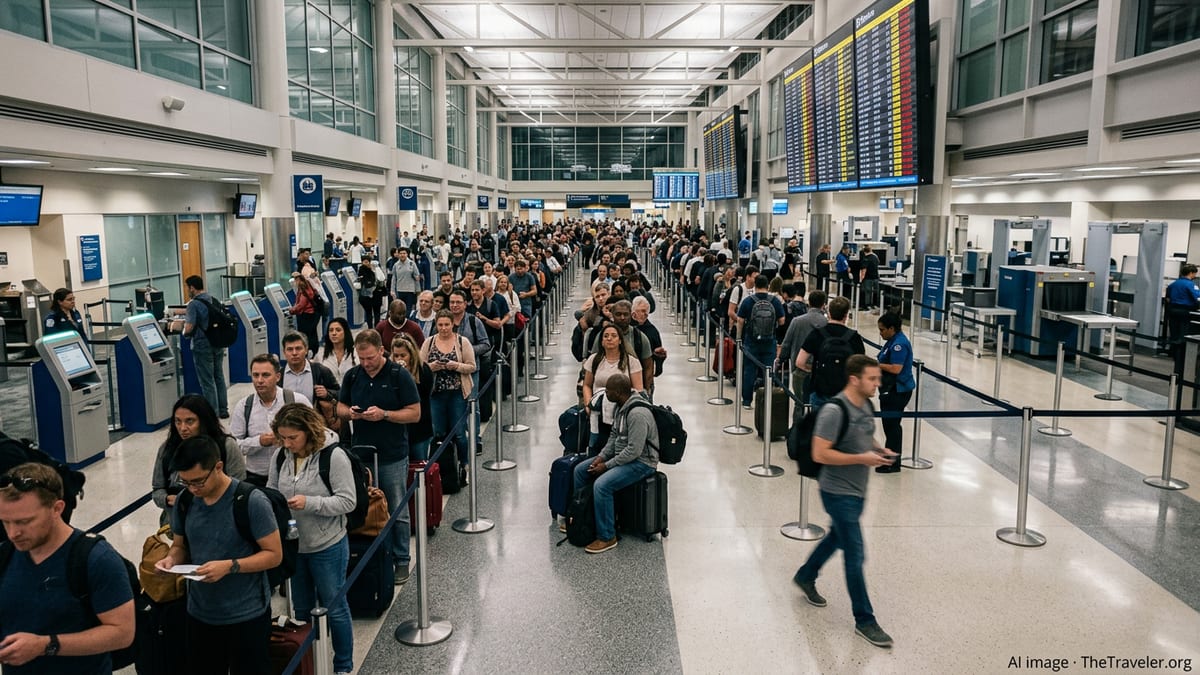
By Friday evening and into Saturday, some of the country’s busiest hubs were contending with scenes of near-gridlock. Reports from Los Angeles International, Chicago O’Hare, Atlanta’s Hartsfield-Jackson, and New York’s LaGuardia and Newark Liberty described packed terminals, lengthy lines at ticket counters and customer-service desks, and passengers stretched out on terminal floors as they waited for updates.
At Los Angeles International Airport, regional coverage described departure boards filled with red ink as cancellations mounted and delayed flights stacked up across terminals used by major US and international carriers. Travelers arriving from long-haul destinations such as New Zealand and Asia reported being pulled off aircraft after landing, only to discover that connecting flights to the Midwest and East Coast had been scrubbed or indefinitely delayed.
Chicago O’Hare and Atlanta, both key national transfer points, became pressure points as the shutdown rippled through the network. Passengers arriving to make connections saw their onward flights listed as “ground stop” or “awaiting crew,” while newly arriving aircraft were sometimes left waiting on taxiways for available gates. Images from these airports showed baggage carousels ringed with unclaimed luggage and long lines at rebooking counters as travelers tried to salvage weekend trips, family visits and business commitments.
On the East Coast, New York’s LaGuardia and Newark Liberty airports were among the hardest hit. Photographs from terminals in the New York region showed large crowds clustered around flight-information screens and check-in areas. Some airports issued their own social-media advisories summarizing the FAA directives and telling passengers to expect extensive delays well into Saturday.
From sports teams to holidaymakers, plans unravel
The timing of the shutdown, two weeks before the US Thanksgiving rush, added to the scale of the disruption. Industry forecasts have projected nearly 29 million people flying on US airlines over the broader holiday period, and many had booked early November travel for work, college schedules and family events.
News coverage indicates that the shutdown forced professional and college sports teams to scramble for alternatives. NBA and NHL squads attempting to reach road games, along with college football teams heading to weekend matchups, found themselves stranded at airports around the country. Some were reported to be exploring charter buses or reconfigured travel plans as it became clear that commercial flight options would remain uncertain through Saturday.
Leisure travelers were caught in the same web of disruption. At major tourist gateways such as Miami International and Orlando International, families on vacations or cruises reported extended waits on terminal floors and concerns over missed departures. Local reports from California airports described families camping in gate areas while baggage piled up at airline service offices as connecting passengers failed to arrive.
Business travelers and conference attendees also felt the impact. Accounts from Los Angeles and other hubs described international passengers bound for events in cities such as Chicago and Washington, D.C., who were forced to rebook onto limited remaining seats or wait for airlines to rebuild schedules. Many faced added costs for hotels, meals and rearranged ground transportation, with uncertain prospects for reimbursement.
Airlines race to recover as weekend cancellations mount
Even after the FAA lifted the nationwide ground stop and described the airspace as fully open again, airlines faced the complex task of restarting an intricate, interdependent system. Aircraft and crews were scattered out of position, maintenance windows had been disrupted, and overnight curfews at some airports limited how quickly flights could be added back.
By Saturday, publicly available data from flight-tracking and aviation analytics services indicated that more than 2,000 flights within, into or out of the United States had been canceled, with thousands more delayed. Some carriers focused on restoring core trunk routes between major hubs, leaving thinner regional and small-city routes with limited or no service for much of the day.
Transportation officials cautioned that the effects would likely extend through the weekend, and that some passengers might not reach their destinations until late Sunday or even Monday. Airlines urged customers to check their flight status before traveling to the airport, make use of mobile rebooking tools where available, and consider accepting reroutes through alternative hubs if they needed to arrive by a specific time.
Consumer advocates noted that, under current US rules, airlines are generally not required to pay cash compensation for delays and cancellations caused by air traffic control issues. Some carriers began issuing travel waivers allowing affected passengers to change flights without additional fees, but many travelers still faced higher last-minute fares on remaining seats, as well as out-of-pocket expenses for accommodation and meals.
Renewed scrutiny of US air traffic infrastructure
The shutdown has intensified scrutiny of the resilience of US air traffic control infrastructure. The incident follows earlier, narrower disruptions caused by technology failures, including the 2023 outage of the Notice to Air Missions system that forced a brief ground stop for departing flights nationwide.
Analyses in recent months by government watchdogs and transportation researchers have already highlighted the challenges of updating legacy systems while keeping daily operations running. The latest shutdown, tied to overloaded communications and radar data pathways, is being cited in policy discussions as evidence that incremental fixes may not be sufficient as traffic volumes and technological demands continue to rise.
Recent budget measures have earmarked billions of dollars for modernization, and officials have publicly discussed seeking an additional emergency infusion to accelerate upgrades to radar, communications, and backup systems. Aviation unions and airport groups have argued that, without more robust redundancy and testing across the network, similar incidents could recur during peak travel periods.
For travelers, the immediate priority remains getting home or on to their next destination. Yet the scenes from the past 48 hours, from crowded concourses to parked jets lined up on taxiways, have already become a vivid illustration of how dependent modern mobility is on the invisible digital backbone of air traffic control, and how quickly a technical failure on the ground can cascade into a national shutdown in the skies.