


The United Quest℠ Card is designed for travelers who fly United Airlines often enough to care about bags, miles, and elite status, but not necessarily enough to justify a premium lounge card. Used well, its combination of mileage earning, free checked bags, and annual United travel credits can offset its annual fee and meaningfully cut your trip costs. Used poorly, it becomes just another expensive piece of plastic. Here is how the card really works in practice for miles, bags, and travel credits, with concrete examples that match the way people actually travel.
Get the latest updates straight to your inbox!
Key United Quest Card basics every traveler should know
The United Quest Card is a co-branded credit card issued by Chase for United MileagePlus members. As of mid 2026, it charges a mid-tier annual fee and sits between the cheaper United Explorer Card and the premium United Club card in the lineup. In exchange, it offers elevated mileage earning on United flights, rich checked bag benefits, and a package of travel credits that can be valuable for anyone flying the airline several times per year.
On the earning side, cardholders receive a total of 10 miles per dollar on eligible United flights purchased directly from United. United awards 6 miles per dollar on the primary cardmember’s base fare for being a MileagePlus member, and the card layers on an additional 4 miles per dollar on the entire United purchase when you pay with the Quest Card. On top of that, most everyday spending categories earn between 1 and 2 miles per dollar, with elevated earnings on travel, dining, and select streaming services, plus bonus miles on certain prepaid hotel bookings through United partner portals.
For a concrete example, consider a roundtrip United flight from Chicago to San Francisco that costs about 400 dollars before taxes. If you are a general MileagePlus member paying with a different credit card, you would typically earn only the base MileagePlus miles, roughly 2,400 miles at six miles per dollar on the base fare. Paying with the Quest Card instead can add roughly 1,600 additional miles from the card’s 4x earning on the purchase, giving you about 4,000 miles from that one trip. For travelers who fly United several times a year, those extra miles add up quickly toward future award flights.
Beyond miles, the card includes an annual United travel credit, an anniversary award flight mileage discount, and automatic travel protections such as trip delay and baggage delay coverage when you pay for your ticket with the card. To decide if the card is right for you, the essential question is how often you realistically fly United and check bags, and whether the credits match your actual travel behavior.
How free checked bags work with the United Quest Card
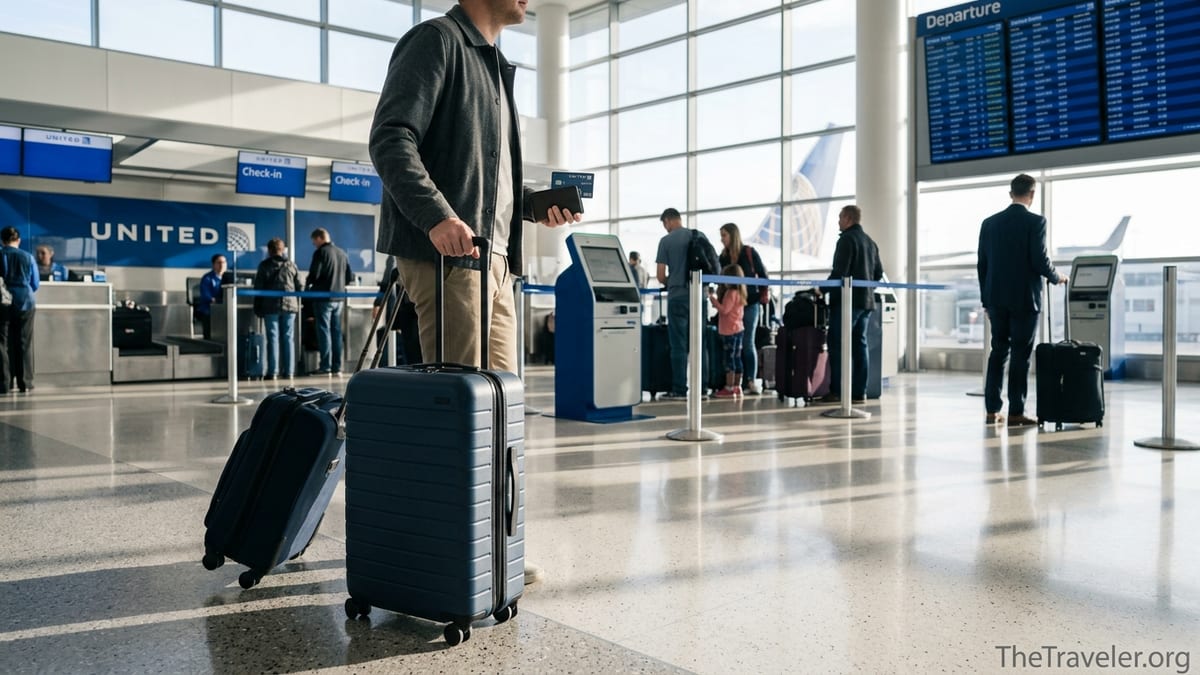
For many travelers, the most tangible benefit of the United Quest Card is its free checked bag perk. As the primary cardmember, when you purchase a ticket on a United-operated flight with your Quest Card and include your MileagePlus number in the reservation, both you and one companion on the same reservation can each receive your first and second standard checked bags free. United currently values the first checked bag on many domestic routes at about 40 to 50 dollars each way, and the second at around 50 to 60 dollars each way, so the potential savings can be significant.
To see how this plays out in real life, imagine a couple flying roundtrip from Newark to Denver on United in standard economy. Without any status or a qualifying credit card, they might pay about 40 dollars for the first checked bag and 50 dollars for the second, per person, each way. If each traveler checks two bags, that could be around 180 dollars in bag fees per person for the roundtrip, or roughly 360 dollars total. With the United Quest Card properly attached to the booking, those four bags can be free, effectively covering a large portion of the card’s annual fee in a single trip.
There are several important conditions. The flight must be operated by United or United Express; codeshare flights run by partners such as Air Canada or Lufthansa typically do not qualify for the Quest Card’s bag benefit, even if the flight has a United flight number. The primary cardmember must be on the reservation, and the ticket should be purchased with the Quest Card or with eligible United credits associated with the account. Additionally, the benefit applies to standard economy and most premium cabins, but it does not stack on top of an already free allowance in a way that would give you extra bags beyond the published limit; instead, it usually replaces what you would have paid for your first and second bags.
This makes the card particularly valuable for United flyers who regularly travel with sports equipment or extended family. For example, a family of three where one parent is the primary cardholder and another adult is the companion under the benefit might structure bookings so that the two adults each check two larger bags free, while their child uses the carry-on allowance. On domestic ski trips to destinations like Bozeman or Salt Lake City, where skis and winter gear quickly push you into multiple checked bags, the Quest Card can keep the family from paying hundreds of dollars in bag fees each season.
Understanding the annual United travel credit and other credits
The United Quest Card currently offers an annual United travel credit that can be used toward purchases with United. In recent iterations of the card, this credit has been structured around United TravelBank or direct United purchases each cardmember year. In practice, this means that eligible purchases such as paid United tickets, seat upgrades, and sometimes other United charges trigger automatic statement credits up to a set dollar amount per year, as long as they are charged to the Quest Card.
For instance, suppose you book a 220 dollar one-way United flight from Los Angeles to Honolulu directly on United’s website using your Quest Card. If you still have 200 dollars of unused annual credit, you might see a 200 dollar statement credit appear within one or two billing cycles, effectively reducing your out-of-pocket cost for that ticket to about 20 dollars, plus any taxes or fees not included. Many cardholders plan one or two United bookings each year specifically to exhaust the credit, often timing it around peak travel periods like Thanksgiving or spring break when fares tend to be higher.
In addition to the core travel credit, the card has offered periodic partner credits highlighted by both Chase and travel websites. Recent examples include statement credits on stays booked through select hotel collections curated for United cardmembers, credits on JSX semi-private flights booked directly with JSX and paid with the card, and smaller credits for rentals with Avis or Budget. These partner credits can change over time, and terms are subject to updates, so it is wise to check your current benefits dashboard in your Chase account before planning a trip specifically around them.
The key to getting full value from these credits is to treat them as part of your normal travel budget instead of an excuse to overspend. If you usually fly United from Houston to Orlando every summer to visit family, you can simply charge that trip to your Quest Card and let the credit offset the cost. Similarly, if you were already planning a weekend hotel stay in a city like Seattle or Austin, checking whether that property is available through a qualifying United-affiliated hotel portal can turn an ordinary purchase into one that both earns extra miles and unlocks a statement credit.
How award miles earning and redemptions really work
On the earning side, the United Quest Card combines the regular MileagePlus mileage you receive as a United customer with the bonus miles from card spending. You earn 10 total miles per dollar on eligible United flights, broken down as 6 miles from United on the base fare and 4 miles from the card on the whole purchase when you pay with Quest. For non-United spending, you generally earn 2 miles per dollar on travel, dining, and select streaming services, and 1 mile per dollar on other purchases, with higher rates possible on certain prepaid hotel bookings made through United’s branded booking channels.
Those miles flow into your MileagePlus account, not a separate bank. Once there, they can be redeemed for award flights on United and partner airlines in the Star Alliance network. For example, a one-way domestic economy saver award on United between New York and Miami sometimes prices around 10,000 to 15,000 miles plus a small amount of taxes. If you have earned 40,000 miles on your Quest Card through a combination of flight purchases and everyday spending, that might be enough for two or three such domestic trips if you find lower-mileage dates.
One of the more distinctive perks of the card is its anniversary award flight mileage discount. After each cardmember anniversary, qualifying cardholders receive an award flight discount, often described as a 10,000-mile reduction spread across eligible award bookings. In recent years this benefit has effectively worked as two separate 5,000-mile credits that apply after you book qualifying award flights. The net effect is that if you book, for example, a 22,000-mile roundtrip economy award from Denver to San Diego after your anniversary date, the credits can reduce the total mileage cost to about 12,000 miles, as long as the terms at that time permit the credits to apply to that type of award.
Because United uses dynamic award pricing, the real value you get from Quest-earned miles depends heavily on when and where you fly. Redeeming miles for last-minute domestic trips around holidays often yields poor cents-per-mile value, while booking off-peak flights to secondary airports, or using miles for economy-plus seats on less popular days, can return much more. Many frequent travelers use tools inside the United booking engine to scan flexible dates and nearby airports, then apply their Quest-derived miles and award flight credits to itineraries that would otherwise be relatively expensive to purchase with cash.
Using the Quest Card for checked bags and credits on real trips
To understand how the card’s benefits intersect in practice, consider three specific trip scenarios. First, imagine two friends in Seattle planning a winter ski trip to Jackson Hole. Their roundtrip United flights might cost 550 dollars per person, and because of ski bags and bulky clothing, each checks two bags on the outbound and one on the return. Without a qualifying card, bag fees could easily reach about 140 to 160 dollars per person for the trip. If the primary traveler pays with the United Quest Card, both can have their first and second bags free on each direction, wiping out most or all of those fees. If one of the tickets was booked after the traveler’s annual travel credit refreshed, part of that 550 dollar fare might also be reimbursed as a statement credit, further lowering trip costs.
Next, consider a solo business traveler flying from Newark to Houston several times a year for client meetings. Suppose she books four United roundtrips annually at an average fare of 350 dollars and usually checks a bag both ways. At typical United bag prices, she might otherwise spend about 320 dollars per year on checked baggage alone. With the Quest Card, those bags can be free as long as she follows the rules, while the annual United travel credit can offset part of one of the tickets. On top of that, the roughly 2,800 dollars in United fares charged to the card could generate close to 28,000 miles annually, enough for at least one off-peak domestic award trip.
Finally, think about a family of four planning a summer vacation from Chicago to San Diego. If one parent holds the Quest Card, they might strategically place that parent plus one child on the reservation covered by the bag benefit and the second parent plus the other child on a separate reservation where they rely on included carry-ons and potentially one paid checked bag. Another option is to have only the two adults check bags while packing the children with carry-ons and personal items. By combining the Quest Card’s two-free-bag benefit for the cardholder and companion with smart packing, the family can often limit total bag fees to a fraction of what they would pay otherwise, especially when bringing beach gear, strollers, or extra clothing for an extended stay.
These examples highlight an important point: the Quest Card is most rewarding when you plan your trip around its rules. Making sure your MileagePlus number is on the reservation, paying with the Quest Card or eligible United credits, and confirming that your flights are actually operated by United or United Express all matter. Many travelers also check United’s online baggage calculator before purchase to confirm that the free bag benefit is recognized for their specific routing and date, particularly on international or multi-carrier itineraries.
Beyond bags and miles: status boost and built-in protections
While miles and free bags get the most attention, the United Quest Card includes a few less obvious benefits that matter to frequent flyers. One of these is its contribution toward United Premier status. Cardholders can earn Premier qualifying points, or PQP, based on their annual card spending. The current structure awards 1 PQP for every 20 dollars in eligible purchases on the card, up to a specified cap per calendar year. This can provide a modest but meaningful boost for travelers who are close to qualifying for Premier Silver, Gold, or higher tiers.
For example, if you put 20,000 dollars of mixed spending on the Quest Card in a year, you could earn about 1,000 PQP from the card alone. For a traveler who typically earns 3,000 to 4,000 PQP from flying, that 1,000-point boost can be the difference between missing and achieving a status level. Premier status in turn brings benefits such as complimentary upgrades on some routes, better seat selection, and additional free checked bags, which can stack with the card’s own bag benefits within the limits of United’s baggage rules.
The card also features several core travel protections when you pay for your ticket with it. These can include trip cancellation and interruption coverage up to set limits if a covered illness or severe weather event forces you to cancel or cut short a trip, baggage delay reimbursement after a qualifying delay period, and trip delay reimbursement when your flight is significantly delayed and you incur costs for meals or a hotel. While the exact policy language changes over time, these protections can save hundreds of dollars on a disrupted trip, especially on international journeys from cities like Washington Dulles or San Francisco to Europe or Asia.
Many travelers discover the value of these protections only when something goes wrong. For instance, if your checked bag with business clothes is delayed overnight on a United flight to Boston, and the delay meets the card’s threshold, you may be able to claim reimbursement for reasonable purchases like a change of clothes and toiletries. Likewise, if a snowstorm in Denver causes a missed connection and forces you to stay in a hotel, the card’s trip delay coverage may reimburse some or all of that unplanned expense, as long as the ticket was charged to the Quest Card and you keep your receipts.
The Takeaway
The United Quest Card is not a casual traveler’s card. Its value is heavily front-loaded into benefits that reward people who fly United several times a year, check bags, and pay attention to how they book. When used strategically, though, the combination of two free checked bags for you and a companion, an annual United travel credit, an anniversary award flight mileage discount, and strong earning rates on United purchases can more than offset the annual fee for many households.
If your typical year includes a couple of domestic United trips from hubs like Chicago, Denver, Houston, or Newark where you check luggage, plus perhaps one longer vacation flight to Hawaii, Mexico, or Europe, the Quest Card can realistically save you hundreds of dollars in bag fees and flight costs, while building a balance of miles for future trips. On the other hand, if you rarely check bags, often fly airlines other than United, or prefer to redeem points for hotels instead of flights, a more flexible travel rewards card might fit you better.
The key is to look at your last 12 to 18 months of actual travel. Add up what you paid in United bag fees, estimate how much of your upcoming flying will be on United or United Express, and think about whether you can reliably use the annual United credit without changing your behavior. If the math pencils out, the United Quest Card can be a powerful tool to turn necessary spending and habitual United flights into more comfortable and more affordable travel.
FAQ
Q1. Do I have to pay for my ticket with the United Quest Card to get free checked bags?
Yes, in most cases the primary cardmember must purchase the ticket with the United Quest Card or eligible United credits tied to the account, and your MileagePlus number must be on the reservation, for the first and second checked bag benefit to apply on United-operated flights.
Q2. Does the free checked bag benefit work on partner airlines like Air Canada or Lufthansa?
No, the United Quest Card’s free checked bag benefit generally applies only to flights operated by United or United Express, even if the itinerary carries a United flight number. Codeshare flights operated by partner airlines usually follow the operating carrier’s baggage rules.
Q3. How many people get free bags on a reservation with the United Quest Card?
The benefit covers the primary cardmember and one companion traveling on the same reservation. Each of those two travelers can receive their first and second standard checked bags free on eligible United-operated flights, subject to weight and size limits.
Q4. Can I get free checked bags if I book through a third-party site instead of United?
Sometimes, but it is less reliable. To maximize your chances, book directly with United, pay with your United Quest Card, and verify during booking or check-in that the system is showing the free checked bag benefit for your reservation before you arrive at the airport.
Q5. How does the annual United travel credit work in practice?
The credit automatically reimburses eligible United purchases charged to your Quest Card up to a set amount each cardmember year. For example, if you buy a United ticket or qualifying add-ons, you will see statement credits appear until you have used your full annual allowance.
Q6. Do I earn miles on award tickets when I pay taxes and fees with the Quest Card?
You do not earn flight miles on the mileage portion of an award ticket, but you can still earn credit card miles on the taxes and fees you charge to the Quest Card. Those charges count as regular purchases and will earn at the applicable earning rate.
Q7. What is the anniversary award flight mileage discount and how do I use it?
After each cardmember anniversary, United deposits a set amount of award flight mileage discounts into your MileagePlus account. When you book eligible United or United Express award flights after your anniversary date, those discounts automatically reduce the miles required, subject to the program’s rules at the time.
Q8. Does everyday spending on the United Quest Card help me earn United Premier status?
Yes, eligible purchases on the card earn Premier qualifying points at a published rate, up to an annual cap. Those PQP add to the PQP you earn from flying and can help you reach or maintain Premier status levels such as Silver or Gold.
Q9. If I downgrade or cancel the Quest Card, do I lose my United miles?
Your United miles live in your MileagePlus account, not in the credit card account, so you generally keep them even if you close or downgrade the card. However, you would lose future card-specific benefits like free checked bags and the annual travel credit going forward.
Q10. Is the United Quest Card worth it if I mostly fly with just a carry-on?
It can be, but the value is less automatic. If you rarely check bags, you would need to rely on the annual United travel credit, anniversary award discounts, extra miles on United flights, and status-boosting PQP to justify the annual fee based on your actual travel patterns.