


Malaga–Costa del Sol Airport is the main gateway to Spain’s southern coast, and in peak season its departure halls can feel like half of Europe is flying out at once. With construction tying older terminals together and a steady flow of holiday and low-cost traffic, the experience can be smooth if you know how the airport works, where the bottlenecks usually are, and how to time each step from curb to gate. This guide walks you through check-in, security, passport control, lounges, food, shops, and boarding, using concrete examples to help you plan a stress-free departure.
Get the latest updates straight to your inbox!
Understanding Malaga Airport’s Departure Layout
Malaga–Costa del Sol Airport has multiple terminal buildings, but for most departing passengers it functions as a single, connected terminal. Terminal 3 is the main modern departures building, handling the bulk of check-in, security, and boarding, while the older Terminal 2 is physically attached and used by some low-cost carriers for check-in or boarding gates. In practice you can move between T2 and T3 airside without going back through security, which means you might, for example, check in at a T2 desk but pass through security and spend most of your time in the larger T3 departure lounge area.
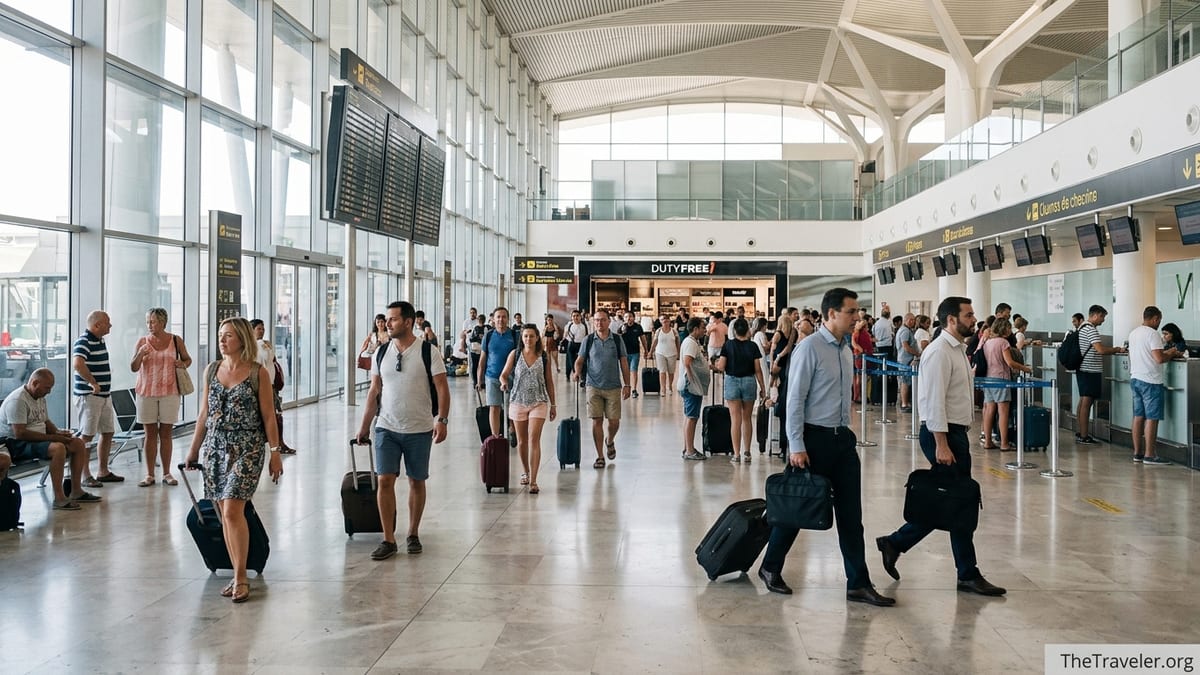
Arriving at the airport by train or bus, you will typically enter on the departures level of Terminal 3. The main departures hall is a tall, bright space with long rows of check-in desks grouped by airline and destination. Overhead screens show which desks are open for your flight, and separate screens list live departures with gate numbers and status updates such as “boarding,” “last call,” or “delayed.” This is your reference point for the rest of the journey to your gate.
After check-in, you funnel toward a single main security checkpoint that serves all Schengen and non-Schengen flights. Once past security, you emerge into the commercial departure area with duty free, cafés, and shops, then out toward two broad concourses used for boarding. Schengen flights to cities like Madrid, Barcelona, Paris, or Berlin usually depart from one set of gates, while non-Schengen services to the UK, Ireland, and further afield use another, separated by passport control.
Because the entire complex works like one integrated terminal, a key planning point is not which terminal you are using but how long it will take you to move through each functional zone: check-in, security, commercial area, passport control if needed, and the walk to your gate. Walking times from security to farthest gates are usually under 10–15 minutes at a normal pace, but at busy times you can easily lose that much time in queues alone, especially at passport control for UK and other non-EU flights.
Check-In Timing and Airline Desk Practices
For most European short-haul departures, airlines at Malaga open their check-in desks around two to three hours before departure and close them 40 to 60 minutes before scheduled take-off. For example, a 10:00 flight to Dublin with an Irish low-cost carrier might open desks around 07:00 and close them around 09:15, while a legacy airline flight to a major hub could close earlier to allow for stricter connection handling. If you arrive at the desk after it closes, staff are usually firm: even if you can see your aircraft on stand, you will likely be refused boarding.
As a practical rule, aim to arrive at the departures level around two hours before a domestic or Schengen flight and at least two and a half hours before a UK, Ireland, or long-haul departure. In the height of the summer holiday season, some carriers such as Ryanair and easyJet have emailed passengers at Malaga advising three hours, reflecting real-life crowding and passport control bottlenecks. Travelers reporting late-morning UK departures in July and August frequently describe long lines that can easily absorb an hour between security and exit border checks, so building in that extra buffer is prudent.
Online check-in is strongly encouraged by most airlines at Malaga, especially low-cost carriers. If you are flying with hand luggage only and have your boarding pass on your phone or printed, you can head straight to security without visiting a desk at all. This can save 20–30 minutes on a busy morning when large holiday groups are queuing to drop bags. For instance, a couple flying with only cabin bags on an 08:30 Amsterdam flight can often arrive at 06:45, go straight to security, and be through to the shops within 30 minutes, while families checking strollers and multiple suitcases might still be at the drop-off counter.
Bag-drop opening times matter if you reach the airport very early. If you arrive at 11:30 for a 20:00 evening flight to London because of a hotel checkout, you may not be able to check your luggage for several hours; desks might only open around 17:00. In that case, you will be stuck in the public area of departures with your bags until the airline opens check-in. Planning hotel checkout or car return to align better with desk opening times can save you a long, uncomfortable wait on the landside benches.
Navigating Security and Typical Waiting Times
All standard departing passengers at Malaga pass through the main security checkpoint in Terminal 3. At quieter times, security can take as little as 10–15 minutes from joining the queue to entering the duty free area. However, at peak times, especially summer mornings between roughly 07:00 and 11:00 and late afternoon waves around 16:00 to 20:00, travelers regularly report much longer waits. It is not unusual for the line to snake back toward the check-in area, with total processing times of 30–45 minutes.
Malaga security uses standard European screening rules: liquids must be in containers of 100 ml or less, all together in a clear 1 liter bag; laptops, tablets, and large electronics typically need to be removed from bags unless an upgraded scanner lane instructs otherwise; jackets, belts with large metal buckles, and sometimes shoes must come off for the X-ray. Families with small children and passengers who are not frequent fliers often slow the flow at busy times, as they reorganize bags at the conveyor belt. Having your liquids bag prepared, electronics easy to remove, and pockets already emptied makes a noticeable difference.
At some airports, staff explicitly discourage arriving excessively early because security halls fill with passengers for flights many hours away. Malaga currently leans more toward the traditional advice of arriving early, especially for non-Schengen flights, but the principle still applies: if everyone turns up four hours before departure, the queues can swell in unhelpful ways. A balanced approach is best: for a 14:00 flight midweek in shoulder season, arriving just before midday is usually sufficient; for a Saturday in August or Easter week, adding an extra half hour on top of the standard recommendations is wise.
If you are traveling with someone who has reduced mobility or a hidden disability, Malaga has assistance services bookable in advance, and dedicated lanes may be available. These are intended for passengers who genuinely need them, not as a shortcut, but they can turn what would be a stressful 40-minute wait into a manageable 10–15 minute process. On the other side of security, allow a few minutes to repack your items calmly at the sorting tables so you do not leave valuables behind in the trays.
Schengen vs Non-Schengen: Passport Control and Gate Areas
After security, passengers at Malaga are funneled into a large duty free store before reaching the main departures concourse. From there, your route depends on whether your destination is inside or outside the Schengen Area. Flights to most of continental Europe, such as France, Germany, Italy, the Netherlands, or domestic Spanish destinations, are Schengen services and usually do not require exit passport control; you will simply walk toward the appropriate gate cluster following overhead signage and the information screens.
By contrast, flights to the United Kingdom, Ireland, and other non-Schengen destinations involve a separate stage of border control before you reach the gate. This is where many recent complaints about Malaga have focused: during busy periods, queues for exit passport control can become very long, with UK-bound passengers in particular reporting waits of 30–60 minutes. For example, a midday departure to Manchester in high season could see lines stretching beyond the entrance to the non-Schengen area, even though the walk itself from the central duty free to those gates is only about five to ten minutes.
Because of this, Malaga’s airport operator explicitly advises passengers who must go through passport control to proceed to their boarding area as soon as the gate is displayed on the screens, instead of lingering in the main shopping area. Real-world cases show why this matters: on some days, airlines have closed gates on time while a visible number of passengers are still stuck in the passport queue, resulting in missed flights even though travelers arrived at the airport two or more hours beforehand.
The practical takeaway is to treat passport control as a separate, potentially significant queue in your time budget. If you are flying to Dublin, London, Edinburgh, or another non-Schengen city, aim to be finished with shopping and food at least 60 minutes before departure and head straight for the non-Schengen access point. If you find no queue, you can always relax near your gate; if the line is long, you will be glad you did not leave it to the last moment. Families with children, or travelers with mobility challenges, should allow an even more generous buffer to avoid stressful sprints down the pier.
Food, Drinks, and Shopping in the Departure Area
Once through security, Malaga offers a typical mix of Mediterranean and international options for food, coffee, and last-minute shopping. The first thing you encounter is a large duty free zone selling perfumes, cosmetics, alcohol, tobacco, and confectionery. Prices for spirits and fragrances can be competitive compared with city-center shops, particularly on promotional multi-bottle deals, though you should not assume every item is a bargain; for example, a one-liter bottle of well-known gin might be a few euros cheaper than in the city, while some premium cosmetics are only marginally less expensive.
Beyond duty free, the departures concourse includes several cafés and fast-food outlets that suit different budgets and time frames. You can expect familiar names offering espresso drinks, sandwiches, and pastries at prices slightly higher than in Malaga city: a cappuccino might cost around 3 to 4 euros, while a ham and cheese bocadillo or simple baguette could be in the 6 to 8 euro range. For travelers with more time to spare, there are sit-down restaurants serving salads, tapas-style plates, burgers, or pasta dishes, where a main course may run 12 to 18 euros, plus drinks.
Shops in the departure area lean heavily toward holiday essentials and souvenirs: beachwear, sunglasses, electronics accessories, books and magazines, local food products such as olive oil and tinned seafood, and regional wines. This can be a good place to pick up last-minute gifts like a selection of Andalusian olive oils or a bottle of local sweet wine, but remember that non-Schengen passengers must still carry these through passport control and to the gate, so buying heavy items just before a long walk may not be ideal.
Practical services are also present, including pharmacies, travel accessories kiosks, and sometimes mini-markets selling bottled water, snacks, and baby items. It is usually cheaper to buy a large bottle of water airside than to rely on drinks purchased on board the aircraft, especially on low-cost carriers where a small bottle can cost 3 to 4 euros. If you are traveling with children, stocking up on snacks and an extra drink in the terminal can make the boarding and early flight stages more comfortable.
Lounges and Quiet Spaces Before Departure
Malaga’s primary official airport lounge for departing passengers is the Sala VIP in Terminal 3, located airside after security in the main departure area. It is accessible to a wide mix of travelers: premium-class passengers on certain airlines, status holders on some frequent flyer programs, holders of independent lounge membership schemes such as Priority Pass, and walk-up customers paying a day rate. Recent pricing information from the airport operator suggests a typical adult entry fee in the mid-30 euros range, with children between 6 and 10 years old paying roughly half that and younger children admitted free, though exact figures can vary slightly year by year.
The lounge environment is noticeably calmer than the main concourse. Inside, you can expect comfortable seating with power outlets, self-service snacks like pastries, sandwiches, fruit, and simple hot dishes, along with a selection of soft drinks, coffee, tea, and usually beer and wine. Free Wi-Fi and quieter corners for working make it popular with business travelers, while families value the ability to spread out away from the busiest gate areas. The lounge can get crowded during summer midday waves, to the point that access may be limited temporarily if it reaches capacity, so turning up earlier rather than at the last possible moment is advisable.
Importantly, Malaga’s terminals are interconnected airside, so passengers departing from gates technically associated with Terminal 2 can still use the Sala VIP in Terminal 3. For example, if you are flying a low-cost carrier from a T2 gate, you can go through the main T3 security checkpoint, access the lounge for an hour or two, and then walk to your gate once boarding time approaches. Walking times from the lounge to most gates are modest, but you should still allow 10–15 minutes, especially if you must pass through passport control for a non-Schengen flight.
For those who do not wish to pay for lounge access, there are still some relatively quiet seating areas in the main departures hall, often at the far ends of the piers or near less-used gates outside peak waves. If you need to work, look for high-top tables near some cafés that offer plug sockets, or consider buying a single drink and taking advantage of the seating and Wi-Fi there. Noise levels near the main duty free exits and central food court can be high, so moving deeper into the gate areas usually pays off for a more relaxed wait.
Boarding Procedures and Time Management at the Gate
Boarding at Malaga follows typical European patterns, but with the added pressure that many flights are operated by low-cost carriers that keep very tight turnaround times. Gates often open around 40 minutes before departure and close 15 to 20 minutes before scheduled take-off, though this can vary by airline. Airlines are generally strict about gate closing times, even when passengers are still arriving from other parts of the terminal, and there have been documented cases where a significant minority of booked travelers did not make it aboard because they misjudged the time required for passport control and walking.
Many airlines departing Malaga, especially to the UK and Ireland, board via a combination of airbridges and buses. For a bus boarding, you may scan your boarding pass at the gate, descend to a lower level, and be held briefly in a waiting area before being driven out to the aircraft. Priority boarding, if you have paid for it or are entitled through status or fare class, is often enforced at Malaga: staff will call priority groups first, then general boarding in zones. That said, the actual experience can feel crowded, with everyone eager to secure overhead bin space for cabin bags.
Realistically, your best strategy is to treat the gate’s “boarding” announcement as your signal to be physically present at the gate area, not still in a café five or ten minutes’ walk away. If screens show “go to gate,” that means the gate has been assigned and you should start heading there, especially for non-Schengen flights where you might still need to pass passport control before reaching the gate cluster. Leaving a shop or restaurant only once you see “final call” can be risky; by then, staff may already be preparing to close the doors.
If you are traveling with hand luggage only and relying on overhead bin space, boarding earlier within your zone can make the difference between placing your bag directly above your seat or having it checked into the hold at the gate. Several low-cost airlines operating from Malaga are strict about bag dimensions and weights, and gate checks are common. Checking your bag at the gate might be free if the overhead bins are truly full, but if staff determine that your bag exceeds the size or weight limit, you could be charged a substantial last-minute fee. Weighing and measuring your cabin bag before departure, and being ready with essentials in a small under-seat bag, can prevent unwelcome surprises at the gate.
The Takeaway
Departing from Malaga Airport can be straightforward if you approach it with a realistic plan: understand that Terminal 3 is the main hub for check-in and security, but that all terminals effectively merge into a single departure experience; allow enough time not only for security but also for potential queues at exit passport control; and give yourself clear, conservative cut-off points for leaving shops and cafés to head to your gate. Real-world reports show that in busy periods, passengers who cut their timings too fine, especially on UK and Irish flights, are the ones most at risk of missing departures.
If you are checking bags, arriving two to three hours before departure is usually sensible, with extra margin in summer and on holiday weekends. Use online check-in and hand luggage only where possible to bypass desk queues, keep your liquids and electronics organized to move quickly through security, and be proactive about reaching passport control early if you are leaving the Schengen Area. Consider the airport lounge if you value a calmer environment and are willing to pay the fee or can access it through a card or status, but remember it does not exempt you from long walks or border queues.
Ultimately, Malaga is a busy leisure gateway rather than a small regional airport, and treating it as such pays off. Build in enough buffer, pay attention to screens and announcements, prioritize getting through the formalities before shopping, and you are far more likely to start your journey home from the Costa del Sol with a final relaxed coffee at the gate, rather than a frantic dash and a sinking feeling as the doors close.
FAQ
Q1. How early should I arrive at Malaga Airport for departure?
For most European flights, arriving about two hours before departure is usually enough, but in summer or for UK and Irish flights, plan on two and a half to three hours.
Q2. Do all passengers at Malaga have to use Terminal 3?
Terminal 3 handles the main security checkpoint and most check-in, but Terminal 2 is physically connected; in practice the departures side functions as one integrated terminal.
Q3. How long does security normally take at Malaga?
At quieter times you might clear security in 10–15 minutes, but in busy holiday periods it can take 30–45 minutes, so you should factor that into your arrival time.
Q4. Is passport control always required when leaving Malaga?
No. Passport control is required for non-Schengen flights, such as to the UK or Ireland, but flights within Spain and most of continental Europe usually do not require exit control.
Q5. Are there lounges I can pay to access at Malaga?
Yes. The main Sala VIP lounge in Terminal 3 allows access for eligible ticket holders, lounge program members, and walk-up guests who pay a fee, typically in the mid-30 euros range for adults.
Q6. Can I use the lounge if my flight departs from Terminal 2?
Generally yes. Terminal 2 and 3 are connected airside, so passengers departing from T2 gates can usually go through T3 security, use the Sala VIP, and then walk to their gate.
Q7. What kind of food options are available after security?
There are cafés, fast-food counters, and sit-down restaurants offering coffee, sandwiches, pastries, and hot meals, with prices slightly higher than in the city but typical for a busy holiday airport.
Q8. How strict are airlines at Malaga about cabin baggage?
Low-cost carriers in particular are strict about size and weight. Oversized cabin bags are often gate-checked and may incur extra fees, so it is important to follow your airline’s rules closely.
Q9. How much time should I leave to get to my gate once it is announced?
Aim to be walking toward your gate as soon as screens show “go to gate,” allowing at least 15–20 minutes before boarding, and more if you need to pass through passport control.
Q10. Is Malaga Airport suitable for travelers with reduced mobility?
Yes. The airport provides assistance services that can be booked in advance, and there are lifts, ramps, and accessible facilities, but you should still allow extra time at peak periods.