


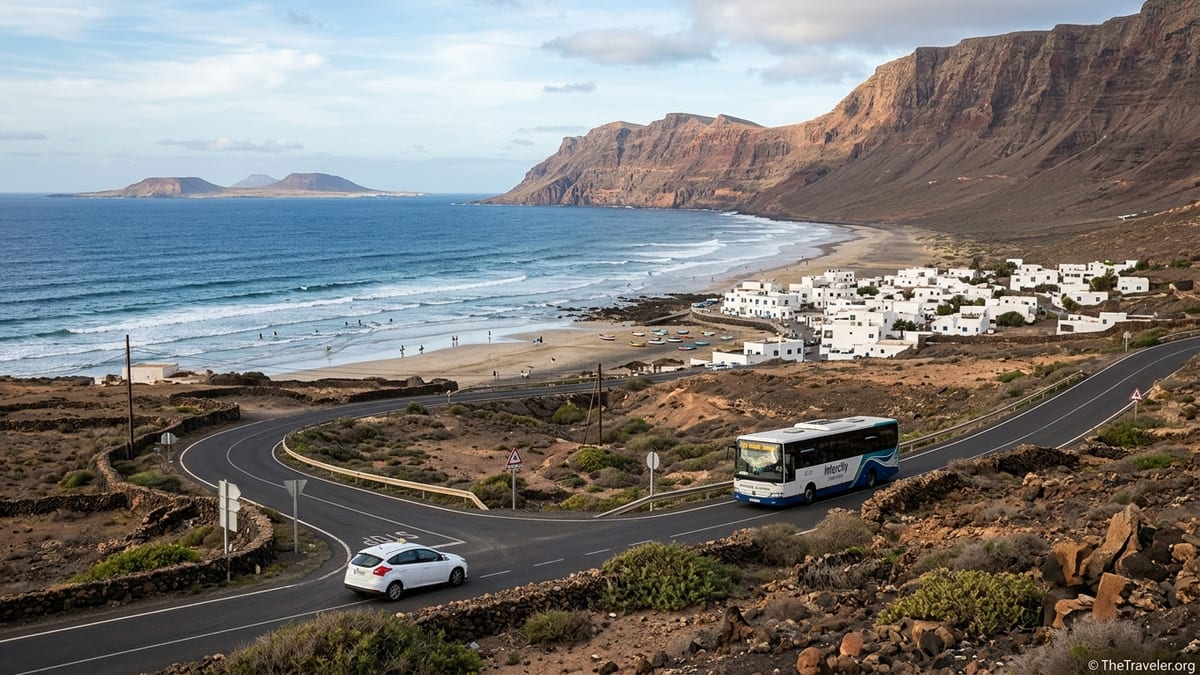
Playa de Famara and the fishing village of Caleta de Famara feel a world away from Lanzarote’s big resorts, but they are perfectly reachable if you understand the island’s transport network. Whether you rely on buses, are considering taxis and new app based services, or want to drive yourself, planning the trip in advance will make your day on this wild surf beach run far more smoothly.
Get the latest updates straight to your inbox!
Where Famara Is and Typical Journey Times
Caleta de Famara sits on Lanzarote’s rugged north west coast, within the municipality of Teguise. The village lies at the southern end of the long Playa de Famara, below the cliffs of the Risco de Famara. Lanzarote Airport, officially César Manrique Lanzarote Airport, is on the east coast near Arrecife, roughly opposite Famara on the island’s road map, so any journey involves crossing the interior.
Driving from Lanzarote Airport to Caleta de Famara typically takes around 25 to 35 minutes, depending on traffic and the route you choose through San Bartolomé and Teguise. From central Arrecife the drive is slightly shorter, often around 20 to 30 minutes. These times are based on current checks with a mainstream mapping service and allow for normal traffic rather than peak holiday congestion or roadworks.
Costa Teguise, on the northeast coast, is relatively close in straight line distance but connected by secondary roads across the interior. Typical driving times from Costa Teguise to Caleta de Famara are around 25 to 35 minutes. From Puerto del Carmen on the south east coast, expect roughly 35 to 45 minutes by car, while from Playa Blanca at the southern tip of Lanzarote you should allow about 50 to 65 minutes, as you must traverse much of the island northwards.
Public transport journeys are usually longer because they involve indirect routes and transfers. If you are tight on time, especially when connecting to or from a flight, it is wise to add at least an extra 30 to 60 minutes to any estimated bus based itinerary, and to monitor live traffic and service updates where available.
Understanding Lanzarote’s Intercity Bus System
Lanzarote’s regular buses, commonly called guaguas, are operated island wide by Intercity Lanzarote. The system links the main towns and resorts with inland villages, and includes dedicated routes to Caleta de Famara. Services are numbered and most routes start or end at the main bus station in Arrecife, with additional hubs in Costa Teguise, Puerto del Carmen and Playa Blanca.
At the time of writing, Caleta de Famara is served directly by at least two numbered lines in the Intercity Lanzarote network: line 20 between Arrecife and Caleta de Famara, and line 31 between Costa Teguise and Caleta de Famara via Teguise. Official route listings and recent local reports confirm that both lines call at the village. Some stop listings also mention line 33 serving the area, although current public information for that line is more limited, so visitors should verify whether it is operating on their travel dates.
Line 20’s published pattern links Arrecife Bus Station with Caleta de Famara through inland villages such as Argana, San Bartolomé, Mozaga, Tao, Tiagua, Muñique and Soo. Line 31 runs from Costa Teguise hotels through Tahiche, Las Cabreras, Nazaret and the town of Teguise before descending to Caleta de Famara. Recent timetable snapshots and local planning documents indicate that services on line 31 run several times per day on weekdays, with a slightly reduced pattern at weekends and on public holidays.
Although third party journey planners can be helpful, the most reliable source for up to date routes, departure times and any service changes remains the official Intercity Lanzarote timetable and live information tools. Routes and frequencies have been adjusted more than once in recent years, and local news has highlighted occasional cuts or suspensions on rural lines, including services affecting Famara at weekends. Treat any printed or older online timetable as a guide only and recheck close to travel.
Reaching Famara by Bus from Arrecife and Costa Teguise
From Arrecife, the simplest car free option is usually line 20 directly to Caleta de Famara. Current route descriptions show this line starting at the main Arrecife bus station, then running inland via Argana and San Bartolomé before continuing through central villages such as Mozaga, Tao, Tiagua, Muñique and Soo to Caleta de Famara. This gives visitors a direct link from the island’s transport hub to the village without changing buses when the service is running.
Frequency on line 20 is moderate rather than high. Published timetables and recent local coverage suggest a handful of departures in each direction daily, with some evidence that services can be thinner on certain weekends or public holidays. Day trippers should therefore plan around specific departure times instead of assuming a turn up and go frequency. Where possible, aim for morning departures from Arrecife so that any missed or delayed bus still leaves room for an alternative later run.
From Costa Teguise, line 31 currently provides the key direct connection to Caleta de Famara. According to the latest line information, this bus departs from hotel areas in Costa Teguise and passes stops such as Lanzarote Gardens, Pueblo Marinero and Playa Bastián before heading inland through Tahiche, Las Cabreras, Nazaret and the town of Teguise, then on to the coastal terminus at Caleta de Famara. Timetable examples show around six or more departures on some days, with a slightly different pattern between weekdays and weekends.
If the direct Costa Teguise to Famara timetable does not fit your plans, another option is to travel first from Costa Teguise or Arrecife to the historic town of Teguise on another line, then connect there to line 31 or another Famara bound service. This can work well for visitors who want to combine sightseeing in Teguise with an afternoon at the beach, but connections are not formally guaranteed. On Sundays and during off peak seasons some services may be cut back, so always confirm the latest timings on the operator’s website or app and allow generous transfer time.
Starting from Puerto del Carmen or Playa Blanca Without a Car
For visitors based in Puerto del Carmen, there is currently no direct bus to Famara. The most realistic public transport strategy is to travel first to Arrecife and then change to line 20 for Caleta de Famara. Regular intercity routes link Puerto del Carmen with Arrecife, and from there line 20 continues across the interior to Famara. In practice, this usually involves at least one change of bus and a total journey time that can easily stretch to around 1.5 to 2.5 hours each way, depending on connection times.
A second, sometimes attractive, option from Puerto del Carmen is to travel by bus to Costa Teguise via Arrecife, then connect to line 31 to Famara. This makes sense only if the line 31 timetable lines up better with your plans than line 20, or if you specifically want to see Costa Teguise on the same outing. Travel time is then similar to or longer than the Arrecife plus line 20 combination, and still requires careful attention to timetables to avoid long waits.
From Playa Blanca, the challenge is greater. Buses typically run from Playa Blanca to Arrecife or sometimes to Puerto del Carmen first, and from there you must still connect via Arrecife or Costa Teguise to reach Famara. In real terms, a Playa Blanca to Famara trip using only scheduled buses, with one or two changes, can easily take 2 to 3 hours or more each way once waiting time and any delays are included. For a simple day trip this can feel long, particularly with children or surf gear.
For families staying in Puerto del Carmen or Playa Blanca who want a straightforward day in Famara, renting a car for a single day or joining an organised excursion can be more practical than relying entirely on buses. Intercity Lanzarote’s network is safe and good value, but services to the north west are relatively infrequent and geared more to local needs than to same day beach excursions from the southern resorts.
Driving to Playa de Famara and Parking Considerations
Driving remains the most flexible way to reach Playa de Famara. The main approaches use well maintained island roads, typically the LZ 20 or LZ 30 between Arrecife and the interior, and the LZ 401 or related local roads near Soo and Caleta de Famara. Road surfaces on these routes are generally good, but some sections closer to the coast are narrower and more exposed to crosswinds, which can be strong around the Famara cliffs.
As you enter Caleta de Famara, streets become tight and residential. Many lanes are one way or effectively single track when cars are parked along both sides. Visitors should drive slowly, yield courteously to oncoming traffic and respect any signed restrictions. In windy conditions, sand can accumulate at the edges of the road or across informal tracks, reducing grip and obscuring potholes; rental cars with low clearance should avoid deep sand.
Parking is typically available within the village on marked streets and in informal areas closer to the beach. However, local authorities have become more active in controlling where vehicles can park, particularly during village fiestas and peak holiday periods. Recent municipal notices for Caleta de Famara highlight reinforced signage and enforcement in zones where parking is not allowed, both to protect dunes and to keep emergency access clear. Expect temporary restrictions and possible towing if you ignore signs or cones.
Unpaved parking on sand or dirt close to the shore is common in some parts of the Canary Islands, but conditions around Famara can change and some spots fall inside protected natural areas. To avoid fines and environmental damage, use clearly designated parking areas, avoid driving over dunes or onto soft beach sand, and if in doubt check with local police, municipal information points or your accommodation host for the latest guidance.
Taxis, On Demand Services and Private Transfers
Licensed taxis are widely available on Lanzarote and represent a practical alternative to renting a car, especially for small groups. Official airport information confirms that metered taxis operate from designated ranks outside both terminals at César Manrique Lanzarote Airport, with regulated tariffs that differ between daytime weekdays and night or holiday periods. The meter applies a starting charge, a per kilometre rate and, in the case of airport journeys, a small supplement for using the terminal rank.
Typical fares from the airport to central Arrecife are reported at around 6 kilometres and roughly 10 minutes’ drive, with an indicative fixed price example of about 25 euros published for that route. While there is less official data for airport to Famara journeys, the longer distance and rural destination mean that travellers can expect significantly higher fares; many local guides and booking platforms suggest budgeting in the range of several tens of euros one way, depending on time of day, luggage and exact drop off point. Because tariffs can be updated by the island and municipal authorities, it is important to check current rates and, where possible, ask the driver or radio taxi operator for an estimated price before setting off.
In addition to traditional taxis, Lanzarote now has an app based on demand mobility service known as VIPO. According to recent local news coverage, VIPO began by linking high demand areas such as Playa Blanca, Puerto del Carmen, Arrecife, the airport, Playa Honda and Costa Teguise, and has recently extended its operations to cover all municipalities on the island. The company states that residents of smaller communities, including Famara, can now request rides through the app, with vehicle availability varying by time of day and demand.
Operating hours and conditions for services such as VIPO may evolve as the scheme expands, and capacity in rural areas is naturally more limited than in the main resorts. Travellers interested in using on demand services for a Famara trip should check the latest information in the provider’s app shortly before travel, paying attention to any notes on service areas, peak times, and requirements such as advance booking. It is also advisable to avoid unlicensed “taxis” promoted informally on social media or around tourist zones; local authorities have recently highlighted enforcement efforts against these operators, which do not offer the same regulatory protections as official taxis.
Surf School Shuttles and Organised Excursions
Because Playa de Famara is one of Lanzarote’s key surf beaches, several surf schools and camps based both in Caleta de Famara and in the main resorts advertise transfers for students. Some schools located in Caleta de Famara include accommodation in the village itself, removing the need for daily transfers once you arrive. Others, particularly those based in Puerto del Carmen, Costa Teguise or Playa Blanca, may offer daily transport to and from Famara as part of a course package.
What is included in these surf transfers varies by operator. In some cases, the service functions as a direct shuttle between a central meeting point in your resort and the surf school in Famara at fixed times, with equipment and wetsuits transported by the school. Other operations rely on car pooling by instructors or small vans that pick up students at or near their accommodation. Most of these options are restricted to customers booking lessons or multi day courses rather than general beach visitors.
There is no single island wide standard for surf transfers or group excursions to Famara, and schedules may change with the seasons and demand. If transport is important to your choice of surf school, ask for clear, written information before you book. Check where exactly you will be picked up and dropped off, how long the journey is expected to take from your resort, whether return journeys are guaranteed on specific days, and what happens if windy or dangerous surf conditions force changes at short notice.
Some general excursion companies occasionally include Famara as a photo stop on full day island tours, often combining it with other sights such as La Graciosa viewpoints or volcanic landscapes. These visits tend to be brief and may not allow for extended time on the beach or in the water, so they are better seen as a scenic overview than as a way to spend a full surf day at Playa de Famara.
Accessibility, Safety and Dealing with Disruptions
Caleta de Famara is a small, relatively level village, but streets and pavements can be uneven, and some beachfront access points involve steps or soft sand. Travellers with mobility limitations should contact their accommodation or chosen surf school in advance to discuss step free approaches, possible drop off points for taxis, and the most suitable sections of the beach. While buses generally have designated stops at the edge of the village, not all stops offer completely level access from pavement to vehicle.
When planning a trip immediately before or after a flight, extra time is essential. Allowing a wide buffer protects you against traffic delays, queues at the airport and timetable changes. This is particularly important if you aim to use infrequent rural bus lines such as the services to Famara. In the event of a missed connection, taxis may not always be readily available in smaller villages, especially late in the evening or on Sundays.
Local news in 2026 has reported industrial disputes and warnings of possible changes to bus operations at Lanzarote Airport, as well as references to service gaps on some rural routes including lines affecting Caleta de Famara at weekends. Although these situations are often resolved or mitigated with minimum services, they underline the need to monitor announcements from Intercity Lanzarote, the island council and your airline in the days before travel.
Weather is another practical concern. Famara is known for wind, blowing sand and, at times, powerful surf and currents. When driving, be prepared for gusts that can affect vehicle stability, and avoid parking in exposed spots where sand drifts might partly bury tyres. In the water, follow local safety advice and surf school guidance, and keep an eye on changing conditions that might force an earlier return to your accommodation than planned.
Choosing the Best Option: Three Common Traveller Scenarios
For a budget conscious, car free traveller based in Arrecife or Costa Teguise, public buses remain the most workable solution. From Arrecife, line 20 offers a direct route to Caleta de Famara when operating, while from Costa Teguise line 31 provides a comparably straightforward connection. By planning around the current timetables, travelling outside the very last evening services, and checking for any weekend reductions, such travellers can reach Famara at modest cost, accepting that total journey times will be longer than driving.
A resort based family seeking a simple day trip, particularly from Puerto del Carmen or Playa Blanca, faces a different calculation. Multi leg bus journeys with long waits can be tiring for children and may leave limited time on the beach. In this case, a one day car rental, a pre booked taxi for the outbound or return leg, or a family place in an organised excursion that guarantees transport can offer a more relaxed experience, even if it is more expensive than buses.
For the surf focused visitor deciding whether to rent a car for the entire stay, the choice turns on flexibility. With a rental car you can chase the best swell windows, arrive early to secure parking, move between surf breaks and adjust quickly if wind or tides change. Without a car, you rely on set bus times, surf school shuttles or on demand rides, which can work well if you base yourself in Caleta de Famara itself or in Arrecife or Costa Teguise and structure your days tightly around the bus network.
In every scenario, the fundamentals remain the same: verify the latest bus and taxi information before you travel, leave generous margins when connecting to flights, respect parking rules and protected areas, and prepare for weather and service disruptions. With thoughtful planning, even visitors who never touch a steering wheel can enjoy Lanzarote’s wild Famara coastline safely and with confidence.