


Cannes may be synonymous with red carpets and movie stars, but for most travelers it is a compact, walkable seaside town where beach life, Old World charm and Riviera glamour blend together. With a bit of planning, you can experience the best of La Croisette, the historic hilltop of Le Suquet, boat trips to the Lérins Islands and easy day trips along the coast without feeling rushed or overwhelmed. This guide walks you through how to plan a trip to Cannes that hits the real highlights, using concrete examples, realistic budgets and on the ground details.
Get the latest updates straight to your inbox!
Choosing the Right Time and Budget for Cannes
The first decision that shapes your Cannes experience is when to go. In May, the Cannes Film Festival turns the city into a global media circus. Hotel rates can double or more, simple bistros are fully booked, and promenading along the Croisette means weaving through security barriers and camera crews. Unless you are coming specifically for the festival or film industry events, most leisure travelers are better off avoiding those two weeks and choosing late April, early June, September or early October, when the weather is usually mild, the sea is swimmable, and prices are more manageable.
For a mid range stay outside peak events, a realistic nightly budget for a well located 3 star hotel near the station or a few blocks behind La Croisette is often in the range of 130 to 200 euros for a double room, depending on how early you book and whether you choose flexible rates. A four star property on or just off La Croisette, such as one of the classic Riviera style hotels with sea views, typically runs from around 250 to 400 euros per night for a standard room in shoulder season, and more in high season. Private apartments can be less expensive, especially a few tram or bus stops away from the center, but factor in cleaning fees and deposits.
France applies a nightly tourist tax in addition to your room rate, and Cannes sets its own schedule of city tax by hotel category. In practice this usually adds roughly 1 to 4 euros per person per night on top of your room price. On a four night stay for two people, that could mean around 16 to 32 euros extra at check out. The tax is almost always paid directly at the hotel or rental check in desk, so do not be surprised if it is not fully included in what you prepay to an online booking site.
Cash wise, you will feel more relaxed in Cannes if you plan a daily budget that accounts for Riviera reality. For a couple eating one sit down meal in a mid range brasserie, one lighter picnic style meal, two beach coffees and a round of evening drinks, 120 to 160 euros per day for food and casual indulgences is reasonable. Add any paid activities such as a return ferry to the Lérins Islands, which is typically a few dozen euros per adult, or a pair of sunbeds at a private beach club that can cost from around 30 to 70 euros per person in high summer depending on location, front row and service level.
Where to Stay So You Are Close to the Highlights
Cannes is compact, but where you sleep still shapes how easily you can reach the main sights. If this is your first visit and you want to maximize walking access, aim for the triangle between the train station, the Vieux Port (old harbor) and La Croisette. A small hotel on Rue d’Antibes, the main shopping street that runs parallel to the seafront, will put you within a five to ten minute walk of the Palais des Festivals, the sandy public beaches, and the lanes of Le Suquet climbing up behind the harbor.
Le Suquet, the medieval old quarter, is one of the most atmospheric places to stay, with stone stairways, shuttered houses and restaurant terraces that spill onto cobbled lanes. Booking an apartment on or just off Rue Saint Antoine, for example, means that in the evening you can simply step outside into a street lined with dining options, then stroll a few minutes downhill to the harbor to see the yachts lit up at night. Be prepared for some steps and a slightly longer walk to the beaches compared with a lower lying hotel.
To keep costs down without missing the highlights, look at areas just west of the center such as around Boulevard du Midi or the Cannes La Bocca district. Here you will find more residential streets, bakeries, and local markets, plus wide stretches of sandy public beach along Plage du Midi. You might be a 20 to 30 minute walk or a short bus ride from the Palais des Festivals and La Croisette, but you gain more affordable accommodation, particularly in summer when seafront hotels charge top rates.
If your priority is classic Riviera glamour and you are comfortable with higher prices, staying directly on La Croisette offers an iconic experience. Waking up in a sea view room, crossing the boulevard under palm trees and stepping straight onto the beach is hard to beat. You can expect grand lobbies, attentive service and details like plush sun loungers on their associated beach clubs. Just remember that even a simple poolside drink might cost over ten euros, and breakfast buffets may be significantly more expensive than a coffee and croissant at a café on a side street.
Arriving in Cannes and Getting Around Without Stress
Most international visitors reach Cannes via Nice Côte d’Azur Airport. From there, you can choose between train, coach style buses, regular commuter buses and private transfers. The regional TER train runs from Nice Saint Augustin or Nice Ville stations to Cannes in around 30 to 40 minutes, with tickets typically in the range of a few euros for standard class. To use the train, you first need to get from the airport terminal to the station, usually by tram or a short bus ride, which can feel cumbersome if you are carrying large suitcases.
Simpler for many travelers are the direct bus services. An express coach style bus connects the airport terminals with Cannes train station and central stops using the motorway, with a journey time often around 45 minutes depending on traffic. Tickets cost more than the regular commuter bus but you get luggage storage and fewer stops. The slower local bus, which still connects the airport area and Cannes along the coastal road, costs only a few euros but can take closer to 90 minutes at busy times, as it stops frequently in towns like Cagnes sur Mer and Antibes. This can be a good option if you arrive outside peak traffic hours and want to save money.
Once you are checked in, you may discover you hardly need motorized transport at all. From the train station to the Palais des Festivals is roughly a five minute walk, and from there another few minutes puts you on either the old harbor side or the central stretch of La Croisette. Walking from the Palais to the western end of Plage du Midi or to the eastern curve of La Croisette near the luxury hotels takes comfortably under half an hour in each direction. For longer runs, local urban buses connect the center with La Bocca, residential districts and neighboring towns, and tickets are generally a couple of euros per ride or cheaper with day passes.
Taxis and ride hailing services are available but relatively expensive compared with public transit, especially during events. A short ride from the station to a hotel a kilometer away can already approach 10 to 15 euros once surcharges are included. It often makes more sense to walk unless you are arriving late at night, carrying heavy luggage or have reduced mobility. Many visitors find that for a three or four day stay, they spend nothing on transport inside Cannes beyond the initial airport transfer and perhaps a boat ticket to the islands.
Must See Sights in Central Cannes
To avoid leaving Cannes feeling like you somehow missed its essence, plan your days around a handful of core areas rather than trying to tick off dozens of individual sights. One anchor is La Croisette, the curved seaside boulevard lined with palm trees, designer boutiques and famous hotels that fronts the bay. A classic experience is to start your morning with a takeaway coffee and walk the section between the Palais des Festivals and the Carlton area, watching joggers, dog walkers and early swimmers, then choose a public beach like Plage du Casino or Plage Macé for your first dip in the Mediterranean.
Another essential stop is the Palais des Festivals et des Congrès, the modernist complex where the Cannes Film Festival takes place each May. Even if there is no event on, visitors flock to the staircase with its red carpet to take their own “premiere” photos. Right in front of the Palais, the pavement is inlaid with handprints of hundreds of film personalities, a Cannes answer to the Hollywood Walk of Fame. On many days the tourist office inside the Palais offers maps, guided tour bookings and information about exhibitions, making it a useful practical stop as well as a sight.
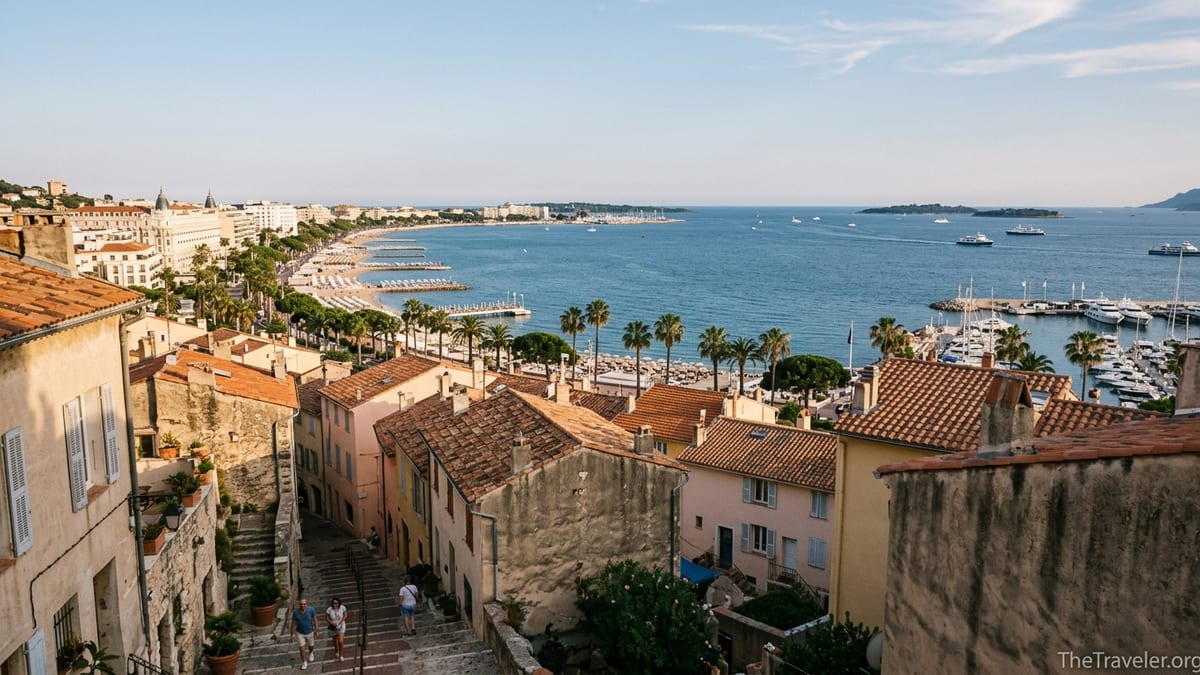
In the afternoon or early evening, head into the Vieux Port to see the contrast between traditional wooden fishing boats and glossy modern yachts. From here, lanes wind uphill into Le Suquet, the oldest part of Cannes. Climb to the terrace by the church and former castle to enjoy panoramic views over the terracotta rooftops, the bay and the Lérins Islands offshore. Time your visit for just before sunset and you will see the facades gradually glow in warm light as lights begin to twinkle along the waterfront.
To round out your understanding of Cannes beyond beaches and film, leave a couple of hours for cultural stops such as the art center in La Malmaison on La Croisette or seasonal exhibitions inside historic villas around town. Many are modestly priced compared with major city museums and offer a dose of Riviera art history. Combine a visit with a walk through nearby residential streets to see 19th century villas and modern apartment blocks that hint at the city’s transformation from small fishing village to international resort.
Beaches, Lérins Islands and How Not to Miss the Coastline
The coastline is the reason most people come to Cannes, so building your trip around a mix of central beaches and quieter shores helps ensure you do not leave feeling shortchanged. Within the city center, the beaches along La Croisette and Plage du Midi are predominantly sandy, which many visitors prefer to the pebbles found in places like Nice. The central public beaches closest to the Palais can fill by late morning in July and August, so arriving before 10 a.m. gives you a better chance of finding a comfortable patch of sand with your towel.
If you prefer comfort and full service, you can book a sun lounger and umbrella at one of the many private beach clubs strung along La Croisette. Prices generally rise the closer you are to the most prestigious hotels and to the waterline. As an example, in peak summer a pair of loungers with an umbrella a couple of rows back from the sea might total between 60 and 120 euros for the day, depending on the venue. Some clubs include towels and a bottle of water in that price, while others charge separately for extras and for food ordered to your chair. Reserving ahead for July and August afternoons is strongly recommended.
To experience a wilder side of the coast, plan at least one half day trip to the Lérins Islands, a pair of wooded isles a short boat ride from the harbor. Regular ferries shuttle between Cannes and Île Sainte Marguerite, known for its pine and eucalyptus forests, cove beaches and the historic fort that once held the so called Man in the Iron Mask. Crossing time is usually around 15 minutes and return tickets are typically in the few dozens of euros range for adults, a bit less for children. On arrival, well marked trails loop the island, and simple snack bars and picnic spots are scattered near the main landing.
The smaller Île Saint Honorat, privately owned by a community of monks, offers vineyards, chapels and more secluded swimming spots. Ferries to this island are slightly less frequent and tickets are priced similarly or a little higher than those to Sainte Marguerite. Plan to bring water shoes for rocky entries into the sea and plenty of sun protection, as shaded coves are popular and fill fast in summer. By including one of these island excursions, you add a memorable change of scenery to a Cannes stay without long transfers.
Markets, Food and Evening Atmosphere
Cannes is not only about expensive terraces. Planning time for markets and local food streets helps you experience everyday life and balance your budget. One key stop is Marché Forville, located a short walk behind the Vieux Port. In the morning, especially from Tuesday to Sunday, stalls overflow with Provençal produce, fish, cheeses and olives. With a small kitchenette in your accommodation, you might easily assemble an evening platter of tomatoes, charcuterie and local rosé for well under what a restaurant dinner would cost.
Even without a kitchen, browsing Marché Forville can set you up for a picnic. Many traders sell ready to eat items like stuffed vegetables, socca style chickpea pancakes or focaccia. Buying a selection for around 10 to 15 euros per person, then walking down to one of the public beaches to eat at the water’s edge, is a pleasant and affordable way to dine. Nearby streets like Rue Meynadier offer bakeries, ice cream shops and casual snack bars, making this area a good place to explore when you want a break from La Croisette’s designer storefronts.
In the evening, Le Suquet comes into its own. Along Rue Saint Antoine and neighboring lanes you will find a concentration of small restaurants, with menus that range from seafood platters and steak frites to modern Mediterranean bistro cooking. Main courses often run from around 20 to 35 euros depending on the dish and the season. It is wise to reserve if you have your heart set on a particular place on a Friday or Saturday night in high season, but you can usually find some table somewhere if you are flexible and willing to look down side streets rather than only the main strip.
For a taste of nightlife without going full nightclub, consider an early evening drink along the harbor or at a rooftop bar. Prices at harbor side spots are higher than in backstreets, and a simple cocktail of the spritz or mojito variety can easily cost 12 to 18 euros. To keep costs predictable, check if the venue lists a happy hour or apéritif specials. Many visitors find that one or two carefully chosen evenings out in these more expensive settings provide plenty of Riviera glamour, while other nights are spent on simpler pleasures such as a sunset stroll with gelato.
Day Trips and How Much Time to Spend in Cannes
Because Cannes sits roughly in the middle of one of Europe’s most famous coastlines, many travelers are tempted to use it as a base for multiple day trips. The regional train and bus network make it easy to reach Antibes, Nice, Monaco or even cross into Italy at Ventimiglia. From Cannes to Antibes by train can be as fast as ten to fifteen minutes, with off peak tickets generally costing less than a typical city taxi fare. A visit to Antibes’ old town and its Picasso Museum, followed by a walk along the ramparts and a late afternoon train back, is a very achievable day.
Nice, with its museums and long Promenade des Anglais, is around 30 to 40 minutes away on the TER regional line. Many visitors choose to split their time on the Riviera between a base in Cannes for beach focus and a stay in Nice for culture and nightlife, but you can also day trip from one to the other. Trains run frequently in both directions, and a day return ticket is often in the range of 10 to 20 euros depending on time and flexibility. If your schedule allows, setting aside one full day to explore Nice, and another for Antibes or one of the perched villages inland, provides welcome variety.
That said, it is easy to over plan. If you have three nights in Cannes, filling two full days with out of town excursions means you will spend a large share of your time on platforms and in trains rather than relaxing on the beach or exploring Le Suquet. Many travelers find that four or five nights is the sweet spot: enough time for two relaxed beach and town days, one island day, and one or two day trips along the coast. With only two nights, focus almost entirely on Cannes itself so you can enjoy sunrise or sunset strolls without rushing.
When planning day trips, keep the last train or bus times in mind so you are not forced into an expensive taxi back. For example, on summer evenings the last direct trains between some Riviera towns can be surprisingly early for night owls, and strike days do occasionally disrupt services. Checking timetables the night before on official apps or at the station helps avoid last minute scrambles and lets you choose a return time that leaves room for dinner in Cannes.
The Takeaway
Planning a trip to Cannes without missing the highlights is less about squeezing in a checklist and more about structuring your days around the city’s strengths. Choose dates that sidestep the biggest price spikes unless you are deliberately chasing the festival scene, and pick accommodation that gives you easy walking access to the Croisette, the harbor and Le Suquet. Treat the journey from Nice Airport as part of the experience by choosing the right mix of comfort and cost in your transfer, then rely mainly on your feet once in town.
Build your itinerary around a few pillars: time on Cannes’ sandy central beaches, an island excursion to at least one of the Lérins Islands, an afternoon or evening wandering Le Suquet and the harbor, and one or two carefully chosen day trips along the coast if you have the days to spare. Mix high end moments, such as a drink on La Croisette or a day at a beach club, with visits to markets and picnics on the sand to keep your budget in balance. With these elements in place, Cannes reveals itself not only as a symbol of glamour but as a very pleasant seaside town where it is easy to slow down and savor the Riviera.
FAQ
Q1. How many days do I need in Cannes to see the main highlights?
For most travelers, three to five nights is ideal. That gives you time for the central beaches, Le Suquet and harbor, a Lérins Islands boat trip and one or two relaxed day trips without rushing.
Q2. Is it worth visiting Cannes outside the Film Festival?
Yes. Outside the festival, Cannes feels more like a laid back seaside town with sandy beaches, markets and walkable streets. Prices are lower, crowds are manageable and you can actually enjoy the Croisette and Palais area without barricades.
Q3. What is the easiest way to get from Nice Airport to Cannes?
The most straightforward options are the express airport bus that goes directly to Cannes train station, or a combination of tram and regional train. The bus is simpler with luggage, while the train can be slightly cheaper and avoids traffic at busy times.
Q4. Are the beaches in Cannes free?
Cannes has a mix of free public beaches and paid private beach clubs. Public stretches along La Croisette and Plage du Midi are free if you bring your own towel and umbrella, while private clubs charge for loungers and service.
Q5. Do I need a car in Cannes?
No. The center is compact and very walkable, and trains and buses connect easily to nearby towns such as Antibes and Nice. A car can be more of a hassle due to parking costs and traffic, especially during major events.
Q6. How expensive is food in Cannes?
Food prices vary widely. A takeaway sandwich or market picnic can cost under 10 euros per person, while a sit down dinner in a mid range restaurant might run 25 to 40 euros per person before drinks. Eating some meals from markets and bakeries helps balance the budget.
Q7. Can I visit the Lérins Islands on a half day trip?
Yes. Ferries to Île Sainte Marguerite take about 15 minutes, and departures are frequent in season. A morning or afternoon is enough time to walk part of the island, swim in a cove and visit the fort, though a full day allows for slower exploration.
Q8. Is Cannes suitable for families with children?
Very much so. The central sandy beaches, shallow areas near the shore, promenade for stroller friendly walks and short boat rides to the islands make it easy to plan child friendly days. Just be sure to pack sun protection and schedule rest breaks in the heat.
Q9. What should I wear for evenings in Cannes?
Cannes is stylish but not strictly formal for most venues. Smart casual outfits work almost everywhere: light dresses, linen shirts, chinos or neat jeans with comfortable shoes. Only a few high end restaurants and clubs expect more formal attire.
Q10. Is English widely spoken in Cannes?
In hotels, restaurants along La Croisette, many shops and tourist facing services, staff usually speak at least some English. Learning a few basic French phrases for greetings and thanks is still appreciated and can make interactions smoother.