


More news on this day
Thanksgiving week air travel in the United States is facing significant disruption after a Delta Air Lines technology outage on Sunday, November 22, 2026, compounded the lingering effects of a separate Federal Aviation Administration nationwide ground stop on Friday, November 13, leaving passengers to navigate delays, cancellations and tighter margins across an already busy holiday period.
Get the latest news straight to your inbox!
What is confirmed about Delta’s November 22 automation failure
Delta Air Lines has confirmed that a problem with its automated system for calculating aircraft weight and balance interrupted operations across its network on Sunday, November 22, 2026. The tool, used by dispatchers and flight crews before every departure, provides essential data on how much an aircraft weighs, how that weight is distributed between passengers, baggage and cargo, and what performance limits apply on takeoff from a specific runway. When the system stopped working correctly on Sunday morning, Delta crews in multiple locations were unable to access the usual electronic figures they rely on before pushback.
Federal Aviation Administration guidance treats accurate weight and balance figures as a core safety requirement, and U.S. officials have stressed in public statements that flights may not legally depart without this information. As a result, affected Delta flights could not simply continue as normal. The carrier has stated that it moved to manual procedures and alternative communication channels once the outage became clear, with pilots and dispatchers exchanging data by radio or phone and completing calculations by hand. These workarounds allowed some departures to continue but at a much lower throughput than the airline would typically achieve on a peak-season Sunday.
Flight-tracking services and airline-status boards on November 22 showed widespread knock-on effects. Publicly available statistics compiled that evening indicated that Delta recorded well over a thousand delayed flights worldwide, representing a substantial share of its scheduled operation. Multiple independent tallies placed the disruption closer to 2,000 delayed flights by late Sunday, though precise totals differ slightly by methodology. Delta has described the problem as a technology outage affecting its own system, and regulators have not reported any evidence that the incident was linked to a cyberattack or broader federal infrastructure failure.
Atlanta ground stop and how disruption spread through Delta’s network
The most visible impact of the outage was at Hartsfield-Jackson Atlanta International Airport, Delta’s largest hub and one of the world’s busiest passenger airports. As delays mounted early on November 22, Delta requested that the FAA halt some Atlanta-bound traffic while it cleared departing aircraft from gates and taxiways. The FAA subsequently issued a temporary ground stop for Delta flights destined for Atlanta, then converted that into a ground delay program that metered arrivals after initial congestion eased. The federal stop itself lasted on the order of an hour before being relaxed, but the backlog of aircraft and the slower manual dispatch process meant that operational ripples continued for much of the day.
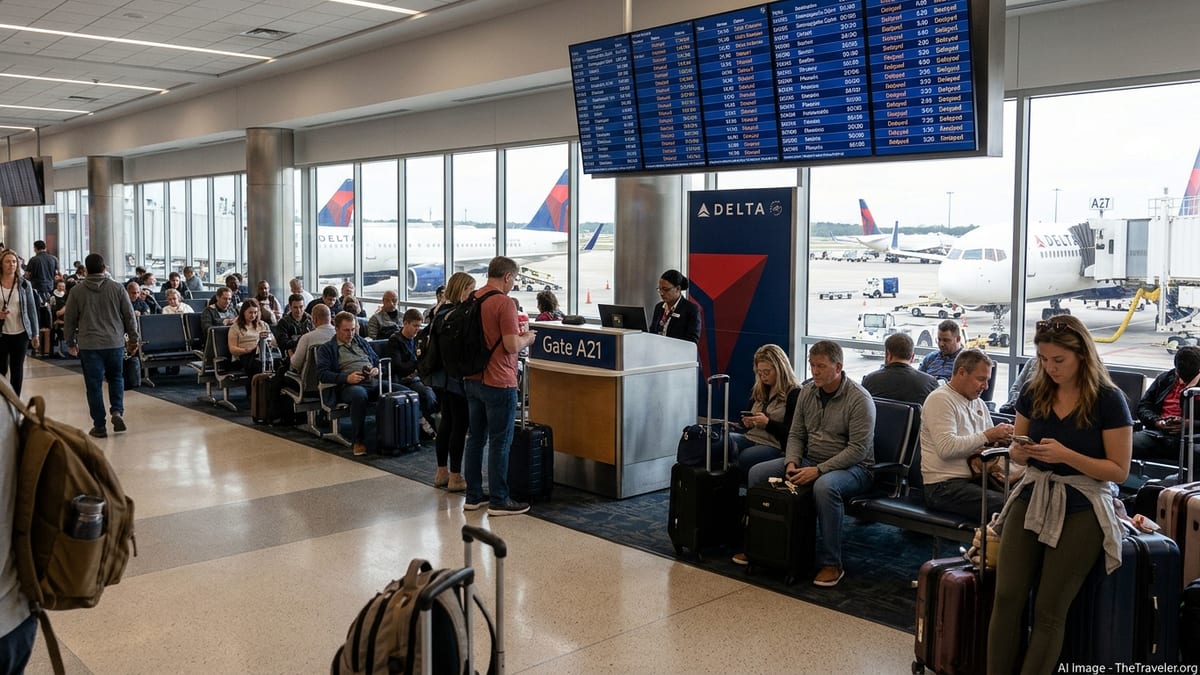
Passengers at Atlanta reported crowded concourses, long queues at customer service and multiple rolling gate changes as departure estimates shifted. Social media posts and local television coverage described some travelers remaining seated on aircraft for extended periods while crews waited for updated paperwork and final weight-and-balance figures to arrive from Delta dispatch. Similar accounts appeared from airports including New York LaGuardia, Seattle, Salt Lake City and Boise, where crews advised passengers that a Delta-wide weight-and-balance system issue was forcing manual workarounds and slowing departures even on routes that did not touch Atlanta.
By late afternoon on November 22, Delta said publicly that its automated system for weight and balance had been restored and that it was working to normalize operations. Early data from Monday, November 23, show a noticeable improvement in punctuality compared with the peak of Sunday’s disruption, with the airline operating the bulk of its schedule. However, residual delays and aircraft and crew misplacements remained, particularly on connecting itineraries that relied on timely flows through Atlanta, Minneapolis–Saint Paul, Detroit, Salt Lake City, Boston and Seattle. Some travelers reported overnight delays and missed connections, and rebookings in the following days have depended on seat availability on already-busy holiday flights.
The November 13 nationwide FAA ground stop and its ongoing effects
Delta’s outage came just nine days after a separate and unusually far-reaching problem in the national air traffic control system. On Friday, November 13, the FAA ordered a nationwide ground stop for departing flights after a telecommunications failure disrupted voice circuits and related systems used by controllers to communicate with pilots and manage radar feeds. Official summaries from the FAA, the U.S. Department of Transportation and congressional committees state that the disruption occurred during an ongoing program to migrate parts of the agency’s network from older copper connections to more modern fiber-optic infrastructure.
According to those briefings, the FAA chose to halt most departures across U.S. airspace for approximately four to five hours on November 13 while engineers worked to stabilize the network and verify redundant paths. Arriving aircraft that were already airborne were allowed to continue to their destinations, but the freeze on new departures and the temporary reduction in overall capacity led to an extensive backlog. Federal tallies and subsequent analyses indicate that more than 17,000 flights were delayed or canceled over the November 13 to 15 period as airlines attempted to rebuild their schedules, with about 6,700 cancellations recorded on November 14 alone and thousands more delays persisting into November 15.
Regulators and lawmakers have emphasized that current evidence does not point to a cyberattack in the November 13 incident. Investigations so far suggest that the trigger was a failure associated with the telecoms modernization work, which in turn destabilized communications between FAA facilities. A detailed technical review is ongoing and may refine the understanding of exactly which components failed and how, but officials have been clear that the decision to implement a nationwide ground stop was made on safety grounds in response to the degraded communications environment rather than after a specific accident in U.S. airspace.
For travelers, the practical effect is that airlines were still managing the aftermath of the November 13 nationwide ground stop as the Delta-specific outage unfolded on November 22. Crews and aircraft were not always in their ideal positions, and some passengers with multi-leg Thanksgiving trips had already endured one wave of cancellations or reroutings linked to the federal disruption before encountering fresh delays connected to Delta’s internal system failure. Although the two incidents involved different organizations and different layers of the aviation system, their closeness in time increased strain on carriers and customers in what is already one of the busiest weeks in the U.S. travel calendar.
What U.S. Thanksgiving travel demand looks like this year
The twin technology problems are colliding with what federal officials describe as a very busy Thanksgiving travel period. On Monday, November 23, 2026, the U.S. Department of Transportation and the FAA published their Thanksgiving air travel forecast, projecting more than 417,000 flights in U.S. airspace over the nine-day window from Monday, November 23 through Tuesday, December 1. That would represent the busiest Thanksgiving aviation period in more than a decade and a half, and leaves limited slack for airlines and infrastructure providers to absorb unexpected shocks.
Separately, travel organization forecasts for all modes of transportation suggest that more than 80 million people in the United States are expected to travel at least 50 miles from home between Tuesday, November 24 and Monday, November 30, 2026, with a significant minority of those trips involving flights. Airlines including American, United and Southwest have issued their own Thanksgiving briefings, each highlighting record or near-record planned schedules for the period. American, for example, has said that it and its regional affiliates expect to operate nearly 85,000 flights and carry more than 8 million customers over its defined holiday period.
Weather could further influence how travelers experience the remainder of the week. Outlooks issued on Monday, November 23, point to storms, strong winds and possible coastal flooding for parts of the Northeast and mid-Atlantic around Thanksgiving Day, with gusts above 40 mph and several centimeters of rain possible in some coastal cities. While those forecasts may change as systems evolve, any significant weather event over major hubs such as New York, Boston, Washington or Atlanta could interact with existing aircraft and crew imbalances, magnifying what would otherwise be routine delays and making it harder for airlines to return quickly to normal patterns.
What affected Delta passengers can reasonably expect and what to check now
As of Tuesday, November 24, Delta and federal officials have been signaling that the airline’s operation is stabilizing after the November 22 outage, even if punctuality metrics remain weaker than a typical mid-November weekday. Delta has said that the technical cause of its weight-and-balance system failure has been addressed and that its immediate priorities are returning to normal on-time performance and accommodating customers whose travel was disrupted. Independent tracking services show a reduction in the proportion of delayed Delta flights on November 23 compared with Sunday, although some routes continued to experience extended gate holds or late arrivals.
From a traveler’s perspective, the main short-term consequence is that schedules on Delta around the Thanksgiving peak may be more susceptible to day-of disruption than usual. Passengers flying into or out of major Delta hubs such as Atlanta, Minneapolis–Saint Paul, Detroit, Salt Lake City, Boston, New York or Seattle should be prepared for last-minute aircraft swaps, minor departure time adjustments or rerouted connections as the carrier repositions aircraft and crews. Some travelers whose November 22 flights were canceled or severely delayed have been rebooked on departures later in Thanksgiving week, which can tighten seat availability on popular routes.
Delta has published an exception policy covering travel directly affected by the November 22 outage, including options to rebook within a defined window without change fees on certain fare types. However, unlike the broad, highly publicized travel waivers that many airlines issued after the November 13 nationwide ground stop, Delta has not, as of November 24, highlighted a sweeping, standalone consumer waiver on its main alerts page tied specifically to the November 22 incident. Instead, passengers are being handled under a combination of the targeted waiver and standard fare rules. Travelers whose flights were canceled and who no longer wish to travel can generally request a refund for the unused portion of their ticket, in line with long-standing U.S. carrier policies, but they may need to apply through normal customer service channels rather than via a dedicated outage portal.
Many passengers caught in the disruption incurred additional expenses while waiting for rebooked flights, such as overnight hotel stays, meals or ground transport to alternative airports. Whether those costs are reimbursable depends on several factors, including the precise reason type documented on the flight’s delay or cancellation, the conditions of the ticket and any protections offered by travel insurance or credit card benefits. Consumer advocates and insurers are advising affected travelers to retain all receipts, keep records of airline communications citing the cause of disruption and check benefit guides carefully before submitting claims. Neither the FAA nor the Department of Transportation has so far announced any special compensation framework specific to the November 13 or November 22 incidents.
Looking ahead to the remainder of the Thanksgiving travel window, passengers across all U.S. airlines can reduce their exposure to ongoing disruption by building extra buffers into their plans. Practical steps include checking in as early as airline rules allow, leaving additional time for security and airport transfers, monitoring flight status frequently via carrier apps and airport screens, and keeping an eye on updated weather forecasts at both ends of the journey. Where itineraries involve tight domestic connections, particularly through Atlanta or other busy hubs later in the week, some travelers may wish to explore earlier departures or slightly longer layovers if seats are available. While forecasts and airline updates suggest that the direct operational impact of both the FAA’s nationwide ground stop and Delta’s weight-and-balance outage should continue to fade as aircraft and crews return to normal patterns, elevated holiday demand means that individual travelers could still feel knock-on effects through at least the end of the current Thanksgiving period.