


Alum Cave is one of the signature hikes in Great Smoky Mountains National Park, often talked about in the same breath as Mount LeConte. The classic route continues another 5 to 6 miles round trip beyond Alum Cave Bluffs to reach the famous LeConte Lodge and summit views. That leaves many visitors wondering: if you are not going all the way to LeConte, is the hike to Alum Cave itself still worth the effort? The short answer for most travelers is yes, absolutely. But whether it is right for you depends on your fitness, time, and what kind of mountain experience you want from your day in the Smokies.
Get the latest updates straight to your inbox!
Alum Cave in Context: Where the Trail Goes and What You See
Alum Cave Trail sits on the Tennessee side of Great Smoky Mountains National Park, off Newfound Gap Road between Gatlinburg and Newfound Gap. It is the most popular of the routes that climb Mount LeConte, a 6,593 foot peak that looms over Gatlinburg and draws hikers from around the world. The full trip from the trailhead to LeConte Lodge and summit areas is roughly 11 miles round trip with over 2,700 feet of elevation gain, which can be a serious undertaking for casual hikers.
Crucially, Alum Cave Bluffs is not at the end of the trail but almost exactly halfway. The National Park Service lists the distance to Alum Cave at about 2.3 miles one way, or approximately 4.6 to 5 miles round trip depending on which map you consult. You gain around 1,100 to 1,200 feet in elevation by the time you stand under the bluffs. For many visitors this is the natural turnaround point, and local guides estimate that the majority of day hikers stop here rather than continuing the steeper 2.5 miles on to LeConte Lodge.
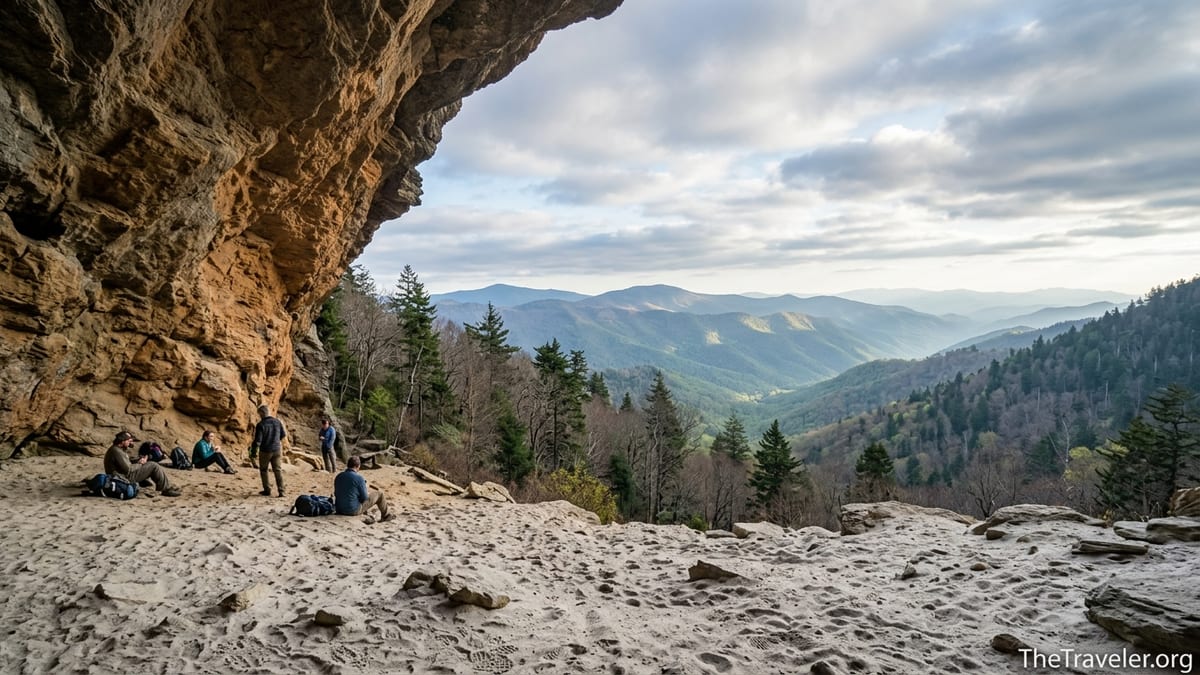
The value of hiking only to Alum Cave lies in how much you experience before you ever reach the bluffs. Within the first couple of miles you pass through old growth forest along Alum Cave Creek and Styx Branch, climb stone steps through the narrow slot of Arch Rock, and reach Inspiration Point, an open perch looking toward Little Duck Hawk Ridge and the rugged Smokies skyline. By the time you step into the sandy amphitheater beneath the 70 to 80 foot overhanging bluff, you have already sampled several of the trail’s most memorable features.
From a scenic standpoint, hikers who stop at the bluffs still see classic Smokies views with layered ridges fading blue into the distance, especially on clear days. While they do not reach the full panorama of Cliff Tops or Myrtle Point near LeConte’s summit, they get a strong sense of the mountain’s drama in less time and with a more moderate physical commitment.
What the Halfway Hike Actually Feels Like
On paper, 4.6 to 5 miles round trip with about 1,100 feet of elevation gain sounds moderate. In practice, the hike to Alum Cave feels like a real mountain outing, especially for travelers more used to flat city walks. The trail begins gently beside the creek on a firm, packed surface with a few short bridges and stone steps. After about 1.3 miles you reach Arch Rock, where a stone staircase climbs through a natural arch in the rock, a section that is narrow but not technically difficult.
Beyond Arch Rock, the grade steepens. By the time you reach Inspiration Point at roughly 2 miles, you have climbed through tighter switchbacks and traversed a few narrow sections carved into the hillside. In dry conditions, most reasonably fit hikers in sneakers or light hiking shoes will be comfortable, but those with vertigo may notice the drop-offs. Families often pause at Inspiration Point for a snack and to let kids explore the rocks while taking in a first big view into the valley below.
From Inspiration Point to Alum Cave Bluffs, the trail continues to climb but soon breaks out from dense forest into the wide, sandy base of the bluff itself. Under the overhang, the ground feels almost like a tiny beach, with a cool, shaded atmosphere on hot days. You can sit on logs or lean against boulders while watching mist or rain fall just beyond the dry zone sheltered by the rock. In winter and early spring, there can be icicles hanging from the bluff and patches of ice on the approach, which is one reason local rangers advise microspikes or extra caution in colder months.
Hikers report typical one way times of about 60 to 90 minutes from the parking area to Alum Cave for someone of average fitness, not counting long photo stops. A visiting couple from Atlanta, for example, who regularly walk 3 miles on flat greenways, might find the climb “moderately hard but manageable,” arriving at the bluffs pleasantly tired rather than exhausted. In contrast, travelers arriving straight from sea level who rarely exercise often comment that the last half mile feels steep and that trekking poles make a noticeable difference on both the ascent and descent.
Comparing the Bluffs to the Full Mount LeConte Experience
To decide whether Alum Cave is “enough,” it helps to compare what you gain and what you miss by not going all the way to Mount LeConte. Past Alum Cave, the trail grows steeper and more exposed, with more sustained climbing on rockier tread and sections that follow the mountainside with cables to hold in icy or wet conditions. The dense spruce and fir forest higher up gives way to cooler air and, on good days, expansive views near the summit at Cliff Tops and Myrtle Point.
Continuing from Alum Cave to LeConte Lodge and the high viewpoints adds around 5 to 6 miles and roughly another 1,600 feet of climbing to your day, turning a half day outing into a serious full day hike. Many hikers who go to the summit leave the parking lot around sunrise and return mid to late afternoon, especially in shoulder seasons when daylight is shorter. Some stay the night at LeConte Lodge, which requires advance reservations that can be hard to secure and includes rustic cabins, simple meals, and the novelty of a lodge accessible only on foot.
What you are primarily “missing” by turning around at Alum Cave is the sense of being high on a 6,000 foot peak, the community vibe around the lodge, and the 360 degree style vistas from Cliff Tops and Myrtle Point that many consider among the finest in the Smokies. If you dream of a full summit day, sunset on the cliffs, and a true mountain marathon experience, then stopping at the bluffs might feel incomplete.
For many travelers, however, especially those visiting Gatlinburg on a family vacation or with limited time, the extra effort and logistics of the summit section do not necessarily add proportionate enjoyment. A family of four staying in a midrange hotel in Gatlinburg, for example, might allocate a morning to hike to Alum Cave, then still make afternoon plans in town, such as a casual dinner on the parkway or a visit to a local aquarium. Attempting LeConte on that same schedule could easily lead to hiking back in the dark and overtired kids the next day.
Who Should Consider Hiking Only to Alum Cave
Certain types of travelers are especially likely to find that stopping at Alum Cave Bluffs is not only “worth it” but actually the better choice. First are visitors with moderate fitness who want a challenge but not an all day sufferfest. If your usual activity level is weekend walks, gentle bike rides or occasional gym visits, the bluffs provide just enough steepness and distance to feel proud without risking an overuse injury or miserable last miles.
Families with school-age children also often do well turning around at Alum Cave. The early creek crossings and Arch Rock make the hike feel like an adventure, and the sandy floor under the bluffs is a natural play area and picnic spot. Parents can pack a simple lunch from a Gatlinburg grocery store or deli, enjoy it under the overhang with mountain views, then head back before kids lose enthusiasm. Pushing young hikers all the way to LeConte can result in tears on the descent and a long day of coaxing rather than shared fun.
Travelers on a tight schedule will likewise get more value from the partial hike. Someone driving up from Knoxville for the day, for instance, could leave the city mid morning, hike to Alum Cave and back, and return home before dark, with time for a coffee stop in Townsend or Gatlinburg on the way. The full summit trip, in contrast, would require a pre dawn start or a night in the area.
Finally, visitors adjusting to mountain conditions, altitude or variable weather may prefer the security of a shorter outing. If skies look unstable or thunderstorms are forecast for mid afternoon, a morning push to the bluffs lets you experience a marquee Smokies trail while avoiding the risk of being far above treeline equivalents in exposed terrain during bad weather.
Logistics: Parking, Timing, and Crowds
Alum Cave’s popularity means that practical planning can make the difference between a relaxed experience and a frustrating one. The trailhead has a main paved lot and an overflow lot along Newfound Gap Road, but on busy spring and fall weekends, these can fill early in the morning. Recent visitor reports describe arriving after 8:00 a.m. in April and needing to circle or park along the road shoulder, which is allowed only in marked pullouts and still requires a valid parking tag for stays longer than 15 minutes.
The park’s parking tag system means you should budget a few extra dollars for a daily or weekly tag, available at kiosks in and around the park and at several visitor centers. Because space is limited, many local guides now recommend starting the Alum Cave hike around sunrise if you want a more peaceful experience, particularly during peak leaf season in October or wildflower season in late April and May. Arriving by 7:00 a.m. often yields easier parking, cooler temperatures, and a quieter trail for your ascent.
Time wise, travelers should budget 3 to 4 hours total for the hike to Alum Cave and back, depending on fitness and how often you stop. That gives most visitors time for a 90 minute ascent, a half hour to enjoy the bluffs, and a slightly quicker descent. If you are staying in central Gatlinburg, the drive to the trailhead along Newfound Gap Road usually takes about 20 to 30 minutes in normal traffic, but it can be longer on holiday weekends or when wildlife sightings slow cars along the road.
Crowding is part of the Alum Cave experience, and expectations matter. This is not a solitary wilderness hike. Expect to share the trail with families in athletic wear, seasoned locals with trekking poles, and visitors taking frequent photo stops. The good news is that the scenery is strong enough to justify the popularity, and the bluff area itself is large enough that you can usually find a patch of sand to yourself for a snack break, even at mid morning.
Safety, Seasonality, and Gear for a Bluffs-Only Hike
Even if you are “only” going to Alum Cave, it is important to treat the outing as a real mountain hike. The National Park Service regularly reminds visitors that search and rescue incidents in the Smokies often involve day hikers who underestimate distance, elevation gain, or changing weather. On Alum Cave, rescues have occurred after slips on wet rock, ankle injuries on the descent, and hikers caught without lights or layers as temperatures dropped later in the day.
At a minimum, plan to carry at least one liter of water per person, a small amount of food, and a lightweight rain layer. Trail runners or hiking shoes with good tread are strongly preferred over flip flops or flat fashion sneakers, especially for the rocky sections near Arch Rock and the steeper switchbacks. Trekking poles are optional but very helpful for those with knee issues or balance concerns on the way down.
Season matters too. In summer, humidity and heat can make the climb feel significantly harder, particularly in the exposed areas near the bluffs. An 8:00 a.m. start in July is often more comfortable than a midday one, and afternoon thunderstorms are common, making a morning turnaround at Alum Cave a smart choice. In winter and early spring, the trail can be icy above Arch Rock, and locals often carry traction devices such as simple microspikes, even if lower elevations in Gatlinburg look snow free.
Wildlife awareness is another practical consideration. Great Smoky Mountains National Park is prime black bear habitat, and the park service encourages visitors to review bear safety guidance before hiking. While bear encounters on Alum Cave are not everyday events, hikers occasionally report seeing bears along Newfound Gap Road or crossing the trail. Keeping snacks sealed, giving wildlife plenty of space, and considering bear spray if you are nervous can all contribute to a calmer hike.
Alternatives and Complements to an Alum Cave Turnaround
Choosing to hike only to Alum Cave does not mean you are missing out on the broader LeConte region. In fact, the bluffs outing can pair nicely with other shorter hikes or scenic drives on the same trip. For example, travelers who hike to Alum Cave one day might explore the quieter Roaring Fork Motor Nature Trail the next, walking the short Grotto Falls Trail, which also eventually leads to LeConte via a different route but offers a gentler experience near a waterfall for those who do not want another long climb.
Other popular day hikes that provide strong payoff for moderate effort include the Gatlinburg Trail near Sugarlands Visitor Center, ideal for a flat stroll along the river, or the trail to Laurel Falls, which combines a relatively short walk with a photogenic waterfall. For visitors seeking a similar “big view” experience to LeConte’s summit but who are happy with a moderate hike, the paved trail to Clingmans Dome observation tower or the trek to Charlies Bunion along the Appalachian Trail are often mentioned as alternatives.
Within a single visit, you could easily structure a Smokies sampler: one day dedicated to Alum Cave Bluffs, another to a waterfall hike, and another to scenic overlooks accessed mostly by car. This strategy leaves the full LeConte summit day as something to aspire to on a future trip when fitness, time and weather all line up, rather than something you feel compelled to force on an already full vacation itinerary.
Many experienced Smokies visitors also note that hiking to Alum Cave once is enough for some travelers, while others return repeatedly just for the bluffs. If you find yourself captivated by the view but not quite ready for the extra 5 to 6 miles, you can always treat your first hike as a scouting trip, then return another season to make a summit attempt when you know the first half of the trail and how your body responds.
The Takeaway
Is Alum Cave worth hiking if you are not going all the way to Mount LeConte? For the vast majority of visitors, the answer is a clear yes. In roughly half a day and about 5 miles of effort, you experience creekside forest, a slot-like rock arch, an airy viewpoint, and a dramatic overhanging bluff with sweeping Smoky Mountain vistas. You avoid the steepest and most committing sections of the route while still enjoying many of its signature highlights.
Choosing to turn around at Alum Cave is not a sign of settling for less. It is often a smart, intentional decision based on realistic fitness, time, and safety considerations. Families, casual hikers, and travelers on tight schedules get an iconic Smokies experience without overextending themselves, while serious summit seekers can still plan a dedicated LeConte day when conditions and preparation align.
If you have just one significant hike to do on a short trip to Great Smoky Mountains National Park, Alum Cave to the bluffs is an excellent candidate. Treat it like the mountain hike it is, start early, bring proper gear and plenty of water, and you are likely to return to your car with tired legs, a camera full of ridge line photos, and a new appreciation for the Smokies. Whether or not you ever stand on LeConte’s summit, the hike to Alum Cave stands on its own as a destination worth your time.
FAQ
Q1. How long does it take to hike to Alum Cave if I am not going to LeConte?
Most hikers should plan on 3 to 4 hours total for the round trip to Alum Cave Bluffs, including time for short breaks and photos. Faster, fit hikers sometimes complete it in about 2.5 hours, while families or those unaccustomed to hills may prefer a slower pace.
Q2. How difficult is the hike just to Alum Cave Bluffs?
The hike is usually rated moderate. It is only about 4.6 to 5 miles round trip, but there is over 1,000 feet of elevation gain and some rocky, uneven sections. Anyone comfortable walking several miles and climbing stairs should manage it with patience and breaks.
Q3. Do I miss the best views if I do not go all the way to Mount LeConte?
You will miss the summit panoramas from Cliff Tops and Myrtle Point, but you still get impressive views from Inspiration Point and from beneath Alum Cave itself. For many travelers, these vistas feel rewarding enough without the extra miles.
Q4. Is it safe to hike only to Alum Cave without special gear?
In good weather, most hikers manage fine with sturdy shoes, water, snacks, and a light jacket. In colder months or after snow and ice, traction devices and extra layers become more important, and you should always check current park conditions before setting out.
Q5. What is the best time of day to start if I am only hiking to Alum Cave?
An early morning start, roughly between sunrise and 8:00 a.m., is ideal. You will find easier parking, cooler temperatures, and fewer crowds on the ascent, even if you are back at your car before lunchtime.
Q6. Is the Alum Cave hike suitable for children or older adults?
Many families and active older adults successfully hike to Alum Cave. Children who are used to walking a few miles and older adults with stable footing and moderate fitness generally do well, especially if you allow plenty of time and bring snacks, water, and trekking poles if needed.
Q7. Do I need a permit or reservation to hike to Alum Cave if I am not staying at LeConte Lodge?
No special hiking permit is required for a day hike to Alum Cave, but you do need a valid parking tag for your vehicle if you will be parked more than 15 minutes in Great Smoky Mountains National Park.
Q8. Are there bathrooms or water sources on the way to Alum Cave?
There are restrooms at or near the trailhead parking area, but no toilets or treated water sources along the trail itself. Plan to use facilities before you start and carry all the water you expect to need.
Q9. What should I bring if I only plan to go as far as Alum Cave?
At minimum, bring comfortable footwear with good traction, water, snacks, a small first aid kit, a light insulating layer, and a rain jacket. A hat, sunscreen, and trekking poles are optional but often appreciated.
Q10. If I enjoy the hike to Alum Cave, what is a good next step toward hiking Mount LeConte another time?
If the bluffs hike feels manageable and fun, you might first repeat it in a different season or add another moderate trail in the park, such as Charlies Bunion or Rainbow Falls. Once you are comfortable with 7 to 9 mile hikes with similar elevation gain, you will be better prepared to tackle the full 11 mile LeConte trip on a dedicated summit day.