


Booking a rental car used to mean comparing prices from a handful of big brands at the airport desk. Today, many travelers start with brokers and aggregators like Rentalcars.com, which promise cheaper deals from dozens of companies worldwide. But with mixed online reviews, horror stories about surprise fees, and confusing insurance options, it is reasonable to ask: is Rentalcars.com actually legit and safe for booking car rentals in 2026?
Get the latest updates straight to your inbox!
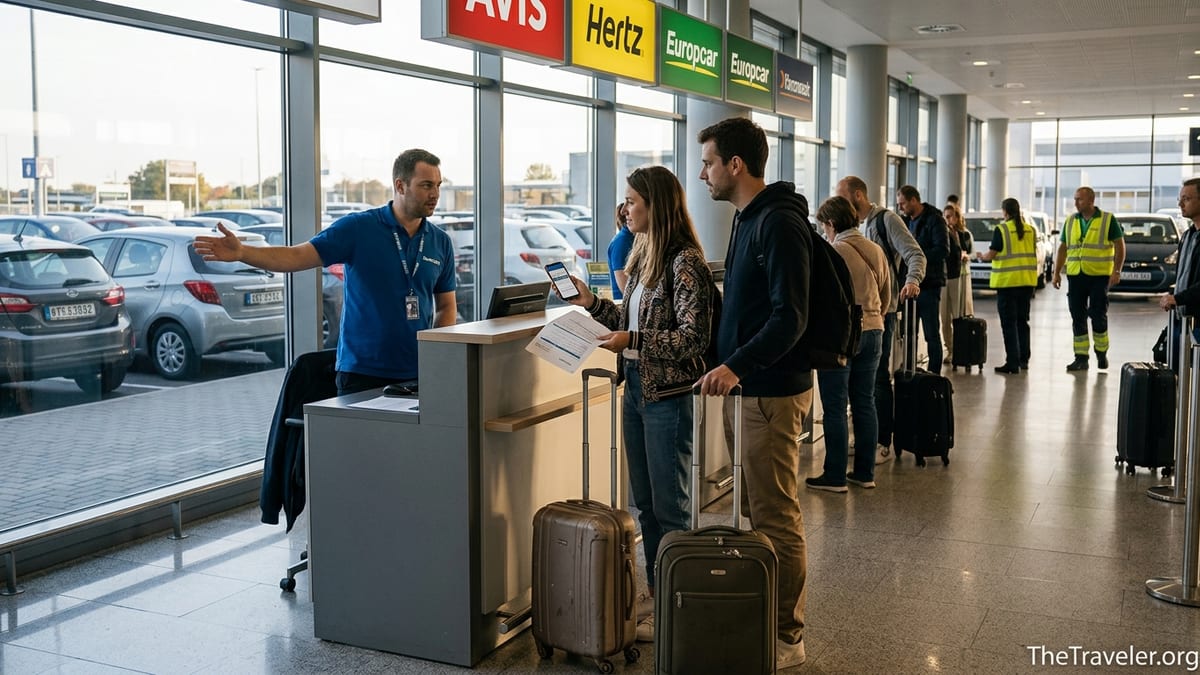
What Is Rentalcars.com and How Does It Work?
Rentalcars.com is a large online car rental broker that sits between you and traditional rental companies such as Hertz, Avis, Budget, Sixt, and hundreds of local agencies. The company is part of the Booking Holdings group, which also owns Booking.com and Priceline. Instead of operating its own fleet, Rentalcars.com sells reservations on behalf of these partners and earns a commission on each booking.
In practice, a typical booking might look like this. An American traveler planning a July road trip around Portugal searches Rentalcars.com for Lisbon Airport. The site returns options from brands like Enterprise, Guerin, Goldcar, and local firms, often showing headline prices that are several dollars per day cheaper than booking direct. The traveler prepays some or all of the rental cost to Rentalcars.com, then receives a voucher to present at the counter on arrival.
Crucially, your contract at the counter is usually with the underlying rental company, not with Rentalcars.com. The broker handles the website, payment processing for the upfront portion, and some customer support. The local rental company controls the vehicle, the security deposit, the final bill, and how strictly its own terms are applied. This split is at the heart of many of the frustrations and complaints travelers later report.
Rentalcars.com offers optional add-ons, including its own “Full Protection” style coverage that sits on top of the rental company’s basic collision damage waiver. If you buy this through Rentalcars.com and later have damage, you typically pay the rental company first, then claim reimbursement from Rentalcars.com afterward. That structure can work, but it also introduces another layer of potential dispute if something goes wrong.
Is Rentalcars.com Legitimate? What the Reputation Data Shows
From a basic legitimacy standpoint, Rentalcars.com is a long-established business rather than a fly-by-night scam site. Domain analysis tools such as ScamAdviser and Scamdoc classify the site as likely safe, citing factors like its age, very high traffic, and valid SSL certificates. One such tool notes that the rentalcars.com domain was registered in the 1990s and is operated by TravelJigsaw Limited in the United Kingdom, with hosting on major providers rather than obscure offshore servers.
However, being legitimate is not the same as having happy customers. On Trustpilot, Rentalcars.com currently holds a very low average score around 1.5 out of 5 based on more than 150,000 reviews across multiple language sites, with recent reviewers frequently mentioning surprise charges at pickup, difficulty getting refunds, and poor support when disputes arise.
The Better Business Bureau lists Rentalcars.com under multiple regional entries in the United States and notes that the company is not BBB accredited. Complaint pages include recent cases from travelers who were referred back and forth between Rentalcars.com and the local rental desk when cancellations, no-shows, or documentation problems occurred. In several of these examples, consumers say they were left paying for unused cars or duplicate bookings while each party blamed the other.
This combination of strong technical legitimacy and weak customer satisfaction is important context. Rentalcars.com is not a fake site stealing credit cards. It is a real, high-volume broker with policies and practices that many travelers find confusing or consumer-unfriendly, especially compared with booking directly with a rental brand they know.
Common Problems Travelers Report When Using Rentalcars.com
Reading through hundreds of recent reviews and forum threads reveals some recurring themes. Understanding these patterns can help you decide whether the platform fits your risk tolerance and travel style.
One frequent complaint involves price transparency. Travelers often think they have locked in a low total rate, only to face significantly higher costs at the counter. For example, a couple booking a compact car in Cancun through Rentalcars.com might see an attractive headline price of 18 to 20 dollars per day, including basic collision coverage. At the desk, the local provider then refuses to recognize third-party insurance and insists on either a large security deposit, sometimes above 2,000 dollars, or the purchase of additional coverage costing 25 to 35 dollars per day. The couple either pays much more than expected or walks away and loses the prepaid voucher.
Another flashpoint is documentation and payment rules. Many local rental agents strictly require a physical credit card in the main driver’s name with embossed numbers and sufficient credit limit for the deposit. Reviewers describe arriving in Spain or Italy with a debit card or a credit card in a spouse’s name and being turned away, even though they had prepaid through Rentalcars.com. In these cases, the local company typically marks the booking as a “no show,” and customers report that Rentalcars.com often refuses refunds because the rental terms were technically not met.
Travelers who buy Rentalcars.com’s own “Full Protection” or similar coverage can also be caught off guard. Real-world examples from Portugal and Majorca show renters being charged 800 to 1,500 euros by the local company after minor damage or disputed scratches. Instead of the charge being waived at the counter, they must file a claim with Rentalcars.com, provide photos, police reports, and invoices, and then wait weeks for potential reimbursement. Some reviewers say their claims were denied on technical grounds they found hard to understand.
Finally, customer support and dispute resolution are recurring pain points. Numerous Reddit posts and BBB complaints describe hours spent on chat or phone being passed between the broker and the rental brand, with each suggesting the other is responsible. For a traveler standing at a counter in an unfamiliar airport late at night, this lack of clear ownership can feel particularly stressful.
When Rentalcars.com Can Work Well
The story is not entirely negative. Amid the critical reviews, there are also accounts of smooth experiences, especially from travelers who pay close attention to the fine print and choose reputable on-the-ground partners.
Consider a traveler flying from New York to Dublin for a ten-day self-drive trip around Ireland in shoulder season. By using Rentalcars.com, they compare offers from Enterprise, Hertz, Europcar, and a smaller local brand. They select a well-known company at Dublin Airport, double-check that the offer includes unlimited mileage and the legally required collision coverage, and make sure they hold a credit card in the main driver’s name. On arrival, they find the rental desk directly in the terminal, present their voucher and card, and drive away within 30 minutes. The final bill matches what was quoted, aside from fuel and an optional GPS hire.
Examples like this are most common when renters book with major international brands rather than unknown budget outfits, stick to rentals at large airports, and meet all documentation and payment conditions exactly. Travelers who are experienced with European or Latin American rental practices, familiar with high deposits and sometimes aggressive upselling, tend to approach Rentalcars.com bookings with realistic expectations and fewer surprises.
There are also instances where Rentalcars.com’s coverage has helped. Some customers recount having damage charges fully reimbursed within a week after submitting invoices and photos, particularly when the paperwork clearly matched the coverage terms. Others appreciate being able to compare smaller local suppliers in destinations such as the Azores, Madeira, or the Greek islands where those companies may not have user-friendly English-language sites of their own.
In short, Rentalcars.com can be a useful research and booking tool, but it rewards obsessive reading of terms and a conservative choice of supplier rather than hunting for the very cheapest headline price.
Key Risks and How to Reduce Them
If you are considering using Rentalcars.com, it helps to approach your booking like a cautious consumer reading a financial contract. The biggest risks are not that your money will vanish into the ether, but that you will end up paying far more than expected or struggling to get support when something changes.
First, treat the price you see on screen as a partial estimate rather than a final total. Before paying, scroll through every section of the “Important information” and “Rental conditions” on the offer page. Look specifically for the local supplier’s security deposit amount, fuel policy, cross-border rules, mileage limits, and any notes about mandatory local insurance. If you see language such as “local charges may apply” or “mandatory cover may be required locally,” assume that your final cost could be substantially higher.
Second, match the payment requirements with your real-life wallet. If the terms say a credit card in the main driver’s name is required with a deposit of 1,500 euros, do not assume that a debit card, virtual card, or card in a partner’s name will be acceptable at the counter. Call the underlying rental company a few days before your trip to confirm what they will accept. Taking a screenshot of that confirmation, along with the Rentalcars.com voucher and conditions, can help if a dispute arises.
Third, consider your appetite for dealing with separate insurance claims. Using Rentalcars.com’s own protection product might save money compared with the rental desk’s insurance, but it means you will pay any damage charges yourself and then seek reimbursement later. Some travelers prefer to rely on credit card rental coverage or direct insurance from the rental company because it simplifies the process at the counter, even if it costs more up front.
Finally, build flexibility into your plans. If you are landing late at night in a small airport and absolutely must have a car to reach remote accommodation, consider booking directly with a major rental brand at that location instead of taking the cheapest aggregator deal. The more critical the rental is to the success of your trip, the more worthwhile it becomes to pay for extra certainty and clearer accountability.
How Rentalcars.com Compares With Booking Direct and Other Brokers
Many travelers wonder whether they are better off skipping brokers entirely and booking directly with companies like Hertz, Avis, or Sixt. There is no one-size-fits-all answer, but real-world comparisons can help illustrate the trade-offs.
Take a five-day rental in August at Rome Fiumicino Airport. On a typical search, Rentalcars.com might show a compact car from a lesser-known brand for around 26 euros per day, with a large deposit and limited included insurance, alongside a similar-sized car from a global brand at 38 euros per day. Booking directly on the global brand’s own website might cost roughly the same as the higher Rentalcars.com rate, but often with clearer terms, loyalty points, or the ability to modify or cancel without going through a third party.
Other large brokers, such as Rentalcars.com’s competitors in Europe and North America, operate with broadly similar models. They collect payment upfront, issue vouchers, and rely on local partners to deliver the car. Travelers report comparable patterns of difficulty when documentation is not perfect or when they chase refunds after cancellations and no-shows. In that sense, the problems associated with Rentalcars.com are part of a wider structural issue with aggregators rather than unique to this brand.
Direct booking becomes more attractive when you value customer service and predictability over saving every last dollar. If a flight is delayed and you arrive at midnight instead of 6 p.m., dealing directly with the rental company can make it easier to keep the booking alive or negotiate a solution. By contrast, with a broker in the middle, you may find yourself stuck between their policies and the local desk’s interpretation of “office hours” or “grace periods.”
Where Rentalcars.com and similar sites excel is in cross-market comparison. For a road trip across several Balkan countries, for example, they can quickly show which suppliers permit cross-border travel, what the surcharges are, and which locations allow one-way drop-offs. Used as a research tool and combined with independent checks of the underlying companies, this can be very helpful.
The Takeaway
So, is Rentalcars.com legit and safe for booking car rentals? From a basic security and corporate standpoint, yes. It is a long-standing, high-traffic broker owned by a major travel group, and independent site-verification services rate it as technically safe to use. There is no widespread evidence of credit card theft or outright fraud originating from the platform itself.
However, the company’s very low customer-review scores, the volume of complaints to consumer forums and the Better Business Bureau, and the consistent themes across negative reviews all point to a service that can be risky or frustrating if you do not read the fine print carefully. Many of the problems stem from its role as an intermediary: you pay Rentalcars.com, but your real-world experience is controlled by the local rental brand, whose strict policies, deposits, and insurance requirements may surprise you.
Rentalcars.com works best for travelers who are experienced with car rentals abroad, comfortable navigating layered insurance arrangements, and willing to invest time in cross-checking terms with the underlying supplier. If you prioritize simplicity, clear accountability, and strong customer support, booking directly with a trusted rental company at a slightly higher price may provide better value in the long run.
Used with caution, Rentalcars.com can be one tool in your travel-planning toolkit, especially for comparing options in unfamiliar destinations. Just remember that in the world of car rentals, the cheapest headline rate rarely tells the whole story.
FAQ
Q1. Is Rentalcars.com a scam site?
Rentalcars.com is not a scam in the sense of a fake website. It is a legitimate car rental broker owned by a major travel group, but many travelers report dissatisfaction with its policies, customer service, and the gap between advertised prices and what they end up paying at the counter.
Q2. Is it safe to enter my credit card details on Rentalcars.com?
From a technical perspective, Rentalcars.com uses standard encryption and has been rated as safe to access by independent site-verification services. The main risk is not theft of your card data, but unexpected charges arising from cancellations, no-shows, or disputes with the local rental company.
Q3. Why are there so many negative reviews about Rentalcars.com?
A large share of complaints involve surprise fees at pickup, strict enforcement of documentation rules, confusion around insurance coverage, and difficulty obtaining refunds. Because Rentalcars.com is an intermediary, customers often feel caught between the broker and the local rental company when something goes wrong.
Q4. Can I rely on the price quoted on Rentalcars.com as my final cost?
The price on screen usually covers the base rental and some taxes, but it may not include all local insurance requirements, deposits, toll-device fees, or extras. You should read the rental conditions for the specific supplier carefully and be prepared for additional costs at the counter, especially in countries where local insurance laws are strict.
Q5. What happens if the rental company refuses my card or documents at pickup?
If the local supplier rejects your booking because you do not meet its payment or documentation rules, it may mark you as a no-show. In that situation, Rentalcars.com often declines refunds on the basis that the rental conditions were not fulfilled, even if you prepaid on the site.
Q6. Is Rentalcars.com’s “Full Protection” insurance worth buying?
It can save money compared with coverage sold at the desk, but it works as a reimbursement product. You pay the rental company for any damage first, then claim the money back from Rentalcars.com. Travelers who prefer simpler, one-step handling of damage charges may find direct coverage from the rental company or a credit card benefit less stressful.
Q7. How can I reduce the risk of problems when booking through Rentalcars.com?
Choose well-known rental brands, read the rental conditions in full, confirm payment rules directly with the local supplier, and keep screenshots of all terms. Avoid very late pickups with tight onward connections, and budget for the possibility of higher local costs than the headline rate suggests.
Q8. Is it better to book directly with Hertz, Avis, or another major brand instead?
Booking direct often provides clearer accountability and easier handling of changes, delays, and cancellations, though it may cost a bit more. Rentalcars.com and similar brokers can be useful for price comparison, but direct booking is usually safer when a rental is critical to your trip or you have little flexibility.
Q9. Does Rentalcars.com help if my flight is delayed and I arrive late?
Policies vary by supplier. Some rental companies honor late arrivals if they are given the flight number, while others close their desk at a fixed time. Because Rentalcars.com is an intermediary, it may have limited ability to override the local company’s rules, so you should check the specific supplier’s office hours and grace period before booking.
Q10. Should first-time international renters use Rentalcars.com?
First-time international renters may find the layers of terms, deposits, and insurance on a broker site overwhelming. If you are new to renting abroad, booking directly with a major brand, even at a somewhat higher price, can provide a gentler learning curve and reduce the chance of costly misunderstandings.