


For many Alaska cruisers, scenic cruising at Hubbard Glacier is one of the big emotional peaks of the entire voyage. In recent years, several major lines have added an expensive small-boat option with names like Hubbard Glacier Wilderness Explorer or Hubbard Glacier & Wilderness Exploration. These tours promise closer views from a catamaran that comes alongside your cruise ship in Disenchantment Bay and then heads toward the ice. With prices advertised around 300 to more than 400 dollars per person, the obvious question is whether that upgrade delivers enough extra value over the already spectacular views available for free from the ship itself.
Get the latest updates straight to your inbox!
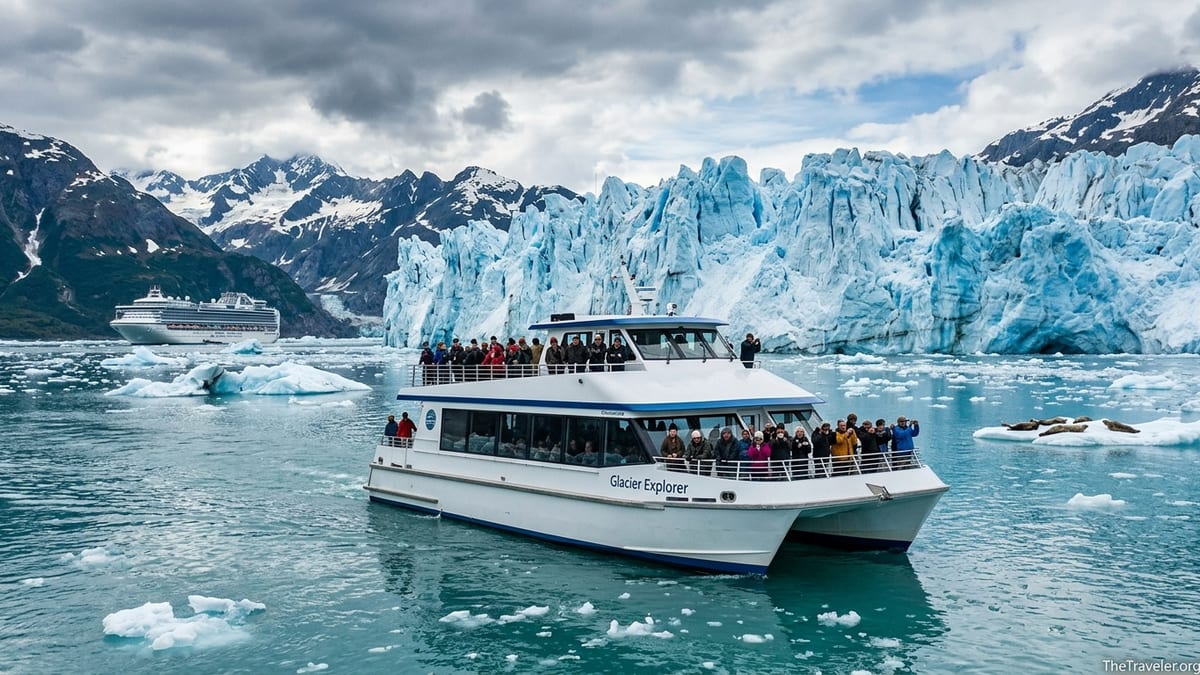
What Exactly Is the Hubbard Glacier Wilderness Explorer Excursion?
The Wilderness Explorer style excursion is a ship-run tour operated directly in Disenchantment Bay, usually during your scheduled Hubbard Glacier scenic cruising day. Instead of tendering to shore, you step from your cruise ship onto a dedicated high-speed catamaran. Princess Cruises, for example, sells a two hour Hubbard Glacier & Wilderness Exploration catamaran trip that embarks directly from the ship, explores the fjord, then returns shipside, with the ship remaining in view during most of the outing. Norwegian Cruise Line and other brands have offered similarly structured Hubbard Glacier Wilderness Explorer sailings that run only when conditions and scheduling allow.
The vessels used are generally purpose-built sightseeing catamarans with enclosed, heated cabins and wraparound windows plus spacious open decks. A typical configuration, based on Princess’s description, is a catamaran carrying around 140 to 150 passengers, with restroom facilities, a small galley offering complimentary hot drinks, snacks for purchase, and an onboard naturalist who provides live commentary on glaciology, wildlife and local history. Some lines also sell a similar catamaran-based Hubbard Glacier Explorer product under their own branding while following the same core model.
The advertised duration is usually about two hours from departure to return, although operators stress that the precise route and timing are flexible. Weather, ice concentration, and ship operations can alter how long the catamaran spends near the glacier face versus in transit through Disenchantment Bay. Importantly, your main ship continues its own scenic cruising schedule, so the small-boat itinerary is designed not to cause you to miss sail-away or later port commitments.
Because no independent operators are allowed to meet cruise ships directly in Hubbard Glacier’s remote waters, this type of excursion is almost always sold exclusively through the cruise line. If your line does not offer a small-boat option on a given sailing, you should assume you will be viewing Hubbard Glacier from the ship only.
Current Pricing and Availability for 2025–2026
Pricing for Hubbard Glacier Wilderness Explorer style tours has risen sharply as demand has grown and operating costs in Alaska have increased. At the time of research in late 2026, Norwegian Cruise Line’s Hubbard Glacier & Wilderness Explorer excursion was listing starting prices around 299.99 dollars per person on selected Hubbard Glacier sailings, with final fares varying by ship and date. That entry point aligns with anecdotal reports from recent passengers on large ships who describe paying roughly 300 dollars per person for Norwegian-branded small-boat Hubbard tours.
Princess Cruises is currently marketing its Hubbard Glacier & Wilderness Exploration catamaran excursion as a two hour “guest favorite” valued at 419.95 dollars per person for upcoming scenic cruising days at Hubbard Glacier. The official description highlights an “easy” activity level, roughly two hours on the water, and notes that the tour departs and returns directly to the Princess ship via a catamaran with a listed capacity of 145 passengers. Travellers in 2025 and 2026 have reported that this price tier reflects an increase of about 100 dollars per person compared with pre-2024 seasons, underscoring how significant the premium has become.
Other mainstream lines such as Royal Caribbean and Disney Cruise Line have either offered similar Hubbard Glacier Explorer catamaran trips or have promoted them as an occasional option. Disney’s Hubbard Glacier Explorer, for instance, is described as a 2 to 2.5 hour deluxe water-jet catamaran tour. However, pricing and dates can vary significantly by ship and year, and products can be withdrawn or temporarily unavailable, as seen when some Royal Caribbean documentation noted that a Hubbard Glacier Wilderness Explorer excursion was no longer bookable for certain sailings.
Because these excursions are capacity limited and operate in a remote wilderness area, they are subject to cancellation or adjustment by the line. Advance booking is strongly encouraged, particularly on itineraries that feature Hubbard Glacier only once. Several 2025 passenger reports describe the Hubbard small-boat option selling out weeks to months before sailing, especially on peak-season departures and on ships known to attract “bucket list” Alaska travelers.
From Gangway to Glacier: What the Experience Actually Feels Like
The day of your Hubbard Glacier scenic cruising typically begins with the cruise ship entering Disenchantment Bay. Passengers joining the Wilderness Explorer style excursion usually gather in a designated lounge where staff check tickets and provide safety information. When the catamaran comes alongside, you proceed down a narrow and sometimes moderately steep gangway to a lower tender platform to board. Operators emphasize that guests must be able to walk that gangway, often with handrails but without a level-boarding system, and step across a small but moving gap between ship and catamaran under crew supervision.
Once onboard, most guests head first to the enclosed cabin to warm up and find seating along large picture windows. The heated interior is a key selling point compared with extended time on chilly outer decks of the cruise ship. You will usually hear a safety briefing from the captain or crew followed by a naturalist introduction, then the vessel pulls away from the ship and begins threading through the ice-studded waters of Disenchantment Bay. Complimentary hot drinks such as coffee, tea and cocoa are typically available from the galley, with additional snacks and local souvenirs available for purchase.
As the catamaran moves closer to the glacier, passengers drift between the indoor cabin and outdoor observation decks. Many reviews describe a festive but somewhat crowded atmosphere on the rails when the boat slows near the ice face. On clear days, guests can look back to see their cruise ship dwarfed by the surrounding peaks and then forward to the blue crevasses and vertical ice cliffs of Hubbard itself. The naturalist points out harbor seals on ice floes, seabirds circling the bay, and occasionally whale blows in the distance, all while explaining glacier dynamics and calving.
After roughly ninety minutes to two hours on the water, the vessel usually turns back toward the cruise ship, which remains within visual range for safety. Boarding is reversed: the catamaran comes alongside, lines are secured, and passengers disembark up the gangway back onto the main ship. Many recent travelers note that the cruise ship continues its scenic cruising period for a while after the small boat returns, so those who booked the excursion can still spend time viewing the glacier from the higher ship decks later in the day.
How Close Can the Small Boat Really Get, and What Affects That?
Promotional language for these excursions often focuses on the phrase “up close,” but there is no fixed or guaranteed minimum distance that the catamaran will reach relative to the glacier face. In practice, proximity is governed by a combination of ice conditions on the day, local maritime safety rules, the captain’s risk assessment, and federal guidelines for safe operation and wildlife disturbance. On a day with widely spaced bergs and good visibility, passengers in 2025 and 2026 reviews describe feeling dramatically closer to Hubbard from the catamaran than from their main ship, with towering ice walls filling their camera frames and calving events producing noticeable wakes that rocked the smaller vessel.
However, Hubbard is an active tidewater glacier that frequently sheds large chunks of ice. Dense brash ice or thick lines of larger icebergs can form natural barriers that any prudent captain will refuse to cross, regardless of the desire for a closer view. Some reviewers recount excursions that had to hold position well back from the glacier because of heavy ice or fog that reduced visibility. Others mention that strong wind across the bay or low, flat light made the scene less dramatic even when the catamaran technically approached more closely than the cruise ship.
NOAA and other federal agencies also publish wildlife protection recommendations that influence operations. Harbor seals, for instance, often haul out on floating ice near tidewater glaciers, especially during pupping and molting seasons. To reduce disturbance, operators may maintain wider stand-off distances when many seals are present or avoid maneuvering aggressively through ice fields dense with resting animals. This can further limit how close the vessel will approach on a given day.
The takeaway for consumers is that the small-boat excursion generally has the potential to reach a meaningfully closer vantage point than the large cruise ship, but nothing about exact distance or calving can be promised. Some passengers report being within what felt like a short boat length or two of large icebergs, while others on different dates insist the difference from ship-only viewing was modest. Conditions are dynamic and vary not only by season but by the hour.
View, Atmosphere and Photography: Small Boat Versus Cruise Ship
From the main cruise ship, Hubbard Glacier usually appears as a sweeping, multi-mile ice front set against a broad amphitheater of mountains and forested slopes. Elevated decks allow you to appreciate the full width of the glacier and the scale of the surrounding landscape. Wide-angle photographs from the ship often capture the entire scene with the ship’s rail or balconies providing a stable, high platform. You can move between sheltered indoor lounges and outer decks with relative ease, and because the ship is large, motion from small waves or calving-generated wakes is usually minimal.
The small catamaran offers a very different style of viewing. On the catamaran, you are effectively at water level, looking up at a vertical wall of ice rather than down from above. This angle is excellent for telephoto shots that isolate the texture and blue tones of the glacier face, and for tight framing of calving events if they occur. Passengers regularly highlight that there are far fewer obstructions such as balcony dividers or glass railings, and that being close to seal-dotted ice floes or bobbing bergs gives their photos a more intimate feel.
There are trade-offs. The catamaran can feel crowded at peak moments when everyone wants to be outside on the same side, and some reviewers note difficulty finding a clear rail spot for tripod or long-lens photography. The vessel is also more responsive to waves and ice-related wakes, so photographers using slower shutter speeds may experience more motion blur. In contrast, the cruise ship’s broad decks remain relatively stable, and because its viewing areas are spread over multiple levels, you can often find quiet corners even on busy sailings.
Comfort is similarly nuanced. The catamaran’s heated interior is a welcome refuge, especially on raw or rainy days, and its shorter duration may appeal to travelers who do not want to stand in the cold for hours. Yet those sensitive to crowds or motion sometimes prefer the ship-only experience, where they can retreat to their cabin, order room service, or step in and out of public lounges while still watching the glacier from large windows.
What Recent Passengers Say: Close-Up Thrills and Disappointments
Passenger accounts from 2025 and 2026 reveal a wide spectrum of experiences. On the positive side, many travelers describe the small-boat Hubbard excursions as the highlight of their entire Alaska cruise. These guests talk about watching towering sections of ice peel away from the glacier face and crash into the bay, feeling the shock wave pass beneath the hull, and hearing the cannon-like crack of calving without the muffling distance of a large ship. Several reviewers emphasize that their small boat clearly operated closer to the glacier than the cruise ship did, making the additional cost worthwhile in their view.
Other reviewers focus on wildlife and atmosphere. Couples recount leaning over the rail to photograph harbor seals on passing ice floes, listening to bald eagles calling from the shore, and snapping near eye-level images of the glacier’s intensely blue seracs. Families mention that onboard naturalists kept children engaged with explanations of glacier science and local stories that did not always filter as clearly over the main ship’s PA systems. For photography enthusiasts, the ability to compose images without the distraction of hundreds of people on open decks was a major selling point.
Not all feedback is glowing. A noticeable number of 2025 and early 2026 reviews describe underwhelming or frustrating outings: heavy fog that obscured most of the glacier face, thick ice forcing the captain to remain far back, or poor visibility that made photographs appear flat despite the smaller boat’s theoretical advantage. Some guests felt cramped on the outdoor viewing decks and expressed disappointment that the excursion did not deliver a dramatically different perspective relative to the ship. A subset of reviews highlight last-minute cancellations or changes due to weather or operational issues, with passengers either refunded or shifted back to ship-only viewing.
There is also recurring commentary around value. Several cruisers who paid over 400 dollars per person on Princess in 2025 noted that while the tour was enjoyable, they might not repeat it at that price point, especially when comparing it with full-day whale watching or flightseeing excursions purchased in ports like Juneau or Skagway. Others argue that for travelers on tight budgets, the glacier experience from the cruise ship’s open decks is already so spectacular that the incremental gain from the catamaran does not justify hundreds of extra dollars.
Accessibility, Seasickness and Cancellations
Accessibility is one of the clearest dividing lines between who should and should not book the Wilderness Explorer style excursion. Cruise line descriptions consistently state that these tours are not wheelchair accessible. Participants must be able to negotiate a narrow, sometimes moderately steep gangway and step between vessels with only minor assistance. Power wheelchairs and scooters generally cannot be accommodated, and even manual wheelchair users may be asked to remain on the ship. Travellers with limited mobility who can walk short distances with a cane or walker may participate at the crew’s discretion, but should be prepared for moving decks and handrail use.
By contrast, Hubbard Glacier viewing from the ship itself is far more accessible. Elevators connect interior lounges and open decks, and many lines provide accessible viewing spaces with level thresholds and sheltered seating. Guests using wheelchairs or scooters can enjoy the glacier from indoor observation lounges or private balconies without facing the extra risks of gangway transfers between moving vessels in open water.
Seasickness is another consideration. While Disenchantment Bay is partly sheltered, the smaller catamaran responds more sharply to waves and the motion caused by calving or maneuvering among ice. Passengers prone to motion sickness may find the motion noticeable compared with the relative stability of a large cruise ship. Antinausea medication, ginger products or acupressure bands can help, but sensitive travelers should weigh whether the potential motion is worth the closer vantage point.
Regarding cancellations and refunds, these ship-run Hubbard excursions are tightly controlled by the lines. If a tour is cancelled because of weather, ice conditions, or operational reasons, guests typically receive a full refund to their onboard account. However, the decision to operate may be made relatively close to departure, meaning you could keep the time blocked off on your day’s schedule and ultimately revert to ship-only viewing if the small-boat component is scrubbed. Tickets are usually changeable or refundable up to a preset cut-off time before the excursion, but policies differ slightly by cruise line and should be checked in the shore excursion terms specific to your sailing.
Cost in Context: Couples, Families and Competing Alaska Splurges
Putting real numbers on the decision helps clarify the trade-offs. On a Princess sailing where Hubbard Glacier & Wilderness Exploration is priced at approximately 419.95 dollars per person, a couple will spend roughly 840 dollars to join the catamaran. A family of four with two older children paying adult rates is looking at around 1,680 dollars. On a Norwegian cruise with Hubbard Glacier & Wilderness Explorer priced from about 299.99 dollars per person, a couple might spend in the neighborhood of 600 dollars, with a similar family of four paying about 1,200 dollars if all book.
Now compare those figures to other marquee Alaska experiences. In Juneau, many reputable operators offer half-day small-boat whale watching trips in the 175 to 250 dollar per person range, often including sightings of humpback whales bubble-net feeding, plus time near coastal scenery and other wildlife. Helicopter or floatplane flightseeing that lands on a glacier or flies over vast icefields might run between 350 and 600 dollars per person, depending on duration and inclusions. Full-day Kenai Fjords or Prince William Sound glacier cruises, reachable pre- or post-cruise, often cost around 200 to 300 dollars per person for six or more hours on the water with meals included.
Framed that way, the Hubbard catamaran tour is a concentrated, two hour glacier and wildlife experience priced as a premium add-on. Travelers whose budget allows only one or two big-ticket excursions may prefer to reserve that spending for activities that cannot be replicated from a cruise ship balcony, such as walking on a glacier surface, flying past mountain peaks, or spending a full day searching for whales and sea lions in a national park. On the other hand, repeat Alaska visitors who have already ticked off those boxes may be more comfortable allocating several hundred dollars to gain a new perspective on Hubbard itself.
Families in particular should think carefully about attention span and value. Young children may enjoy the novelty of the small boat but could tire quickly in cold, wet conditions, while teenagers keen on photography or science may find the naturalist commentary and close-up views deeply rewarding. Because the base cruise fare already includes hours of glacier viewing from the ship, there is no risk of “missing” Hubbard by skipping the small-boat option, which is an important reassurance when budgets are tight.
Comparison: Cruise Ship Viewing vs Small-Boat Excursion
The decision ultimately turns on how you balance cost, comfort and the desire for immersion. At Hubbard Glacier, everyone on the ship, regardless of cabin category, has access to panoramic glacier views from public decks and indoor lounges during scenic cruising. The small-boat tour adds proximity and intimacy but cannot guarantee specific distances or calving. The following comparison summarizes the main differences in practical terms that matter for most travelers.
Cost: Ship-only viewing is already included in your fare, with no extra cost. The Wilderness Explorer style catamaran generally runs about 300 dollars per person on Norwegian-branded sailings and around 420 dollars per person on Princess at current published rates, with similar levels on other lines when offered. Distance and perspective: The cruise ship usually maintains a conservative stand-off distance, giving a broad, sweeping view of the glacier and surrounding mountains. The small boat often, but not always, reaches a noticeably closer position, delivering a more vertical, eye-level view of the ice and nearby wildlife when conditions allow.
Comfort and accessibility: Cruise ships provide numerous indoor lounges, broad decks, seating, and elevator access that significantly benefit guests with mobility or balance issues. The catamaran adds a heated cabin and large windows but requires more agility to board and offers fewer seats relative to the number of guests who want to be at the rail during prime viewing. Stability: Large ships feel steadier, especially in small chop or waves generated by calving events. The catamaran can be bouncy enough to bother those prone to motion sickness, even though the trip is relatively short.
Photographic potential: Ship decks give strong vantage points for wide-angle shots of Hubbard’s full width and the larger landscape. The small boat is superior for close-up textures of the ice face, seals on floes, and dramatic compositions of calving if you are fortunate. Crowds can still be an issue on either platform, but the catamaran’s unobstructed rails and lower height can make some images feel more immersive. Wildlife viewing: Both platforms offer the chance to see harbor seals, seabirds and occasionally whales. However, the small vessel’s ability to maneuver among ice floes typically increases the odds of near-field wildlife encounters, albeit without guarantees.
Cancellation risk: Ship-only viewing is extremely reliable; while fog or rain may reduce visibility, the ship will almost always reach Disenchantment Bay unless broader itinerary changes occur. The small-boat excursions are more vulnerable: heavy ice or poor weather can lead to late cancellations, leaving guests with refunds but no alternative close-up experience. Travelers who dislike uncertainty may prefer relying on the included ship experience instead of tying up several hundred dollars in a weather-dependent add-on.
Buying Advice: Who Should Book, Who Can Skip and When to Say No
For serious photographers, glacier enthusiasts and repeat Alaska cruisers who have already enjoyed helicopter landings, whale watching and other classic excursions, the Hubbard Glacier Wilderness Explorer style tour can be a compelling splurge. If your budget can comfortably absorb 600 to 800 dollars for a couple, and you understand that ice and weather may limit how close you get on the day, the odds of coming home with striking, intimate images and powerful memories are good. Travelers who feel deeply drawn to glaciers and who value in-depth naturalist commentary in a small-boat setting are often the most satisfied customers.
First-time Alaska cruisers with moderate budgets should think carefully. The views of Hubbard Glacier from a modern cruise ship, especially from the forward observation decks and high-level lounges, are already spectacular and rank among the most impressive free experiences in mainstream cruising. If booking the small-boat excursion would force you to sacrifice a Juneau whale watch, a Skagway rail trip, or a once-in-a-lifetime helicopter landing on a glacier, the better overall use of funds is usually to prioritize those activities instead and enjoy Hubbard from the ship.
Guests with mobility challenges, wheelchair users, or those who are very prone to seasickness are generally better off skipping the catamaran in favor of the ship’s more accessible and stable viewing. Families with younger children should balance the high cost against attention span, remembering that ship decks and warm lounges still provide hours of dramatic glacier watching without additional fees. If poor visibility, dense fog or heavy ice are forecast for your scheduled Hubbard day, it may be wise to avoid booking late or to consider cancelling, where permitted, rather than risk paying a large premium for only a modest improvement in view.
Ultimately, the small-boat Hubbard Glacier Wilderness Explorer is a classic high-cost, high-reward excursion. It can transform a beautiful scenic day into an unforgettable immersion in ice and wilderness, but it cannot guarantee closeness or calving, and the price premium over ship-only viewing is substantial. Travelers who value that incremental intimacy above all else and have room in their budget will likely be glad they went. Everyone else can step onto the ship’s outer decks, breathe in the cold, clean air, and know that they are not missing Alaska’s essential magic by staying onboard.
FAQs About the Hubbard Glacier Wilderness Explorer Excursion
Is the small-boat excursion safe? The catamarans used for Hubbard Glacier Wilderness Explorer style tours are inspected passenger vessels operated by experienced crews. Captains adhere to strict safety margins around ice and wildlife and will not approach closer than they deem prudent. Lifejackets, safety briefings and professional deckhands are standard. While no wilderness excursion is entirely without risk, cruise lines have every incentive to maintain conservative standards given the remote location.
Will I get seasick on the small boat? Some passengers who are fine on the cruise ship do feel more motion on the catamaran, especially when crossing choppy patches of water or reacting to waves generated by calving events. If you are prone to seasickness, consider taking medication in advance and choosing a seat closer to the center of the vessel. If you are extremely sensitive to motion, you may prefer to remain on the main ship, which is much more stable.
Is the excursion accessible for wheelchairs or scooters? Official descriptions from lines such as Norwegian and Princess state that these tours are not wheelchair accessible. Guests must walk down a sometimes steep, narrow gangway and make a controlled step between vessels. Power wheelchairs and scooters are generally not permitted on the catamaran. Travelers who rely on wheeled mobility should plan to enjoy Hubbard Glacier from accessible ship decks and lounges instead.
How good are the photo opportunities, really? When visibility is good and ice conditions allow a closer approach, the small boat offers excellent opportunities for detailed images of Hubbard’s ice face, calving events if they occur, and wildlife resting on ice floes. However, weather and ice can reduce the advantage. Photographers who value sweeping vistas of the entire glacier may still prefer some of their images taken from high on the cruise ship, while those seeking intimate close-ups often rave about shots captured from the catamaran’s rail.
When should I book, and can the excursion sell out? Because capacity is limited by the size of the catamaran and the short time window in Disenchantment Bay, these excursions frequently sell out, especially for mid-season sailings in June and July. Booking in advance through your cruise line’s online planner is advisable if the tour is a priority. If you prefer to wait and watch the forecast, be aware that last-minute availability can be very limited or nonexistent.
Does the small boat really get closer to the glacier than the ship? On many days, yes, the small boat is able to maneuver closer to Hubbard Glacier than the cruise ship does, leading to a more immediate, wall-of-ice impression for passengers on board. However, no reputable operator will promise a specific distance or guarantee dramatic calving. Dense ice, fog, wildlife considerations or safety assessments may keep the catamaran farther back on any given outing. Travelers should book for the possibility of a closer, more immersive experience, not for any guaranteed measure in yards or meters.