


With Japan rail products reshaped by price rises and discontinued passes, the classic question for 2027 visitors is sharper than ever: should you buy the nationwide Japan Rail Pass or stick to ordinary tickets and regional passes? This investigation uses current official prices and real itineraries to test where the value now lies, and where old online calculators quietly steer you wrong.
Get the latest updates straight to your inbox!
2027 Japan Rail Pass pricing and what changed in late 2026
As of late 2026 heading into 2027, the nationwide Japan Rail Pass remains available in Ordinary (standard) and Green (first class) versions for 7, 14 and 21 consecutive days. A key complication for value calculations is that Japan Rail Group differentiates prices by purchase channel. From 1 October 2026, many overseas travel agents began selling 7, 14 and 21 day Ordinary exchange orders at around 53,000 yen, 84,000 yen and 105,000 yen respectively. At the same time, the official JR online sales channel continued to list roughly 50,000 yen, 80,000 yen and 100,000 yen for the same durations pending a separately announced adjustment.
These split prices mean travelers in 2027 must be precise about where they buy their pass. It is no longer safe to assume a single universal price. A calculator that simply plugs in 50,000 yen for a 7 day pass without asking whether that price is via an overseas agent or the JR web portal risks misjudging the break even point by several thousand yen. When comparing to ordinary tickets in this article, values are identified clearly as agent price or official online price where relevant.
On top of the nationwide product, the JR companies maintain a wide range of regional passes. These include the Hokuriku Arch Pass for Tokyo to Kanazawa routes via the Hokuriku Shinkansen, several JR West passes for Kansai and western Honshu, and JR Kyushu passes for northern, southern or all Kyushu. Each has its own price, coverage map and validity rules, which shifted in several cases in 2026. Any traveler planning a 2027 trip should therefore rely on current official pages rather than older blogs.
Another important 2026 change is discontinuation of some older regional products. The JR West Kansai Area Pass, for example, stopped being sold after 30 September 2026. Travelers who see it recommended with attractive pre 2026 pricing on older English language websites need to understand that this specific product no longer appears in current sales materials. JR West now promotes products such as the Kansai Wide Area Pass, which has a different coverage zone and price structure.
Eligibility, exchange procedures, validity and booking rules
The nationwide Japan Rail Pass in 2027 remains limited to temporary visitors. Travelers need to enter Japan under the short term stay status, typically proved by the stamp or sticker in the passport. Long term residents, students with medium to long term residence status, and Japanese citizens living in Japan are not eligible for this pass. Some overseas agents still highlight that foreign residents of Japan are excluded, which can surprise people who hold foreign passports but reside in the country.
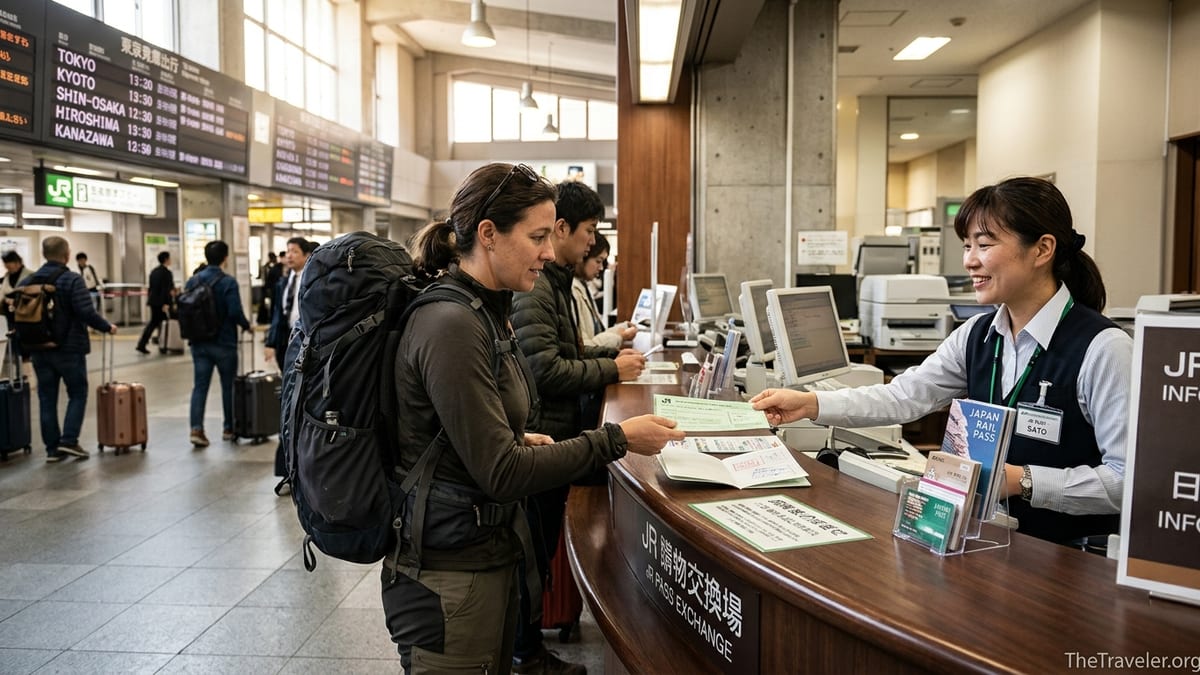
When purchasing through an overseas agent, customers receive an exchange order rather than the actual pass. After arriving in Japan, they must visit a designated JR ticket office, often labeled as a Japan Rail Pass exchange office, and present the exchange order, passport and arrival record. The staff will verify eligibility and then print the pass starting on the date the traveler chooses, which can be any date within a limited period from arrival. Purchases through the official JR online site may use a QR code process at major stations, but the fundamental step of verifying temporary visitor status remains the same.
The pass validity period is counted in consecutive calendar days, not hours. A 7 day pass activated on 10 April will expire at the end of service on 16 April, regardless of the time it was first used. During that window, the pass generally covers unlimited travel on JR lines nationwide, including most Shinkansen and limited express trains. Seat reservations on eligible trains can be made at station counters or at ticket machines that accept the pass. In recent years JR companies have expanded online reservation compatibility, but conditions vary by region and some systems require a separate registration process.
There are important limitations. The pass does not allow travel on Nozomi and Mizuho services on the Tokaido, Sanyo and Kyushu Shinkansen. Holders need to choose Hikari, Sakura, Kodama and similar categories instead. Attempts to ride Nozomi or Mizuho with only the pass can result in a request to pay a special ticket or surcharge. In addition, some premium services such as certain overnight trains, private railway limited express services and special tourist trains are not fully covered. In some cases the basic JR segment is included but a supplemental ticket is required for the non JR or special compartment portion; travelers should always confirm at a JR ticket counter before boarding.
Tokyo–Kyoto–Osaka–Hiroshima: the classic loop under the microscope
One of the most common itineraries for first time visitors is a loop that starts in Tokyo, moves to Kyoto and Osaka, then continues to Hiroshima before returning to Tokyo or exiting via Kansai International Airport. To test pass value, this investigation uses approximate current ordinary reserved seat Shinkansen fares sourced from JR price tables for 2026 and cross checked for 2027 timetables. Actual fares may shift slightly with seasonal adjustments, but the comparisons remain robust.
For a Tokyo to Kyoto one way journey on a Hikari service with a reserved seat, the total fare is around 14,000 yen. Kyoto to Osaka on a JR Special Rapid or conventional line train is roughly 580 yen. Osaka to Hiroshima on a Sakura Shinkansen with reserve seat costs in the area of 10,500 yen. Hiroshima back to Tokyo on a combination of Sakura and Hikari with a reserved seat runs approximately 19,000 yen. Adding these together, a traveler making these four main legs with reserved seats spends close to 44,000 yen in base long distance JR fares, and this does not yet include short hops such as Osaka to Shin Osaka or Hiroshima city trams, which are non JR.
Comparing this 44,000 yen total to a 7 day nationwide pass at the official online price of 50,000 yen suggests that the nationwide product is slightly more expensive if the traveler only rides these exact trains and no others. At an overseas agent price of 53,000 yen, the gap increases. However, once the traveler adds common side trips such as Tokyo to Nikko and back on JR lines, a round trip from Osaka to Himeji by Shinkansen, or extensive local JR travel around Kansai and Tokyo within the same week, the value equation changes. It becomes quite easy to add 6,000 to 10,000 yen of additional JR fares, eliminating the difference and turning the 7 day pass into a modest saving, particularly at the 50,000 yen official web price.
Another nuance is flexibility. The nationwide pass allows near unlimited adjustments to travel dates and side trips within the validity period without financial penalty, something that is harder to quantify than yen totals. For travelers arriving in Tokyo, spending two days there, then moving through Kyoto, Osaka and Hiroshima within a tight seven day window, the 7 day pass purchased via the official channel can be a convenience product that ends up close to break even, especially when late booking of multiple reserved seats is considered.
Tokyo–Kanazawa–Kyoto and the role of the Hokuriku Arch Pass
A second popular route links Tokyo, Kanazawa and Kyoto using the Hokuriku Shinkansen and limited express trains along the Sea of Japan coast. This is an area where a regional pass often competes directly with the nationwide pass. As of the latest information, the Hokuriku Arch Pass remains available to foreign temporary visitors and offers seven consecutive days of travel linking Tokyo with Kanazawa, Kyoto and Osaka using JR East and JR West lines along a defined corridor. It is priced significantly lower than the nationwide Japan Rail Pass, reflecting its limited geographic range.
For costing, consider a traveler who goes from Tokyo to Kanazawa on the Hokuriku Shinkansen with a reserved seat, then rides from Kanazawa to Kyoto on a limited express such as Thunderbird, and finally returns from Kyoto to Tokyo on the conventional Tokaido Shinkansen. Official JR fare tables indicate that Tokyo to Kanazawa reserved seat on a faster Kagayaki service is around 15,000 yen. Kanazawa to Kyoto on a limited express reserved seat is close to 7,000 yen. Kyoto to Tokyo reserved on a Hikari is around 14,000 yen. Combined, this itinerary totals roughly 36,000 yen in long distance JR tickets.
Against a 7 day nationwide pass at 50,000 yen or more, ordinary tickets clearly win if the traveler restricts themselves to this triangle and does not continue on to Hiroshima or Kyushu. However, the Hokuriku Arch Pass price falls below the 36,000 yen combined ticket cost while allowing additional travel between Tokyo, Kanazawa, Kyoto and Osaka within its validity. This makes the Arch Pass a strong candidate for travelers whose trip is entirely or mainly within this corridor. Buying a full nationwide pass for a Tokyo–Kanazawa–Kyoto–Tokyo journey in 2027 is difficult to justify financially unless it is part of a wider national itinerary including other distant regions.
The Arch Pass comparison also underscores the importance of checking coverage maps. Some travelers assume that any travel between Tokyo and Kyoto using JR is automatically covered by any regional pass that mentions both cities. In reality, products like the Hokuriku Arch Pass specify routes via Kanazawa and do not cover the most direct Tokaido Shinkansen path between Tokyo and Kyoto. Someone who wants the fastest Tokyo–Kyoto round trip on Nozomi or Hikari and only a brief Kanazawa visit may find ordinary tickets more suitable.
Kansai and Kyushu regional passes in a post Kansai Area Pass world
The JR West Kansai Area Pass, a long standing option centered on Osaka, Kyoto, Nara and Kobe, ceased sales after 30 September 2026. For 2027, JR West instead emphasizes products such as the Kansai Wide Area Pass, which generally covers a broader zone including areas like Okayama and Kinosaki Onsen over multiple days at a higher price point than the old Kansai Area Pass. This shift directly affects many English language trip calculators and blog itineraries that still build savings examples around the discontinued product.
Consider a regional Kansai itinerary: Kansai International Airport to Kyoto, multiple days of JR travel between Kyoto, Osaka and Nara, plus a day trip to Himeji from Osaka by Shinkansen or Special Rapid, before returning to Kansai Airport. Individual JR fares for Kansai Airport to Kyoto on the limited express Haruka using a discounted IC rate plus non reserved seat are roughly in the 3,000 yen range one way. Kyoto to Osaka and Nara returns on JR local and rapid trains can add another 3,000 to 4,000 yen over several days. Osaka to Himeji and back using a mixture of Shinkansen one way and conventional rapid the other can total near 7,000 yen, depending on seat choice. Summed, such a Kansai focused itinerary might reach around 15,000 to 18,000 yen in JR costs.
Compared to the old Kansai Area Pass, which once undercut this total, the currently marketed Kansai Wide Area Pass may cost more than these ordinary fares if a traveler does not venture beyond the core Osaka Kyoto Nara Himeji axis. For strictly Kansai based visitors in 2027, the nationwide Japan Rail Pass almost never makes sense. It is significantly more expensive than both the total of ordinary tickets and the remaining JR West regional products designed for deeper exploration into Chugoku or Hokuriku regions.
On Kyushu, JR offers passes such as the All Kyushu Rail Pass and the Northern Kyushu Rail Pass, available for varying day lengths. A traveler flying into Fukuoka and visiting Nagasaki, Kumamoto, Beppu and Kagoshima over a week can quickly accumulate Shinkansen and limited express fares that approach 30,000 to 40,000 yen if bought individually. In those cases a Kyushu regional pass can generate substantial savings without the need for a far more expensive nationwide pass, provided all main routes are on JR lines and not competing private railways like Nishitetsu.
Tokyo–Kyoto return, Hiroshima add on and where the break even lies
For many visitors the core question is narrowly focused. Does a simple round trip between Tokyo and Kyoto justify a nationwide pass. Using representative 2027 prices, a Tokyo to Kyoto reserved seat on a Hikari train is about 14,000 yen each way. A straight round trip therefore costs near 28,000 yen. Even the cheapest 7 day nationwide pass price of 50,000 yen on the JR official web channel is far above this. In this scenario, ordinary tickets are the logical choice, potentially paired with a small regional pass if spending many days on JR lines in Kansai alone.
The picture changes when Hiroshima or other distant destinations are added. Add Kyoto to Hiroshima on a Sakura Shinkansen at around 11,000 yen and Hiroshima back to Tokyo at roughly 19,000 yen, and the total intercity spend increases to close to 58,000 yen, excluding any short JR segments. At this point, a 7 day nationwide pass at 50,000 yen appears cheaper than ordinary tickets if the entire sequence is done within seven days and if purchased through the JR official channel before any adjustment. Even at the overseas agent price of 53,000 yen there is a modest saving compared to buying individual tickets for Tokyo–Kyoto–Hiroshima–Tokyo with reserved seats.
If, however, the traveler spreads this itinerary over more than seven days and starts considering a 14 day pass at 80,000 yen to keep coverage active, individual tickets regain the advantage. The combined intercity fares of about 58,000 yen are well below the 14 day pass price. A frequent pattern is that travelers try to stretch a pass to cover both arrival and departure days plus a week and a half between. This often leads to paying for a longer pass that no longer pays off relative to the ordinary fare total.
For those who add further long distance segments, such as Tokyo to Hakodate in Hokkaido or Osaka to Fukuoka in Kyushu within a seven day window, a 7 day nationwide pass can again look attractive. The crucial point is that a single Tokyo–Kyoto return alone is not enough. Long distance additions like Hiroshima, Fukuoka or Hokkaido, concentrated into a short period, are usually required to reach the break even threshold.
Reserved vs non reserved, luggage, children, couples and families
When comparing passes with ordinary tickets it is important to factor in seat type. Shinkansen and many limited express trains have reserved and non reserved cars. Non reserved tickets are slightly cheaper, often by several hundred yen each way, but carry the risk of standing during busy periods. The nationwide Japan Rail Pass allows free reservations on covered trains, which effectively locks in the reserved seat surcharge at no extra cost once the pass is purchased. Travelers relying on non reserved tickets to lower costs must compare against this inclusive reserved seat value.
Seat availability during peak holidays such as Golden Week in late April and early May, Obon in mid August and New Year at the end of December can be tight. In these periods, pass holders who reserve well in advance via ticket offices or compatible online systems gain clear comfort advantages. However, the pass does not guarantee seats if all reserved allocations are sold out. Those without passes can still sometimes find space in non reserved cars, but may have to queue and board at starting stations.
Oversized luggage policies on Shinkansen have become stricter. For the Tokaido, Sanyo and Kyushu Shinkansen, luggage beyond certain dimensions requires advance seat reservations in designated oversized luggage areas. Japan Rail Pass holders must also comply and may need to ask for oversized luggage seats at reservation time. Failure to do so can result in additional fees or being asked to move. This makes the pass most convenient for travelers who plan and book their major hops ahead of time rather than winging it at the last minute.
Children aged 6 to 11 generally qualify for child pricing on passes and tickets, typically about half the adult price, while children under 6 often travel free without their own seat if not occupying a reserved position. For a couple, the question is simply doubled: two 7 day passes at 50,000 yen each versus two sets of ordinary tickets. On the Tokyo–Kyoto–Hiroshima–Tokyo example with intercity fares near 58,000 yen per adult, two adults pay roughly 116,000 yen in individual tickets. Two 7 day passes purchased via the official channel cost around 100,000 yen, yielding a saving of about 16,000 yen plus additional value from side trips. For a family of two adults and two children, four 7 day passes would total about 150,000 yen at full adult price and half price for children, while four sets of ordinary tickets for the same route might hover around 174,000 yen, making the national pass more compelling when long jumps are concentrated in a short span.
Refunds, exchange rate exposure and planning risk
Refund policies for the Japan Rail Pass and regional passes depend on where and how they are purchased. Overseas travel agents usually apply service fees if a customer requests a refund before exchanging the order in Japan, and some do not allow refunds after a certain date. The official JR online channel publishes its own refund rules, which can include a percentage cancellation fee deducted from the pass price. Once a pass is activated in Japan, refunds are typically not possible unless JR cancels services due to extraordinary circumstances.
Exchange rates add another layer of risk. Many international travelers purchase passes denominated in yen but pay in their home currency via credit card. If the yen weakens between purchase and travel, those who locked in an earlier exchange rate may end up paying more in home currency terms than if they had waited. Conversely, a strengthening yen can make early purchase advantageous. Because 2027 exchange rate movements cannot be predicted, pass buyers should avoid treating speculative currency guesses as a central part of their strategy.
Buying a pass before an itinerary is final can also be risky. If a traveler imagines an ambitious multi region tour and purchases a 14 day nationwide pass, then later shortens the trip to only Tokyo and Kansai with no Hiroshima or Kyushu, the pass may turn into a poor value compared to ordinary tickets or a regional option. Given that refunds either incur fees or may not be possible after activation, it is generally safer to finalize at least the skeleton of long distance travel before committing to an expensive pass.
An additional subtlety is that some regional passes are only available to purchase outside Japan or only via certain channels, while others can be bought in Japan at slightly different prices. This affects flexibility: a traveler can choose to wait until arrival to gauge weather or personal energy before buying a regional product at a station ticket office, while the nationwide Japan Rail Pass often rewards earlier planning, especially if the more favorable official online prices remain in place separate from overseas agent levels.
Covered vs non covered transport and final recommendations
All pass calculations must distinguish JR from non JR transport. Japan Rail Passes and most JR regional passes do not cover private railways like Kintetsu in Kansai, Hankyu in Osaka, or Tokyo Metro and Toei subway lines in the capital. Airport links are a mix. JR segments such as the Narita Express, the JR portion of the Kansai Airport access and the Haruka limited express to Kyoto are usually covered by JR passes, whereas private operators like Keisei from Narita or Nankai from Kansai Airport are not. Buses, trams and municipal subway systems in cities such as Hiroshima and Kyoto mostly require separate payment, though some regional passes include limited JR bus routes.
The value of any pass therefore rests heavily on how much of a traveler’s movement is on JR steel rails. A visitor who plans to base in Kyoto and mostly use city buses and private rail to Arashiyama or Kurama will see relatively little benefit from a JR focused product. In contrast, someone stringing together long intercity hops almost entirely on JR Shinkansen and limited express trains can extract far more yen per day from the same pass.
For 2027 travelers visiting only one region, such as Kansai or Kyushu, the data favors either ordinary tickets or carefully chosen regional passes. With the discontinuation of JR West’s Kansai Area Pass and the evolution of regional products, it is vital to consult current official pass lists rather than relying on older guidebooks. Only those planning multiple long distance Shinkansen journeys between distant regions within a short period, for example Tokyo–Kyoto–Hiroshima–Fukuoka–Tokyo compressed into seven days, are likely to unlock clear savings from the nationwide Japan Rail Pass at its current price points.
The safest approach is to build a draft route, price out the major JR segments using official fare tables for reserved seats, then compare that sum against both the nationwide pass prices by channel and any relevant regional products like the Hokuriku Arch Pass, Kansai Wide Area Pass or JR Kyushu passes. When the total of ordinary tickets approaches or exceeds the 7 day nationwide pass price at the official web level, and the journey is JR heavy, the pass can still offer strong value and convenience in 2027. When it falls far short, or is confined to a single region, ordinary tickets and region specific passes remain the smarter buy.