


More news on this day
Japan is moving ahead with plans for a next generation inspection Shinkansen that will be able to examine tracks, overhead lines and wayside equipment at up to 320 kilometers per hour, matching the top speed of the country’s fastest passenger bullet trains.
Get the latest news straight to your inbox!
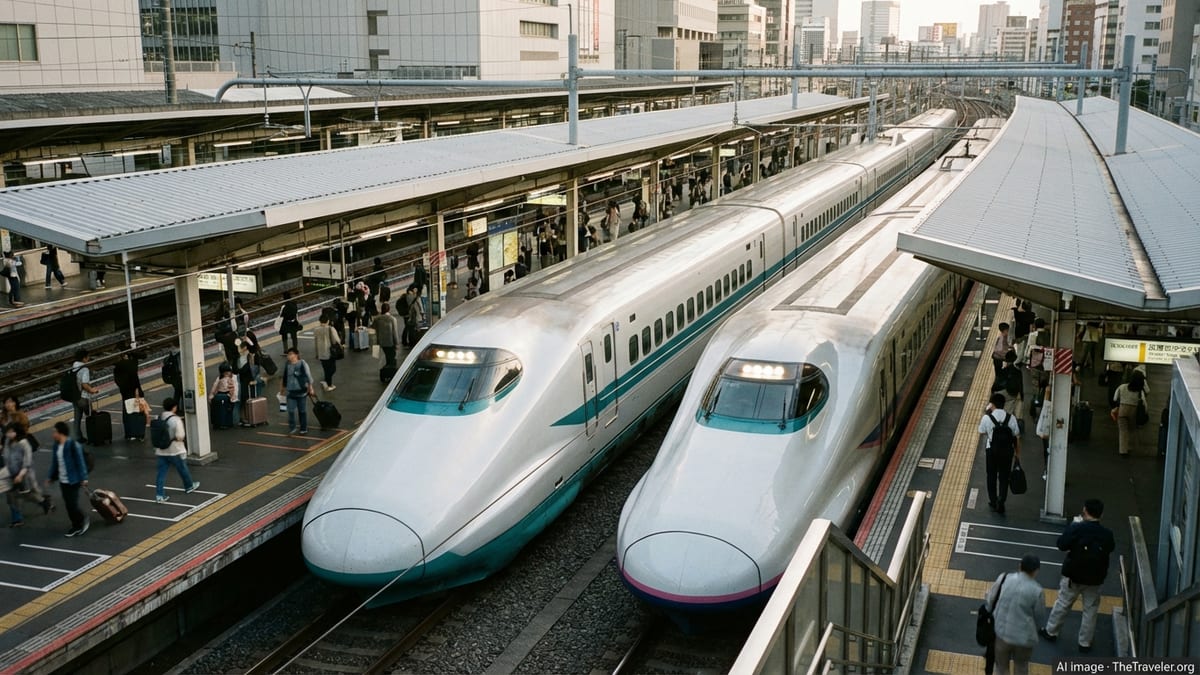
New 320 km/h inspection train named “Soar”
Publicly available information from East Japan Railway Company indicates that the new inspection train, designated E927 and nicknamed “Soar,” is scheduled to enter service in fiscal 2029 on the company’s Shinkansen network. It will replace the long serving East i diagnostic train, which currently inspects high speed lines at a maximum of 275 kilometers per hour.
Reports in Japanese and international media describe Soar as a dedicated seven car train based on the next generation Akita Shinkansen rolling stock. It is being engineered to operate safely at 320 kilometers per hour, enabling infrastructure checks at the same pace as commercial services on the Tohoku Shinkansen.
According to published coverage, the new design retains the characteristic streamlined nose profile of recent Shinkansen models in order to reduce noise and aerodynamic resistance at high speed. The exterior livery combines white and red tones that visually link the train to JR East’s existing mini Shinkansen fleet while clearly distinguishing it as a specialist diagnostic vehicle.
JR East material highlights that the inspection territory will cover the Tohoku, Joetsu, Hokuriku, Yamagata and Akita Shinkansen routes. The ability to conduct tests at full line speed is described as a first within Japan for a dedicated inspection train, reflecting the growing importance of maintaining reliability on increasingly busy high speed corridors.
Extensive onboard technology for real time diagnostics
The new E927 train is being equipped with a wide range of measurement and imaging systems intended to capture a detailed picture of asset condition in real time while the train is running at 320 kilometers per hour. Reports indicate that around 48 cameras will be installed to monitor rails, overhead lines, trackside equipment and surrounding infrastructure.
Technical summaries released by the operator explain that sensors will estimate the forces acting between wheels and rails, helping engineers identify subtle distortions, wear or alignment issues before they develop into faults. Additional imaging equipment mounted at the front of the train and along its flanks will record changes in the condition of structures, embankments and the wider railway environment.
The incoming train is also planned to support greater use of artificial intelligence and data analytics. Information from cameras, lasers and other sensors will be combined with existing inspection records to build predictive maintenance models, allowing teams to prioritize work and schedule interventions more efficiently.
Publicly available documents on JR East’s wider safety strategy show that image based screening and AI assisted assessments are being expanded across the network. The new inspection Shinkansen is positioned as a core component of that digital maintenance push, collecting large volumes of standardized, high quality data at operational line speeds.
Replacing East i as Shinkansen infrastructure guardian
Japan’s current East i train has been responsible for inspecting JR East’s Shinkansen lines since the early 2000s, running at up to 275 kilometers per hour while monitoring track geometry, overhead wiring and signaling equipment. With trains on the Tohoku Shinkansen now operating commercially at 320 kilometers per hour, the gap between inspection and service speeds has become more pronounced.
Industry analyses note that aligning inspection speed with commercial operation helps reveal dynamic behaviors and loads that may not appear at lower speeds. By operating at 320 kilometers per hour, Soar is expected to provide a more accurate representation of how infrastructure performs under day to day conditions, particularly on long high speed sections north of Tokyo.
Reports indicate that the introduction of the new train also reflects a broader generational change across Japan’s diagnostic fleet. Central Japan Railway’s well known Doctor Yellow inspection trains on the Tokaido and Sanyo Shinkansen are slated for retirement, with some of their functions shifting to commercial trainsets fitted with embedded measurement equipment.
In contrast, JR East has opted to retain a purpose built diagnostic Shinkansen while still exploring ways to supplement its work with additional sensors on passenger trains and new tunnel and subgrade inspection methods. The forthcoming E927 is therefore expected to remain the central tool for high speed line checks across the company’s territory.
Part of a wider investment in Shinkansen safety
The development of a 320 kilometer per hour inspection train is being framed within a longer term effort to maintain and enhance the safety record of Japan’s high speed railways. Government and industry publications regularly highlight that Shinkansen lines have operated for decades without fatal passenger accidents caused by train operations, a record supported by rigorous maintenance and frequent inspections.
JR East and other operators are gradually shifting from time based maintenance to condition based strategies that rely on continuous monitoring and detailed diagnostics. Documents outlining these initiatives describe plans to expand automated crack detection in tunnels, deploy imaging vehicles for subgrade inspections and introduce drone based observation around vulnerable sections of line.
The high speed capabilities of Soar are intended to complement this suite of tools by providing fast, repeated coverage of long mainline sections. By running at line speed during regular inspection cycles, the train can survey more track in less time, freeing maintenance crews to focus on locations where data suggests potential deterioration.
Analysts of Japan’s rail sector point out that such investments are also designed to support future service enhancements, including potential speed increases on some corridors and the expansion of high speed services into additional regions. Ensuring that infrastructure monitoring keeps pace with these developments is seen as essential for sustaining public confidence in rail travel.
Implications for high speed rail worldwide
The introduction of a Shinkansen inspection train capable of 320 kilometer per hour operation is being closely watched by rail professionals and enthusiasts outside Japan. Many high speed networks in Europe and Asia rely on similar specialist diagnostic trains, but relatively few currently survey infrastructure at the full line speed of their fastest passenger services.
Industry commentators suggest that the approach taken by JR East could influence how other operators plan future maintenance fleets. As more railways adopt trains capable of 300 kilometers per hour or more, the ability to inspect at comparable speeds may become increasingly attractive, especially on heavily used routes where downtime for conventional checks is limited.
Japan’s experience with combining high speed diagnostics, advanced sensing technology and data driven maintenance is expected to provide case studies for infrastructure managers around the world. Observers will be watching how effectively Soar integrates into routine inspection cycles after its planned debut in fiscal 2029, and how the wealth of data it generates is used to refine maintenance practices over time.
For travelers and rail fans, the new train is also likely to become a symbolic presence on the network, succeeding East i as a visible reminder of the intensive behind the scenes work that underpins the Shinkansen’s reputation for punctuality and safety.