


More news on this day
Flight disruptions in and around Jordan intensified this week as Iranian missile and drone attacks triggered renewed airspace alerts, prompting airlines to cancel, divert and reroute services across an already tense region.
Get the latest news straight to your inbox!
Missile and drone barrages rattle Jordanian airspace
Jordanian military reports indicate that air defense systems intercepted multiple missiles and unmanned aerial vehicles originating from Iran over recent days, with incidents recorded on July 20 and July 21. Official readouts describe three missiles brought down after entering Jordanian airspace late on July 20, followed by at least five drones neutralized overnight into July 21 as they approached from the east.
Publicly available briefings state that the incoming projectiles were heading toward Jordanian territory before being engaged, with no direct strikes reported on populated areas. Authorities have repeatedly emphasized the priority placed on protecting national airspace and maintaining constant monitoring as regional tensions escalate.
The interceptions follow earlier episodes this year in which Jordan’s armed forces reported dealing with dozens of missiles and drones launched from Iran across the wider region. Aviation observers note that each new wave of activity raises the operational risk calculus for airlines using Jordanian routes, even when airports remain open and damage on the ground is avoided.
Travel industry analysts say that the latest barrages have reinforced perceptions of volatility along east–west corridors that cross Jordan and neighboring Gulf states, adding further uncertainty for passengers who rely on Queen Alia International Airport as a key regional hub.
Carriers adjust schedules as cancellations mount
Travel coverage from regional outlets shows that airlines serving Jordan have been steadily recalibrating operations since Iranian attacks in late winter first forced widespread airspace closures across the Gulf and Levant. Data cited by industry reports from that period indicated that flights to Jordan accounted for more than a tenth of cancellations linked to those initial strikes, underscoring the country’s exposure to regional disruption.
In more recent weeks, publicly available statements from Royal Jordanian describe a cautious approach as the flag carrier monitors security developments and neighboring airspace restrictions. Earlier guidance indicated that flights to certain high‑risk destinations, including Iraq and Syria, were suspended or curtailed for specified periods, while services on other routes continued with heightened risk assessments.
While some carriers have maintained largely intact schedules to and from Amman, others have adopted a more conservative stance, canceling sectors that traverse contested airspace or extending planned suspensions toward parts of Iraq, Iran and the eastern Mediterranean. Industry trackers note that even when Jordanian airspace remains technically open, an uptick in cancellations to and from the kingdom is likely as airlines seek to reduce exposure to potential overflight hazards.
Airlines operating long‑haul routes between Europe and Asia have also made tactical adjustments, removing Jordanian stopovers in favor of more southerly routings, or consolidating frequencies to limit crews and aircraft deployed near active conflict zones. These changes have translated into a shrinking range of options for travelers who previously relied on Jordan as a convenient connection point.
Regional fallout and complex rerouting across the Middle East
The latest disruption in Jordan is unfolding against a wider regional backdrop in which Iranian attacks have repeatedly prompted temporary airspace closures and flight suspensions across several Gulf states. Earlier rounds of strikes this year led Bahrain, Kuwait, Qatar and Oman to restrict or close their skies, forcing carriers to divert or cancel hundreds of flights over a matter of hours.
International aviation bodies have publicly highlighted the threat posed to civil aviation by missile and drone activity directed at Gulf Cooperation Council members and Jordan. Council communiqués have pointed to a pattern of emergency measures, including rerouting around conflict areas, extended flight times and congestion on remaining open corridors as airlines crowd into narrower bands of airspace deemed safer.
For Jordan, this regional reshaping of routes has a dual effect. On one hand, diversions away from neighboring countries can funnel additional traffic through Amman when conditions are stable. On the other, any fresh salvos from Iran toward Israel or the Gulf often result in precautionary holds, diversions or cancellations involving Jordan itself, particularly when intercepts occur within or near its airspace.
Analysts note that the cumulative impact of these disruptions is most visible in the patchwork of flight paths now crisscrossing the Middle East. Routes that once followed relatively direct trajectories across Iraq, Syria and western Iran increasingly bend south toward Saudi Arabia or further out over the Arabian Sea, eroding schedule reliability and adding costs for airlines and passengers alike.
Impact on passengers and Jordan’s role as a transit hub
For travelers, the continuing wave of cancellations and last‑minute rerouting has translated into longer journeys, missed connections and acute uncertainty over itineraries involving Jordan. Travel advisories and airline notices reviewed by TheTraveler.org consistently urge passengers flying via Amman to verify their flight status close to departure and remain prepared for sudden time changes.
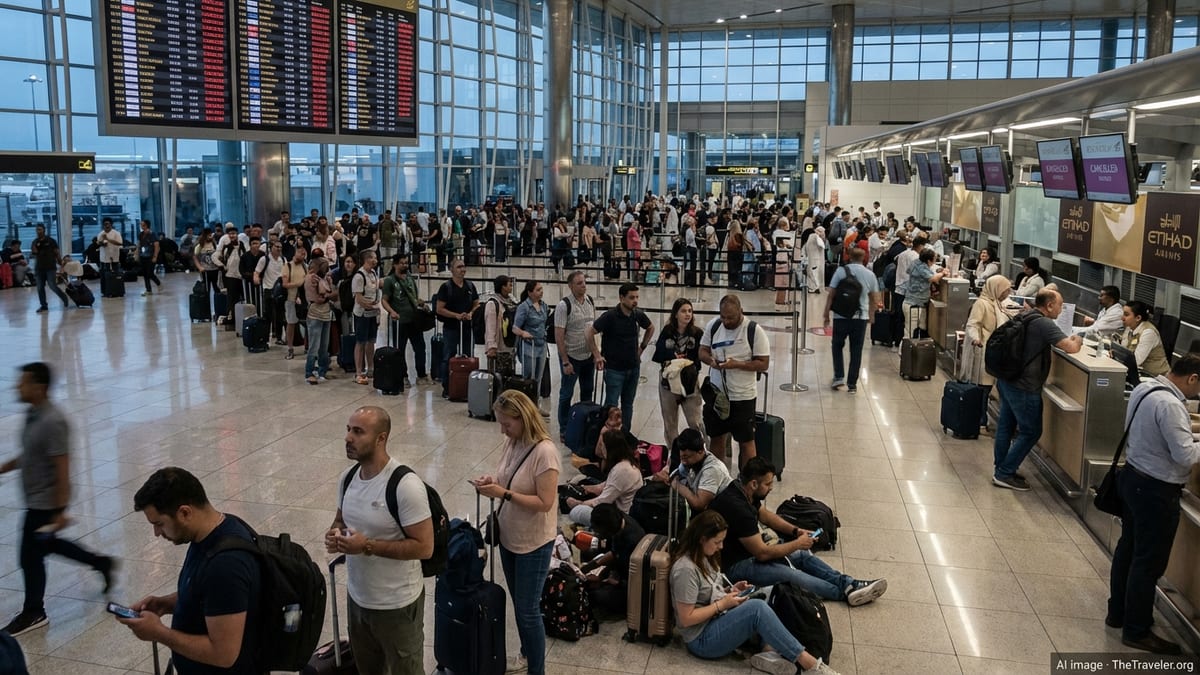
Reports from regional media describe crowds of passengers at airports across the Middle East seeking rebooking after services were halted due to shifting security assessments. While Jordan’s main gateway has so far avoided prolonged closure in the latest round of attacks, transit passengers in particular have faced challenges as connecting flights are delayed, consolidated or rerouted away from higher‑risk airspace.
Tourism operators in Jordan, especially those focused on inbound visitors to sites such as Petra, Wadi Rum and the Dead Sea, are monitoring developments closely. Industry commentary suggests that short‑term bookings are more vulnerable to disruption, as travelers may hesitate to finalize trips until there is greater clarity over the stability of regional skies.
At the same time, some regional analysts argue that Jordan’s track record of quickly restoring air operations after previous alerts could help preserve its role as a transit and tourism hub if the security situation stabilizes. Much will depend on whether Iranian attacks and retaliatory strikes ease in the coming weeks or evolve into a more sustained pattern of cross‑border fire that keeps airlines on a heightened state of alert.
Safety assessments and the outlook for the summer travel season
Aviation safety specialists stress that decisions on whether to overfly or operate into Jordan are driven by continuous risk assessments that weigh the likelihood of further attacks, the performance of local air defenses, and the proximity of missile and drone trajectories to established civilian routes. Public documents from Jordan’s aviation regulators emphasize their focus on maintaining a safe and stable operating environment while retaining the flexibility to impose restrictions if threats intensify.
For now, industry observers expect a cautious approach through the remainder of the busy summer travel season. Airlines are likely to maintain contingency plans for rapid diversions, additional fuel loads for longer routings, and crew scheduling buffers to absorb sudden changes. These measures can keep passengers moving, but they also increase operational costs that may eventually filter through to fares.
Travel planners recommend that passengers heading to or transiting through Jordan in the coming weeks build in extra time, avoid tight connections and remain open to rebooking on alternative routings if operational disruptions persist. Although many flights are still operating, the pattern of Iranian attacks and intercepts around Jordanian airspace suggests that bouts of cancellations and delays may continue without warning.
Looking ahead, the resilience of Jordan’s aviation sector will hinge on the broader regional security trajectory. If Iranian missile and drone launches diminish and neighboring states relax emergency airspace measures, airlines may gradually rebuild schedules and restore confidence in Jordan‑linked itineraries. Continued instability, however, would likely entrench the current climate of uncertainty that is reshaping travel across the Middle East.