


Flying into Kilimanjaro International Airport and heading straight for the legendary Ngorongoro Crater is one of the classic northern Tanzania safari routes. Yet the logistics are not always obvious: driving times, where to break the journey, what permits you need, and whether a same-day crater visit from an international arrival is realistic. This guide breaks down the route from Kilimanjaro International Airport to Ngorongoro, looking at private transfers, overnight options in Arusha and Karatu, and how to plan your luggage and timing so the journey feels part of the adventure, not an exhausting slog.
Get the latest updates straight to your inbox!
Understanding the Route from Kilimanjaro Airport to Ngorongoro
Kilimanjaro International Airport (often shown as JRO on tickets) sits roughly halfway between the towns of Arusha and Moshi. For Ngorongoro-bound travelers, almost all routes funnel through Arusha, the gateway city for northern Tanzania safaris. From Arusha, you follow the main tarmac road west through Makuyuni and Mto wa Mbu, then continue up into the highlands toward Karatu and the Loduare Gate, the main entrance to the Ngorongoro Conservation Area.
In terms of distance, you should think in segments rather than one big drive. Kilimanjaro International Airport to central Arusha is typically about 50 kilometers, taking around one hour in normal daytime traffic by private vehicle. From Arusha to the Ngorongoro Conservation Area gate is another three and a half to four and a half hours by road in a safari vehicle, mostly on paved surfaces. Once through the gate, you still need an additional 30 to 60 minutes to reach crater-rim lodges, and roughly another 30 to 45 minutes to descend into the crater floor when you start your game drive.
For many visitors, the realistic door-to-door time from Kilimanjaro International Airport to a crater-rim lodge works out at five and a half to seven hours, depending on the time of day, roadworks, delays at the Loduare Gate, and how many stops you make en route. That is before you add a three- to six-hour game drive inside the crater itself. Understanding this basic timing is the key to deciding whether to push through in one day or break the journey in Arusha or Karatu.
The good news is that the main safari road west from Arusha is fully paved and heavily used by safari operators. The final stretch inside Ngorongoro is on gravel and can be corrugated and muddy in the rains, but for visitors traveling with established safari companies in 4x4 vehicles, this is standard terrain. The bigger considerations are fatigue, daylight and park regulations rather than off-road technical driving.
Private Safari Transfers: What to Expect and Typical Costs
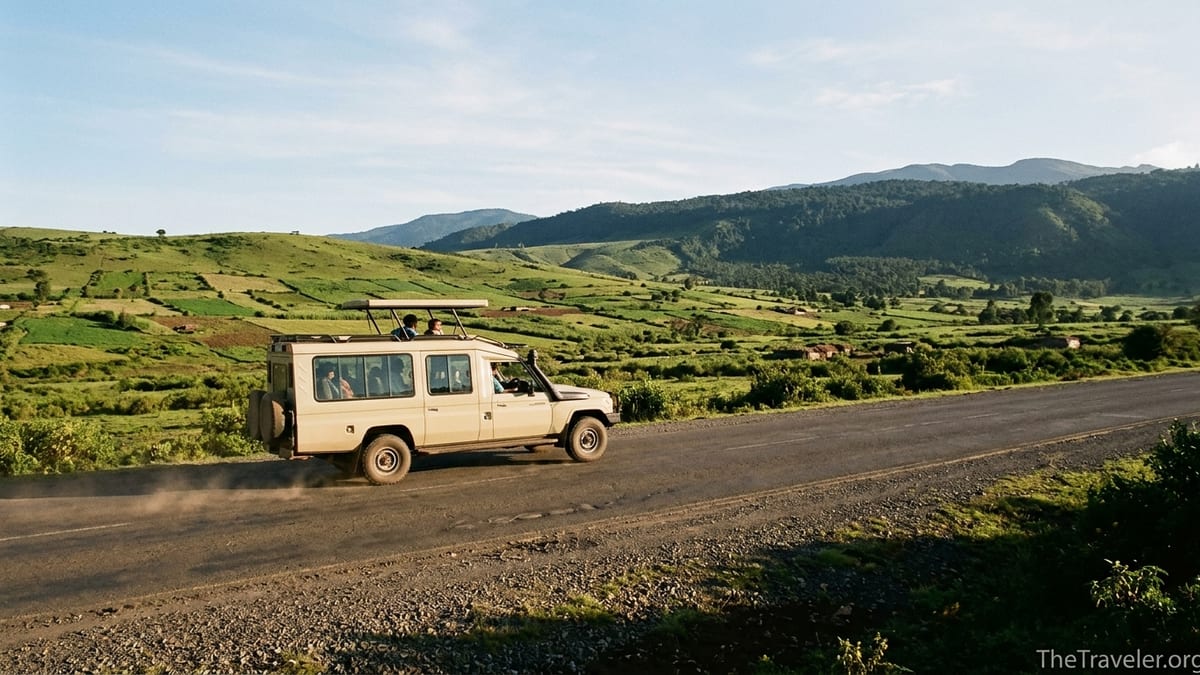
Most travelers connect from Kilimanjaro International Airport to Ngorongoro on a private transfer arranged through their safari operator. This usually means a professional driver-guide meeting you in the arrivals area, loading your luggage into a long-wheelbase 4x4 Land Cruiser or similar vehicle, and driving you via Arusha toward Karatu and Ngorongoro. The same vehicle often becomes your game-drive car for the rest of your safari, so you unpack once and keep your bags with you.
As of mid-2026, many mid-range safari packages that include Ngorongoro build the airport transfer into an overall itinerary price rather than itemizing it. When transfers are sold separately, local operators commonly quote a one-way private transfer from Kilimanjaro International Airport to Arusha in the region of the equivalent of 60 to 120 US dollars per vehicle, depending on vehicle type and pick-up time. A private transfer from Arusha onward to Karatu or straight to Ngorongoro is usually significantly more, reflecting the longer distance and conservation area fees that may apply to vehicles entering Ngorongoro.
In practice, international visitors rarely book these transfers as stand-alone taxi rides. Instead, they typically purchase a two- to seven-day safari package that includes a night in Arusha or Karatu along with park fees and guiding. For example, a three-day Ngorongoro and Serengeti road safari marketed to international clients might bundle an airport pick-up, Arusha overnight, Ngorongoro crater game drive and onward travel for a per-person rate, letting the operator handle how the vehicle and driver time is costed. The important point for travelers is that a reputable operator will meet you at Kilimanjaro, track any flight delays and ensure you are not driving long distances at night on unfamiliar roads.
Scheduled shuttle buses and shared transfers focus mainly on the more popular Arusha to Moshi corridor, serving Kilimanjaro trekking guests. For Ngorongoro trips, there is no reliable public shuttle system that takes you from the airport to the crater in a single step. That is why arranging a private safari transfer, either through a specialist Africa tour operator in your home country or a vetted local company based in Arusha or Karatu, is the safest and most time-efficient approach.
Arusha Overnight: When a City Stop Makes Sense
Arusha works as the natural staging point between Kilimanjaro International Airport and Ngorongoro. Many itineraries intentionally include the first night in or near Arusha so travelers can shower, rest, adjust to jet lag and repack their day bags before heading into the bush. This is particularly attractive after overnight flights from Europe or North America that land at Kilimanjaro in the late evening or very early morning, when attempting a long same-day drive would mean traveling in the dark or arriving at the crater utterly exhausted.
Accommodation options in and around Arusha range widely. Close to the city but in leafy surroundings, places like Arusha Coffee Lodge or Arusha Serena Hotel offer comfortable rooms in coffee plantations or gardens, often with on-site restaurants, swimming pools and easy vehicle access for the next morning’s departure. Closer to budget and mid-range levels, smaller guesthouses and boutique lodges in suburbs just outside the city center provide quieter overnight stays while keeping you within a 15 to 25 minute drive of the main safari roads.
An Arusha overnight is also practical if you need to sort out last-minute logistics such as ATM withdrawals, SIM cards, pharmacy visits or meeting your ground operator in person. Travelers arriving with oversize luggage, such as technical climbing gear for Kilimanjaro followed by a safari, often arrange to store extra bags securely at an Arusha hotel or with their operator’s office while they head to Ngorongoro with only what they need for a few days.
Time-wise, if your flight lands at Kilimanjaro any time after mid-afternoon, it is rarely wise to attempt the drive beyond Arusha on the same day. A realistic pattern is to be collected at the airport, transfer one hour to Arusha, check in, enjoy dinner and sleep, then depart after breakfast the next morning for a three and a half to four and a half hour drive to the Ngorongoro gate, arriving comfortably by late morning or mid-day ready to enjoy the highlands scenery.
Karatu Overnight: The Smart High-altitude Stop Before the Crater
Karatu is a small highland town set between Lake Manyara and the Ngorongoro Conservation Area, and it has become a major base for safari lodges and tented camps. Located roughly 30 kilometers before the Loduare Gate, Karatu offers a cooler climate, access to coffee farms and rural walks, and a wide spread of accommodations that often cost less than crater-rim lodges while still keeping you within striking distance of the crater. Many travelers know Karatu by lodge names rather than the town itself, staying at places such as Bougainvillea Safari Lodge, Marera Valley Lodge or The Retreat at Ngorongoro.
For the Kilimanjaro to Ngorongoro journey, an overnight in Karatu can be ideal if you land at Kilimanjaro in the morning or around mid-day and have the energy for a five- to six-hour drive that same day. In that scenario, your driver might meet you at the airport, drive you through Arusha with only a short coffee or lunch stop, and continue directly onward to Karatu. Standard itineraries often use this pattern: Day 1, arrive Kilimanjaro and overnight in Karatu; Day 2, early departure from Karatu, enter Ngorongoro, enjoy a full crater game drive, then continue to the Serengeti or return to Karatu.
Staying in Karatu rather than on the crater rim often means a slightly earlier start on crater day because you need about 30 to 45 minutes to reach the gate and then additional time to climb to the rim and descend into the crater. On the other hand, you sleep at a slightly lower altitude, which many travelers find more comfortable than the cool, damp conditions that can prevail on the crater rim at night. Karatu also tends to offer better value for money at mid-range levels, with comfortable rooms, good food and landscaped gardens at rates that are generally below the premium charged by crater-rim properties.
From a practical point of view, Karatu gives you a convenient halfway point on longer itineraries that combine Tarangire, Lake Manyara, Ngorongoro and the Serengeti. Families with children, for example, often appreciate the chance to break up road days across several shorter hops and enjoy lodge facilities such as pools or guided walks in the late afternoon rather than arriving at accommodations after dark.
How Long the Drive Really Takes and Whether Same-day Travel Works
While raw distances suggest that it is possible to travel from Kilimanjaro International Airport to Ngorongoro and even fit in a crater game drive on the same day, in real-world conditions this is rarely a good idea. The sequence you need to complete is long: clearing immigration and collecting bags, meeting your driver, driving an hour to Arusha, then three and a half to four and a half hours to the Ngorongoro gate, then entering the conservation area, reaching a descent road and conducting a meaningful game drive, all before park regulations and daylight constraints start to bite.
For a same-day crater visit to make sense, you would need a morning arrival at Kilimanjaro, a group that is already rested from a shorter regional flight rather than an overnight long-haul, and a driver-guide who is comfortable pushing the schedule. Even then, any delays at the airport, traffic around Arusha, or slow processing at the Ngorongoro gate may eat into your game-viewing time. More importantly, driver fatigue and wildlife safety are real concerns. Reputable operators are cautious about scheduling very long road days followed immediately by game drives for both safety and guest satisfaction reasons.
A more practical same-day plan, if you are determined to get close to Ngorongoro, is to use your arrival day simply as a transfer day to Karatu or a crater-rim lodge without entering the crater itself. For example, arriving at Kilimanjaro around mid-morning, you might reach Karatu by mid to late afternoon, check in, enjoy views over the highlands, and be ready for an early start the following day. This keeps your total road time on day one to around five to six hours including stops, which is manageable for most travelers.
Seasonal weather also affects timing. In the long rains, typically around March to May, sections of the gravel road inside Ngorongoro can become slippery and slower, and visibility from the crater rim may be reduced by cloud and mist. In the dry months, dust and corrugations can make travel tiring. Building in an overnight along the way gives you flexibility if conditions are slower than expected and helps avoid driving in darkness, which is strongly discouraged outside urban areas because of livestock, pedestrians and unlit vehicles.
Permits, Fees and Conservation Rules You Need to Know
Ngorongoro is a multi-use conservation area administered by the Ngorongoro Conservation Area Authority, and all visitors must pay entry fees. In addition, vehicles pay separate fees to enter, and there is a specific crater service fee charged per vehicle for each descent into the crater floor. The exact figures change periodically, and different rates apply to Tanzanian citizens, East African residents and foreign non-residents. Most foreign visitors experience these fees as part of an inclusive safari quote from their operator rather than paying them individually at the gate.
For planning purposes, assume that a one-day visit to Ngorongoro for a non-resident visitor will involve a significant daily conservation fee per person plus a per-vehicle crater descent fee. Most mid-range and high-end safari itineraries are priced with these costs already included, and operators time your entry and exit carefully so that your 24-hour entry permits are used efficiently. It is rare and usually uneconomical to enter Ngorongoro just for a short drive and then exit again the same day without at least one meaningful game drive or an overnight stay inside the area.
Because of these costs and the 24-hour nature of the permits, squeezing a rushed crater visit into a late-arriving day makes poor financial sense. If your group only has one day available in Ngorongoro, it is usually better to arrive nearby the previous afternoon, spend the night in Karatu or on the rim, and dedicate the following morning and early afternoon to the crater. This way your permit window is used for actual wildlife viewing rather than just transit from the airport.
Note, too, that self-driving visitors must ensure their vehicle meets conservation area rules and that they have the correct paperwork and payment methods for fees. For most first-time visitors, especially after international flights, engaging a licensed safari operator that handles permits, payments and gate formalities is worth the extra cost and reduces the risk of being turned back at the gate because of incorrect documentation or outdated pricing assumptions.
Luggage, Packing Strategy and Vehicle Space
On the Kilimanjaro to Ngorongoro route, your luggage arrangements depend on whether you continue overland for the rest of your safari or connect to small planes later. Road-based safaris using 4x4 vehicles typically tolerate more luggage than internal bush flights, which often enforce strict soft-bag limits of about 15 kilograms per person including hand luggage. Travelers who are climbing Kilimanjaro first and then going on safari often find themselves with large duffel bags, trekking poles and heavy boots that are not needed in Ngorongoro.
If your safari starts immediately after an international arrival, discuss luggage in advance with your operator. Many Arusha-based companies offer secure storage at their offices or partner hotels, allowing you to leave climbing gear or excess suitcases in the city and travel to Ngorongoro with one soft duffel and a small daypack. This not only makes loading and unloading easier at each lodge but also gives everyone in the vehicle more space, which matters on the longer drive days and during game viewing when people want room to move and stand.
From a practical perspective, you should pack a day bag that stays accessible in the vehicle throughout the transfer from Kilimanjaro Airport. Include any medications, a light fleece or windbreaker for cooler highland air, sunglasses, sunscreen, a hat and a reusable water bottle. If your operator provides a packed lunch for the airport-to-Karatu transfer, keep snacks and wipes handy. Main suitcases can remain in the rear of the vehicle until you reach your lodge. Travelers who are prone to motion sickness may want to keep remedies close by, especially for the winding climb up to the crater rim.
Lodges in Arusha and Karatu are generally accustomed to guests arriving with more luggage than they will use in the bush. Most are happy to store one or two suitcases per room for several days if you are returning after your Ngorongoro and Serengeti segment. Confirm this ahead of time, particularly if you are carrying expensive camera equipment or work electronics and want them kept in secure, monitored storage rather than simply behind the reception desk.
Sample Itineraries: How Travelers Actually Do It
Looking at how real travelers structure their journeys can clarify the options. One common pattern for visitors whose priority is Ngorongoro and the Serengeti works like this: arrive at Kilimanjaro International Airport in the afternoon, transfer an hour to an Arusha-area lodge, sleep, then depart after breakfast for a three and a half to four and a half hour drive to Ngorongoro the next day. They enjoy a full crater game drive, then continue on the same day to a Serengeti camp, where they spend several nights before returning to Arusha by road or light aircraft.
Another pattern used by families and travelers trying to minimize one-way internal flights is to drive directly from Kilimanjaro to Karatu on arrival day, when flight times allow. In this scenario, a morning arrival at Kilimanjaro leads to a quick rendezvous with the driver, a short stop in Arusha for currency exchange or lunch, then a continued drive on the paved safari highway through Makuyuni and Mto wa Mbu, arriving in Karatu by mid to late afternoon. Guests settle in at a lodge such as Africa Safari Karatu or Bougainvillea Safari Lodge, enjoy dinner and an early night, then start their crater day fresh at dawn.
Travelers on tighter budgets or shorter time frames sometimes combine Ngorongoro with only one other park, such as Tarangire or Lake Manyara. In these cases, they might arrive at Kilimanjaro, spend a night in Arusha, then visit Tarangire on the way to Karatu, overnight there, and dedicate the following day to Ngorongoro before driving back to Arusha. This creates a loop that keeps drive times each day within roughly four to six hours while still delivering varied wildlife experiences.
Experienced safari-goers increasingly recommend resisting the temptation to see too many parks in too few days. The Kilimanjaro to Ngorongoro road can be long and busy, and adding extra side trips to already full days can make your safari feel like a sequence of transfers rather than an immersion in wildlife. Scheduling a gentle first day to Arusha or Karatu, followed by a dedicated crater day, usually results in a more relaxed and rewarding experience.
The Takeaway
Planning the journey from Kilimanjaro International Airport to Ngorongoro Crater is about more than just booking a car. It means understanding realistic drive times, park fee structures and how your body will feel after long flights and multiple hours on the road. For most travelers, the most enjoyable and practical plan is to build in at least one overnight stop in Arusha or Karatu rather than racing from the arrivals hall directly into a crater game drive.
Private transfers with reputable safari operators remain the backbone of this route, providing door-to-door service in 4x4 vehicles, careful attention to daylight hours and support with conservation permits. Arusha offers a soft landing after your flight and a chance to organize luggage and essentials, while Karatu positions you closer to the crater and provides highland charm and good value accommodation. Thinking through where to break the journey, how to manage your bags and which day to allocate to the crater itself will go a long way toward turning a necessary transfer into a memorable part of your Tanzanian safari.
Most importantly, do not underestimate the value of rest and margin in your itinerary. Ngorongoro is one of Africa’s great wildlife spectacles and deserves your full energy and attention. Arriving there rested, with permits handled and logistics smoothed out, is far better than tumbling into the crater after a rushed, dawn-to-dusk travel day. Treat the Kilimanjaro to Ngorongoro leg as an integral chapter of your trip, and the highland vistas, villages and changing landscapes along the way will become part of the story you remember.
FAQ
Q1. Can I travel from Kilimanjaro International Airport to Ngorongoro Crater and do a game drive on the same day?
It is technically possible with a morning arrival, but rarely recommended. Once you factor in immigration, baggage, a one-hour drive to Arusha, another three and a half to four and a half hours to the Ngorongoro gate and then the descent to the crater floor, you are left with limited game-viewing time and a very long, tiring day. Most operators prefer to schedule an overnight in Arusha or Karatu first, then dedicate the following day to Ngorongoro.
Q2. How long does the drive from Kilimanjaro International Airport to Ngorongoro Crater take?
In normal conditions, plan about one hour from Kilimanjaro International Airport to Arusha, another three and a half to four and a half hours from Arusha to the Ngorongoro gate, and an additional 30 to 60 minutes to reach crater-rim lodges. Including short rest stops, the total road journey typically runs to five and a half to seven hours door to door.
Q3. Is it better to overnight in Arusha or Karatu before visiting Ngorongoro?
Both work, but they serve different purposes. Arusha is ideal if you land later in the day, are recovering from long-haul flights, or need city services such as ATMs, pharmacies and gear storage. Karatu is better if your flight arrives earlier and you want to get closer to the crater on day one, enjoy cooler highland surroundings and often better mid-range value, while still being only about 30 to 45 minutes from the Ngorongoro gate.
Q4. Do I need to arrange Ngorongoro permits myself, or will my safari operator handle them?
Most visitors book Ngorongoro as part of an organized safari, and the operator handles all permits and conservation fees on your behalf. The costs are usually bundled into your package price. Independent self-drivers must arrange and pay the correct entry, vehicle and crater descent fees directly, which can be complex for first-time visitors, so using a licensed operator is generally easier and more reliable.
Q5. Are there luggage limits for the road transfer between Kilimanjaro and Ngorongoro?
Road transfers in 4x4 safari vehicles are more flexible than internal bush flights, but space is still finite. Large hard suitcases and multiple bags can make the vehicle cramped, especially when shared by several travelers. It is wise to use one soft duffel and a small daypack per person for the Ngorongoro segment and store excess luggage in Arusha if you are carrying climbing gear or bulky items.
Q6. What type of vehicle is normally used for the transfer and game drives?
Most safari operators use modified 4x4 vehicles such as extended Land Cruisers with pop-up roofs for game viewing. These vehicles are built to handle tarmac highways and the rougher gravel roads inside Ngorongoro. They usually seat six to seven guests in window seats, plus the driver-guide, with luggage carried in the rear or on a roof rack if necessary.
Q7. Is it safe to drive this route at night?
Driving after dark outside major towns is generally discouraged in Tanzania because of unlit vehicles, livestock on the road and pedestrians. Reputable safari operators try to plan transfers so that most of the journey from Kilimanjaro to Arusha and onward to Karatu or Ngorongoro takes place in daylight. If your flight arrives late at night, an overnight near the airport or in Arusha is safer than attempting to continue toward the highlands immediately.
Q8. How do seasonal weather conditions affect the trip from Kilimanjaro to Ngorongoro?
During the long rains, typically around March to May, sections of the gravel road inside Ngorongoro can become muddy and slower, and cloud can reduce visibility at the crater rim. In the dry months, dust and corrugations can make travel more tiring. These conditions do not usually prevent the trip, but they can add time and discomfort, which is another reason to avoid overly aggressive same-day schedules.
Q9. Can I use public transport or shared shuttles instead of a private safari vehicle?
Public buses and shared shuttles operate between Kilimanjaro, Arusha and other towns, but they do not provide a seamless, reliable connection straight to Ngorongoro lodges or the crater. They also do not include conservation fees or guides. For most visitors on a wildlife-focused trip, a private safari transfer arranged by an operator is the most practical and time-efficient choice, even if public options seem cheaper on paper.
Q10. What is the best way to minimize fatigue on this journey?
Plan for a realistic pace instead of trying to do everything immediately. If you arrive on a long-haul flight, consider an overnight in Arusha before tackling the longer road to Karatu or Ngorongoro. Keep your day bag light but well stocked with water, snacks and layers for changing temperatures, and discuss with your operator when you would like to build in rest stops. Above all, allow a full separate day for your crater experience so you are not combining a major wildlife highlight with a marathon transfer.