


Landing at Kilimanjaro International Airport is an exciting moment: the start of your Kilimanjaro climb or northern Tanzania safari. It is also the moment when you need to quietly get a few practical essentials in place: a working phone, local data, enough cash for your transfer, and a plan for paying tips and incidentals over the days ahead. This guide walks you step by step through what to do between clearing immigration and walking out of the arrivals door so you can leave the terminal fully set up and avoid money or connectivity headaches later.
Get the latest updates straight to your inbox!
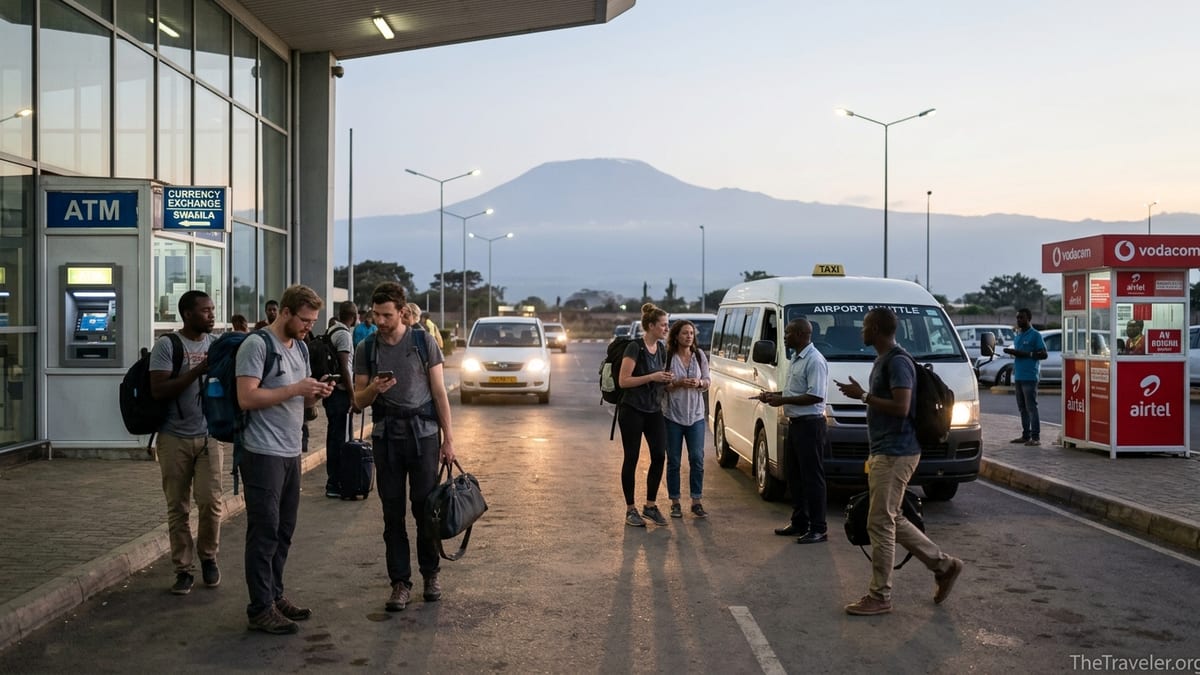
What to Expect When You Land at Kilimanjaro International Airport
Kilimanjaro International Airport (JRO) is a small, straightforward airport serving the Kilimanjaro, Arusha and safari circuit region. After you step off the plane, you will pass through a short corridor into immigration, collect your bags in a single baggage hall, and then pass customs before entering the public arrivals area. There is only one main terminal, so you do not have to worry about changing buildings or levels to find ATMs, SIM card desks, or taxi stands.
Once you are in the public arrivals hall, you will see several familiar features in a compact space: bank ATMs along one wall, at least one small bank or currency exchange counter, and desks and boards for tour operators and hotels. Recent traveler reports describe two ATMs in the terminal from major Tanzanian banks, with a separate small exchange office nearby offering to buy and sell foreign cash in US dollars, euros and other major currencies. The selection is not huge, but it is enough to get you started.
Most climbers and safari guests are met here by a pre-arranged driver holding a sign with their name or their tour company’s logo. If you have booked a transfer through your lodge or outfitter in Moshi or Arusha, you will almost certainly find your driver immediately outside the sliding doors. If not, there are licensed taxi drivers waiting just beyond the exit. You will want at least some local cash or small US dollar bills ready before you start discussing fares.
Because JRO is relatively compact and quiet compared with big hubs, there is rarely pressure to rush. Take a few extra minutes inside the terminal to sort out your SIM and money. Once you step outside, you will be focused on finding your driver and dealing with bags in the dark, cool night air that is typical of Kilimanjaro arrivals.
Mobile Connectivity: Local SIM, eSIM and Roaming Options
Tanzania has a competitive mobile market with four main operators that most visitors use: Vodacom, Airtel, Tigo and Halotel. In the Kilimanjaro and northern safari region, Vodacom and Airtel are often cited by guides and recent climbers as having the most reliable coverage on the mountain and across the parks, while Halotel and Tigo tend to perform well in towns and on main roads. For someone planning a Kilimanjaro climb followed by Serengeti or Ngorongoro, a Vodacom line is a safe default if available.
You have three basic approaches for connectivity: turn on international roaming from your home carrier, buy a physical Tanzanian SIM at or soon after arrival, or install an eSIM data package. Roaming from US and European carriers is the simplest but can be expensive, often charging a flat daily rate per device. A local SIM is usually far cheaper. As a rough guide, travelers report paying the equivalent of 10 to 20 US dollars for several dozen gigabytes of data valid for two to four weeks on Vodacom or Airtel packages bought locally. For many, this comfortably covers messaging, maps and occasional calls for the entire trip.
Buying a SIM at Kilimanjaro Airport is possible, but availability and opening hours can vary. At busy arrival times there is usually at least one small kiosk or agent selling SIMs for major operators, sometimes under a generic “Mobile” or “Vodacom” sign rather than a branded shopfront. Tanzanian law requires SIM registration with a passport and biometric verification, so you should expect to hand over your passport and have your photo or fingerprints captured. This process can take 10 to 15 minutes per person, which is manageable if you are not in a rush to meet a group transfer.
If you prefer to walk out of the airport fully connected without spending time at a kiosk, an eSIM can be a good option. Several international providers sell Tanzania or East Africa eSIMs that you can install on an iPhone or newer Android phone before departure. Some also partner with local networks such as Vodacom, so your eSIM will latch onto the same towers you would use with a local SIM. Travelers who arrive with an active eSIM often still buy a small local prepaid SIM in Moshi or Arusha later if they need a local number for calls or mobile money, but for most tourists, data plus messaging apps is enough.
Where and How to Get a SIM at or Near the Airport
After customs at JRO, look to the sides of the arrivals hall for small counters or stands advertising mobile services. These are usually simple setups: a glass counter, a staff member with branded lanyard, and a printed tariff sheet for data packages. You can ask specifically for Vodacom or Airtel if you want the widest coverage around Kilimanjaro and the northern circuit. Have your passport in hand and your phone unlocked and ready so the process goes quickly.
Expect the staff to insert the SIM, help you register it, and often preload a package on the spot. Registration is not optional. The agent may take a photo of you with their tablet or use a fingerprint scanner linked to the national registration system. Once that is complete, they will usually place a test call or open a web page to confirm that your line is active. In many cases, you will walk away with a Tanzanian number and a working data bundle within 10 minutes.
If you arrive very late at night or during a quiet window when no kiosk is open, do not panic. You can still use airport Wi-Fi to message your hotel or guide, and you can buy a SIM the next morning in Moshi or Arusha. Both towns have numerous official Vodacom, Airtel, Tigo and Halotel shops, often on or just off the main streets, where the same registration and setup process is offered. Some safari outfitters even arrange for a staff member to help guests stop at a mobile shop en route from the airport if connectivity is a priority.
One important caution is to avoid buying unregistered third-party SIMs from informal touts who may approach you outside the terminal. Apart from legal and security risks, these SIMs can be deactivated without warning if they are not properly registered to your identity. Stick to official counters inside the terminal or clearly branded retail shops in town, and always ensure your own name and passport number are used for registration.
ATMs and Currency Exchange at Kilimanjaro Airport
For most travelers, the simplest way to get local currency on arrival is to use one of the ATMs in the arrivals hall. Kilimanjaro Airport’s own information and recent visitor reports mention multiple ATMs from major Tanzanian banks such as NMB and Exim. These machines typically accept Visa and Mastercard debit and credit cards. You insert your card, choose English on the screen, and withdraw Tanzanian shillings. Withdrawal limits vary by bank and by your own card issuer, but many travelers report being able to withdraw the equivalent of roughly 150 to 200 US dollars per transaction and then repeat if necessary.
Using an ATM usually gets you a mid-market exchange rate with only your home bank’s foreign transaction fee plus a small local ATM fee, if any. This is almost always better value than changing a large amount of cash at an airport exchange counter. As an example, if you withdraw 400,000 Tanzanian shillings, you might see a charge in your online banking near what public currency converters show, with perhaps a 2 to 3 percent difference after fees. By contrast, exchange desks can easily build in a 5 to 10 percent spread in the rate they offer.
There is normally at least one small currency exchange desk in the arrivals area where you can swap US dollars, euros, or British pounds for Tanzanian shillings. This can be useful if your bank card is declined or an ATM is temporarily out of cash. However, it is usually best to exchange only what you need for the first day or two. Bank branches and bureaux de change in Arusha and Moshi often offer slightly better rates on larger sums.
As a backup, bring some clean, newer US dollar notes. In Tanzanian tourism, US dollars are widely accepted for tips and many payments, and they serve as an emergency option if your cards fail. Bills issued from 2009 onward and in good condition are preferred, and high denominations can sometimes get marginally better exchange rates at banks. Still, keep a stack of 1, 5 and 10 dollar bills for day to day use and tipping.
Paying for Taxis, Shuttles and First-Night Expenses
One of the first uses for your cash at JRO will be ground transport. Most climbers and safari guests have a transfer included with their package, so they simply meet their driver and go. Payment for this transfer is handled by the tour company, often long before you travel. Your only cash needs in that scenario are any tips for the driver and perhaps a snack or drink on the way to town.
If you have not arranged a transfer, licensed taxis wait directly outside the arrivals exit. Fares are usually quoted in US dollars or Tanzanian shillings for popular routes such as JRO to Arusha or JRO to Moshi. While exact prices vary with fuel costs and time of day, a private taxi to Arusha is commonly in the ballpark of 50 to 80 US dollars. To avoid confusion, ask the driver to confirm both the amount and the currency before you get into the car. Clarify whether “eighty” means shillings in thousands or US dollars, and agree whether you will pay in cash or by card if a card terminal is offered.
Shuttle buses do operate between the airport and Arusha or Moshi, often aligned with major international flights. These are cheaper than private taxis but less flexible. If your safari company has not booked you on a specific shuttle, check the schedule in advance and carry enough shillings or small US bills for the fare. Some companies require payment in shillings only, while others are relaxed about dollars for tourists.
When you reach your first-night hotel or lodge, you will likely be able to pay the room balance by card if it has not already been settled. However, small extras like bottled water, laundry, or local beers may be easier to pay in shillings. Many mid-range lodges in Moshi or Arusha happily accept either US dollars or shillings for a quick bar tab or snack, but change is often given in shillings even if you pay in dollars. Having both currencies in your wallet gives you flexibility.
Regardless of whether your transfer and hotel are prepaid, plan to have the equivalent of at least 80 to 100 US dollars in a mix of local currency and dollar bills in your pocket when you step into your first taxi. This covers unexpected fees, a fuel surcharge for a long late-night drive, or a tip for a driver who waits patiently for a delayed flight.
Money for Safaris, Kilimanjaro and Tipping Culture
For most travelers arriving at Kilimanjaro Airport, the biggest cash question is how to handle tips and incidental payments on a climb or safari. The core cost of your trip is usually paid in advance by bank transfer or card. What remains is a stream of smaller amounts: tips for your safari driver-guide, lodge staff, Kilimanjaro guides and porters, and various service staff along the way. In northern Tanzania’s tourism industry, tipping is customary and expected, though never legally required.
Safari specialists commonly suggest budgeting roughly 20 to 30 US dollars per day per vehicle for your driver-guide on a standard private safari, plus around 10 to 15 US dollars per guest per night for lodge staff, placed into a communal tip box on departure. For a week-long safari for two people, that can easily total several hundred US dollars. On Kilimanjaro, tipping norms are higher because of the large support teams. Many outfitters publish their own guidelines, but for a one-week climb, it is common for each climber to allocate several hundred dollars in cash to be split among guides, assistant guides, cooks and porters at the end.
Most of these tips are still given in cash. US dollar notes remain the preferred currency for many guides and porters, because they are easy to save or exchange into shillings later. Tanzanian shillings are also welcome, particularly for smaller amounts given to hotel porters, transfer drivers and restaurant staff. A typical quick tip might be 2 to 5 US dollars or the equivalent in shillings for a bag carried to your room or an airport transfer.
Because so much tipping is done in person and in cash, it is smart to arrive with a prepared envelope of small, clean US dollar bills. Many travelers bring 300 to 800 US dollars in mixed denominations for a combined Kilimanjaro and safari trip, depending on trip length and group size, then top up with shillings from ATMs for restaurants and shopping. While some upscale lodges now allow you to add a staff tip to your credit card bill at checkout, this is not yet universal, and relying entirely on cards can leave you scrambling on your final morning.
As you draw cash from ATMs in Arusha or Moshi in the days after arrival, think about how you will break large shilling notes into smaller ones for markets and local eateries. Hotel front desks often help guests exchange a stack of 10,000 shilling notes into smaller bills so you can comfortably pay for street food, bottled water and small souvenirs without constant change problems.
What to Arrange Before You Step Out of the Terminal
The most efficient arrivals at Kilimanjaro Airport follow a simple checklist inside the building before they worry about drivers, fresh air or mountain views. After clearing immigration and customs, the first step is usually to locate an ATM and withdraw an initial amount of Tanzanian shillings. Many visitors start with 200,000 to 400,000 shillings, enough to cover a taxi fare, a restaurant meal, some drinks, and a cushion for the next day or two. If you are carrying emergency US dollars, there is no need to withdraw a huge amount of shillings on day one.
Next, sort out your mobile connectivity. If you already have an active eSIM or roaming package, connect to the network and send a quick message to your driver or hotel confirming that you have landed and cleared customs. If you need a local SIM and see an open kiosk for a major operator, buy and register it now. This is also a good moment to download any offline maps for Arusha, Moshi and the national parks if you have not already done so, while you are on Wi-Fi or fresh mobile data.
Once your phone and wallet are in order, take a moment to find your transport. If you have a transfer arranged, confirm the pickup details and price with your operator by message or email before you leave home, and carry a printed voucher or screenshot of the confirmation in case your phone battery dies. At the airport, look for a sign with your name or company name just outside the exit. If you are taking a taxi, agree the fare and currency clearly. It is easier to negotiate confidently when you have shillings and small US bills already in your pocket.
Finally, do a quick mental check: you should walk out of the terminal with local currency, a functioning SIM or roaming connection, an understanding of how you will pay for your first taxi or shuttle, and enough cash reserves set aside for early tips and minor expenses. If any of these pieces are missing, it is far easier to solve them inside the terminal than on the dark roadside between JRO and town.
The Takeaway
Arriving at Kilimanjaro International Airport does not have to be stressful, even if it is your first time in East Africa. The terminal is small, the choices are limited but adequate, and with a short plan you can leave with everything important in place. A local SIM or well-chosen eSIM ensures that family and outfitters can reach you, and that you can coordinate plans if a flight is late or a bag goes missing.
On the money side, mixing one or two ATM withdrawals in shillings with a prepared envelope of clean US dollar bills covers nearly every situation you are likely to encounter, from a taxi into Arusha to a final handshake and tip with your safari driver. Airport exchange desks are best viewed as backup options rather than primary sources of cash, useful when cards fail but seldom the cheapest way to change money.
Above all, remember that most operators around Kilimanjaro are used to working with first-time visitors. If something goes wrong with your card or your phone on arrival, a reputable tour company or hotel will help you solve it once you reach town. By taking ten extra minutes between baggage claim and the arrivals door to organize SIM, shillings, and transfer details, you give yourself the best chance of a smooth first evening in northern Tanzania.
FAQ
Q1. Can I buy a local SIM card directly at Kilimanjaro International Airport?
Yes, there is usually at least one kiosk or agent in the arrivals hall selling SIM cards for major networks like Vodacom or Airtel, though hours can vary.
Q2. Do I need to show my passport to buy a SIM in Tanzania?
Yes, Tanzanian regulations require all SIM cards to be registered, so you must present your passport and complete a short biometric registration.
Q3. Is it better to use an ATM or a currency exchange desk at JRO?
ATMs typically offer better effective rates because they track the live bank rate, while exchange counters often build in a wider margin, so most travelers prefer ATMs.
Q4. Will taxis from Kilimanjaro Airport accept US dollars?
Many taxi drivers quote fares in US dollars for tourists and will accept dollar bills, but it is still wise to confirm the currency and amount clearly before departure.
Q5. How much cash should I withdraw on arrival?
Many visitors start with the equivalent of 80 to 150 US dollars in shillings, enough for a taxi, a meal, and small expenses, then withdraw more later in town if needed.
Q6. Do I need Tanzanian shillings if most of my trip is prepaid?
You will still want some shillings for snacks, drinks, local restaurants and small purchases, even if your hotels, safari or climb have been paid in advance.
Q7. Are US dollars or Tanzanian shillings better for tipping?
For larger tips to guides and porters, clean US dollars are widely preferred, while shillings work well for smaller tips to hotel staff, drivers and porters.
Q8. Can I rely only on my home mobile roaming plan instead of a local SIM?
You can if your plan offers affordable roaming in Tanzania, but most travelers find a local SIM or eSIM much cheaper for heavy data use over several days.
Q9. Is there Wi-Fi at Kilimanjaro Airport if I cannot get a SIM immediately?
Yes, there is usually basic Wi-Fi available in the terminal, which is enough to send messages to your driver or hotel while you sort out a SIM later.
Q10. Should I arrange my airport transfer in advance or take a taxi on arrival?
Pre-arranged transfers through your lodge or tour operator are generally safer and simpler, especially at night, though licensed taxis are available outside arrivals.