


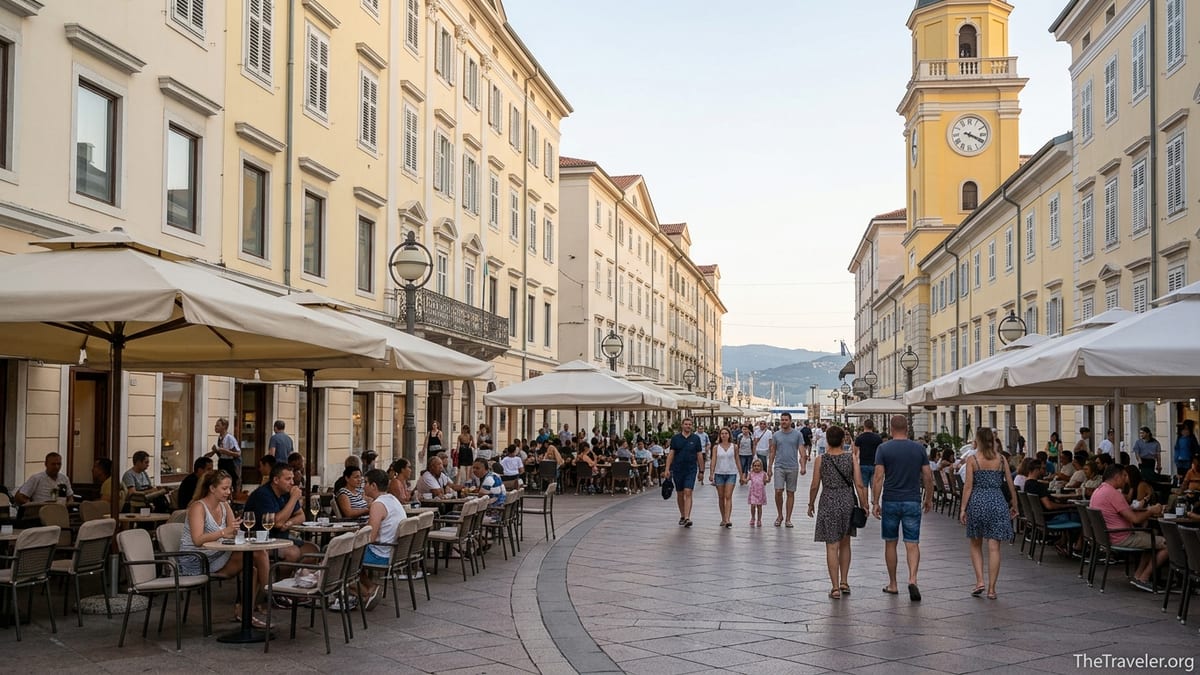
Korzo is Rijeka’s living room: a short, flat pedestrian street that concentrates the city’s cafés, shops, street life and history into a few hundred meters. For most visitors, this is the natural place to start exploring Rijeka. From the baroque City Tower that once guarded the old town gate to the stretch of pavement lined with café terraces and Austro-Hungarian facades, Korzo is both everyday hangout and historic stage. This guide walks you through how to experience it, where to pause for coffee or an aperitif, and how to use Korzo as a springboard for evening walks and wider city explorations.
Get the latest updates straight to your inbox!
Getting Oriented: First Steps on Korzo
Korzo runs for roughly 450 meters through the heart of Rijeka’s compact center, just inland from the harbor. It is a fully pedestrian street, paved and mostly flat, which makes it easy for all ages and for travelers with luggage or strollers. If you arrive by bus or train, you will likely reach it on foot in ten to fifteen minutes, simply following the flow of people heading toward the old town and the sea. Many locals describe meeting “on Korzo” rather than at a specific address, which gives a sense of how central it is to city life.
Architecturally, Korzo reads like a timeline of Rijeka’s modern history. Nineteenth century palaces with stucco decoration sit beside more sober twentieth century blocks with arcades and shopfronts. Look up as you walk: ornate balconies, decorative cornices and the occasional coat of arms remind you that this port was once a bustling Austro-Hungarian hub. You will also notice that, despite the busy feel, traffic noise is muted. Cars stick to surrounding streets, so the dominant sounds are conversation, coffee cups, and the occasional busker’s guitar.
Korzo is short enough that you can walk its full length in ten minutes, but it rewards slow strolling. Benches are placed at intervals specifically for people-watching. Locals linger over coffee along the southern side where most terraces catch the light, while shoppers and students thread past in a constant stream. If you land in Rijeka with no fixed plan, simply joining this flow for your first hour in the city is an excellent soft landing.
For orientation, think of Korzo as a spine with the sea to the south and the old town lanes to the north. Between those two, everything a first-time visitor needs sits within a five-minute radius: banks and ATMs, bakeries, pharmacies, a tourist information office, and the walkway to the waterfront. Once you know how to find your way back to Korzo, you are unlikely to get seriously lost.
The City Tower: Gateway to the Old Town
About midway along Korzo, you reach Rijeka’s emblematic City Tower, a yellow, slightly squat clock tower that straddles a passage into the old town. Historically it was part of the fortifications and a gate into the walled city; today it acts as a symbolic threshold between the broad promenade and the intimate network of alleys behind it. The clock still keeps time and is one of the easiest landmarks to use when giving or receiving directions.
Stand across the street from the tower and you will see its mix of styles: a rounded base that once formed part of the defensive wall, topped by later Baroque and classicist touches, and crowned by a small dome. The city’s coats of arms and reliefs on the facade echo centuries of changing rulers. Walk under the archway and you instantly feel a shift: the light narrows, stone underfoot replaces wider pavement, and the soundscape softens as you step into the old town.
Practically, the City Tower is your main orientation point. If you are exploring the maze-like lanes of the old center and feel turned around, simply drift downhill or follow signs back to “Korzo” and look for the tower’s arch. Many guided tours of Rijeka meet either directly under the tower or beside it, because it is easy to find and photograph. If you join a morning walking tour, arriving ten minutes early gives you time to watch the interplay of commuters, café waiters and tour groups funneling through this bottleneck.
In the evening, the tower takes on a different character. Soft lighting picks out its yellow facade and clockface, and the archway frames glimpses of the old town’s bars and wine spots behind. It is a naturally romantic photo stop; step slightly to the side of the main flow of pedestrians, lean on the nearby railing, and you can capture both tower and the stream of people passing under it without blocking anyone’s way.
Café Culture on Korzo: Where to Pause and What to Order
Cafés are the true engines of Korzo’s social life. Terraces line much of the promenade, making it easy to sit down for a drink almost anywhere along its length. Prices are moderate by European standards: as of 2026, a standard espresso on Korzo typically ranges from about 1.30 to 1.80 euros, while a macchiato or cappuccino may come in closer to 2.00 to 2.50 euros, depending on the venue and whether you are sitting on the terrace.
Several cafés have become local institutions. Traditional coffee bars serve strong espresso and simple drinks at metal or wooden tables, with no rush to vacate your seat. More contemporary spots experiment with specialty coffee, fresh juices and light brunches. For example, a central café might offer a breakfast plate of scrambled eggs, local cheese and bread for around 7 to 9 euros, while a slice of cake or a pastry paired with coffee might total about 4 to 5 euros. Chocolate-focused spots on Korzo tempt passersby with elaborate sundaes and hot chocolate served in tall glass mugs, making them a popular choice on cooler evenings and in winter.
Ordering follows a relaxed but efficient rhythm. Take an empty seat on the terrace, and a server will usually appear within a minute or two. Most visitors simply say “espresso,” “macchiato,” or “cappuccino,” though you can ask for “bijela kava” if you prefer a larger milky coffee similar to a latte. Beer and wine are also standard daytime options; a local draft beer often costs around 3 euros for a 0.5 liter glass, while a glass of house white or red wine may be in the 3 to 4 euro range. Tipping in Croatia is modest; rounding up the bill or leaving about 5 to 10 percent for good service is customary but not mandatory.
Beyond drinks, Korzo’s cafés double as informal offices, living rooms and places to watch sports. Do not be surprised to see laptops open midmorning or groups gathering in the evening to watch a football match on TV screens inside. If you prefer a quieter experience, aim for late morning between 10:00 and 11:30, when the breakfast rush has eased but lunchtime has not yet started, or midafternoon on weekdays when the terraces are busy but not crowded.
Shops, Side Streets and Everyday Errands
Korzo is not only about coffee and conversation; it is also Rijeka’s main shopping street. You will find a mix of international clothing chains, Croatian brands, shoe shops, perfumeries and small boutiques. Prices vary, but in general they are similar to those in other mid-sized European cities: a mid-range dress or pair of shoes might cost 40 to 80 euros, while casual T-shirts, swimwear and accessories are more budget friendly. This makes Korzo a convenient place to replace worn travel clothes or pick up a more polished outfit for a night out.
Just off Korzo, narrow lanes lead into the old town where smaller independent shops hide amid stone buildings. Here you might find a family-run goldsmith, an art gallery, or a tiny bookstore that stocks both Croatian literature and a modest English-language shelf. These side streets are excellent for browsing without an agenda. Duck into a bakery for a burek pastry or a slice of pizza to go, often for 2 to 3 euros, or step into a delicatessen selling local olives, cheeses and cured meats you can later assemble into a picnic on the waterfront.
Everyday services are also close at hand. ATMs are located on or just off Korzo, usually attached to banks on the ground floor of larger buildings. Pharmacies, recognizable by the green cross, are convenient if you need sunscreen, basic medicine or toiletries. A small city-market area and fish market sit within walking distance toward the harbor, so you can combine a stroll along Korzo with a quick visit to see local produce and seafood. Even if you do not plan to cook, passing through the market gives you another slice of Rijeka’s daily rhythm.
For travelers arriving in Rijeka with no local SIM card, note that many cafés and some shops on and around Korzo offer guest Wi-Fi. The network name and password are usually printed on the menu or available on request. This can be handy for quickly checking maps, confirming accommodation details or researching opening hours for museums and attractions without using mobile data.
Evening Walks and Nighttime Atmosphere
Korzo’s character changes as the day progresses. In the early evening, typically between 18:00 and 20:30 in summer, the promenade fills with families, couples and groups of friends taking a slow “passeggiata” after work or beach time. Temperatures are milder, streetlights begin to glow, and musicians sometimes set up near the center of the street. Children weave between café tables on scooters, while older residents occupy the benches, greeting acquaintances as they pass.
As night falls, bars along and just off Korzo shift gears. Some cafés dim their lights and raise the volume of music, functioning as informal lounges where people linger over drinks until midnight or later. Others close earlier, especially outside high season, leaving pools of light and quiet stretches where you can hear only footsteps and conversation. Compared with larger party destinations on the Croatian coast, Rijeka’s nightlife in the center is sociable but generally relaxed rather than wild, and the streets around Korzo usually remain active until late without feeling chaotic.
Safety-wise, many locals and visitors report feeling comfortable walking around Korzo and its immediate surroundings at night, including solo travelers. As in any city, common sense applies: keep an eye on your belongings, avoid excessively intoxicated groups, and stick to the better-lit streets if you are walking back to your accommodation after midnight. The compactness of the center works in your favor, since most central hotels, guesthouses and apartments are within a ten- to fifteen-minute walk of the promenade.
For a simple but memorable evening route, start at the western end of Korzo around sunset, stroll slowly past the City Tower, continue east to the end of the promenade, then turn toward the waterfront. From there, loop along the harbor edge, passing moored boats and occasional pop-up events or food stands in summer, before circling back toward the tower and choosing a bar or gelato shop for a final stop. This loop takes about forty minutes without breaks, but you will likely stretch it to an hour or more with photo stops and people-watching.
Using Korzo as a Launchpad: Nearby Streets and Short Detours
One of Korzo’s strengths is its role as a connector. From here, you can easily dive into the old town, reach the waterfront, or start longer walks uphill toward Trsat and other viewpoints. Immediately north of the City Tower, alleys lead to small squares where you find wine bars, bistros and hidden terraces. These backstreets come alive on weekend evenings, when locals spill into them with drinks in hand, creating a dense, sociable atmosphere without much car traffic.
Head south from Korzo and in a few minutes you reach the harbor promenade, where ferries and local boats dock. Here you can enjoy open views across the water to cranes, hills and, on clear days, distant islands. Benches and railings provide informal seating, and the sea breeze can feel especially refreshing after a hot day in the city. Watching the reflections of city lights on the water at night is an appealing contrast to the tighter, more vertical space of Korzo itself.
If you are in the mood for a more energetic walk, Korzo can be your flat warm-up before climbing toward Trsat. From the eastern end of the promenade, you can weave through streets that gradually rise away from the center before picking up the start of the historic Petar Kružić staircase, which climbs more than 500 stone steps to the hilltop church and Trsat Castle. Even if you only tackle the first section of the stairs, the combination of harbor views and the knowledge that you began at Korzo’s level ground gives a satisfying sense of progress.
Another easy detour is to follow the streets parallel and behind Korzo to discover quieter residential pockets, small neighborhood bars and everyday shops. Within ten minutes, you can move from the bustle of the main promenade to streets where laundry hangs from balconies and local life unfolds at a slower pace. This contrast helps you see Korzo not as an isolated tourist strip but as the animated front room of a lived-in city.
How to Start a City Visit Around Korzo
For many travelers arriving in Rijeka, the simplest and most effective way to start is to drop their bags at their accommodation and walk straight to Korzo. A practical first three hours might look like this: begin with a slow promenade along the full length of the street, noting the position of the City Tower, the tourist information office and a couple of cafés that appeal to you. Pause for a coffee or sparkling water on a terrace to rest from your journey and take stock of the city’s pace. From there, step through the tower arch to explore a few old-town lanes, then circle back to Korzo for a light lunch.
In the afternoon, use Korzo as your anchor while you branch out to a nearby museum, market or the harbor promenade. Because the center is compact, you can comfortably fit in a visit to at least one cultural site without feeling rushed. When you are done, make your way back to Korzo almost instinctively by heading toward the City Tower or asking anyone for directions to the main street. Knowing you can always find this hub reduces the stress of navigation and lets you wander with more confidence.
If you are staying only one night in Rijeka, plan your early evening around the promenade. Return to Korzo around sunset, perhaps after a quick side trip to the waterfront, and join the locals on their pre-dinner stroll. Choose a bar or café that has a mix of locals and visitors, order a glass of local wine or a spritz, and watch the sky darken over the facades. Afterward, follow the flow into the old town streets behind the City Tower, where you can find dinner in a konoba-style restaurant serving grilled fish, risotto or meat dishes in the 12 to 20 euro range for mains.
Travelers with more time in Rijeka can use Korzo as a recurring base. Each morning, start with a walk along the promenade to grab coffee and a pastry, then set out to beaches, nearby coastal towns or inland excursions. Each evening, return for a short stroll and drink, keeping a mental note of how the patterns of people, music and light shift from day to day. Over a few days, you may even begin to recognize familiar faces and feel, briefly, like a part-time local.
The Takeaway
Korzo is both address and idea: a physical street and the shorthand locals use for the city’s social and commercial heart. For visitors, it works as a clear, walkable axis around which to organize a stay in Rijeka. The City Tower marks the hinge between old town and promenade, cafés provide an endless supply of reasons to sit and watch life flow by, and the waterfront and hillside neighborhoods are close enough to fold easily into your daily routine.
Whether you have a single afternoon or several days in Rijeka, centering your plans on Korzo simplifies everything. Start and end your days here, using its clock tower and benches as reference points, and you will quickly absorb the city’s rhythm. From morning coffee to late-night conversation, from impulsive detours into side streets to purposeful walks toward the sea or Trsat, Korzo gives structure to your visit without demanding a rigid itinerary. It is the rare city-center promenade that feels at once ordinary and memorable, a place you will likely recall long after you have left the port behind.
FAQ
Q1: Where exactly is Korzo in Rijeka and how do I get there from the bus or train station?
Korzo sits in the very center of Rijeka, a roughly ten- to fifteen-minute walk from both the main bus and train stations. From either, head toward the sea and follow signs or the flow of people into the old town; most locals can point you to “Korzo” if you ask.
Q2: What is the best time of day to visit Korzo for people-watching?
The liveliest times are late morning, between about 10:00 and 12:00, and early evening from around 18:00 to 21:00, especially in warmer months. During these windows, terraces are busy, families stroll, and you get a good sense of everyday city life.
Q3: Are cafés on Korzo expensive compared with the rest of Rijeka?
Cafés on Korzo are slightly pricier than some neighborhood spots but still moderate by European standards. Expect to pay around 1.30 to 2.50 euros for coffee, with drinks like beer or wine typically a little more, reflecting the central location and terrace seating.
Q4: Is Korzo safe to walk at night, especially for solo travelers?
Korzo and the surrounding central streets are generally considered safe, and many locals walk there late into the evening. Usual urban precautions apply, but solo travelers, including women, commonly report feeling comfortable walking back to their accommodation after dark.
Q5: Can I use Korzo as a base to explore other parts of Rijeka on foot?
Yes. Korzo works well as a central anchor: from here you can easily reach the old town, harbor promenade, city market and the start of the climb toward Trsat, all within a fifteen- to twenty-minute walk.
Q6: Are there good food options directly on Korzo or should I look elsewhere?
You will find plenty of cafés and casual eateries on Korzo itself for light meals, snacks and desserts. For more traditional restaurants or quieter dinners, step through the City Tower into the old town where konoba-style places and bistros cluster in side streets.
Q7: Is Korzo suitable for travelers with limited mobility or strollers?
Korzo is flat, pedestrianized and paved, which makes it accessible for wheelchairs and strollers. Benches are frequent, and crossings at either end connect to nearby streets without major obstacles, though older side alleys off Korzo can be steeper and less even.
Q8: What should I wear for an evening walk on Korzo?
Smart casual clothing is typical: locals often dress neatly but not formally, especially in the evening. Comfortable shoes are recommended for strolling and possible detours, and in shoulder seasons a light jacket is useful once the sun goes down.
Q9: How long should I plan to spend on Korzo during a short visit?
For a brief introduction, allow at least one to two hours to walk the length of Korzo, pause for a drink and pass through the City Tower into the old town. With more time, returning in both daylight and evening gives a fuller picture of its atmosphere.
Q10: Are there public facilities like ATMs and pharmacies near Korzo?
Yes. Several banks with ATMs are located directly on or just off Korzo, and pharmacies, bakeries, convenience stores and the tourist information office are all within a few minutes’ walk, making it a convenient place to handle practical errands while sightseeing.