


Rijeka has quietly become one of the most useful gateways for exploring the northern Adriatic islands. From its central position on the Kvarner Gulf, passenger catamarans and ferries fan out to Cres, Lošinj and seasonal routes that reach Rab and beyond. Services change markedly between winter and summer, and knowing how these lines work in practice can save you missed connections, long bus detours and last-minute ticket stress.
Get the latest updates straight to your inbox!
How Rijeka Fits Into the Northern Adriatic Ferry Network
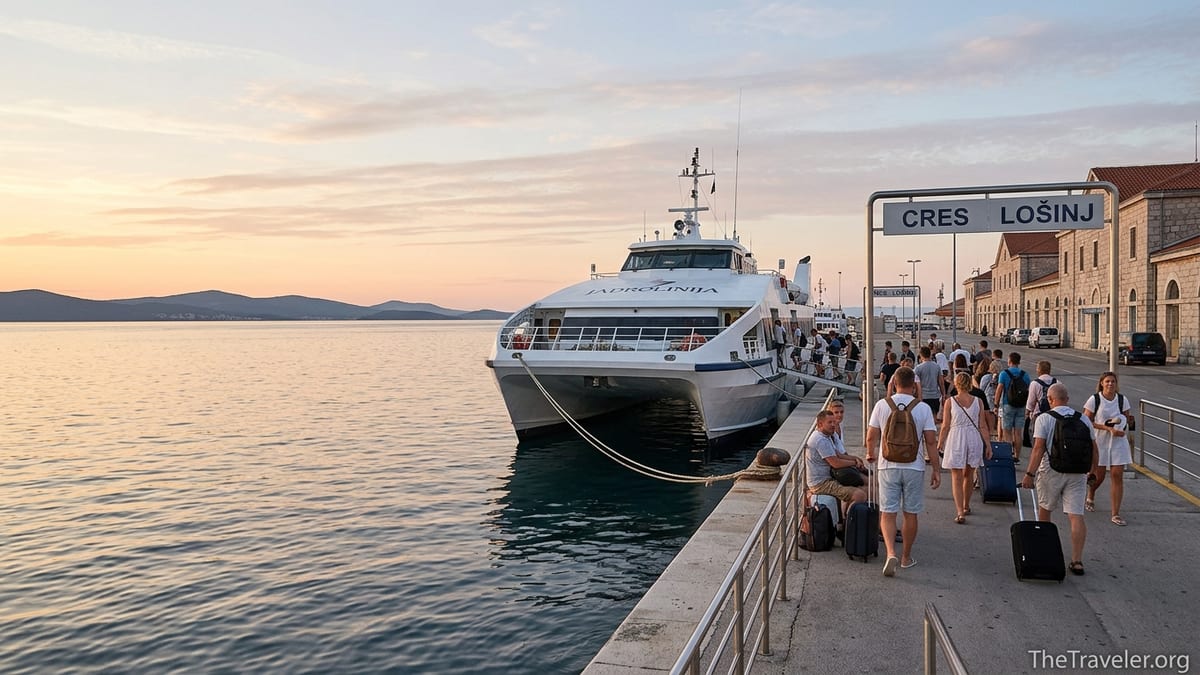
Rijeka is the main mainland port for the Kvarner islands, linking the city with Cres, Lošinj and, in high season, Rab and Novalja on Pag. The most important route for island-hoppers is the state fast ferry line 9308, operated by Jadrolinija, which connects Rijeka with Cres town, Martinšćica on Cres, Unije, Susak, Ilovik and Mali Lošinj. This is a passenger-only catamaran and effectively acts as a floating bus through the archipelago, widely used by locals as well as visitors.
On top of this, state fast ferry line 9309 connects Rijeka with Rab town and Novalja on Pag in summer, again as a passenger-only catamaran. In 2026, Jadrolinija extended this with a short seasonal hop between Novalja and the small island of Silba, giving travelers another way to combine the Kvarner islands with the Zadar region without backtracking by road through the mainland.
Car ferries to Cres and Lošinj do not sail from Rijeka itself. Vehicles are routed instead through the island of Krk, from where very frequent vehicle ferries link Valbiska on Krk with Merag on Cres. Once you are on Cres, a single main road runs south across a short bridge to the island of Lošinj, so Rijeka’s role is to get foot passengers directly onto the islands, while drivers usually approach via Krk.
For many travelers, this mix of direct catamarans and car ferries via Krk makes Rijeka a practical, if slightly complex, starting point. Understanding which services accept vehicles and which are passenger-only, and in which season they run, is the key to planning realistic itineraries.
Core Routes: Rijeka to Cres and Lošinj in Practice
The backbone of island travel from Rijeka is the daily fast catamaran line 9308 between Rijeka and Mali Lošinj. The typical routing is Rijeka – Cres – Martinšćica (Cres) – Unije – Susak – Ilovik – Mali Lošinj in one direction, then the reverse going back. In summer, this usually runs once per day in each direction, with departures in the morning from Rijeka and return sailings in the late afternoon or evening from Mali Lošinj, though exact times change from year to year and should always be checked on Jadrolinija’s timetable before travel.
Cres town is the first island stop heading out of Rijeka, making it a logical base if you want a quieter island atmosphere without committing to the extra sailing time further south. For example, a typical summer day might see you leaving Rijeka around 14:30 and stepping off in Cres town roughly 2 to 2.5 hours later, in time for an evening swim and dinner in the harbor. Depending on the year’s schedule, some sailings stop in Martinšćica but not always in every intermediate port on every run, which is why it is important to read the timetable notes carefully.
Continuing all the way to Mali Lošinj turns the trip into a mini-cruise through small islands that otherwise require complex combinations of local ferries. Unije and Susak are especially prized by travelers looking for offbeat stops: Unije has no cars and a sandy main bay, while Susak is a tiny sandy island often described as one of the more unusual places in Croatia. Many visitors use Rijeka as the entry point and then string together several nights on Unije, Susak and Mali Lošinj, returning north by bus via Cres and Krk or by catamaran if schedules suit.
If you have a car, the more common pattern is to drive from Rijeka over the bridge to Krk island, then take the Jadrolinija car ferry from Valbiska to Merag on Cres. This crossing typically runs every one to two hours in summer, so even if you do not match a specific departure time, you rarely wait long. Once in Merag, you follow the single main road to Cres town, Veli Lošinj or Mali Lošinj, with the road crossing a short movable bridge at Osor between Cres and Lošinj.
Seasonal and Rab-Style Routes: What Changes in Summer
Where Rijeka really becomes interesting as an island-hopping hub is in peak season, usually from late June through early September. During this period, additional fast ferry services link Rijeka with Rab and Novalja on Pag, and extra sailings are sometimes added on the main Rijeka–Cres–Lošinj line. For instance, the Rijeka–Rab–Novalja catamaran on line 9309 operates as a daily or near-daily summer service, allowing travelers to jump from Rijeka to Rab without passing through Krk by road, and then on to Pag for onward buses to Zadar.
These “Rab-style” routes are highly seasonal. A traveler planning an island-hopping trip in early May will find that the Rijeka–Mali Lošinj catamaran is already running, but Rijeka–Rab–Novalja likely has not started yet. By mid-July, both routes are usually in full swing, often with crowded departures around weekends. The same seasonal pattern applies to extensions further south. In 2026, Jadrolinija’s announcement of a Novalja–Silba seasonal add-on created a new way to connect Pag with Silba without going via Zadar, but that extra leg only runs in the core summer period.
For a concrete example, consider a traveler in late July who wants to visit Rab and then Cres. One realistic plan is to take the morning catamaran from Rijeka to Rab town, stay one or two nights, then continue by Jadrolinija car ferry from Lopar on Rab to Valbiska on Krk, and from there connect to the Valbiska–Merag ferry for Cres. On paper this looks like a simple island-to-island hop, but in practice it is three different ferries and potentially a taxi or bus ride between Krk ferry ports, which is why it helps to think of Rab and Pag as part of a larger northern Adriatic circuit rather than direct extensions of the Cres–Lošinj line.
In shoulder seasons such as late September, some of these fast connections thin out or stop completely. You might still have the daily Rijeka–Mali Lošinj catamaran, but the Rab and Novalja services could be reduced to a few weekly sailings or not run at all, leaving buses and car ferries via Krk as the main back-up. Always check for the current year’s “seasonal” or “summer” timetables, and do not assume that a July connection exists in late April or mid-October.
Tickets, Prices and How to Actually Buy Them
For the main fast ferry line 9308 between Rijeka and Mali Lošinj, tickets are sold by Jadrolinija. Prices vary by season and distance, but as a rough guideline a one-way Rijeka–Cres adult ticket on the catamaran typically sits in the range of a few tens of euros, with Rijeka–Mali Lošinj somewhat higher. Children, students and certain categories of residents may receive discounts, but visitors should budget according to the standard adult price unless they clearly qualify for concessions.
In practice, you can buy tickets in three main ways: online via Jadrolinija’s booking system, in person at the Jadrolinija office or kiosk in Rijeka port, or from smaller authorized agencies in island ports such as Cres or Mali Lošinj. Online purchase is recommended in July and August, especially for the midday and Friday departures, which are often busy with both locals and tourists. For example, travelers arriving from Vienna by morning train often target a same-day catamaran to Cres; if you wait to buy your ticket on arrival, you can easily find that the day’s sailing is full or has already left.
Car ferry tickets for Valbiska–Merag are sold separately from the fast catamarans. On this line you usually buy the ticket at the port just before boarding, and in high season you should arrive well in advance, as embarkation works on a first-come, first-loaded basis. Prices are structured per vehicle and per passenger; a small car with two adults will pay more than two foot passengers but much less than a camper van. The same general approach applies to other car ferries in the region, such as Stinica–Mišnjak on Rab or the Lopar–Valbiska route linking Rab and Krk.
Smaller private operators and excursion boats often sell day-trip tickets on the promenade in Rijeka or on island harbors, advertising routes such as “Rab by boat” or “Cres bays tour.” These are not substitutes for the state-subsidized transport network and should be treated as tourist excursions rather than reliable public transport. They can be a pleasant way to see hidden coves, but if you need to be in a specific port on a specific day, stick to Jadrolinija or the other recognized fast ferry companies.
Luggage Rules, Onboard Experience and Practical Tips
Luggage allowances on the fast catamarans are relatively generous but designed around foot passengers rather than heavy expedition gear. A typical rule is one main piece of luggage plus hand baggage, with extra or oversized items sometimes incurring a small surcharge. In practice, travelers regularly board with standard check-in suitcases and rucksacks without issue, but turning up with surfboards or very large equipment should be discussed with the operator in advance.
On board, the fast ferries function more like regional buses than cruise ships. Seating is usually airline-style indoors, often air-conditioned, with limited or no access to open decks while the boat is at speed. There may be a small bar counter selling coffee, soft drinks and snacks, but it is best not to rely on a wide food choice. Most people bring their own water and a sandwich from a bakery in Rijeka or Cres. Wi-fi, if available, can be patchy, and mobile coverage sometimes drops on segments between islands, so download tickets or maps beforehand.
Car ferries offer more space to walk around, including outdoor decks, and are more forgiving if you are traveling with bulky luggage or bicycles. You roll or drive on board, leave your vehicle parked on the open or enclosed deck, and climb up to the passenger lounge or sun deck for the rest of the crossing. Taking a bicycle on Valbiska–Merag, for example, is straightforward and common among bikepackers linking Cres, Krk and Pag in a multi-island route.
If you are connecting directly from a long-distance train or bus into a catamaran in Rijeka, factor in buffer time. A common stress point is passengers arriving on delayed trains from Central Europe and discovering that the daily catamaran to Cres left hours earlier. In these cases, local advice often points to the evening buses towards Krk and the early morning car ferries, or to staying a night in Rijeka and catching the next-day fast ferry.
Is Rijeka a Good Base for Island Hopping?
Whether Rijeka works as a base depends on what you expect from “island hopping.” As a transport hub, it is excellent: mainline trains from Zagreb and Central Europe, long-distance buses along the Adriatic and the growing network of fast ferries all converge here. You can arrive in Rijeka, spend a night in the city, then set off the next morning by catamaran to Cres and Mali Lošinj, or by bus and car ferry via Krk, without complicated transfers.
As a place to repeatedly return to between islands, however, Rijeka is less convenient than it looks on the map. Most ferries from Cres and Lošinj either continue south or run in such a way that you would be retracing your steps through Rijeka each time. For a classic “every two or three days a new island” trip, it usually makes more sense to keep moving forward: for example, Rijeka – Cres – Lošinj – Zadar region via onward ferries, or Rijeka – Rab – Pag – Zadar, instead of bouncing back to the mainland in between.
That said, Rijeka is an underrated city break in its own right, with a historic center, industrial waterfront, and easy access to nearby Opatija and the hills above Kvarner Bay. Some travelers deliberately build in two nights at the start or end of an island trip to adjust after flights and trains, shop for supplies and enjoy a different side of the Adriatic before hitting the beaches of Cres and Lošinj.
If your priority is maximizing time on the islands and minimizing logistics, it can be smarter to treat Rijeka as a gateway rather than a base: arrive, overnight if needed, catch the earliest suitable catamaran or bus-and-ferry combination, then base yourself in Cres, Mali Lošinj or Rab, where you can reach beaches and trails on foot.
Sample Itineraries Using Rijeka, Cres and Lošinj
One of the simplest and most realistic itineraries for a week is Rijeka – Cres – Mali Lošinj – mainland. You might arrive in Rijeka by train from Zagreb in the late afternoon, stay overnight near the port, and catch the next morning’s Jadrolinija catamaran to Cres town. After two or three nights exploring Cres and nearby beaches such as Sveti Ivan near Lubenice, you could continue by the same catamaran or by bus and road south to Mali Lošinj for another three nights, then return to the mainland via car ferry and bus through Krk if catamaran timings do not line up with your onward plans.
Another popular pattern for summer travelers is to combine the islands with the Zadar region. You might sail from Rijeka to Mali Lošinj, spend a few days there, then continue south by fast ferry or a series of local connections towards Zadar or Pula, depending on which seasonal lines are running that year. By checking which routes are active, it is often possible to design a one-way route without ever having to backtrack by road to Rijeka.
For travelers keen on Rab, a loop such as Rijeka – Rab – Krk – Cres – Lošinj – Rijeka is possible if you are comfortable with multiple ferries. In high season, you might start with the Rijeka–Rab–Novalja catamaran, move by car ferry from Rab’s Lopar to Valbiska on Krk, take the Valbiska–Merag ferry to Cres, then road-hop down to Lošinj before exiting the archipelago via Mali Lošinj or Cres and returning to Rijeka or to Istria.
Cyclists and motorcyclists often approach things differently, using Rijeka mainly as a road node rather than a ferry port. A common route is to ride from Rijeka over Krk bridge, then use the Valbiska–Merag ferry to Cres, continue south to Lošinj, and eventually take onward links towards Zadar or back to the mainland. In this case, the fast catamarans are less relevant, but Rijeka is still the logical jumping-off point from the continental road and rail network.
The Takeaway
Rijeka is not the sun-and-sand destination that nearby islands offer, but as a transport hub it underpins almost every journey to Cres, Lošinj and the northern Adriatic. Daily fast ferries carry foot passengers directly from its city waterfront to island harbors, and a dense mesh of car ferries via Krk looks after those arriving with vehicles. Seasonal additions to Rab, Pag and smaller islands like Silba add exciting options in summer, though they also introduce complexity and the need for careful timetable reading.
If you understand a few key realities, your trip planning becomes much easier. First, most Rijeka routes to Cres and Lošinj are passenger-only catamarans, so cars must detour through Krk. Second, summer brings more choice but also more crowds, so advance booking pays off, particularly on Fridays and weekends. Third, Rijeka works best as a gateway and staging point, rather than a place to bounce back to after every island.
With these points in mind, you can use Rijeka to unlock a chain of experiences that might start with espresso on the city’s Korzo promenade and end with a sunset swim on a quiet Cres cove or a bike ride along Lošinj’s pine-lined paths. The ferries and catamarans are the links that make this possible, and with a little preparation, they can become one of the most enjoyable parts of the journey.
FAQ
Q1. Can I take a car directly from Rijeka to Cres or Lošinj by ferry?
Not on the main fast ferries. The Rijeka–Cres–Lošinj catamaran is passenger-only. With a car, you usually drive from Rijeka over the bridge to Krk island and then take the Valbiska–Merag car ferry to Cres, continuing by road to Lošinj.
Q2. How far in advance should I buy catamaran tickets from Rijeka?
In July and August it is wise to buy tickets several days ahead for popular departures, especially Friday and weekend sailings. Outside peak season, buying a day or two in advance or at the port on the day is often enough, but you should still check that the line is operating on your chosen date.
Q3. Are there daily ferries from Rijeka to Mali Lošinj all year?
The Rijeka–Mali Lošinj fast ferry generally operates year-round but with different schedules in winter and summer. In low season, sailings can be fewer and may skip some intermediate islands, so you should always confirm the current timetable for your travel dates.
Q4. Can I island-hop from Cres to Lošinj without going back to Rijeka?
Yes. Cres and Lošinj are linked by a road bridge at Osor, and a single main road runs across both islands. Once you are on Cres, you can drive or take a local bus to Lošinj without needing to return to the mainland or to Rijeka.
Q5. Is Rijeka a good base to visit Rab as a day trip?
In peak summer, the Rijeka–Rab–Novalja catamaran makes a long day trip technically possible, but timing is tight and any delay can cause problems. Most travelers find Rab works better as an overnight or multi-night stop rather than a simple there-and-back day trip from Rijeka.
Q6. What happens if my train or bus to Rijeka is delayed and I miss the ferry?
If you miss the daily catamaran to Cres or Lošinj, the usual options are to stay a night in Rijeka and take the next sailing, or to continue by evening bus towards Krk and use the early car ferries. In high season there may be alternative fast ferries, but you should not count on same-day rebooking at busy times.
Q7. Can I take bicycles on the ferries and catamarans?
Bicycles are routinely carried on car ferries such as Valbiska–Merag. On fast catamarans, acceptance depends on space, the operator and how many bikes are already booked. It is best to ask the company in advance and arrive early, especially if traveling in a group with several bikes.
Q8. Are there luggage limits on the Rijeka catamarans?
Fast ferries usually allow one larger bag and one hand item per passenger, with extra or oversized luggage sometimes charged a supplement. Normal suitcases and backpacks rarely cause issues, but very bulky items should be cleared with the operator in advance.
Q9. Is it better to buy tickets online or at the port in Rijeka?
For peak season travel, buying online is safer to secure a seat, particularly on routes to Mali Lošinj and Rab. At quieter times of year, buying at the port ticket office works well and gives you flexibility to adjust plans according to the weather or delays.
Q10. Is Rijeka or one of the islands a better base for a week-long stay?
For a classic beach and nature holiday, Cres, Mali Lošinj or Rab are generally better bases than Rijeka, as you can walk to beaches and hiking trails. Rijeka is ideal as an arrival and departure hub or for a short urban stay, but most travelers prefer to spend the bulk of their week on the islands themselves.