


Kusadasi is one of the easiest cruise ports in the eastern Mediterranean, with Ege Port sitting right on the waterfront and the town and tours unfolding almost at your gangway. With limited hours in port, though, cruise passengers need a clear plan: how to walk into town, whether to book an Ephesus excursion, where to shop near the pier, and what to do if you decide to skip the ruins. This guide breaks down Kusadasi specifically from a cruise-passenger perspective, using current, real-world examples to help you make the most of a single day.
Get the latest updates straight to your inbox!
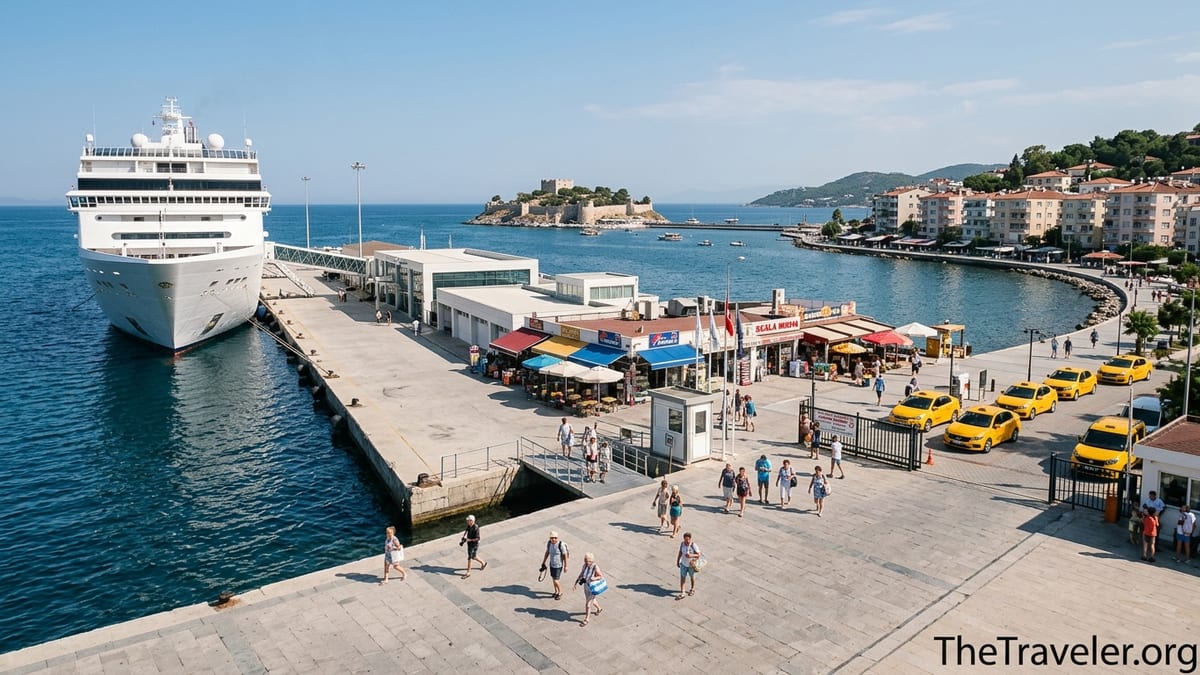
Understanding Ege Port Kusadasi
Ege Port Kusadasi is Turkey’s busiest cruise port and the main gateway for ships visiting Ephesus. Operated by Global Ports Holding, the terminal is purpose-built for cruise calls, with ships docking along a concrete pier directly beside the town. The walk from the ship’s gangway to the terminal building typically takes 5 to 10 minutes depending on where your ship berths, and you remain inside a secure port zone until you exit at the main gate onto the seafront road.
Inside the cruise terminal complex you will find a compact mall-style area that many lines refer to as Scala Nuova Village. It includes duty-free shops, Turkish carpet and leather boutiques, jewelry stores, a few cafés and snack bars, and stands selling last-minute souvenirs such as nazar evil-eye charms and Turkish delight. Prices here are generally higher than in the streets just beyond the port, but the environment is clean, air-conditioned and convenient if you only have a few minutes before boarding.
The terminal area also offers basic passenger services that are useful on a tight port day. There are ATMs that usually dispense both Turkish lira and euros, a first-aid point, and a passenger and crew center where you may find Wi-Fi and information desks. Restrooms here are modern and better maintained than many public options in town, so it is worth using them before heading out on a long excursion to Ephesus or a walking tour.
On busy summer days several large ships can dock at once, and the pier can feel crowded when tours are disembarking at the same time. Port security staff funnel passengers toward the main exit and to pre-arranged tour coaches parked within the secure area. If you have booked a ship excursion, you will normally meet your group on the pier or at a numbered bus bay just outside the terminal, while private tour guides often wait beyond the security gate holding signs with passengers’ names.
Walking from the Port into Kusadasi Town
One of the biggest advantages of Kusadasi over many Mediterranean ports is that you dock right beside the town. Once you exit Ege Port’s main pedestrian gate onto the waterfront road, you are effectively in central Kusadasi. The bazaar and old town streets begin just across the road, and the seafront promenade stretches left and right with a mix of cafés, ice-cream stands and taxi ranks. For most passengers it is a flat 5-minute walk from the port gate to the heart of the shopping district.
Turning left as you leave the gate leads you along the promenade toward the small marina and a string of seafront restaurants. Turning right takes you toward the old quarter, known as Kaleici, where narrow streets are filled with textiles, leather shops and small lokanta eateries. Signs in English are common and most shopkeepers speak at least some English or German, as Kusadasi has been hosting cruise ships and European holidaymakers for decades.
If you want a short, scenic stroll, follow the seafront right from the port toward Pigeon Island, the small islet connected to town by a causeway crowned with a stone fortress. The walk to the island takes around 25 to 30 minutes one way at a relaxed pace and offers classic views back toward the cruise pier and the town’s low-rise skyline. This can be a pleasant option if you have already visited Ephesus on a previous trip and simply want fresh air and easy photography without committing to a full-day tour.
The town around the port is generally safe and busy during cruise hours, but you should expect the usual tourist hustling. Restaurant staff may invite you in as you pass, and some shopkeepers will call out offers or ask which country you are from. A polite “no, thank you” works fine if you are not interested. As in any crowded port, keep wallets and phones secure and be cautious about accepting unsolicited offers of private tours unless you have time to verify details and agree a price clearly in advance.
Ephesus Excursions: Timings, Options and Costs
Ephesus is the main reason most cruise ships call at Kusadasi. The ancient city lies roughly 18 to 20 kilometers from the port, near the town of Selçuk, and the drive usually takes around 25 to 30 minutes in normal traffic. That short distance makes it realistic to visit Ephesus, explore the site for two to three hours and still return to the ship well within a standard 7- to 9-hour port call, as long as you manage your schedule carefully.
Cruise lines typically offer several flavors of Ephesus excursion. A basic coach tour might include transport from the pier, a guided walk along the main marble street past the Great Theater and the Library of Celsus, and a brief stop at a handicraft center or rug showroom on the way back. These ship-organised tours often run 4 to 5 hours and can cost approximately 90 to 150 US dollars per person, depending on whether terrace house tickets and lunch are included. The benefit is convenience and the reassurance that the ship will wait if the coach is delayed.
Independent travelers have a growing choice of private and small-group tours that start directly from Ege Port. As of mid-2026, some well-reviewed operators advertise private Ephesus shore excursions in the 3- to 7-hour range, typically starting around 70 to 80 US dollars per person for a small group when entrance fees are included, with lower per-person rates for larger parties sharing a vehicle. These tours often allow you to customize the route, adding the House of the Virgin Mary in the hills above Ephesus or the ruins of the Basilica of St John in Selçuk, and to adjust the pace if you are traveling with children or older relatives.
For budget-minded passengers, it is technically possible to reach Ephesus using local dolmuş minibuses, but this option eats into your limited time ashore. You would walk or take a short cab ride to Kusadasi’s bus stop area, board a dolmuş toward Selçuk and ask the driver to drop you near the Ephesus road. From there you might need another short taxi ride or a walk to the lower gate. The combined cost is lower than a guided tour but you will sacrifice the context an experienced guide provides and you will need to watch the clock very carefully.
Taxis, Private Drivers and Timing Your Day
Right outside the Ege Port exit you will find a cluster of yellow taxis and drivers offering set-price trips to Ephesus and other nearby sights. In recent seasons, a common ballpark figure for a roundtrip taxi from Kusadasi port to Ephesus with a basic waiting time of two to three hours has been in the region of 60 to 90 euros per car, depending on your bargaining skills, the size of the vehicle and how crowded the port is on that day. Larger minivans arranged from port-side stands or pre-booked online can cost more but may still work out economical for families or small groups sharing the fare.
When dealing with taxis, the critical point is to agree clearly on the total price, what it includes and the timing before you get in. For example, clarify whether the price is for a simple return transfer with two hours of waiting time at Ephesus, or whether it includes additional stops such as the House of the Virgin Mary or a leather outlet. Ask what happens if you need an extra hour. Some drivers are happy to extend for a reasonable surcharge, while others may quote a much higher add-on once you are already at the ruins.
Private drivers and licensed guides booked in advance usually meet passengers just outside the security gate at Ege Port holding a sign with your name. Reputable operators will ask for your ship’s arrival and departure times and plan the day accordingly, often suggesting an early departure to reach Ephesus before the big coach groups or a mid-morning start if your ship docks very early. A typical private tour schedule on a 9 a.m. to 5 p.m. port day might see you leaving the pier around 9:30 a.m., spending 10 a.m. to 12:15 p.m. at Ephesus, stopping for lunch or a quick carpet demonstration on the way back, and returning to Kusadasi by around 2:30 or 3 p.m. with time left for shopping.
Because Kusadasi can host multiple ships at once in peak months, traffic between the port and the highway can occasionally slow to a crawl, especially in the late afternoon when all tours are attempting to return simultaneously. Even though the journey is short, it is wise to build in a buffer of at least 45 to 60 minutes between your scheduled return to the ship and the final all-aboard time. This is particularly important if you are traveling independently by taxi or local transport rather than on a ship-run excursion.
Shopping and Food Near the Cruise Port
The shopping scene around Ege Port has been shaped by decades of cruise calls and package tourists, so you will find a dense mix of shops within a short walk of the pier. Immediately outside the terminal the Scala Nuova area focuses on duty-free goods, brand-name sunglasses and watches, and higher-end jewelry. As you move a block or two into town, the character shifts toward typical Turkish bazaar offerings: textiles, pashminas, T-shirts, leather jackets, bags, ceramics, spices and souvenir trinkets bearing the blue evil eye symbol.
Bargaining is expected in many of these shops, particularly for textiles, leather and carpets. Initial prices may be quoted in euros or US dollars as well as in Turkish lira, and it is not unusual to agree on a final price 20 to 30 percent lower than the first number mentioned, depending on the item and the season. For small fixed-price items like fridge magnets, Turkish delight boxes or prepackaged spices, haggling may be limited or not worthwhile. If you prefer a more transparent experience, look for stores that display clear price tags and emphasize that they welcome credit cards with no “special cash price.”
Food and drink options near the port are oriented toward short-stay visitors. Along the seafront and in the streets immediately behind it you can find cafés serving Turkish coffee, fresh orange juice, ice cream and light snacks, as well as restaurants offering meze plates, grilled fish and kebabs. A typical casual lunch of grilled chicken skewers, salad and a soft drink in a midrange restaurant near the port might cost the equivalent of 12 to 18 US dollars per person, while a simple simit sesame bread or gözleme flatbread from a street stall will be significantly cheaper.
If you prefer something quick and familiar before re-boarding, a number of places in and around the terminal serve take-away sandwiches, pastries and espresso-style coffee targeted at cruise passengers. These can be noticeably more expensive than similar items a few blocks away in town but save time when you have only a short window between an excursion and the ship’s departure. As everywhere, check menus for any separate service or cover charges before sitting down, and confirm if credit cards are accepted, as some small establishments still prefer cash.
What to Do with One Day in Kusadasi
Your ideal Kusadasi day depends heavily on whether you have visited Ephesus before, your mobility and how long your ship is in port. For first-time visitors with a standard full-day stop, the classic pattern is a morning excursion to Ephesus followed by a relaxed afternoon of shopping and a drink on the seafront. This option gives you the historical highlight while still leaving time to experience the town immediately around Ege Port without feeling rushed.
If you have mobility limitations or simply prefer a slower pace, it is perfectly reasonable to skip Ephesus and focus on Kusadasi itself. You might start with a short stroll along the promenade to get your bearings, then wander the bazaar streets behind the port, stopping to watch carpet-weaving demonstrations or to browse ceramics galleries. Later, you could continue along the coast toward Pigeon Island, resting on benches along the way and enjoying the views of the Aegean and your ship anchored or docked in the harbor.
Beach time is another possibility, although the closest proper swimming beaches are not directly beside the cruise pier. Some passengers take a short taxi ride to Ladies Beach, a popular stretch of sand a few kilometers south of town lined with cafés and sunbed rentals. Others book a boat trip or “lazy day” cruise that departs from the harbor area and visits nearby coves for swimming. If you choose a beach or boat outing on a tight schedule, make sure departure and return times give you ample margin to get back to Ege Port.
Religious or cultural sites beyond Ephesus can also be woven into a one-day plan. Many Ephesus tours include a visit to the House of the Virgin Mary in the hills above the ruins, regarded by some as a pilgrimage site. Alternatively, you could ask a private guide or taxi to include a brief stop in Selçuk to see the exterior of the medieval fortress and the remains of the Basilica of St John, then still be back in Kusadasi with time to shop. With careful pacing and an eye on the clock, a one-day call can feel full but not frantic.
Time Limits, Practical Tips and Staying On Schedule
Most cruise calls to Kusadasi fall within a window of roughly 6 to 10 hours in port, but your exact all-aboard time will be printed on your daily program and often repeated over the ship’s public address system before arrival. Treat that time as fixed and plan your day backwards from it. For example, if all-aboard is at 5:30 p.m., aim to be back at the port gate no later than 4:30 p.m., especially if you are traveling independently rather than on a ship-organised tour.
Heat is another factor that directly affects how much you can accomplish in one day. In July and August, midday temperatures in the Kusadasi and Ephesus area can exceed 30 degrees Celsius, and much of Ephesus is exposed with limited shade. This makes an early-morning or late-afternoon visit more comfortable than walking the marble streets under the noon sun. Even on a cooler spring or autumn day, comfortable walking shoes with good grip are important, as the ancient paving can be polished and slippery in places.
Currency and payments are generally straightforward. Turkish lira is the official currency, but many shops and taxis in the port area quote prices in euros or US dollars, especially for souvenirs aimed at cruise passengers. Credit cards are widely accepted in larger stores and restaurants, although smaller stalls and some taxi drivers may prefer cash. If you plan to use public buses, small denominations of lira are particularly useful.
Finally, keep your ship’s name, docked berth and port agent contact details with you, usually found on the daily program. In the unlikely event of a delay, traffic jam or lost taxi driver, these details can help local authorities or your driver coordinate with the ship. Kusadasi is accustomed to handling thousands of cruise visitors in a single day and most trips run smoothly, but a little preparation and a conservative approach to timing will make your one-day call feel relaxed rather than rushed.
FAQ
Q1. How far is Kusadasi town from Ege Port and can I walk it?
The town effectively begins at the port gate. Once you exit the secure area onto the seafront road, the main bazaar and old town streets are about a 5-minute flat walk away.
Q2. How long does it take to reach Ephesus from the cruise port?
Under normal conditions the drive from Ege Port to Ephesus takes around 25 to 30 minutes each way, so a typical excursion including site time lasts 3 to 5 hours.
Q3. Do I need to book an Ephesus tour through the cruise line?
No. Ship tours are convenient and guaranteed to return on time, but many passengers use reputable private guides or taxi arrangements from the port, often at lower per-person cost.
Q4. Are taxis at Kusadasi port reliable and how much do they cost?
Official yellow taxis cluster outside the port gate and are generally reliable if you agree the price in advance. Recent roundtrip quotes to Ephesus with waiting time often fall somewhere around 60 to 90 euros per car.
Q5. Is Kusadasi safe to explore on my own?
During cruise hours the areas around the port, bazaar and seafront are busy and generally feel safe. Normal city precautions apply, such as watching your belongings and avoiding overly aggressive sales pitches.
Q6. What should I wear for an Ephesus excursion from Kusadasi?
Wear light, breathable clothing, a hat and comfortable walking shoes with good grip. Bring sunscreen and a refillable water bottle, as shade at the site is limited and surfaces can be slippery.
Q7. Can I swim near the cruise port in Kusadasi?
There is no proper beach directly beside Ege Port. For swimming, many visitors take a taxi to Ladies Beach or join a short boat trip to nearby coves instead.
Q8. Is bargaining expected when shopping near the port?
Yes, bargaining is common for carpets, leather, textiles and some souvenirs. Prices for drinks, snacks and clearly labeled small items are more likely to be fixed.
Q9. What currency is best to use in Kusadasi for a cruise stop?
Turkish lira is the official currency, but many port-area shops and taxis accept euros and US dollars. Credit cards are widely used in larger stores and restaurants.
Q10. How much buffer time should I leave before all-aboard?
Plan to be back at Ege Port at least 45 to 60 minutes before the official all-aboard time, especially if you are not on a ship-organised excursion and are using taxis or local transport.