


Perched on Turkey’s Aegean coast, Kusadasi is one of the country’s busiest resort towns and a major cruise gateway to the ancient city of Ephesus. For many travelers it is also their very first taste of Turkey. This guide walks you through what Kusadasi is really like on the ground, from the compact cruise port and town beaches to historic Pigeon Island, easy day trips to Ephesus, where to stay, what things roughly cost, and how to navigate Turkey confidently on your first visit.
Get the latest updates straight to your inbox!
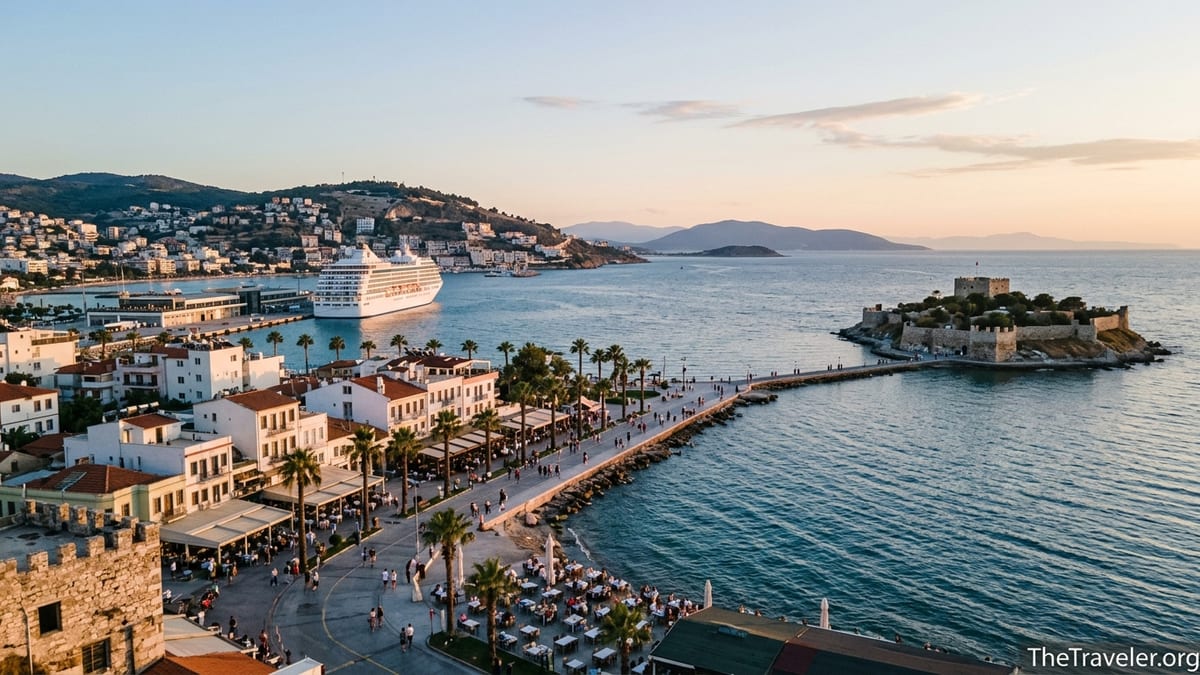
What and Where Is Kusadasi?
Kusadasi is a mid-sized resort city on Turkey’s Aegean coast in Aydin province, roughly 95 kilometers south of Izmir and facing the Greek island of Samos across the water. Its Turkish name Kuşadası means “Bird Island,” a nod to the small island with a stone fortress that anchors the bay. The city grew from a modest fishing port into one of Turkey’s most popular seaside resorts, with a population that swells dramatically from late spring through early autumn when package tourists and cruise ships arrive.
First-time visitors are often surprised by how compact the center is. The old town and bazaar cluster just behind the seafront promenade, and steep residential streets rise quickly up the surrounding hills. The cruise terminal known as Ege Ports or Scala Nuova sits right on the edge of downtown, so passengers can walk from ship to shops and cafés in around 5 to 10 minutes. Inland, low mountains frame the bay, while a string of sandy beaches runs south toward the Dilek Peninsula National Park.
For planning your trip, it helps to think of Kusadasi less as a historic destination in itself and more as a relaxed base: it is the practical jumping-off point for Ephesus, the pretty hillside wine village of Sirince, and boat trips or jeep safaris into the surrounding coastline. You can easily fill a single cruise day here, but many land-based visitors stay three to seven nights to combine history, sea and nightlife.
The main visiting season runs roughly from May to October. July and August are hot and crowded, with daytime highs often above 30 degrees Celsius and busy beaches. May, June, September and early October are more comfortable for sightseeing at Ephesus and walking around town while still warm enough to swim.
Getting Oriented: Cruise Port, Town Center and Pigeon Island
If you arrive by cruise ship, your first impression of Kusadasi is the modern Ege Ports terminal on the waterfront. As you walk off the ship you pass through a compact duty-free and shopping complex labeled Scala Nuova, with jewelry stores, a supermarket-style shop for toiletries and snacks, and several cafés. Once outside the port gate you are effectively on the town’s main coastal road, İskele Caddesi, with the old town bazaar directly ahead and the pedestrian promenade running along the sea.
The cruise port’s location makes Kusadasi one of the easier Eastern Mediterranean stops to explore independently. From the port gate it is roughly a 5-minute flat walk to the bazaar streets, where you will find carpet and leather shops, Turkish delight counters and cafés. A further 20 to 30 minutes on foot along the seafront gets you to Pigeon Island, locally called Güvercinada, which is linked to the mainland by a causeway. The walk is straightforward, with sea views on one side and restaurants on the other, though summer afternoons can be hot so a hat and water are useful.
Pigeon Island itself is a low rocky outcrop crowned by an Ottoman-era stone fortress and ringed by paved pathways and viewpoints. It is a pleasant place for first-time visitors to get their bearings, photograph the town’s skyline and watch local families strolling in the evening. There is usually a small café inside the island complex selling drinks and simple snacks at prices slightly higher than in town but still reasonable by European standards. If you have only a few daylight hours and do not want to venture far, a loop from the port through the bazaar and out to Pigeon Island and back makes a manageable introduction to Kusadasi.
For practical needs, ATMs line the streets behind the port, and pharmacies are common in the center. Supermarket chains such as Migros, A101 and Şok have branches within a 10 to 15 minute walk, where you can buy bottled water, sunscreen and snacks at local rather than cruise terminal prices. Taxis congregate outside the port gate and will typically propose set prices for Ephesus or city tours; always confirm the total cost and whether it is per taxi or per person before you get in.
Beaches and Seafront Life
While Kusadasi is best known internationally as the gateway to Ephesus, the town’s beaches are a big part of its appeal for package holidaymakers and Turkish families. Directly in town there are small stretches of sand and swimming platforms along the main promenade, but most visitors gravitate toward the more famous beaches south of the center, easily reached by local dolmuş minibuses or short taxi rides.
The best known is Ladies Beach, or Kadınlar Denizi, about 3 kilometers from the center. Despite the name, it is a mixed-gender public beach; the historic restriction to women no longer applies. The curving bay has soft sand, relatively shallow water, and a dense strip of cafés, beach clubs and small hotels set just above the promenade. In high season you can expect rows of rentable sunbeds and umbrellas; a pair with umbrella might cost the equivalent of a few euros for the day, with prices varying slightly between beach clubs. Many venues will waive the rental fee if you order drinks or lunch from them.
Farther south, Long Beach and the sands near Davutlar and Guzelcamli are more spacious and generally less crowded than Ladies Beach, especially on weekdays. These areas are popular with longer-stay visitors who rent apartments or stay in all-inclusive resorts. Dolmuş minibuses signed for “DAVUTLAR” or “GÜZELÇAMLI” run along this stretch; they are a very typical Turkish experience, with passengers hopping on and off at the roadside and paying the driver in cash. Fares are usually only a few dozen lira for several kilometers, which often works out to the equivalent of well under one euro at current exchange rates.
For something more natural, day trips by boat or dolmuş to the coves of Dilek Peninsula–Buyuk Menderes Delta National Park appeal to many first-time visitors who want clear water and pine forest scenery. Local operators in Kusadasi sell simple full-day boat trips that include multiple swimming stops and a basic onboard lunch, often for the equivalent of a few tens of euros per person, depending on the season and inclusions. At the park’s Karasu or İçmeler beaches, you pay a small entry fee at the gate, and sunbeds and food are available from seasonal kiosks or small restaurants.
Ephesus and Other Key Sights Near Kusadasi
The biggest single reason many travelers call at Kusadasi is Ephesus, one of the best-preserved classical cities in the Mediterranean. The archaeological site lies near the modern town of Selçuk, about 20 kilometers inland. By air-conditioned coach or taxi the trip typically takes 25 to 35 minutes each way, depending on traffic. Shore excursions sold by cruise lines bundle transport, admission and a licensed guide; independent travelers commonly book small-group tours online ahead of time or hire a local guide at the site’s entrance.
A typical half-day Ephesus excursion from Kusadasi will include the Marble Road, the Celsus Library facade, the Great Theater and the Terrace Houses, where covered walkways protect intricate mosaics and frescoes. Tour prices vary widely: ship-organized tours can cost several times more per person than a locally arranged small-group option, but they come with the security that the ship will wait if the bus is delayed. Independently arranged group tours starting in Kusadasi often cost in the area of a few dozen euros per person plus the entrance fee, while a private car and English-speaking driver will be more.
Many itineraries also include the nearby House of the Virgin Mary, set in the hills above Ephesus, and a stop at a carpet weaving cooperative or leather factory outlet on the way back to Kusadasi. These shopping stops can be interesting for seeing traditional techniques, but prices for carpets, leather jackets or gold jewelry are rarely bargains by Turkish standards. If you are not in the market for big-ticket purchases, be polite but firm about saying no, and do not feel obliged to buy anything in exchange for tea or snacks.
Beyond Ephesus, popular side trips from Kusadasi include the wine-producing village of Şirince, about 8 kilometers from Selçuk, known for its stone houses and fruit wines, and the Dilek Peninsula national park with its coves and the Cave of Zeus near Guzelçamli. Families often spend a day at Adaland or Aqua Fantasy water parks just outside town, with full-day tickets typically priced at the equivalent of several tens of euros depending on age and season. These parks offer wave pools, slides and lazy rivers and are reachable by shuttle buses or short taxi rides from Kusadasi hotels.
Where to Stay and What It Costs
Accommodation in and around Kusadasi spans everything from small pensions above the bazaar to large all-inclusive resorts along Long Beach. First-time visitors often find it useful to choose between three broad areas: central Kusadasi near the port, the Ladies Beach area a short ride away, and the longer strip toward Davutlar and Guzelçamli.
Staying in the center near the cruise port suits travelers who want to walk out to restaurants, bars and shops. Here you will find midrange city hotels with rooftop pools and sea views, as well as budget guesthouses on back streets. Rooms in this area can range from simple, older hotels offering basic doubles at relatively low nightly rates to renovated boutique-style properties that charge more but give you comforts such as good soundproofing and better breakfast spreads. Because Kusadasi hosts many coach tours, June through September can see strong demand, so advance booking is wise.
The Ladies Beach zone is more of a relaxed beach neighborhood. Many properties here are small hotels and apartment-style stays set just a street or two back from the sea. You trade some of the convenience of central location for direct beach access and good sunset views. This area works well if you plan to split your days between Ephesus and swimming. At the higher end, large resorts with multiple pools, kids’ clubs and buffet restaurants line Long Beach and the coast further south, often sold as part of European package holidays. These resorts are generally self-contained, with nightly entertainment programs and extensive food and drink options, and prices can vary widely based on inclusions and season.
Overall, Kusadasi still tends to be more affordable than many Western Mediterranean resorts. A couple visiting in shoulder season can often find a midrange hotel near the center that includes breakfast for a nightly rate that might be comparable to or lower than a similar room in a major Western European city. Eating out is also relatively good value, especially if you choose local lokanta-style restaurants rather than the most touristy seafront venues.
Nightlife, Food and Everyday Costs
Kusadasi has a distinctly lively atmosphere in the evenings, especially from June to early September. The streets behind the port and in the Kaleiçi old quarter are lined with bars, pubs and small nightclubs playing everything from Turkish pop to international dance hits. Some venues advertise themed nights aimed at European package tourists, while others feel more like casual Turkish bars where locals and visitors mix. Drinks are generally cheaper than in Western Europe, though imported spirits and cocktails can still add up, so many budget-conscious travelers favor local beer or raki, an anise-flavored spirit served diluted with water.
For a quieter evening, the seafront promenade is full of cafés and family-friendly restaurants where people linger over meze, grilled fish and kebabs. You might order a shared plate of eggplant salads, stuffed vine leaves and fresh bread, followed by grilled sea bream or lamb shish. Prices vary with location and fish choice, but a simple meal at a non-luxury place can often cost significantly less than a comparable seaside dinner in many Western European countries. Inexpensive lokantas away from the very front of the port serve trays of stews, rice and vegetables at clearly posted prices, which is helpful for first-time visitors nervous about haggling.
Street-level snacks are easy to find. Simit, a ring-shaped sesame bread, is sold from carts in the mornings, and you can pick up gözleme, a thin stuffed flatbread cooked on a griddle, from small stands on the way to Ladies Beach or around the dolmuş terminals. Typical fillings include cheese, spinach or potato, and the cost is usually modest, making it an affordable lunch option. For dessert, baklava shops and ice cream parlors dot the center, with many offering pistachio-rich sweets at prices by weight.
In terms of everyday costs, rides on dolmuş minibuses around town and to nearby beaches are among the most budget-friendly ways to get around. Fares are paid in cash to the driver, and while exact amounts shift with inflation, locals and recent visitors report they remain low enough that tourists often spend only the equivalent of a few euros total on public transport over several days. Taxis are metered in theory; in practice many drivers will propose a fixed fare for beach trips or late-night rides. It is acceptable to agree a total price in advance if the driver suggests one, and this can help avoid misunderstandings later.
Shopping, Bazaars and Dealing With Sales Tactics
Shopping is a major part of the Kusadasi experience, particularly for cruise visitors who funnel directly from the port into a dense zone of jewelry, carpet, leather and souvenir shops. The main bazaar streets sit just behind the waterfront, with colorful displays of lanterns, T-shirts and spice packets. Shopkeepers often call out playful greetings in multiple languages to draw you in, a practice that can feel overwhelming if it is your first time in Turkey.
Common big-ticket items on offer include hand-knotted carpets, kilims, gold and silver jewelry, leather jackets and branded-looking clothing. Some stores are reputable and can provide certificates for higher-value purchases, but it is important to remember that high-pressure sales tactics are not unusual. You might be offered apple tea while a salesperson unrolls one carpet after another, gradually shifting from friendly small talk to active persuasion. If you are not genuinely interested, the simplest response is to say clearly and politely that you are not buying today and then stand up and leave.
For small souvenirs, you will see fridge magnets, Turkish delight and nazar evil-eye charms at many stands. Prices are often flexible, so a degree of haggling is expected, particularly if you are buying several items or shopping in a non-fixed-price store. That said, supermarkets and some modern shops in town carry boxed Turkish delight, olive oil soaps and packaged spices with printed price tags. These can be a good option for travelers who prefer not to negotiate and want an idea of local price levels.
If you are serious about buying a carpet or substantial jewelry, it can help to research typical price ranges before your trip and to compare several shops rather than purchasing at the first stop on a tour. Cruise-organized excursions that emphasize a “special demonstration” at a factory or cooperative often route groups to particular vendors, where prices may be higher than at smaller independent shops. Only commit if you are comfortable with the total amount, and consider using a credit card with clear purchase protections for large transactions.
First-Time Turkey Tips from Kusadasi
Because Kusadasi is many travelers’ first point of contact with Turkey, a few countrywide basics are useful. The official currency is the Turkish lira. While many hotels, larger restaurants and shops that cater to tourists will accept euros, dollars or cards, small purchases such as dolmuş fares, simit or water from corner markets are easiest in lira. ATMs are common in the center and at the port; using machines belonging to established Turkish banks and declining dynamic currency conversion when offered can help you avoid higher fees.
English is widely spoken in the tourism industry, especially in Kusadasi’s shops, hotels and restaurants, but outside that bubble you may encounter less fluent speakers. Learning a few Turkish phrases such as “teşekkürler” for thank you and “merhaba” for hello is appreciated. Dress codes in town are relaxed, especially in peak summer, although covering shoulders and knees is advisable when visiting mosques or more conservative inland towns. At beach clubs and resort pools, standard European swimwear is normal; just remember to cover up when walking through town.
Safety-wise, Kusadasi is generally considered a low-crime destination, particularly in busy tourist zones. Standard city precautions apply: keep an eye on bags in crowded bazaars, agree taxi prices clearly and be cautious of overly friendly strangers who quickly steer the conversation toward jewelry, carpets or “special deals.” Tap water in Turkey is usually not drunk; most locals and visitors use bottled water, which is inexpensive and sold everywhere. Sunscreen can be pricey in resort shops compared with home, so bringing your preferred brand is a good idea.
Tipping is part of local custom. In restaurants with table service, leaving around 5 to 10 percent in cash for good service is common. Taxi drivers are not usually tipped heavily, but rounding up the fare is appreciated. In hotels it is customary to leave a small amount for housekeeping or to tip porters for carrying luggage. When taking organized tours from Kusadasi to Ephesus, guides and drivers often receive pooled tips at the end; amounts vary, but many visitors give what feels reasonable based on the tour length and quality.
The Takeaway
Kusadasi combines a walkable Aegean resort town with one of the world’s great archaeological sites just over the hills. For first-time visitors to Turkey, that mix of sea air, bazaar bustle and classical history offers an accessible introduction to the country, without the intensity of Istanbul or the long distances of Cappadocia. You can step off a cruise ship and be sipping Turkish coffee in a café within minutes or use the town as a base for several days of day trips and beach time.
Understanding the basic layout of the cruise port, town center, beaches and nearby highlights like Pigeon Island and Ephesus will help you use limited time wisely. Being aware of common sales tactics and everyday costs makes it easier to enjoy browsing the bazaars without stress. Combined with a few simple Turkey-wide tips on currency, etiquette and safety, you will be well prepared to make your first encounter with Kusadasi and Turkey enjoyable, whether you are here for a single afternoon or a full week.
FAQ
Q1. How far is Kusadasi cruise port from the town center?
The main cruise terminal is essentially in town; once you exit the port gate you are on the seafront road, and the bazaar streets are around a 5 to 10 minute walk away.
Q2. Can I visit Ephesus on my own from Kusadasi?
Yes. You can book a local tour operator, hire a taxi for a set fare, or take public transport to Selçuk and then a taxi to the Ephesus entrance, though organized tours are usually more time-efficient for cruise passengers.
Q3. Is Kusadasi safe for first-time visitors to Turkey?
Generally yes. Tourist areas are busy and feel safe, especially in daylight and early evening. Normal travel precautions apply, such as watching your belongings in crowded places and avoiding overly aggressive sales pitches.
Q4. Do I need Turkish lira, or can I pay in euros?
Many hotels, tourist shops and some restaurants accept euros, but having lira is very useful for small purchases like bus fares, snacks and tips, and usually gives you better value.
Q5. What is the easiest beach to reach from Kusadasi center?
Ladies Beach is the most convenient for many visitors. It is about 3 kilometers from the center and reachable in a short taxi ride or on a dolmuş minibus that runs frequently from town.
Q6. Are the sales tactics in the bazaar really pushy?
Some shopkeepers can be insistent, especially with carpets, leather and jewelry. A friendly but firm “no, thank you” and continuing to walk usually works, and you should not feel obliged to enter or buy.
Q7. What should I wear when visiting Ephesus from Kusadasi?
Light, breathable clothing, a hat and comfortable walking shoes or sandals with good grip are important. There is little shade, so sun protection and plenty of water are essential in summer.
Q8. Can I swim near the cruise port?
There are small swimming spots along the town promenade, but most people prefer to take a short trip to more established beaches such as Ladies Beach, Long Beach or the coves of the Dilek Peninsula for better water and facilities.
Q9. Is Kusadasi a good base for exploring other parts of Turkey?
It works well as a base for the immediate region, including Ephesus, Sirince and Dilek Peninsula. For destinations like Istanbul, Cappadocia or Pamukkale, you would typically combine Kusadasi with domestic flights or longer overland journeys.
Q10. What is the best time of year to visit Kusadasi?
Late spring and early autumn, roughly May to June and September to early October, offer warm weather and sea temperatures suitable for swimming without the peak summer crowds and heat of July and August.