


Driving into the green mountains of Jayuya to visit La Piedra Escrita, I expected a quick roadside stop to see some Taíno carvings. What I found instead beside the Río Saliente was a complete heritage and nature experience: a carefully built boardwalk descending toward the river, a huge carved boulder rising from the current, and a quiet valley that made the petroglyphs feel less like a photo opportunity and more like an encounter with living history.
Get the latest updates straight to your inbox!
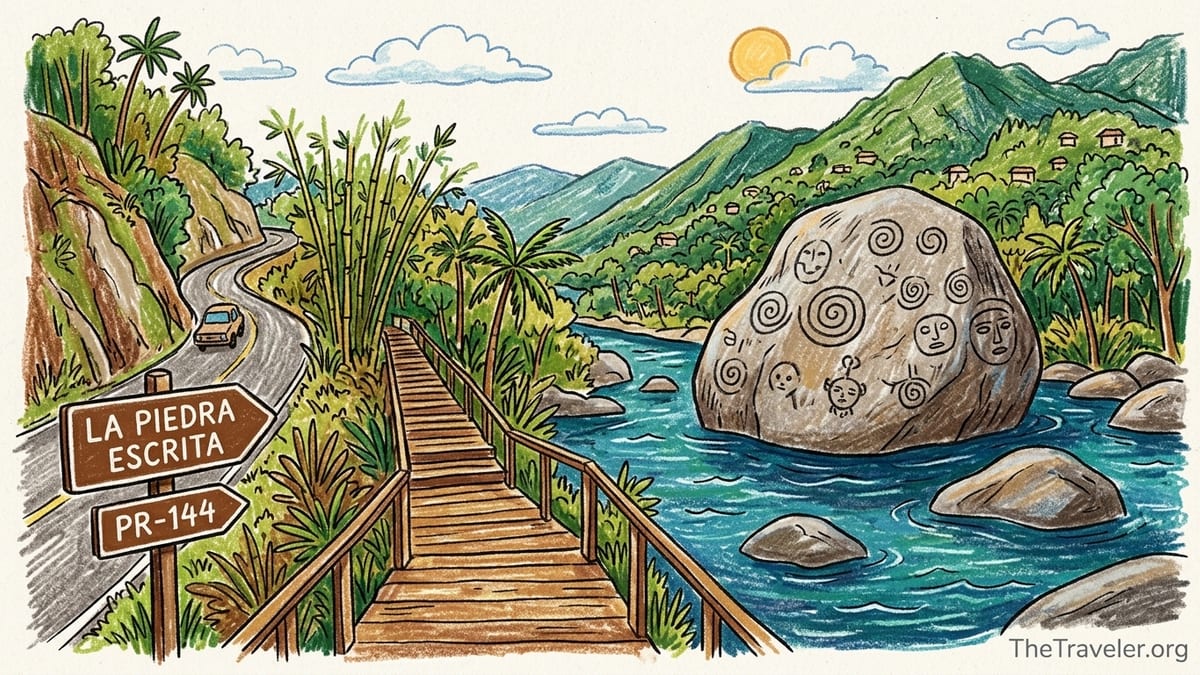
Getting to La Piedra Escrita Along PR-144
La Piedra Escrita sits in the Coabey area of Jayuya, along Puerto Rico highway PR-144 between kilometer markers 7.7 and 8, on the mountain road that links Jayuya with Ciales. Approaching from the town center of Jayuya, I followed PR-141 out of town, then connected with the bypass PR-5141 before joining PR-144 heading west toward Coabey. The drive took about 15 to 20 minutes from the plaza, climbing and curling through coffee country with frequent views of steep ridges and the valley of the Río Saliente below.
PR-144 here is a narrow, rural two-lane road with sharp curves and changing light as the forest canopy opens and closes overhead. I passed small houses, roadside fruit stands and signs for coffee haciendas before a modest brown tourism sign for "Área Recreativa La Piedra Escrita" appeared on the right-hand side. There is no traffic light or large gateway, so it is important to watch the kilometer markers and reduce speed well before reaching the site, especially in wet weather when the pavement can feel slick.
Public transportation into Jayuya exists in the form of shared vans that run mainly toward Utuado and Ponce during the day, but they do not reliably serve the exact entrance to La Piedra Escrita. For all practical purposes, visitors should plan to arrive by rental car or with a local driver. Because PR-144 is a through mountain road, I found it more comfortable to plan my arrival mid-morning, when visibility was good and local commuters were already past the morning rush.
There is no entrance gate with staff, nor any ticket booth charging admission as of my visit. Local tourism information and recent traveler reports confirm that access to La Piedra Escrita and its parking area remains free of charge, which makes the site accessible for families and independent travelers budgeted tightly for a longer central-mountain itinerary.
Parking, Signage and First Impressions of the Recreational Area
Turning off PR-144, a short paved lane led to a small parking area adjacent to the boardwalk. The lot is flat and open, with space for roughly a dozen vehicles when drivers park carefully. There were no marked lines or attendants, but the surface was in good condition, and I saw a couple of shaded spots along the tree line. Parking here was free, with no visible meters, payment machines or donation boxes.
Several informational signs stand near the edge of the lot, including a basic panel identifying the site as Área Recreativa La Piedra Escrita and another highlighting the importance of the Taíno petroglyphs. The language on the signs is primarily Spanish, reflecting the local audience, but even if you do not speak Spanish the icons make key rules clear: no littering, no open fires in undesignated spots and respect for the archaeological rock. Close to the head of the boardwalk, another sign reminds visitors not to touch or walk on the petroglyphs, echoing guidance shared by local tourism boards and cultural organizations.
The atmosphere on arrival contrasted with busier river spots elsewhere on the island. On a clear weekday late morning there were only three other cars in the lot. The sounds of PR-144 faded quickly, replaced by the steady rush of water from below and the high calls of birds moving through the hillsides. The entire recreational area is compact. From car door to the start of the descent I walked less than a minute, which makes the site appealing as a short stop even for travelers with a dense Jayuya itinerary focused on other attractions like the Museo El Cemí or Cerro de Punta viewpoints.
There are basic facilities nearby, though visitors should not expect a full-service park. I noted a small structure that locals described as restrooms, but they were closed during my visit and travelers report that maintenance can be intermittent. Trash cans were present at the top of the boardwalk and near the parking area. Given the limited services, I found it wise to arrive with water already in the car and to treat the site like a natural area rather than a staffed recreation complex.
Descending the Wooden Boardwalk to Río Saliente
The heart of the approach to La Piedra Escrita is a long wooden boardwalk that descends from the parking area down to the river level. The structure consists of a series of straight ramps connected by small landings, with sturdy wooden railings on both sides. Unlike a simple set of stairs carved into the hill, the boardwalk was clearly designed to be relatively accessible: there are no individual steps, only a continuous, moderately sloped ramp.
Walking down, I immediately noticed two things. First was the constant presence of the river’s sound, a low roar that grew more pronounced with each turn of the ramp. Second was the shift in climate. The canopy closes over parts of the boardwalk, filtering the sun and adding a noticeable drop in temperature compared with the exposed parking lot. The wood planks underfoot felt secure but slightly damp in shaded patches, particularly where leaves had fallen, which made me slow my pace and keep one hand on the railing.
In dry weather, most reasonably fit visitors will find the descent straightforward, taking about three to five minutes from top to bottom at an unhurried pace. For older travelers or those using mobility aids, the continuous slope can still feel demanding, especially considering the return climb. The boardwalk is often described as wheelchair friendly because there are no stairs, but pushing a chair back up the full incline requires significant effort or assistance. Based on the grade and my own walk, I would not underestimate the return: people with heart conditions, knee problems or poor balance should treat the climb as moderate exertion rather than a casual stroll.
In wet conditions, the boardwalk can become slippery, particularly where algae or fine mud accumulate on the planks closest to the river mist. During and after heavy rain, I would advise against rushing and would recommend closed shoes with good traction instead of sandals. There are no handrails in the middle of the ramp, only on the sides, so children should be kept close to avoid running or leaning too far over the edge to look at the valley.
The River Valley: Sounds, Vegetation and Mountain Setting
As the boardwalk approaches the bottom of the slope, the landscape opens dramatically. The Río Saliente cuts a broad channel through the valley floor, with the main current running toward the opposite bank and a quieter pool forming closer to the boardwalk side. The valley is framed by steep, forested hills that remind you Jayuya is part of Puerto Rico’s central cordillera, with elevations that include nearby peaks such as Monte Jayuya and Cerro de Punta.
The vegetation around the river includes a mix of native and naturalized trees: I noticed yagrumo with their pale undersides flashing in the breeze, tall bamboo stands leaning over the water, and clusters of ferns and grasses anchoring the rocks along the banks. Bird calls echoed from the forest, but down at river level the dominant sound was always water, sliding and splashing over stone. In calmer sections that water sound softened to a hiss, while near the big rock it deepened into a steady wash.
On the day of my visit, the river was running clear with a bluish-green tint, and I could see smooth stones on the bottom of the shallower sections. In the stiller pool above the rock, a few families sat on submerged boulders, feet braced, talking quietly over the current. A couple of teenagers were on the opposite bank taking selfies with the boardwalk at their back. Even with these small groups, the valley felt peaceful, helped by the fact that there are no loudspeakers, vendors or roadside traffic directly beside the water.
The combination of cultivated access and wild surroundings is what sets La Piedra Escrita apart from many other archaeological sites. You do not approach through a museum, nor through a long trail in dense forest. Instead, the boardwalk deposits you into a natural amphitheater where water, stone and carved history coexist in the same eye-level frame.
Meeting the Carved Boulder and Reading the Petroglyphs Responsibly
From the last landing of the boardwalk, a short concrete and rock path leads to the water’s edge. Directly ahead stands La Piedra Escrita itself, a massive granite boulder anchored in the middle of the river. The rock rises several meters above the waterline and presents one broad face toward the boardwalk side. This surface is covered with a dense constellation of carvings: spirals, concentric circles, faces with large circular eyes, and abstract figures that seem to emerge and recede as the light shifts across the damp stone.
Archaeologists identify these markings as Taíno petroglyphs, part of a wider tradition of rock art carved into river boulders and cave walls across the island. Studies and official heritage documents refer to La Piedra Escrita as one of Puerto Rico’s most significant petroglyph concentrations, included in the National Register of Historic Places and in regional inventories under designations that classify it as a key indigenous site. Researchers have documented the motifs carefully but generally avoid assigning precise, literal meanings to each spiral or face, acknowledging that modern observers can only infer limited aspects of Taíno cosmology from these forms.
Walking along the bank, it is tempting to point at a spiral and declare it a sun, or at a figure and decide it is a shaman or a specific deity. However, contemporary archaeological interpretation tends to speak in broader terms: some motifs appear to represent anthropomorphic beings, others possible celestial or natural elements, and still others may mark ceremonial or territorial significance along the river. What impressed me most was not an individual symbol but the overall density of carving and the way the petroglyphs interact with the flowing water, as if story and landscape were carved into the same surface.
Unfortunately, alongside the ancient work, evidence of modern impact is visible. On one flank of the boulder, above the main panel of petroglyphs, faint traces of scratched initials and dates appear, and I heard local visitors mention that in past years some people had climbed onto the rock to jump into the river. Any bright-colored paint or fresh scratches stand out sharply against the weathered, lichen-streaked surface of the genuine carvings. The difference is clear once you look closely: the Taíno engravings are worn, smoothly incised and often partially polished by centuries of exposure, while modern graffiti tends to be shallow, sharp-edged or pigment-based, lacking that patina of age.
Why We Should Not Touch, Climb or Jump from La Piedra Escrita
Standing at the bank with families nearby, I watched one child ask his father if he could climb onto the big stone. The father pointed deliberately at the sign and shook his head. This small moment encapsulated a key message: La Piedra Escrita is not just a river rock but a protected archaeological monument. Oils from human skin, abrasion from shoes and impacts from jumping all contribute, even in small increments, to the erosion and loss of petroglyph details that cannot be replaced once worn away.
Local authorities and heritage organizations explicitly request that visitors do not touch or walk on the carved surfaces. The reasoning is both cultural and practical. From a cultural perspective, these petroglyphs are among the most visible legacies of Taíno communities who lived in the Jayuya region long before Spanish colonization. Many Puerto Ricans today see them as symbols of national and Indigenous identity. Treating the rock as a diving platform reduces that heritage to a backdrop for thrill seeking.
From a safety perspective, climbing the boulder is riskier than it looks. The rock’s upper surface is sloped, with patches of algae and moss that become extremely slippery when wet. The turbulent water flowing around the base can conceal submerged stones and variable depths. Even if some locals or adventurous visitors choose to scramble up and leap into the river, their behavior should not be interpreted as a signal that such activity is safe or permitted. A single misstep on the slick granite could result in a fall onto hard rock or into strong current.
Respect in this context means admiring the carvings from the shoreline, photographing them using zoom instead of touch, and explaining their significance to children or travel companions. It also means gently but firmly discouraging anyone in your group from adding initials, chalk or any other mark to the boulder. The integrity of La Piedra Escrita depends on thousands of individual decisions like these, made quietly by visitors who may never meet each other but share the same space.
River Safety: Currents, Slippery Rocks and Changing Conditions
Río Saliente at La Piedra Escrita can look deceptively calm, especially in the sunny pool formed on the upstream side of the boulder. During my visit, several people waded in the shallows or sat on rocks with water around their waists. Yet local residents I spoke with and regional safety advisories share the same caution: rivers in Puerto Rico, including this one, can change character very quickly, particularly after intense mountain rainfall, which can occur even when the sky overhead at the site appears only partly cloudy.
The main risks here are a combination of slippery rocks, uneven depth and currents that strengthen suddenly when water volume increases. The stone riverbed is coated in algae that becomes slick underfoot, especially where the current is moderate but not strong enough to wash the growth away. Stepping from one rock to another in bare feet or simple flip-flops can feel like walking on greased glass. I watched one visitor lose footing in thigh-deep water and only just catch themselves on a nearby boulder, a reminder that falls do not need deep water to result in injuries.
Depth is also unpredictable. A spot that reaches mid-calf on one side of a rock may drop abruptly to chest-deep a step later, with stronger current drawing water toward the main channel near the big stone. After recent rains, locals say the river can rise noticeably and the tranquil pool becomes more turbulent, with stronger flow around and behind the boulder. In those conditions, even good swimmers may find themselves pushed against rocks or pulled into swifter water.
For these reasons, swimming or wading at La Piedra Escrita should never be assumed safe simply because others are in the water. There are no lifeguards, no posted real-time depth or current information and limited cell signal in parts of the valley. Sensible precautions include assessing the river from the shore first, avoiding entry after heavy rainfall locally or upstream, keeping children out of the main current, wearing water shoes with grip and setting a clear limit not to approach the immediate base of the boulder where the flow can be stronger. If in any doubt, treat the river as a scenic feature to admire rather than a place to swim.
Crowds, Litter and the Reality of a Popular Local Spot
One of the most pleasant surprises of my visit was how peaceful La Piedra Escrita felt despite its reputation as a beloved local swimming hole and weekend hangout. On a weekday late morning and early afternoon, I counted fewer than fifteen people spread along the river and the boardwalk. Most were families from the area or small groups of friends who came with coolers and folding chairs, speaking quietly and occasionally calling across the water. The setting allowed ample space to sit on rocks, photograph the petroglyphs and simply listen to the river without feeling crowded.
Local accounts note that weekends and holidays, especially during summer and on long weekends, tell a different story. Residents describe full parking, music from car speakers reaching down into the valley and a more festive atmosphere with grills, inflatables and children playing in the water. On such days, the site functions as both historical monument and community recreation area. Travelers seeking solitude or a meditative experience with the petroglyphs may prefer to plan their visit for weekday mornings or outside school vacation periods.
In terms of cleanliness, the area around the boardwalk and immediate riverbank was generally well maintained. I did see a few plastic bottle caps and a snack wrapper caught between rocks, but the quantity of litter was low compared with some other easily accessed river sites in Puerto Rico. Trash cans at the top encourage visitors to pack out waste, though they can overflow on busy days. Nothing about the small amount of litter I observed diminished the overall impression of a cared-for place, but it served as a reminder that the site’s condition depends heavily on visitor behavior.
Noise levels shifted with each small group that arrived or left. For most of my time, the river’s sound dominated; occasional music drifted faintly from a distant car in the parking lot but did not intrude. Travelers particularly sensitive to noise should avoid high season weekends and consider pairing La Piedra Escrita with a stay in rural accommodations nearby, where mornings and late afternoons at the site are likely to be quieter.
Food, Refreshments and the Cost of the Visit
Because there are no kiosks or formal concessions directly inside the recreational area at La Piedra Escrita, I planned to stop for food in the broader Coabey and Jayuya area. After leaving the boardwalk and returning to the parking lot, I drove a short distance along PR-144 to a small roadside eatery that locals recommended for simple Puerto Rican dishes: rice and beans, stewed chicken and pastelillos. For lunch, I ordered a plate of arroz con habichuelas and pollo guisado, plus a cold bottled water. The total came to the equivalent of around 12 US dollars, a typical price in Jayuya’s countryside for a filling, home-style meal.
Earlier in the day, before driving down to La Piedra Escrita, I had bought coffee and a small pastry at a bakery near the town plaza of Jayuya, spending about 5 dollars. Combined with gas for the drive up into the mountains from the northern coast, my full day in and around Jayuya remained relatively low-cost, especially compared with resort-based experiences. The most significant expenditure was fuel rather than entrance or parking fees.
Travelers who prefer to picnic beside the river can purchase supplies in Jayuya’s supermarkets or corner stores. Because the site has limited infrastructure, it is important to bring water, snacks and any special dietary items in advance, as options within walking distance are extremely limited. When picnicking, pack reusable containers instead of disposable plastics and carry everything back up to the parking lot trash cans, or better yet, take it out entirely to ensure nothing blows into the river.
In practical terms, a half-day visit to La Piedra Escrita can be managed comfortably on a budget of 20 to 30 dollars per person, including a sit-down meal in town and snacks or drinks. Those staying overnight in Jayuya to explore additional attractions will, of course, need to factor in lodging, which ranges from small guesthouses to rural cabins and coffee farm stays in the wider municipality.
What La Piedra Escrita Taught Me About Taíno Heritage
Before visiting Jayuya, I had read about Taíno history in Puerto Rico and had seen reproductions of motifs like the famous Taíno sun used in municipal symbols and tourism materials. Encountering the carvings at La Piedra Escrita in situ, however, changed the way that heritage felt. Instead of isolated images in a book or museum, the petroglyphs appeared as part of a lived landscape, carved into a river that people still visit to cool off, talk, pray or simply gaze at the mountains.
The experience underlined how central Jayuya is to the story of Taíno presence on the island. The municipality’s official imagery, the nearby archaeological sites like the Mural de Zama and the local festivals dedicated to Indigenous culture all connect back to places like this rock in the Río Saliente. Standing there, I felt a continuity between ancient and contemporary uses of the valley: the river as corridor, gathering place and focal point of meaning.
At the same time, the visit highlighted the care required in speaking about Taíno symbols. Many popular accounts online offer confident explanations of each petroglyph, assigning them fixed roles in a pantheon or linking them to specific myths without direct evidence. Recent scholarship takes a more careful stance, asking visitors to appreciate the carvings visually and contextually while acknowledging the limits of our knowledge about precise narrative content. That humility deepened rather than diminished my respect for the site.
Perhaps most importantly, spending unhurried time at La Piedra Escrita made clear that protecting Taíno heritage is not only the responsibility of archaeologists and government agencies. Every visitor shapes the future of the carvings, whether by stepping lightly and leaving no trace, or by scratching a name, trampling moss and treating the boulder as furniture. The choice between those paths is made quietly, often without witnesses, and yet its cumulative impact will determine what remains for future generations.
The Takeaway
La Piedra Escrita turned out to be far more than a quick photo stop on a mountain drive. The combination of an accessible boardwalk, a powerful river landscape and a major concentration of Taíno petroglyphs makes it Jayuya’s signature firsthand heritage and nature experience. From the moment the wooden ramp drops away from PR-144 and the sound of water replaces traffic, the site asks visitors to adjust their pace and attention.
What impressed me most was the way the enormous carved boulder commands the center of the Río Saliente while still feeling integrated into the valley’s everyday life. Families chatted on the banks, teenagers compared photos and yet the stone itself maintained a quiet gravity. Looking at the weathered spirals and faces cut into its surface, I felt less like I was “discovering” something and more like I was being allowed a brief, respectful glimpse of a much longer story.
The river setting matched my expectations in some ways and exceeded them in others. I anticipated beauty and a chance to cool my feet, but I had not fully appreciated how quickly conditions can become hazardous after rain or how invisible some of the risks are from the boardwalk. The visit reinforced the importance of treating all natural pools and rivers in Puerto Rico with caution, regardless of how many people appear to be swimming comfortably at any given moment.
As for where La Piedra Escrita fits into a Jayuya itinerary, I would argue it deserves a dedicated stop of at least an hour, ideally more, to walk the boardwalk, study the carvings from different angles and sit quietly by the water. At the same time, it makes the most sense as part of a broader stay in Jayuya that also includes the Museo El Cemí, nearby coffee haciendas and mountain viewpoints. Together, these experiences provide a fuller picture of how Taíno heritage, agricultural history and contemporary rural life intersect in Puerto Rico’s central highlands.
FAQ
Q1. Where exactly is La Piedra Escrita located in Jayuya?
La Piedra Escrita is in the Coabey area of Jayuya, beside the Río Saliente along highway PR-144 between kilometer markers 7.7 and 8, a short drive from the town center.
Q2. Is there an entrance fee or parking charge at La Piedra Escrita?
At the time of my visit, access to the recreational area and parking lot was free, with no entrance booth or meters. Visitors should still bring cash for food or supplies purchased elsewhere in Jayuya.
Q3. How long does it take to walk from the parking lot down to the river?
The descent on the wooden boardwalk from the parking area to river level generally takes about three to five minutes at a relaxed pace, depending on mobility and how often you stop to enjoy the view.
Q4. Is the boardwalk suitable for older visitors or people with limited mobility?
The boardwalk is a continuous ramp with railings and no stairs, which can help some visitors, but the slope is long. The climb back up can be challenging for older people or anyone with heart, knee or balance issues, and wheelchair users will likely need assistance pushing uphill.
Q5. Can visitors swim in the river at La Piedra Escrita?
People often wade or swim in the calmer sections of the Río Saliente near the site, but there are no lifeguards and conditions can change quickly. Strong currents, slippery rocks and sudden depth changes mean that entering the water is always at your own risk, and caution is essential, especially after rain.
Q6. Are you allowed to touch or climb the petroglyph rock?
No. Visitors are asked not to touch, climb or jump from La Piedra Escrita. The rock is a protected archaeological monument, and contact accelerates erosion of the petroglyphs and increases the risk of falls and injuries.
Q7. How can you tell the difference between ancient petroglyphs and modern graffiti?
Ancient petroglyphs appear smoothly incised, weathered and often partially polished by time, with lines that blend into the rock’s patina. Modern graffiti tends to be shallow, sharply edged or painted, lacking the same aged surface and usually placed in clashing styles or brighter tones.
Q8. What should I wear and bring for a visit to La Piedra Escrita?
Wear comfortable closed shoes with good grip for the boardwalk and rocky riverbank, and bring water, sun protection and insect repellent. If you plan to approach the water, consider water shoes for traction, but always prioritize safety over swimming.
Q9. When is the best time of day or week to visit?
Weekday mornings or early afternoons outside major holidays are generally quieter, with fewer crowds and more chances to experience the site in relative peace. Weekends and summer holidays can be busy with local families using the area as a swimming and picnic spot.
Q10. Should La Piedra Escrita be a quick stop or part of a longer Jayuya trip?
You can see the rock and river in under an hour, but La Piedra Escrita is most rewarding when included in a longer Jayuya stay that also visits the Museo El Cemí, local coffee farms and mountain viewpoints to appreciate the region’s broader cultural and natural context.