


More news on this day
Record-breaking Labor Day travel volumes converged on Atlanta’s Hartsfield-Jackson International Airport this weekend, triggering hours-long lines, gate congestion and rolling delays that rippled across the national air network.
Get the latest news straight to your inbox!
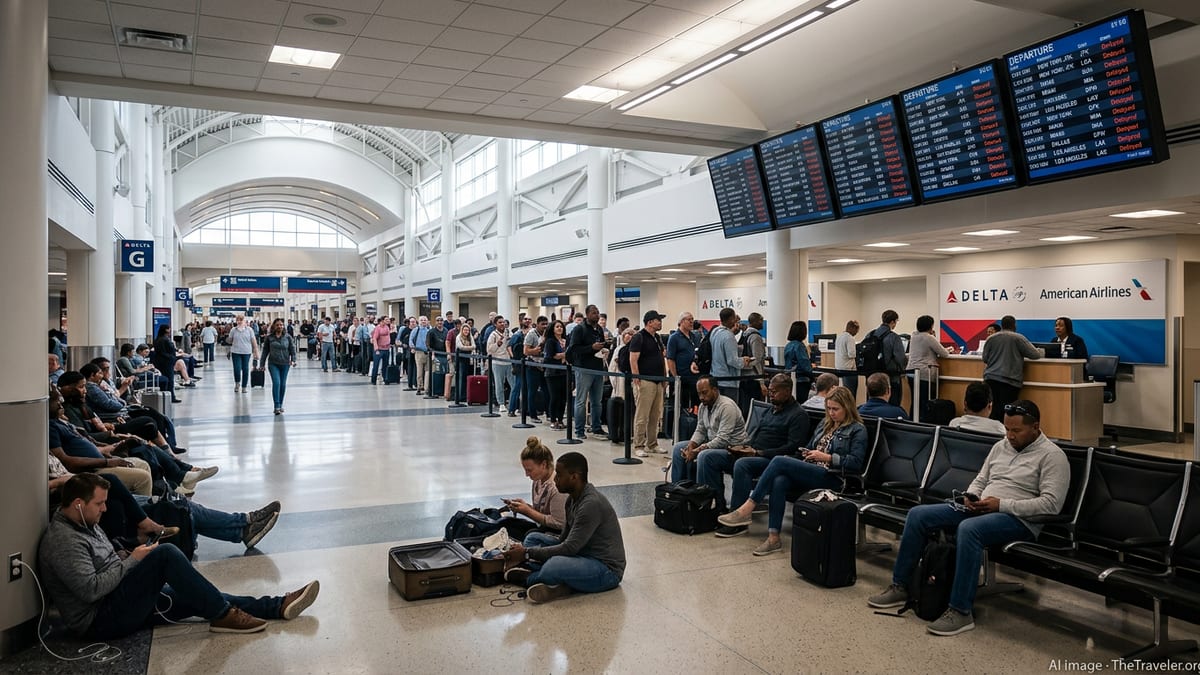
Record volumes converge on the world’s busiest hub
Hartsfield-Jackson, consistently ranked as the world’s busiest airport by passenger traffic, entered the Labor Day holiday period already operating near capacity after a summer of heavy demand and periodic bottlenecks. Publicly available passenger data shows the airport handled more than 106 million travelers in 2025, underscoring how even modest holiday surges can strain its intricate operation.
For this Labor Day stretch, airport forecasts pointed to roughly 2.3 million passengers moving through Atlanta between Thursday and Monday, eclipsing last year’s levels and rivaling some peak summer weekends. Local coverage indicated that Sunday and Monday were expected to be the heaviest days, as leisure travelers returned home and college and business traffic layered on top of holiday demand.
The crush coincided with broader U.S. air travel patterns. Transportation data for recent holiday periods shows nationwide screening volumes hovering near or above prior records, leaving little slack in the system when one mega-hub such as Atlanta encounters disruption. In that context, even minor slowdowns at checkpoints, on the ramp or in air traffic control can quickly snowball into missed connections and flight crews timing out of their duty windows.
Unlike some past holiday weekends that unfolded relatively smoothly at Atlanta, early reports this year pointed to mounting challenges from the first outbound bank of morning flights and persisting well into the evening peaks.
Long security lines and baggage choke points
The initial visible symptom for many passengers was security screening. Travelers described waits stretching well beyond the typical 30 to 40 minutes, with some morning lines looping back toward baggage claim and evening queues spilling deep into the domestic terminals. Earlier in the year, Atlanta’s checkpoint operations had already drawn attention after reports of security waits approaching five hours during a spring travel surge, raising concern about how the system would handle another record holiday wave.
Part of the strain, according to published coverage of prior disruptions, has been attributed to staffing gaps at security checkpoints and the difficulty of flexing enough agents across multiple lanes at peak times. When paired with holiday behavior such as less frequent flyers unfamiliar with procedures, extra luggage, and families traveling together, throughput can drop significantly just as volume reaches its highest point.
Once through security, some passengers encountered a second bottleneck at baggage carousels. Heavy checked-bag loads associated with extended summer trips and end-of-season relocations slowed delivery times in several concourses. Travel forums and social posts from the weekend referenced waits of 45 minutes or more for luggage, complicating tight connections and ground transport plans.
Observers noted that while Atlanta’s automated baggage handling system is designed for very high throughput, spikes concentrated in certain time bands can still overwhelm specific piers, particularly when upstream flight schedules are disrupted and multiple arrivals bank into the same window.
Gate congestion, rolling delays and missed connections
On the airside, the combination of packed departure boards and limited spare gates fueled a cascade of delays. Real-time flight tracking data over the weekend showed departure times sliding across multiple major domestic carriers, with knock-on effects for connecting banks. Once early-morning flights began leaving late, aircraft and crews struggled to get back on schedule.
Atlanta’s role as a primary connecting hub meant that even localized disruptions quickly propagated throughout the network. Passengers traveling from smaller markets in the Southeast and Midwest found themselves missing onward flights by minutes as narrow connection windows were eroded by ground holds, ramp congestion or crews reaching regulatory duty limits.
The situation was further complicated by summer thunderstorm patterns typical for the region, which introduce additional spacing between aircraft and can temporarily halt ramp operations for lightning. Aviation analysts have long noted that Atlanta’s tightly timed “banked” schedule, efficient under normal conditions, is vulnerable when even short weather or ground stops coincide with peak holiday demand and limited spare aircraft.
As delays stacked up, airlines rebooked travelers through later evening departures and, in some cases, onto next-day flights, swelling terminal crowds and lengthening lines at customer service counters.
Strain on ground transport and regional travel
The ripple effects were not confined to the concourses. Road approaches to the airport, including key interstate interchanges, intermittently backed up as holiday motorists combined with rideshare traffic and shuttle buses. The Georgia Department of Public Safety had already warned of heavier-than-normal traffic volumes across the state for the Labor Day period, reflecting a broader surge in road trips alongside record air travel.
Inside the airport complex, parking facilities saw periods of near-capacity conditions, particularly in on-site garages favored by weekend travelers. This pushed more drivers toward off-airport lots and ride-hailing services, adding to curbside congestion in front of the domestic terminals. Reports from local outlets noted that some passengers underestimated the extra time required to navigate both highway traffic and airport roadway backups, arriving to the check-in counters already behind schedule.
MARTA, Atlanta’s rail link to the airport, absorbed a share of the overflow as transit agencies promoted rail as a way to bypass gridlocked highways. However, the sheer number of travelers with large bags, strollers and sports equipment made boarding slower than on typical weekdays, underscoring the constraints of moving holiday crowds through infrastructure designed primarily for daily commuters and regular flyers.
The compound pressure on roads, rail and curbs demonstrated how tightly intertwined airport performance has become with the broader transportation ecosystem in and around major U.S. metro areas.
Growing questions about holiday resilience
The Labor Day crunch in Atlanta has amplified ongoing questions about the resilience of the U.S. air travel system during peak periods. Industry data from recent summers shows that eight of the ten busiest days in Transportation Security Administration history have occurred in the last two years, reflecting an industry operating close to its ceiling even outside of traditional holiday peaks.
At Hartsfield-Jackson, airport documents and financial reports highlight billions of dollars in recent and planned investments in concourse expansions, gate modernization and airfield improvements aimed at keeping pace with demand. Yet the weekend’s experience suggests that physical capacity alone may not fully insulate operations from disruption when staffing, weather and national airspace constraints intersect with record traffic.
Travel advocates argue that passengers are increasingly bearing the risk of these systemic stresses in the form of missed family events, added hotel costs and lost workdays. Consumer complaints filed with federal regulators in recent years have reflected frustration with cascading delays and a perception that the system struggles to recover quickly once a peak period goes sideways.
As the industry looks ahead to Thanksgiving and the winter holidays, Atlanta’s Labor Day turbulence is likely to serve as a reference point in debates over staffing levels, infrastructure pacing, and whether U.S. air travel has enough redundancy to manage the next round of unprecedented crowds.
CBS News Atlanta: Atlanta airport predicts busier Labor Day travel period
Atlanta Journal-Constitution: Labor Day travel outlook for Atlanta
TSA: Record Labor Day screening volumes nationwide
Background on Hartsfield-Jackson Atlanta International Airport