


More news on this day
Los Angeles International Airport turned into an impromptu waiting room for thousands of stranded travelers on Friday after a rare nationwide ground stop by the Federal Aviation Administration halted most U.S. departures and sent delays rippling across the country.
Get the latest news straight to your inbox!
Nationwide halt follows critical communications failure
The disruption began on Friday, November 13, when the FAA ordered a national ground stop in response to serious communications issues affecting multiple air traffic control centers. Publicly available advisories described a halt to departures at all U.S. airports while technicians investigated gaps in radar and voice links between controllers and aircraft.
According to published coverage, the pause lasted more than four hours before departures were gradually cleared to resume. During that window, thousands of flights were delayed or canceled, creating bottlenecks from Los Angeles to Boston as aircraft already in the air continued to land but few were allowed to take off.
Transportation updates indicated that the failure was tied to overloaded routers and aging time‑division multiplexing equipment used to move radar and voice data around the national airspace system. Federal transportation leaders have spoken in recent days about the need for tens of billions of dollars in accelerated technology upgrades, linking Friday’s failure to long‑running concerns about the resilience of U.S. air traffic control infrastructure.
Officials in public briefings emphasized that investigators had found no evidence of a cyberattack or foreign interference, calling the stoppage a precautionary safety measure. Still, the scale of the outage made it the most sweeping grounding of domestic flights since the FAA’s NOTAM system failure in January 2023.
LAX becomes a pressure point for West Coast travel
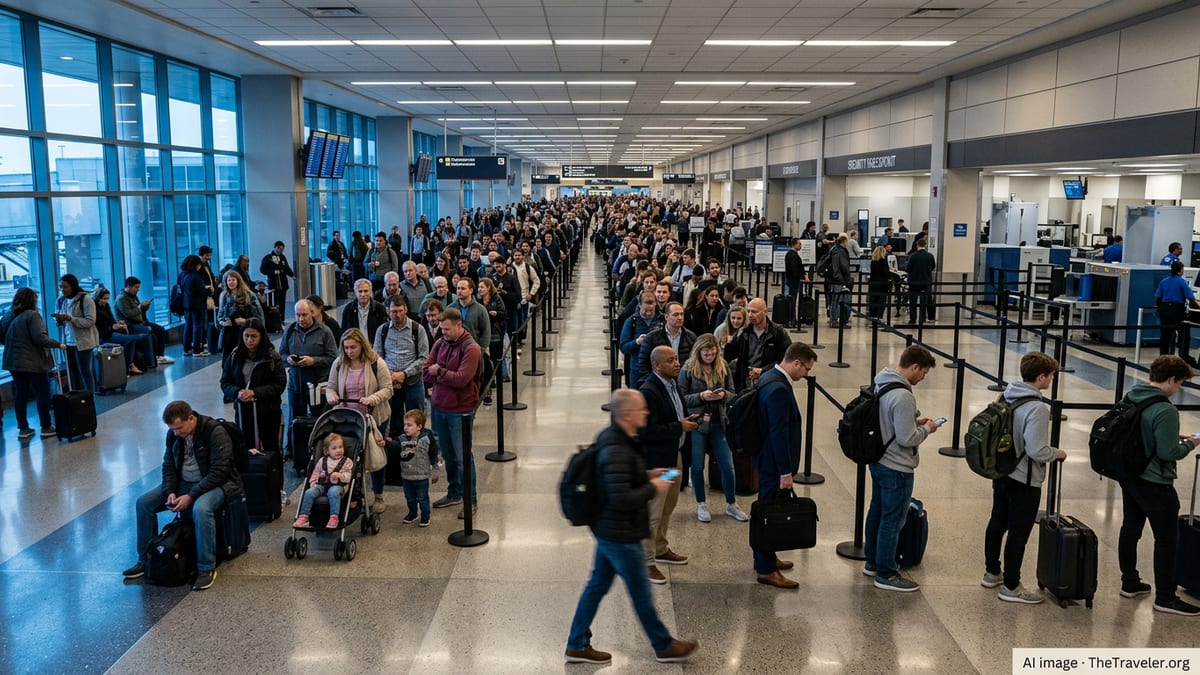
At LAX, one of the nation’s busiest international gateways, the ground stop quickly translated into real‑world gridlock. Reports from the airport described crowded terminals, long lines at airline counters and security checkpoints, and passengers sprawled across floors, clustered around power outlets and anxiously refreshing flight apps.
Los Angeles Times coverage indicated that more than 1,000 flights nationwide were delayed as the order took hold, with LAX bearing a disproportionate share because of its role as a major hub for transcontinental and transpacific routes. A social media post from an air traffic discussion forum noted that LAX began running out of available gates, forcing arriving aircraft to wait on taxiways while crews arranged buses and air stairs to offload passengers.
While landings continued, new domestic departures were largely frozen for hours. Travelers headed to short‑haul destinations such as San Francisco and Las Vegas described being called to board, then held at gates or seated on aircraft before being told their flights would not be leaving as planned.
The ripple effects extended well into the evening. Flight‑tracking services showed disrupted schedules persisting overnight as airlines repositioned aircraft and crews, with some westbound red‑eye services and early‑morning Saturday departures canceled outright to realign operations.
Scenes of uncertainty from terminals across the country
LAX was not alone. Photos and eyewitness accounts from airports in Boston, Chicago, Miami and smaller regional facilities showed departure boards filled with delays and cancellations. National news outlets described passengers learning of the ground stop only after clearing security and seeing screens flip from “on time” to “delayed” en masse.
Coverage from California and national broadcasters highlighted travelers who had already boarded when the order came down, then spent extended periods waiting on ramps or at remote stands before being instructed to deplane. In online forums, one traveler described a short‑haul flight that landed at LAX and then sat for roughly five hours on the taxiway while the airport searched for an open parking position.
Los Angeles‑based reporting captured the mood inside LAX’s Terminal 6, where one frustrated passenger trying to reach San Francisco joked that they “might spend the rest of my life here” amid repeated rebookings and dashed hopes of catching an evening departure. At Miami International Airport, an entire family on vacation was photographed camped out near a gate, waiting for word on a new flight after their original plans dissolved.
Sports teams and business travelers were among those caught up in the disruption. National reports indicated that NBA, NHL and college football squads faced last‑minute scrambles to reach weekend games, while some corporate travelers abandoned same‑day trips altogether in favor of virtual meetings.
Technical fault revives concerns about aging aviation systems
The outage has renewed focus on the complexity and fragility of the technology underpinning U.S. aviation. According to detailed explanations shared in press briefings and expert analyses, the ground stop followed “instability” in data flowing through critical communications equipment that links radar sites, control centers and airport towers.
Newer, software‑driven systems are gradually being layered on top of older copper‑wire networks and legacy hardware. Aviation technology specialists quoted in recent coverage described Friday’s incident as an example of what can happen when modern, data‑intensive tools are introduced into infrastructure that has not been fully modernized.
The FAA has already launched multi‑year programs aimed at retiring decades‑old components, including information systems that until recently relied on outdated storage media. Planning documents cited by technology publications indicate that the agency does not expect the full transition to more resilient digital systems at hundreds of facilities until at least 2028.
Analysts note that this latest disruption follows other recent communication failures affecting individual airports or regions, underscoring how a single severed cable or software fault can trigger cascading delays. Policy commentary in national magazines has argued that as air travel demand continues to grow, rare but large‑scale stoppages may become more consequential without major investment.
What travelers experienced and how airlines responded
For passengers, the technical explanations did little to ease the immediate strain of missed connections, lost vacations and upended business plans. Reports from LAX and other hubs described long waits to speak with airline agents as customer service desks were overwhelmed with rebooking requests.
Some travelers were offered same‑day alternatives through circuitous routings, such as connecting overnight through cities far from their original path in the hope of reaching their final destination the following day. Others were rebooked on flights leaving on Saturday or later, particularly on already‑busy transcontinental and international routes with limited spare seats.
Consumer advocates interviewed in media coverage stressed the importance of checking airline apps and signing up for flight alerts whenever large‑scale disruptions occur. Many carriers updated passengers via push notifications before gate agents were able to make announcements in terminals, giving some travelers a head start on securing scarce seats.
At LAX, some local passengers facing extended delays simply abandoned their trips or postponed departures, according to regional news reports. Those who had to travel pressed on, searching for available hotel rooms near the airport or preparing for overnight stays in terminals as cots and blankets began to appear in certain concourses.
Lingering delays expected as system recovers
Although the FAA lifted the nationwide ground stop Friday night, published forecasts from airlines and travel data firms suggest that the fallout will extend through the weekend. Aircraft and crews remain out of position, and many routes are operating with little spare capacity to absorb displaced passengers.
At LAX, schedule data on Saturday morning showed a mix of on‑time operations and residual delays, particularly on routes linking Southern California with East Coast hubs that were also heavily affected. Travelers departing on November 14 and November 15 are being advised by airlines and airport communications to arrive early, monitor flight status closely, and be prepared for gate or time changes.
Aviation analysts caution that, even as operations normalize, the incident is likely to feature prominently in policy debates in Washington over how quickly to replace legacy equipment and how much redundancy to build into the system. For travelers navigating the immediate disruption at LAX and other airports, however, the more urgent concern remains far simpler: finding a seat on a flight that actually departs.