


More news on this day
Passengers flying from Manchester Airport to popular holiday destinations in Spain, Greece and other parts of southern Europe are facing a mix of schedule changes and delays as busy late-summer traffic and airspace congestion ripple through the region’s flight network.
Get the latest news straight to your inbox!
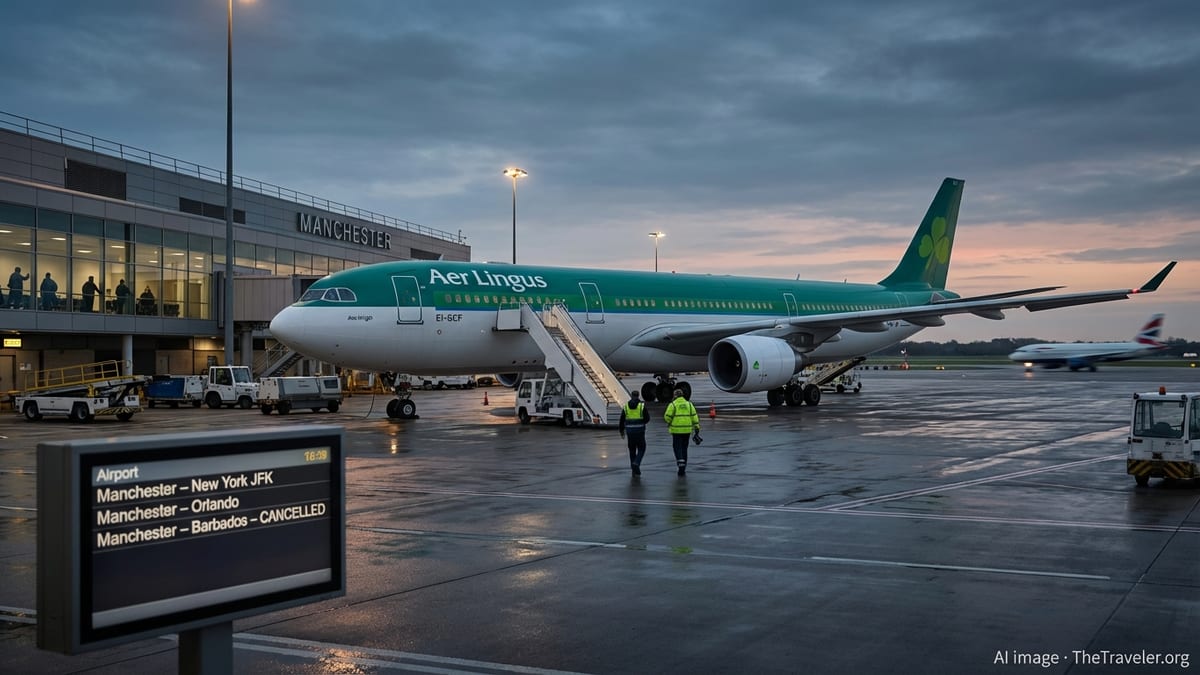
Late-summer pressure on Mediterranean routes
Late August and early September are among the busiest weeks of the European summer, and traffic data shows that flights across the continent remain at or near record levels. EUROCONTROL’s most recent network briefings report more than 35,000 flights a day across Europe, with traffic up on last year and demand particularly strong in southern destinations including Spain and Greece.
Those pressures are visible on services linking Manchester with Mediterranean holiday spots. Routes to Spain’s coastal airports and the Greek islands operate at high frequency from Manchester, with carriers such as easyJet, Jet2, Ryanair and TUI running dense schedules to Athens, Heraklion, Kos, Mykonos and other resorts, often with several departures a day on peak days.
With aircraft and crews operating back-to-back rotations, any disruption on earlier legs can quickly translate into knock-on delays out of Manchester. Flight tracking data for popular services between Manchester and Athens, for example, shows a pattern of late departures and arrivals on some recent days, with individual flights running from a few minutes behind schedule to more than three hours late in isolated cases.
While many departures still leave broadly on time, the cumulative effect for travellers is increased uncertainty, longer waits at the gate and more frequent schedule revisions as airlines adjust departure times to reflect congestion in the wider network.
Spain and Greece emerge as European delay hot spots
Airspace conditions over Spain and Greece are playing a major role in the delays now being felt by UK travellers. EUROCONTROL network reports identify both countries as among the largest contributors to en-route air traffic flow management delays so far this summer, alongside France. Earlier briefings highlighted Spain and Greece together accounting for around 30 to 40 percent of all en-route delay minutes across the European network.
In practice, that means flights heading from Manchester to Spanish and Greek destinations can be held on the ground awaiting departure slots or slowed en route to manage congestion. Even when Manchester Airport’s own operations are running smoothly, restrictions in downstream airspace or arrival queues at busy holiday airports can push arrival times back and compress turnaround windows for return legs.
Greek airspace in particular has seen sharp growth in traffic this year as tourism rebounds strongly across the islands and mainland resorts. Industry coverage notes that Greece has recorded some of the largest year-on-year increases in flight movements in Europe, while also reporting significantly more delays than in the previous summer as controllers manage packed traffic flows into Athens and regional airports.
For passengers, the result is that departures from Manchester bound for the Mediterranean may appear to depart more or less on time, only to arrive late due to airborne holding patterns or route restrictions over southern Europe.
Manchester performance under strain from heavy schedules
Locally, Manchester Airport continues to manage one of the densest schedules in the UK outside London, with aviation data providers listing around 380 flights a day to more than 200 destinations served by some 80 airlines. Industry punctuality statistics compiled earlier in the year placed Manchester’s on-time departure rate in the mid-60 percent range, below some European peers, reflecting a combination of weather, airfield works and the complexity of its operation.
Recent network performance reports from EUROCONTROL highlighted that work on taxiway infrastructure at Manchester generated aerodrome capacity-related delays through late 2025, and while much of that work has progressed, the airport continues to operate close to its available capacity at peak times. When traffic is heavy, even relatively minor incidents on the airfield or short periods of low visibility can trigger rolling delays as departures and arrivals are resequenced.
Data on delay performance for individual airlines at Manchester also points to a challenging operating environment. One analysis of Ryanair services from the airport between late May and late August showed that just over half of flights departed on time, with roughly 43 percent experiencing moderate to major delays and an average delay of around 25 minutes. Similar patterns can be seen in tracking data for selected leisure routes, where a run of broadly punctual days can be punctuated by single days of severe disruption.
These statistics do not translate into widespread cancellations, but they do indicate that travellers, particularly on busy leisure routes, should factor in a realistic risk of late departures or arrivals even when their flight is scheduled to operate as normal.
What travellers can expect on Spain and Greece departures
Live operational data this week suggests that Manchester’s departures remain broadly stable overall, but with noticeable pockets of delay on certain routes. Real-time disruption maps from flight-tracking platforms show a modest share of departures from Manchester leaving outside their scheduled window, while major hubs in Spain and Greece, such as Barcelona and Athens, also report elevated levels of delayed flights.
Looking at specific services between Manchester and Athens, schedules for carriers including Aegean Airlines, easyJet and Jet2 indicate that flights are operating daily, yet recent histories show a mix of outcomes: some services arriving only a few minutes late, others touching down close to an hour behind schedule, and one late-August rotation recording a delay of nearly three hours following a significantly late departure from Manchester.
To Spain, flight data aggregators list frequent services from Manchester to destinations such as Barcelona, Malaga, Alicante and the Balearic Islands, with airlines operating tight turnarounds to meet demand. On days when Spanish airspace is highlighted as a network hot spot, Manchester-origin flights to these airports are particularly exposed to flow restrictions and arrival metering, which can cascade into the evening schedule.
For passengers, this environment means that “on time” can be a fluid concept. A flight listed as on schedule at check-in may still be adjusted at short notice once European network managers issue updated slot times for traffic entering crowded sectors of Spanish or Greek airspace.
Advice for passengers heading for late-summer sun
Travel experts and consumer advocates consistently recommend that passengers build additional buffer time into their plans when flying to or through known congestion points, especially during peak holiday seasons. For Manchester travellers heading to Spain, Greece and other Mediterranean destinations, that can mean allowing extra time for connections at the far end, avoiding tight same-day plans on arrival and ensuring flexible ground transport or accommodation arrangements where possible.
Publicly available data from airlines and airports also underlines the value of real-time monitoring. Most carriers serving Manchester provide online or app-based updates on departure and arrival times, and independent tracking platforms allow passengers to check the recent delay history of specific flight numbers to get a sense of how services have been performing in recent days.
In addition, consumer guidance around UK and EU air passenger rights highlights that travellers may be entitled to assistance, refreshments or compensation in some circumstances when flights are heavily delayed or cancelled, depending on the cause and length of disruption. While each case is assessed individually, understanding the rules in advance can help passengers navigate any problems that arise on the day of travel.
With European skies still exceptionally busy as summer runs into September, Manchester Airport remains a crucial gateway for holidaymakers across northern England. For now, the message for those bound for Spain, Greece and beyond is to expect crowded flights, stay informed and be prepared for schedules that may run later than planned as the network absorbs another intense holiday season.