


More news on this day
Hundreds of riders were left stranded in Anaheim Hills after a Metrolink commuter train suffered a mechanical failure over the weekend, halting service between stations and triggering a lengthy rescue operation involving a second train.
Get the latest news straight to your inbox!
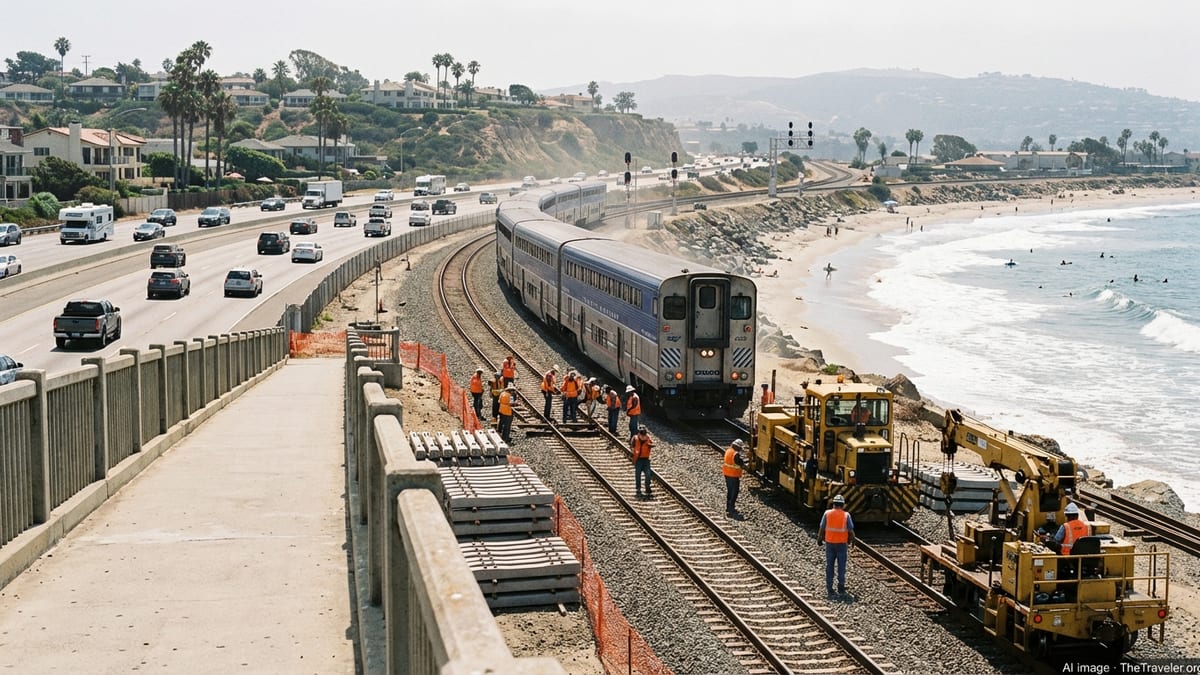
Train stalls between Anaheim Canyon and Corona West
According to published coverage, the disruption occurred Saturday afternoon on Metrolink’s Inland Empire–Orange County Line when Train 1858 came to an unexpected stop on a segment of track in Anaheim Hills between the Anaheim Canyon and Corona West stations. Reports indicate the locomotive experienced a mechanical problem that disabled both propulsion and onboard electrical systems.
Publicly available information shows the stalled train was carrying roughly 500 passengers traveling from coastal Orange County toward inland communities including Riverside and San Bernardino. With the locomotive unable to move, the consist remained stopped on the line while rail dispatchers and Metrolink operations staff developed a plan to move the passengers to safety.
The breakdown cut service on a key regional corridor that links job centers, residential suburbs and popular leisure destinations. The Inland Empire–Orange County Line is a frequent choice for commuters seeking to avoid freeway congestion on State Route 91, as well as for weekend riders heading to and from beach cities and entertainment districts.
Reports from the scene describe the train as stationary for an extended period while crews confirmed the status of the locomotive and waited for a rescue train to be routed into position. Passengers remained onboard as rail traffic in the area was slowed or halted until the disabled train could be cleared.
Passengers endure hours without power in summer heat
Because the locomotive provides both traction and electrical power, the mechanical failure left the train’s passenger cars without air conditioning or lighting for much of the incident. Local coverage indicates conditions inside the coaches grew uncomfortable as afternoon temperatures remained high and riders waited for information about when they would be able to resume their journeys.
Social media posts from riders and local residents referenced darkened cars and limited ventilation while the train sat in place. Some passengers described opening vestibule doors when permitted and gathering near stairwells and end doors to find fresher air as crews worked through safety protocols.
Despite the difficult conditions, reports so far have not highlighted any serious injuries related to the breakdown. Paramedics and local emergency personnel were positioned nearby as a precaution while rail staff coordinated the transfer to another train and monitored passengers who might be vulnerable to heat or mobility challenges.
The incident added to a growing sense of frustration among regular riders who rely on Southern California’s regional rail network for daily travel. Recent months have seen service reductions and sporadic cancellations tied to equipment availability and ongoing mechanical issues, a pattern that has sparked debate about long-term investment in new rolling stock and infrastructure upgrades.
Rescue train tows disabled cars and ferries riders onward
To clear the line and move passengers off the stalled train, Metrolink dispatched a second train from another route to reach the disabled consist. Published reports describe Train 1752, which usually operates on the 91/Perris Valley Line, being rerouted and coupled to the stalled cars to provide both motive power and a controlled way to bring the passengers to a station platform.
Once the rescue train arrived and was secured to the disabled equipment, crews conducted checks before slowly moving the combined train toward San Bernardino. Riders were eventually able to disembark at a station, where they were offered connections to other rail services or alternative transportation options.
The use of a second train to tow the stalled consist allowed the line to reopen more quickly than if heavy maintenance equipment had been required. However, the maneuver also led to cancellations and schedule changes on the 91/Perris Valley Line, affecting additional riders who were not directly involved in the Anaheim Hills breakdown but nonetheless saw their trips disrupted.
Travelers who had planned to make connections to long-distance Amtrak services, local buses or ride-hailing trips faced further delays as they adjusted plans on the fly. The incident underscored the knock-on effects that a single mechanical problem can have across interconnected Southern California transit networks, especially on busy summer weekends.
Service reliability concerns for visitors and commuters
The breakdown comes at a sensitive moment for regional transit in and around Anaheim. The city’s rail stations, including Anaheim Canyon and the Anaheim Regional Transportation Intermodal Center, serve residents, commuters and large numbers of visitors headed to nearby attractions, convention venues and sports facilities.
Analysts note that Anaheim’s tourism economy depends on seamless connections between trains, local buses and private shuttles. With separate changes already under way in local bus operations serving the resort district, incidents that halt rail service can make it harder for travelers to rely on public transportation as a primary mode.
Riders have increasingly voiced concerns online about sporadic breakdowns and service cuts across several Metrolink lines, pointing to older locomotives and limited spare equipment as recurring issues. Industry documents and public planning reports have flagged the need for fleet modernization and better resiliency as Southern California’s population grows and road congestion intensifies.
For many daily commuters, occasional extended delays can erode confidence in the system, prompting a shift back to private vehicles or other modes. Transportation advocates argue that maintaining reliable rail service is essential not only for convenience but also for reducing greenhouse gas emissions and managing long-term regional growth.
Investigation and operational review expected
As of Monday, no detailed technical explanation of the exact component failure had been publicly released, but reports indicate maintenance and engineering teams are reviewing the locomotive to determine the root cause. Such reviews typically examine mechanical systems, electrical equipment and recent inspection records to identify whether the issue stemmed from a single malfunction or a broader pattern.
Observers expect the incident to feed into ongoing discussions about funding for new locomotives, expanded maintenance capacity and potential future upgrades to cleaner propulsion technologies. Regional transportation plans have highlighted both the cost and urgency of replacing aging diesel units while preserving enough equipment to maintain or grow service levels.
Publicly available information about Metrolink’s current capital programs suggests that new locomotives and coach refurbishments are in the pipeline, but delivery schedules and budget constraints may limit how quickly older units can be retired. Until then, system reliability will depend on intensive maintenance regimes and careful dispatching designed to keep older trains in daily service.
For the hundreds of passengers caught in Saturday’s breakdown, the experience was a stark reminder that a mechanical problem in a remote stretch of track can turn an ordinary regional rail journey into an hourslong ordeal. For planners and policymakers, it adds urgency to efforts to shore up a network that plays a critical role in Southern California’s broader transportation system.