


Manila’s Ninoy Aquino International Airport (NAIA) is busy, fragmented and, for many visitors, confusing. With multiple terminals scattered around crowded city streets, changing airline allocations and Manila’s unpredictable traffic, moving from one terminal to another can be the most stressful part of a trip. This guide explains how the official NAIA inter-terminal shuttle works, when to use taxis or ride-hailing services, what to expect with baggage, and how much time to allow for common connection scenarios in 2026.
Get the latest updates straight to your inbox!
Understanding NAIA’s Terminals in 2026
NAIA functions more like a cluster of separate airports than a single integrated hub. Terminals 1, 2 and 3 sit in a rough line along the airport perimeter road, while the former Terminal 4 area is being redeveloped and many of its former domestic operations have been absorbed into the other terminals. As of mid 2026, Terminal 1 handles many international carriers, Terminal 2 is heavily used by Philippine Airlines and several partner airlines, and Terminal 3 serves a mix of large international and domestic low-cost and full-service carriers. Airline allocations can and do change, so always check your booking and boarding pass to confirm which terminal you are actually using.
The terminals are not connected airside. Even if you are flying on one ticket, transfers between terminals are essentially “self transfers” in the sense that you must clear immigration and customs (for international arrivals), exit to the public arrivals level, then move landside to the next terminal. For example, a passenger arriving from Dubai into Terminal 1 with Emirates and connecting to a Cebu Pacific domestic flight from Terminal 3 must fully enter the Philippines, pick up bags, go outside and use the shuttle or a vehicle to reach Terminal 3, then check in and clear security again.
Distances between terminals are short on a map, but they are separated by busy access roads and intersections. Walking is only realistic between Terminals 1 and 2, and only for fit travelers with minimal luggage willing to navigate uneven sidewalks and roadside sections. For most people and for any transfer involving Terminal 3, a vehicle or the official inter-terminal shuttle is strongly recommended.
Because NAIA is hemmed in by dense Pasay and Parañaque neighborhoods and connected to the city by congested roads and the NAIA Expressway, any terminal transfer is vulnerable to traffic. A 10 to 15 minute drive off peak can stretch to 30 or 40 minutes at rush hour, particularly during long weekends, holidays and weather disruptions. Planning for this variability is crucial if you have onward flights.
The NNIC Inter‑Terminal Shuttle: How It Works
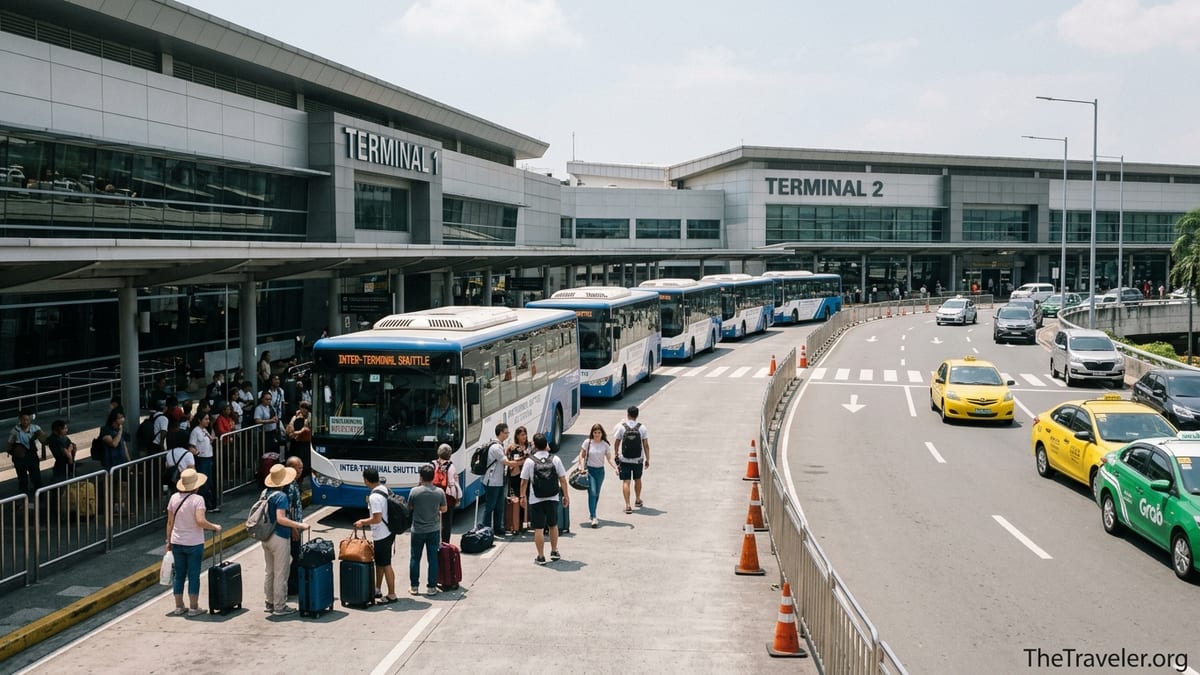
The official inter-terminal shuttle at NAIA is operated under the New NAIA Infrastructure Corporation (NNIC) and is intended primarily for passengers with ongoing flights. Recent improvements added more buses to the fleet, which has helped reduce gaps, but service can still feel slow when lines build up at busy times. The shuttle is free of charge, so you do not need to buy a ticket, just show proof of travel such as a boarding pass or itinerary when requested.
In practice, the shuttle runs 24 hours a day linking Terminals 1, 2 and 3 in a loop. At Terminal 3, for example, signs at the arrivals level point to a designated area near the transportation hub where buses for Terminal 1 and Terminal 2 board. At Terminal 2, a similar bay is located at the arrivals curb, and at Terminal 1, the waiting area is towards one end of the arrivals forecourt. Look for blue or airport-branded shuttle buses and posted boards referencing the airport transfer service. If you are confused, the simplest approach is to step to the nearest information counter and ask specifically for the “inter-terminal shuttle for passengers.”
Headways can vary. Some travelers in 2025 and 2026 report buses arriving roughly every 15 to 20 minutes at peak hours, but lines extending such that they actually board 30 to 40 minutes after queuing. At quieter times overnight or mid-day, you may board the next bus almost immediately. The ride itself, from Terminal 3 to Terminal 1 or 2, typically takes around 10 to 20 minutes when the access road is flowing, but can slow significantly if multiple flights arrive and the internal roads clog with private vehicles and taxis.
Because the shuttle is free and relatively convenient once you are on board, it is an excellent option when you have a generous buffer. As a concrete example, a family arriving on a Korean Air flight into Terminal 2 in the early afternoon with a five-hour gap before a Cebu Pacific domestic departure from Terminal 3 can comfortably clear immigration, collect their bags, join the line for the shuttle, and still reach Terminal 3 in good time to check in and maybe have a meal. The same journey with only a 90 minute connection window during the Friday evening rush would be much riskier.
Taxis, Grab and Other Ground Options Between Terminals
When time is tight or when you are traveling with a lot of luggage or young children, paying for a private vehicle can be worthwhile. You have three main options at NAIA: metered taxis, fixed-fare “coupon” taxis sold at airport booths, and ride-hailing services such as Grab, which has dedicated pick-up zones and booths in the terminals. All three can be used just to move between terminals, not only for trips into the city.
Short terminal-to-terminal rides are not expensive in absolute terms, although pricing feels high relative to distance. As a rough reference, a GrabCar or GrabTaxi ride from Terminal 3 to Terminal 1 off peak might cost in the low hundreds of pesos, while older accounts of opportunistic street taxis charging four-digit “special” rates for the same short hop highlight why many locals prefer booking through the Grab app or going to an official coupon taxi desk. In coupon taxis, you pay a fixed fare based on a published table, which reduces haggling and scams. When in doubt, ask at the official airport transport counters just outside arrivals.
Ride-hailing has become the default for many tech-savvy travelers because fares are shown upfront in the app and vehicles can be tracked. For example, a traveler arriving at Terminal 3 at 11:00 at night who needs to catch a flight from Terminal 1 at 01:30 might open Grab while still walking out of customs, select Terminal 1 as the destination, and be in a car within 10 to 15 minutes if demand is moderate. The drive along the NAIA perimeter can take as little as 10 minutes at that hour. Even assuming some buffer for a queue at check in and security, that passenger would have more than an hour in hand.
Meters and apps, however, do not control traffic. During late afternoon and early evening, especially on Fridays and at the start or end of Philippine holiday periods, the airport roads back up with family cars, hotel shuttles and buses. In these windows it is not unusual for a seemingly trivial terminal hop to take 30 minutes or more in crawling traffic. If your onward flight has strict check-in cutoffs, it is safer to assume the longer end of that range and plan your layover accordingly rather than gambling on ideal conditions.
Bags, Check‑through Policies and What Happens in Reality
Your baggage situation has a big impact on how easy or stressful a terminal transfer will feel. At NAIA, bags are generally reclaimed when changing terminals, even on international connections, unless your flights are on a single ticket with an airline or alliance that specifically offers interline transfer at Manila. Philippine Airlines, for instance, can through-check bags between many of its international arrivals and domestic departures when everything is on one booking, and may offer its own transfer assistance and buses between Terminals 1 and 2 for eligible passengers.
For most travelers, especially those mixing different airlines or low-cost carriers, the process is more manual. After landing, you clear immigration, collect your checked luggage from the carousel, pass customs and exit into arrivals. You then either find the NNIC inter-terminal shuttle or hire a taxi or Grab to the next terminal. On arrival at the new terminal, you re-check your bags at the airline counter, pass through security and, if applicable, immigration, then proceed to your gate. Each of these steps can involve queues, particularly at busy periods when multiple flights open check in at once.
To illustrate, imagine you arrive into Terminal 1 at 07:00 on an Emirates flight from Dubai with two checked bags and a separate-ticket AirAsia domestic flight from Terminal 2 at 11:30. If immigration lines move reasonably, you might be landside with your bags by 08:00. From there, taking the inter-terminal shuttle or a Grab to Terminal 2 could have you at the check-in counters by 08:30 or 08:45 in typical traffic. You would then join the AirAsia counters, drop your bags and still have an hour or more to clear security and reach the gate. The same itinerary with only two hours between flights would leave almost no margin for a delayed arrival, long immigration queues or a stalled shuttle.
Because of these uncertainties, travelers on separate tickets often choose to travel with hand luggage only when transiting Manila, particularly if they have less than four hours between flights. Without checked bags, you move much faster: straight from immigration to the exits, then into a shuttle or taxi, and directly to your next terminal’s security checkpoint. Those savings can make the difference between a comfortable and a nerve-wracking connection when traffic or queues are worse than expected.
How Much Time to Allow: Realistic Connection Windows
Connection times that might be routine at highly integrated Asian hubs such as Singapore Changi or Seoul Incheon are often too tight for Manila, especially when you must change terminals. While each trip is unique, some patterns have emerged in recent traveler experiences and airline guidance. The safest strategy is to think in terms of “door to door” time: from when your arriving aircraft’s door is opened, to when you need to be at the check-in counter or gate of your onward flight.
For international to domestic connections involving a terminal change and baggage collection, many frequent Manila flyers now view 3.5 to 4 hours as a comfortable minimum. This allows around 30 to 60 minutes for immigration and baggage, 20 to 40 minutes to reach the next terminal using the shuttle or a vehicle, and another hour or more for check in and security. Elderly passengers, families with children, or anyone unfamiliar with the airport would be wise to err closer to four hours, particularly in the afternoon and evening when airport and city traffic is more unpredictable.
Domestic to international transfers with a terminal change are similar. For instance, arriving from Cebu into Terminal 3 on a domestic flight at 14:00 and catching a long-haul departure from Terminal 1 at 19:00 gives you roughly five hours. Even if your Cebu flight lands 45 minutes late, you should still be able to collect your bags, ride the shuttle or a taxi to Terminal 1, and meet the common three-hour pre-departure check-in expectation for long-haul flights. Trying the same connection with only 2.5 hours would leave little room for disruptions, especially if you land at a busy bank of arrivals when the shuttle queues are long.
Domestic to domestic transfers, especially if both flights use the same terminal, can be faster. A through-ticketed Philippine Airlines itinerary from Davao to Manila to Laoag, both via Terminal 2, might be safely sold with a 90-minute connection, with bags checked through and airline staff able to assist if the inbound is delayed. However, if your domestic connection requires changing terminals on separate tickets, it is prudent to treat it like an international to domestic transfer and build in similar buffers, because you still face the same landside transfer and queue risks.
Managing Manila Traffic and Peak Times
One of the defining challenges of NAIA is not the distance between terminals but the roads that connect them. Manila’s airport complex is enmeshed in the broader traffic patterns of Metro Manila. The NAIA Expressway has improved access between some parts of the city and the terminals, but the last stretches in and out of the terminal forecourts still clog easily with private cars, buses and transport vans dropping off and picking up passengers.
Morning peaks often occur between roughly 05:00 and 09:00, when many international flights arrive and local passengers head to early domestic departures. Evening peaks are common between 16:00 and 20:00, coinciding with end-of-day city traffic and another wave of long-haul departures. Holiday periods such as Holy Week, All Saints’ Day, Christmas and New Year intensify congestion, with vehicles lining up well outside the immediate terminal zone. During these windows, what is nominally a 3 kilometer drive between terminals can easily feel like inner-city rush hour.
The practical implication is that you should not judge transfer time by distance alone. If your international flight lands at 17:00 on a Friday at Terminal 1 and you have a separate domestic departure from Terminal 3 at 20:00, your three-hour gap may be technically possible but operationally stressful. Long immigration queues, a slow baggage carousel, a full shuttle and bumper-to-bumper traffic at the terminal rotundas could erode your margin quickly. In contrast, a 03:00 arrival with a 06:00 onward flight may face far lighter road traffic, though you can still encounter slow baggage or security lines.
Travelers with flexibility sometimes plan longer Manila layovers to sidestep these bottlenecks. For example, families traveling with seniors often choose five or six hours between flights, allowing time for a sit-down meal in the departure terminal, some rest, and a buffer for any airport road issues. Others deliberately pick connections that keep them in the same terminal, even if it means flying a different carrier, to avoid the added risk of crossing the airport’s busy perimeter roads altogether.
Terminal 4’s Redevelopment and What It Means for Transfers
For years, Terminal 4 served as a small, crowded domestic terminal used by several low-cost airlines operating turbo-prop and short-haul flights. In recent infrastructure plans and announcements, the area formerly used as Terminal 4 has been earmarked for redevelopment to support improved airfield operations, with airlines progressively relocating to the main terminals. This has reduced the number of passengers needing to shuttle specifically to or from the old Terminal 4 apron.
Nonetheless, travelers may still see references to Terminal 4 on older tickets, blogs or airport signage while the transition is fully implemented. If your airline previously operated from Terminal 4, check recent communication and your booking confirmation for updated terminal assignments. Carriers that historically used the old domestic terminal have been shifted into the main terminal complex, simplifying some connection patterns but also concentrating more traffic in the remaining buildings.
From a transfer perspective, the key message is that future improvements and consolidation are aimed at making inter-terminal movement less chaotic, but the physical reality in 2026 is still that you move landside between distinct buildings. Even as new shuttle buses, revised road layouts and potential rail links are proposed or rolled out, travelers in the near term should plan as if NAIA remains a fragmented airport where terminal transfers always require extra padding.
The Takeaway
Transferring between terminals at Manila’s NAIA remains one of the more challenging connections in Asia, not because of massive distances, but because of separated buildings, landside-only links and the unpredictability of Manila traffic. The official NNIC inter-terminal shuttle is free, useful and improving, but it is not a high-frequency rail link that you can rely on for tight, 60-minute turnarounds. Taxis and ride-hailing services add flexibility but are still at the mercy of the same congested access roads.
To protect your trip, build in generous time, especially for any international to domestic or domestic to international transfer on separate tickets. For many travelers, 3.5 to 4 hours is the new normal minimum when a terminal change is involved, with longer buffers recommended during peak periods or when traveling with checked bags, children or older relatives. Whenever possible, choose itineraries that keep you in one terminal or on a single ticket with through-checked baggage, and use the shuttle or official taxis instead of informal offers.
Approached with realistic expectations and a conservative schedule, NAIA connections can be manageable. Know which terminal you are arriving at and departing from, understand how the shuttle and ground transport options work, and factor in Manila’s traffic rhythms. With that preparation, you can turn what might otherwise feel like a chaotic scramble into a predictable, if still busy, part of your journey.
FAQ
Q1. Is the NAIA inter-terminal shuttle free, and who can use it?
The official inter-terminal shuttle linking Terminals 1, 2 and 3 is free for passengers with ongoing flights. You may be asked to show a boarding pass or itinerary, but in practice staff often use their discretion. It is not designed for people who are not flying the same day.
Q2. How much time should I allow for an international to domestic connection with a terminal change?
For most travelers collecting bags and changing terminals, allowing around 3.5 to 4 hours is sensible. This covers immigration, baggage claim, a shuttle or taxi ride between terminals and check-in and security queues at your onward domestic flight.
Q3. Is 2 hours enough to transfer between terminals in Manila?
Two hours can be enough in perfect conditions, but it leaves very little room for delays in immigration, baggage, traffic or shuttle queues. For separate tickets or any international connection, it is generally considered risky to plan only two hours between flights at NAIA.
Q4. Should I use the shuttle or Grab/taxi to move between terminals?
The shuttle is free and useful when you have plenty of time. Grab or official taxis are more flexible and can be faster when roads are clear, but fares apply. In heavy traffic, both can be slow, so the more important factor is how much buffer time you have rather than the mode itself.
Q5. Can I stay airside when transferring between NAIA terminals?
In almost all cases, no. NAIA’s terminals are not connected airside, so you must clear immigration and customs if arriving internationally, exit into the public arrivals area, and then move landside to the next terminal before re-clearing security.
Q6. What happens to my checked bags when I change terminals?
If your flights are on one ticket and your airline offers through-checking at Manila, your bags may be tagged to your final destination and transferred for you, especially on full-service carriers. On separate tickets or low-cost carriers, you almost always need to collect bags at arrivals, take them to the next terminal and check them in again.
Q7. Is it safe to walk between NAIA terminals?
Walking is realistically only an option between Terminals 1 and 2 for fit travelers with light luggage, and even then it involves roadside sections and exposure to heat and pollution. Walking between any terminal and Terminal 3, or to the former Terminal 4 area, is not recommended for most passengers.
Q8. How do peak times in Manila affect terminal transfers?
Morning and evening peaks, especially around 05:00 to 09:00 and 16:00 to 20:00, and major holidays can significantly slow traffic on airport access roads. During these times, short drives between terminals may take 30 minutes or more, so it is wise to build in extra time for connections.
Q9. Are there special transfer services for passengers flying Philippine Airlines?
Philippine Airlines often provides additional transfer support and its own buses between terminals for eligible connecting passengers on single tickets, particularly between its international and domestic operations. If you are flying PAL on one booking, check your confirmation or ask the airline about dedicated transfer arrangements at NAIA.
Q10. What if my inbound flight is delayed and I miss my separate-ticket connection?
If flights are on separate tickets, the onward airline is usually not obliged to rebook you for free if you miss your connection, even if the delay was beyond your control. This is why travelers using separate tickets through Manila often choose long layovers, avoid checking bags when possible, and consider flexible or changeable fares for the second leg.