


Landing at Montego Bay’s Sangster International Airport is the start of most Jamaica beach holidays. The very next question, usually after immigration and customs, is how to get safely and efficiently from the terminal to your resort. This guide walks you step by step through using authorized airport taxis at MBJ, what fares to expect, where the official desks are located, and how to avoid common pitfalls with informal drivers.
Get the latest updates straight to your inbox!
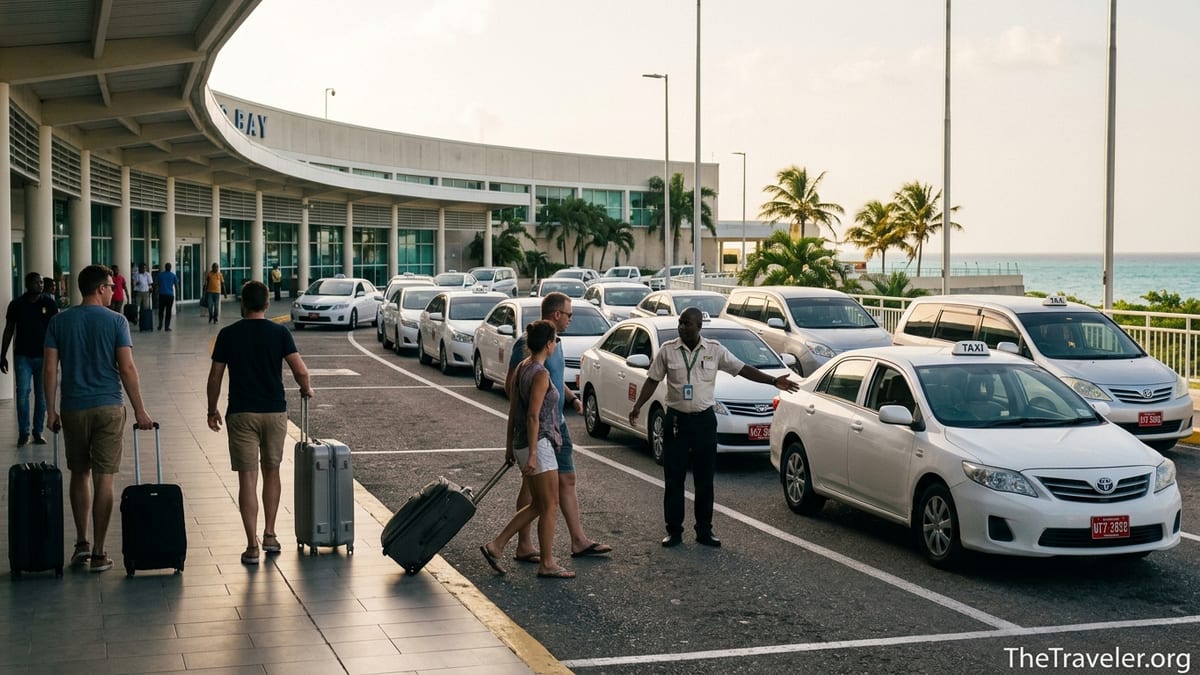
How Airport Taxis Work at Montego Bay (MBJ)
Sangster International Airport in Montego Bay is Jamaica’s busiest tourist gateway, and the airport has a structured system for ground transportation. Inside the arrivals area, visitors pass through immigration, collect their bags, clear customs, and then enter the Ground Transportation Arrivals Hall. This is where you will see a mix of hotel lounges, tour operator counters and the desks for official airport taxis.
There are two licensed airport taxi companies based at MBJ: JUTA and JCAL. Both operate under a government concession for airport taxis and share a single “Authorised Airport Taxi” desk just outside the customs exit in the ground transportation zone. Staff at this combined JUTA / JCAL desk quote fares, issue a receipt and then radio a driver, rather than leaving you to haggle with individual drivers in the car park.
Unlike in some cities, Montego Bay does not use metered taxis from the airport. Fares are set point to point and quoted in US dollars or Jamaican dollars before you get in the vehicle. The dispatcher will normally ask your hotel name rather than the street address, since almost every major resort and guesthouse near Montego Bay is on their route list. Prices are based on the general area, such as the Hip Strip, Rose Hall, or further afield destinations like Negril, Ocho Rios or the south coast.
Vehicles operating as authorised airport taxis are usually white or light coloured cars, minivans or small buses displaying JUTA or JCAL branding and a red licence plate. Cars may be modest sedans, while groups are often placed in Toyota Hiace or Coaster minibuses. You should not expect luxury vehicles by default, although some resorts and tour companies do offer upgraded cars or SUVs via separate pre-booked desks.
Finding the Authorized Taxi Desks Step by Step
After you clear customs at MBJ, you walk through a short corridor into the public arrivals zone. On one side are small lounges for major resorts and tour operators, often with staff holding signs for guests who have pre-booked transfers. Look for familiar names like Sandals, Secrets, Iberostar or RIU. If you have a transfer included in your package, you should go straight to your resort’s lounge and follow their instructions instead of using the taxi desk.
If you need a regular taxi, continue straight ahead following the “Ground Transportation” signs. The shared Authorised Airport Taxi desk for JUTA and JCAL is usually positioned just outside the main exit doors or immediately adjacent to them. The counter is clearly marked with “Authorized Airport Taxi” and the companies’ logos, and there is typically a dispatcher in a uniform shirt with an airport or JUTA / JCAL badge.
Walk directly to this desk before speaking with anyone else offering rides. Tell the dispatcher the name of your hotel or the approximate area. For example, you might say “RIU Reggae in Montego Bay,” “Hyatt Ziva Rose Hall,” or “Royalton Negril.” The staff will check a fare chart and quote you a total price, often in both US and Jamaican dollars. If you agree, they will issue a ticket or receipt and then lead you or direct you to the correct waiting taxi just outside the terminal.
In the same Ground Transportation Hall, you will also notice counters for private transfer companies and shared shuttles that mostly serve guests who have already booked online. Names change over time, but examples include island tour operators and hotel partners with numbers, such as desk 5 or 14. These desks are legitimate, but prices and terms are set by each company. If you have not reserved ahead, the simplest approach remains the common JUTA / JCAL taxi desk where rates and process are standardized.
Typical Fares and What to Expect to Pay
Because MBJ airport taxis are not metered, it is important to have a rough idea of typical fares before you arrive. Exact prices change periodically, and exchange rates between US dollars and Jamaican dollars fluctuate, but ranges remain relatively stable in the short term. The dispatcher will quote the current rate on the day, and you should treat any figures here as approximate benchmarks rather than fixed tariffs.
For resorts close to the airport around the Hip Strip and central Montego Bay, such as properties on Gloucester Avenue or near Doctor’s Cave Beach, a one way authorised taxi for up to three or four passengers often falls in the region of 15 to 30 US dollars, depending on the specific location and time of day. Many travelers report paying roughly the cost of a casual restaurant lunch per car for these short hops, which typically take 10 to 15 minutes without traffic.
For the Rose Hall resort strip east of the airport, home to hotels like Hilton Rose Hall, Hyatt Ziva and Zilara, Half Moon, Iberostar and Jewel Grande, fares are higher due to the longer distance along the coastal highway. Expect the dispatcher to quote a one way fare in the ballpark of 35 to 60 US dollars for a standard car, again usually covering up to three or four passengers. The drive is usually 15 to 25 minutes, and while this can feel like a noticeable upfront cost, it is still competitive compared with many resort-town airports worldwide.
Longer routes such as Montego Bay airport to Negril, Ocho Rios or Runaway Bay cost significantly more because they involve one and a half to two and a half hours of driving each way. Travelers frequently report authorised taxi prices to Negril that hover around a three-figure US dollar amount for the vehicle one way, with Ocho Rios and the north coast beyond Falmouth typically in a similar or slightly higher range. At this distance, many visitors consider pre-booked private transfers or even domestic flights or chartered shuttles when available, especially for family groups or those carrying bulky luggage.
Resort Routes: What to Expect by Area
Most international visitors arriving at Montego Bay are heading to an all inclusive resort, and the airport taxi system has evolved around those patterns. The easiest routes for drivers are to the Montego Bay urban area and its immediate resort zones. If you are staying at a downtown guesthouse, a villa in Ironshore, or a hotel on the Hip Strip, expect a quick ride largely on city roads with some ocean views. Drivers are typically very familiar with major landmarks, but it helps to have your booking confirmation handy with the full property name.
East of the airport, the Rose Hall corridor lines the coast for several kilometers with large beachfront resorts, golf courses and gated communities. A ride from MBJ to a Rose Hall resort is straightforward along the A1 highway, and most drivers do this route many times a day. Traffic can slow at peak check in and check out windows, especially on Saturdays, but the road itself is modern, and the journey is generally smooth. If three or four couples are arriving on the same flight and heading to neighboring Rose Hall resorts, it can be cost effective to share one authorised taxi and split the fare.
Travelers continuing beyond Rose Hall to Falmouth, Runaway Bay, Ocho Rios, or even Port Antonio will spend much longer in the car. The coastal highway is scenic, and authorised airport taxis are accustomed to these routes, but fatigue after a long international flight can make a two hour road transfer feel taxing. Some visitors choose to break their journey with a short stay in Montego Bay first, while others pre-arrange a private transfer with extra comfort features like cold drinks and scheduled rest stops. For high end south coast resorts that are several hours from MBJ, the resort may suggest a charter flight from the airport’s small domestic terminal instead of a road taxi.
On the western side, the route to Negril follows the coast through the outskirts of Montego Bay, Lucea and then down towards the famous Seven Mile Beach. Road conditions are generally acceptable, but traffic and road works can slow progress, so a transfer advertised as 75 minutes can easily stretch closer to two hours. Because of the distance and cost, many travelers heading to Negril either use a dedicated private shuttle company that groups guests by resort or take advantage of transfers included in package deals when offered.
Late Arrivals, Luggage and Family Travel
Sangster International Airport handles flights well into the evening, and authorised taxis operate in step with those arrivals. The JUTA / JCAL desk and dispatch operation runs for the airport’s full passenger schedule, so you can expect to find official taxis even if your flight lands late at night. That said, the atmosphere changes after dark, with fewer staff at some resort lounges and a quieter terminal. If you are arriving on a late flight, plan to head straight to the taxi desk without lingering, so that you are on your way promptly.
Authorised airport taxis are used to handling holiday luggage. Standard sedans can comfortably manage two full size suitcases and two carry ons for a couple. For families or groups with more bags, strollers or sports equipment such as golf clubs, the dispatcher will assign a minivan or small bus. In many reported cases, fares are quoted per vehicle rather than per piece of luggage, but it is still worth confirming whether there are any surcharges for oversized items before you finalize the ticket.
Traveling with young children raises questions about car seats. In Jamaica, taxi drivers are not routinely required to provide child seats, and most standard airport taxis do not carry them by default. Families who prioritize this safety feature often bring a portable travel car seat or booster in their checked luggage or arrange a private transfer service in advance that guarantees an age appropriate seat. If you are flying in with an infant or toddler, it is important to plan for this ahead of time rather than expecting the airport taxi desk to supply one on request.
For passengers with mobility issues, the authorised taxi operators can usually provide a suitable vehicle if you explain your needs clearly at the desk. A low step minivan often works better than a sedan for those with limited mobility. Visitors who use a wheelchair should consider contacting a specialist transfer company in advance or asking their resort to arrange accessible transport, then going directly to that operator’s desk in the arrivals hall.
Paying for Taxis: Cash, Cards and Currency
At MBJ, many visitors pay for taxis in US dollars, which are widely accepted in the tourist economy. The authorised taxi desk will generally quote your fare in US dollars and may also mention the approximate Jamaican dollar equivalent. Bills of 1, 5, 10 and 20 dollars are convenient for short rides. If you plan to pay in Jamaican currency, there are ATMs and currency exchange counters at the airport, but you should expect a less favorable rate than using a bank ATM in town.
Whether the authorised taxi desk accepts credit or debit cards can vary over time and by operator policy. Some dispatch counters have point of sale terminals and can process major cards, while others prefer or require cash, especially for shorter urban rides. Even when cards are accepted, connectivity issues can delay processing. For that reason, many experienced travelers carry at least enough cash in US dollars to cover the expected taxi fare from the airport to their resort, plus a modest tip.
Tipping is customary but not strictly mandatory. For short rides within Montego Bay, rounding up the fare or adding a couple of dollars for good service is common. For longer transfers such as Montego Bay to Negril or Ocho Rios, adding around ten percent of the fare is a reasonable guideline if the driver is courteous, drives safely and handles luggage carefully. Tips are best given in cash at the end of the ride.
If you booked a prepaid private transfer through a tour company or resort desk in the arrivals hall, confirm whether your payment has been made in full in advance or if there is a balance due on arrival. In many cases, third party websites charge the full amount online and you only need extra cash for tipping. Keeping a printed or digital copy of your confirmation helps avoid confusion at the desk.
Avoiding Informal Drivers and Common Pitfalls
Like many busy tourist airports, Montego Bay sees a mix of official and unofficial drivers looking for arriving passengers. The simplest way to stay safe is to go directly to the Authorised Airport Taxi desk or to your resort or tour operator’s official counter and avoid accepting rides from anyone who approaches you in the terminal or outside holding a handwritten sign you do not recognize. Legitimate taxi drivers working under the airport concession operate through dispatch and should not be hustling for individual fares inside the building.
Informal drivers may offer lower prices or claim that the authorised desk is more expensive or closed. In very rare cases, scammers might use the name of a well known company without actually being affiliated. If someone approaches you, politely decline and continue walking to the Ground Transportation Hall and the clearly marked taxi desk. The peace of mind of using a licensed, traceable operator is generally worth more than any small savings promised by an unofficial driver.
A common pitfall for first time visitors is accidentally agreeing to an unmetered ride without a confirmed price. Because taxis in Montego Bay do not run on meters, you should always know the full fare before you get into the vehicle. At the JUTA / JCAL desk, the dispatcher quotes a price, and you can clarify whether it is per taxi or per person, and whether it includes all passengers and luggage. Once you have a ticket or written receipt, there is less room for misunderstanding at the destination.
Another point to watch is shared rides that are not clearly labeled as such. While some pre-booked shuttle services legitimately group travelers going to the same resort area to keep prices lower, an informal driver may suggest adding “just one more stop” along the way, which can lengthen your journey. If you have paid for a private transfer, be clear that you expect to go directly to your resort. If you are comfortable sharing to save money, agree on that arrangement and the total fare in advance.
Shuttles, Buses and Alternatives to Airport Taxis
Authorized airport taxis are the default option at MBJ, but they are not the only way to leave the airport. Some large all inclusive brands include group transfers in their room rates or package deals. In these cases, resort representatives meet guests in the arrivals hall and guide them to dedicated coaches or minibuses parked in a reserved area. While this can mean waiting for other guests from the same flight to clear immigration, it eliminates the need to pay separately for a taxi.
A popular alternative for longer inter city journeys is the Knutsford Express coach service, which operates air conditioned buses between Montego Bay and other Jamaican cities. The company maintains a terminal right next to Sangster International Airport, a short walk from the arrivals area. Travelers sometimes use an authorised taxi or a short walk to reach the Knutsford terminal, then take the coach onward to destinations such as Kingston, Negril or Port Antonio, and finally a local taxi to their accommodation. This approach can be cheaper than taking a single long airport taxi ride for solo travelers or couples comfortable managing their luggage.
Within Montego Bay city itself, there are also route taxis, local minibuses and charter cars that Jamaicans use for everyday transportation. These are not the same as the authorised JUTA / JCAL airport taxis and can be confusing for visitors unfamiliar with the system. For safety and simplicity, most new arrivals stick to the airport taxis or pre-arranged hotel transfers at least for the first journey from MBJ to their accommodation, then explore local transport options later if they wish.
Ride hailing apps that are familiar in North America and Europe, such as Uber or Lyft, are not widely available or officially operational in Montego Bay at the time of writing. Some visitors do use locally developed ride apps or arrange drivers through messaging, but these options remain informal compared with the authorised airport taxi system. Until app based services become firmly established and regulated, relying on licensed airport taxis or reputable transfer companies remains the more straightforward choice for most travelers.
The Takeaway
Getting from Montego Bay’s Sangster International Airport to your resort does not need to be stressful. The airport’s authorised taxi system, led by JUTA and JCAL from a shared desk outside the customs exit, offers a predictable, regulated way to start your trip. By heading straight to the official counter, confirming your fare before you leave, and ignoring unsolicited offers from informal drivers, you dramatically reduce the chances of misunderstandings or overcharging.
Having a realistic sense of typical fares by area helps you budget. Expect modest prices for short rides within Montego Bay, higher but still reasonable costs for the Rose Hall corridor, and significantly more for long coastal routes to Negril, Runaway Bay or Ocho Rios. If you are traveling with a group, sharing a single authorised taxi or pre booking a private shuttle may bring the per person cost down. Families with young children, guests with mobility needs and late night arrivals should plan a little extra in advance, especially around car seats and accessibility.
For those looking beyond taxis, resort included transfers and the nearby Knutsford Express coach terminal give you additional options, particularly for cross island travel. Whatever you choose, the key principles remain the same: use official desks, confirm prices and expectations up front, and keep the first leg of your Jamaican adventure as stress free as possible so you can focus on the beaches, reggae and warm hospitality that brought you to Montego Bay in the first place.
FAQ
Q1. Where exactly do I find the authorised taxi desk at Montego Bay airport?
The authorised JUTA / JCAL taxi desk is located in the Ground Transportation area just after you exit customs at Sangster International Airport. Follow the “Ground Transportation” signs, and you will see a clearly marked “Authorised Airport Taxi” counter near the main exit doors, staffed by uniformed dispatchers.
Q2. Are taxi fares from Montego Bay airport fixed or do I have to negotiate?
Fares are not metered, but the authorised taxi desk uses a standard point to point fare chart. The dispatcher will quote a set price based on your hotel or area before you travel. You do not need to haggle, although you can ask for the amount in both US and Jamaican dollars to be sure you understand it.
Q3. How much should I expect to pay from MBJ to a hotel on the Hip Strip?
Exact fares change over time, but a typical one way authorised taxi fare for up to three or four passengers from the airport to the Hip Strip or central Montego Bay usually falls in the rough range of the cost of a casual restaurant meal in US dollars. Confirm the precise price with the dispatcher on arrival.
Q4. Is it safe to arrive late at night and still get an authorised taxi?
Yes. Authorised airport taxis operate in line with the airport’s flight schedule, and the JUTA / JCAL desk is staffed for incoming flights throughout the evening. For peace of mind, walk directly to the official taxi desk after customs and avoid lingering in the arrivals area.
Q5. Can I pay for my airport taxi by credit card?
Some authorised taxi desks can process major credit or debit cards, but cash is still the most reliable method, particularly for short rides. It is wise to carry enough US dollars in small bills to cover your expected fare and tip in case card terminals are unavailable or connectivity is poor.
Q6. Do airport taxis in Montego Bay provide child car seats?
Most standard authorised airport taxis do not carry child car seats as a matter of routine. If you need one, the safest approach is to bring your own travel seat or pre arrange a private transfer service that explicitly guarantees an appropriate child seat in the vehicle.
Q7. What is the difference between an authorised airport taxi and a regular street taxi?
Authorised airport taxis at MBJ operate under a formal concession, work through the official desk, and use set point to point fares. Street taxis may not be licensed to pick up at the airport, and arrangements are usually made directly with drivers. For new arrivals, using the authorised desk offers clearer pricing and stronger oversight.
Q8. Should I tip my airport taxi driver in Jamaica?
Tipping is customary but not compulsory. For short rides within Montego Bay, rounding up the fare or adding a small amount in US dollars is common. For longer journeys such as to Negril or Ocho Rios, adding around ten percent of the fare is a reasonable guideline for good service.
Q9. Are there cheaper alternatives to taking a taxi for long distances from MBJ?
Yes. For long cross island journeys, some travelers use the nearby Knutsford Express coach service combined with short local taxi rides at each end, or they book shared shuttles that group passengers by resort area. These options can be cheaper per person than a private airport taxi, although they may involve more time and logistics.
Q10. How can I avoid unlicensed or informal drivers at Montego Bay airport?
Ignore unsolicited offers of rides inside or just outside the terminal, even if the person uses the name of a well known company. Walk directly to the Authorised Airport Taxi desk or your resort’s lounge, confirm your booking or fare there, and only board vehicles assigned through those official channels.