


Renting a car on Mykonos can be the difference between jostling for space on crowded buses and slipping away to quiet coves on your own schedule. It can also be stressful if you arrive unprepared for tight parking, steep lanes and sometimes patchy insurance coverage. This guide explains, in practical terms, how car hire works on Mykonos in 2026, using real examples of prices, locations and conditions so you can decide confidently whether driving is right for you.
Get the latest updates straight to your inbox!
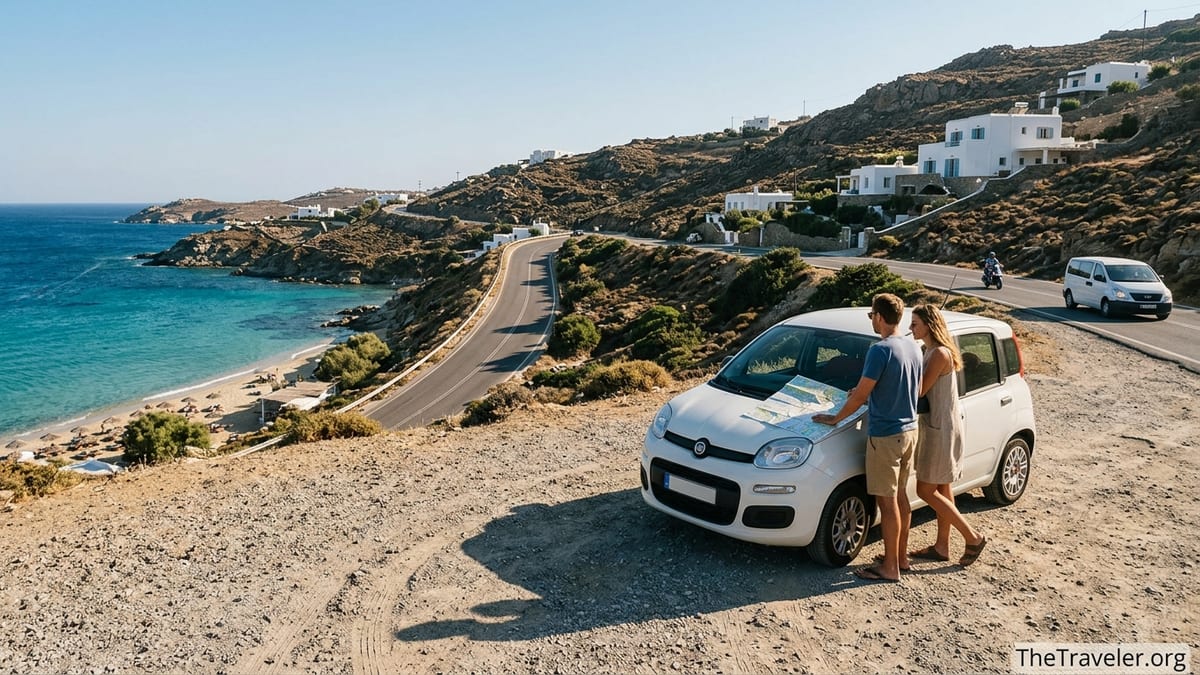
Should You Rent a Car on Mykonos?
The first decision is whether you actually need a car. Mykonos is a compact island, roughly 15 kilometers across, but its beaches and hilltop villages are scattered and public buses do not cover every bay late into the evening. In July and August, buses between Mykonos Town and major beaches such as Paradise, Super Paradise and Elia can be standing-room-only, with long queues in the late afternoon. A rental car gives you direct access to less crowded spots like Fokos Beach in the north or Agios Sostis, where buses do not run regularly.
On the other hand, driving on Mykonos is not like cruising an American freeway. Many access roads to beaches narrow to a single lane between stone walls, with tight hairpin bends and limited pull-out space. Travelers who rented small hatchbacks such as a Nissan Micra or Fiat Panda often report that even these compact cars can feel large on the steep access roads to beaches like Agios Ioannis or parts of the south coast. If you are nervous on hills, unused to manual transmissions or uncomfortable reversing on narrow roads, a car may add stress rather than freedom.
Think about where you are staying. If you are in or very close to Mykonos Town (Chora) and mainly plan to enjoy nightlife, shopping and one or two well-served beaches like Ornos or Platis Gialos, you can often rely on buses, taxis and organized boat trips. Guests staying in villas above Elia, Kalo Livadi or Panormos, or in more remote northern properties, tend to benefit most from having a car because taxis are limited and waits can be long on busy nights.
Finally, consider your budget and group size. In June 2026, typical online quotes for a basic “mini” car from airport agencies start around 40 to 50 euros per day when booked ahead, rising significantly in late July and August. For a couple or family of three sharing costs, that can compare favorably with repeated taxi rides from the port, town and beaches. Solo travelers focused on a few key beaches may find the expense less compelling.
Where and How to Pick Up Your Rental: Airport, Port and Town
Most visitors arrive at Mykonos by air or ferry, and in both cases it is simple to collect a rental if you plan ahead. At Mykonos International Airport (JMK), four major brands maintain desks directly in the small arrivals hall: Avance, Avis Budget, Hertz and Sixt. Their counters sit a short walk from baggage claim and cars are parked just outside the terminal, so there is no off-site shuttle as you might experience at a large European hub. Typical opening hours in summer stretch from early morning until close to or past midnight, though exact times vary by company.
If you prefer to compare several local agencies, many Mykonos-based firms offer “meet and greet” service at the airport. With these, a staff member waits in arrivals with a sign and walks you to a nearby parking area where the handover takes place. Companies sometimes charge a small out-of-hours fee for pickups after around 21:00, so it is worth confirming if your flight lands late. For example, one international brand operating on the island notes that arrivals after 21:00 require prearranged after-hours service and may involve a modest surcharge.
Ferry passengers can also arrange port pickup. Large ferries and many fast catamarans now use the New Port at Tourlos, a few kilometers north of Mykonos Town. Several local rental agencies maintain small kiosks or dispatch staff to meet clients as they disembark. A typical arrangement is that you send your ferry details in advance, then an employee meets you at the gate and walks you to a nearby lot. Some international chains will instead provide a free or low-cost shuttle from the port to their main town office; this can be more comfortable if you are arriving with heavy luggage at midday when the sun is intense.
If you only plan to drive for a day or two, another strategy is to wait and rent from a town-based office once you are settled. You can walk around the fringes of Mykonos Town or Ornos and compare several agencies side by side. Town offices may also be more flexible if you want to pick up late morning and return after dinner, as they are used to short-term holiday rentals. The trade-off is that last-minute availability in peak season can be very limited and prices can spike, particularly for automatic cars, so advance online booking remains advisable in July and August.
Insurance, Deposits and Fuel: What to Expect
Greek rental contracts can feel complex, but most Mykonos agencies follow broadly similar patterns. Basic rates usually include third-party liability insurance, covering damage you may cause to other vehicles or property up to a defined limit. One well-known local company, for instance, lists third-party property damage coverage up to approximately 100,000 euros for standard cars. This base cover does not protect your own vehicle; if you scratch the side on a stone wall getting into a tight beach car park, you are liable unless you have purchased additional protection.
To reduce your risk, you will typically be offered a Collision Damage Waiver (CDW) or similar package. With CDW, the rental car is covered for collision damage but you remain responsible for an excess, often in the range of 600 to 1,200 euros for a small car on Mykonos, depending on brand and car class. Many agencies also sell “Super CDW” or “Full Damage Waiver” that further reduces or eliminates this excess for an extra daily fee. Read the exclusions carefully. Some renters report that even with an extra waiver, items like broken mirrors, underbody damage or scratched alloy wheels may be excluded, especially if caused by driving on unpaved or unauthorized roads.
Credit card holds are standard. International chains at Mykonos Airport commonly require a credit card in the main driver’s name and place a security block equivalent to the excess or a flat amount such as 500 to 1,500 euros. This is released after the vehicle is returned without new damage or unpaid fines, though it can take several days to clear on your bank statement. Smaller local agencies sometimes accept lower deposits or even cash, particularly for older manual models, but terms vary widely and should be confirmed when booking.
Fuel policies also differ. Many brands follow a straightforward “full to full” system, where you collect the car with a full tank and must return it full, keeping fuel receipts if asked to prove you filled up close to drop-off. Others, particularly local outfits, may deliver cars with a quarter tank and expect you to bring them back at a similar level, charging if you return it nearly empty. On a small island like Mykonos, fuel consumption is relatively modest, but do not underestimate costs if you plan multiple trips to far beaches; petrol prices in Greece are generally higher than in North America and can vary between stations.
Parking Realities in Mykonos Town and at the Beaches
Parking is often the most frustrating part of driving on Mykonos, especially in and around Mykonos Town. The historic center of Chora is entirely pedestrianized and private vehicles are not allowed into the narrow lanes. Instead, you park on the outskirts and walk in. Around the town, several informal and semi-organized parking areas exist, including large gravel lots near the Old Port and on the New Port road between Tourlos and town. Local rental firms describe these as suitable places to leave your car for a few hours while you explore, with walking times of 10 to 15 minutes into the center depending on the lot.
During high season evenings, from around 19:00 to midnight, these lots can fill up and drivers end up circling or parking further up the hillside. Free roadside parking is common on Mykonos, but you must be careful not to block driveways, bus stops or areas marked with yellow lines. Greek traffic police periodically ticket vehicles in no-parking zones around the port, and rental contracts make the renter responsible for all fines. Some boutique hotels on the edge of town, such as those in the Agios Stefanos or Megali Ammos areas, offer private or valet parking; if you are staying in town, ask explicitly whether your accommodation provides a reserved space.
At the beaches, the situation varies. Popular south coast spots like Platis Gialos, Ornos and Paradise have a mixture of small free areas and private paid lots managed by beach clubs or tavernas. A typical example is a dirt lot behind the beach where you pay a few euros in cash on entry or receive free parking if you rent sunbeds from a specific club. At more remote beaches like Fokos and Mersini, parking is often just an informal pull-off on the dirt approach road; space can disappear by mid-afternoon in August, and careless parking can block other cars from turning around.
Northern winds, known as the Meltemi, can also influence your parking decisions. On windy days, beaches on the north coast may be rough and less popular, shifting crowds to the more sheltered south beaches and increasing demand for parking there. When planning your day, it is wise to arrive at busy beaches before 11:00 if you want an easy parking spot, especially if you have a larger vehicle such as a compact SUV rather than a tiny hatchback.
Driving Conditions: Narrow Roads, Night Driving and Beach Access
The driving environment on Mykonos comes as a surprise to many visitors. Primary routes between the airport, New Port and Mykonos Town are paved and reasonably wide, but as soon as you turn toward most beaches or hilltop villas the roads narrow considerably. Stone walls, parked vehicles and sudden curves mean you often have to slow to a walking pace and sometimes reverse to a wider passing point when you meet oncoming traffic. This is especially common on the access roads down to smaller beaches and in residential areas above Ornos and Elia.
Road surfaces range from smooth asphalt to patched concrete and dirt. After dry, windy periods, sand can blow across the tarmac near some beaches, reducing grip. In wet conditions, polished concrete sections can be slippery. It is not unusual to encounter delivery trucks or hotel minibuses taking up most of the road, particularly around midday. Patience and low speeds are essential. Many experienced visitors recommend choosing the smallest car that comfortably fits your group and luggage, such as a Fiat Panda, Toyota Aygo or similar, rather than an oversized SUV that will be harder to maneuver.
Night driving adds another layer of challenge. Street lighting outside town is sporadic and many rural stretches are unlit. In summer, nightlife areas generate heavy late-night traffic, including scooters and ATVs sometimes driven by inexperienced riders. Returning from clubs at Paradise or Super Paradise around 02:00 or 03:00 can mean sharing narrow roads with drivers who may be tired or have been drinking. If you plan to enjoy cocktails or late-night parties, it is safer to use taxis, pre-booked transfers or club-operated shuttle buses whenever possible rather than driving yourself back to town.
Finally, be prepared for unconventional parking and turning situations at beach roads. Some dead-end lanes finish in a tight loop or small dirt area where you must execute several-point turns, often with other cars waiting. When you drive down to a beach, think about how you will get back out before taking the last available space. If a spot requires you to reverse uphill on loose gravel between parked scooters, it might be better to look for something slightly farther away but easier to exit.
ATVs, Scooters and Other Alternatives to a Car
Mykonos has a long history of visitors renting scooters and quad bikes, but attitudes and regulations have tightened in recent years due to safety concerns. Many local residents and repeat travelers now strongly discourage ATV use on the island’s main roads, pointing out that accident rates involving quads are disproportionately high compared with cars. Some people who live on nearby Cycladic islands and visit Mykonos regularly report seeing serious ATV accidents each year, particularly in peak season when both tourists and local drivers are rushing between beaches and nightlife spots.
Local rental agencies have responded with stricter age and license requirements. One Mykonos-based company specializing in scooters and ATVs sets the minimum age at 23 for scooters and 26 for quad ATVs and UTVs, and requires at least one year of driving experience. Contracts often make clear that material damage to the vehicle caused by the renter’s responsibility is not covered by their standard insurance and must be paid in full, including loss of rental income during repairs. Some also impose specific restrictions such as prohibiting scooters or ATVs from entering Mykonos Town or parking along certain main approach roads.
For many visitors, a small car or combination of buses and taxis is a safer alternative. Public buses connect Mykonos Town with Ornos, Platis Gialos, Paradise and several other beaches through much of the day, with schedules expanding in July and August. Taxi numbers on the island are limited, but ride-hailing apps, hotel-arranged transfers and private drivers fill some of the gaps. For example, some upscale beach clubs operate shuttle vans that run between town and their entrances in the evening for a fee or as part of table reservations.
If you are set on two wheels, consider renting from a reputable scooter company that emphasizes helmets, clear insurance terms and realistic power levels for beginners. Even then, it is essential to ride defensively, avoid alcohol entirely when driving and stay off the roads after dark if you are unfamiliar with the island. For most travelers, especially those without prior European scooter experience, a modest car offers a much better balance of flexibility and safety.
Who Should Avoid Driving on Mykonos
Driving on Mykonos is not for everyone. Visitors who are very new to driving, easily stressed in tight spaces or accustomed only to wide, straight highways are likely to find the combination of narrow roads, busy summer traffic and creative parking habits overwhelming. If you are a new driver or have not driven in the last few years, it is worth skipping car rental on this particular island and choosing destinations or accommodations with easy beach access on foot instead.
Anyone who plans to drink heavily or stay out late most nights should also arrange alternatives. Greek drink-driving laws are strict, and police conduct occasional roadside checks around major nightlife areas. Even without enforcement, navigating unlit, winding roads after a night of cocktails is simply unsafe. Consider staying near Mykonos Town and walking to bars, or rely on taxis and pre-arranged transfers to and from beach clubs; many groups now structure their evenings around a driver who remains sober and responsible for the car.
Travelers with mobility challenges may face a different set of concerns. While a car can make reaching certain villas or beaches easier, parking areas are often uneven dirt or gravel and access paths can include steps or slopes. If level access is important, work closely with your hotel to confirm whether they have on-site parking near the entrance and whether your planned beaches offer paved parking areas instead of rough tracks. In some cases, arranging a private driver familiar with accessible routes can be more comfortable than self-driving.
Finally, consider local regulations and your own documentation. Greece requires a valid driving license, and visitors from some countries outside the European Union may still be advised to carry an International Driving Permit along with their home license, depending on their rental company’s policy. If your license is very new or restricted, or if you cannot provide a major credit card for the deposit, many agencies will decline to rent to you. In such cases, organized excursions, buses and taxi transfers will be your main options for exploring the island.
The Takeaway
Renting a car on Mykonos can unlock quiet beaches, hilltop viewpoints and flexible day trips that are difficult to access by bus or taxi alone. Airport and port pickups are straightforward, with international brands and local companies offering meet-and-greet services, and a small manual hatchback is usually the most practical choice for the island’s narrow roads. Understanding how insurance works, what deposits are required and where you can realistically park near Mykonos Town and at the beaches will help you avoid unwelcome surprises.
At the same time, the island’s driving environment is demanding. Tight lanes, steep access roads, limited lighting and heavy summer traffic make it unsuitable for nervous or very inexperienced drivers, and the risks associated with ATVs and scooters are significant. For many visitors, a mix of walking, buses, taxis and occasional day rentals strikes the right balance, ensuring that travel between beaches remains a pleasant part of the holiday rather than a daily source of stress.
Before you book, honestly assess your comfort behind the wheel, your plans for nightlife and your accommodation’s location. If you do decide to drive, reserve well in advance for peak season, choose the smallest suitable car, take photos at pickup, keep speeds low and treat parking with patience. Approach Mykonos’ roads with the same respect you give its sea, and they can become a memorable, manageable part of experiencing the island on your own terms.
FAQ
Q1. Do I really need a car on Mykonos, or are buses enough?
For visitors staying in or near Mykonos Town and mainly visiting major beaches like Ornos, Platis Gialos and Paradise, buses can be enough, especially in high season when services are frequent. If you are staying in a remote villa, want to reach quieter beaches such as Fokos or Agios Sostis, or dislike crowded buses, a rental car will give you far more flexibility.
Q2. How much does it cost to rent a small car on Mykonos in summer?
In June 2026, advance online quotes for a basic small car from airport agencies typically start around 40 to 50 euros per day, with prices rising in late July and August. Last-minute rentals, automatics and larger vehicles can cost significantly more, so booking weeks ahead usually brings better rates and availability.
Q3. Is parking in Mykonos Town difficult?
Yes, parking around Mykonos Town can be challenging, particularly in the evening during July and August. The old center is pedestrian-only, so you must use edge-of-town lots or roadside spaces and then walk 10 to 15 minutes into the center. Arriving earlier in the evening or choosing accommodation with its own parking can make the experience easier.
Q4. What kind of insurance should I get for a Mykonos rental car?
At minimum, your rental will include third-party liability insurance, which covers damage to others but not your own car. Most drivers choose a Collision Damage Waiver with a reasonable excess and often add a super waiver to reduce their financial risk. Always check the exclusions, particularly regarding off-road use, underbody damage and tires, and decide whether your credit card offers any additional coverage.
Q5. Are ATVs and scooters a good alternative to renting a car?
ATVs and scooters may look fun, but many locals and experienced travelers strongly advise against them on Mykonos because of accident risks, traffic conditions and limited protection in a crash. Rental companies often impose strict age and license rules, and damage to the vehicle is frequently not fully covered by basic insurance. For most visitors, a small car or combination of buses and taxis is a safer choice.
Q6. Can I pick up a rental car at the airport and return it at the port?
Many Mykonos agencies allow different pickup and drop-off locations, such as airport to New Port or town office, sometimes with a small one-way fee. You need to arrange this when booking so they can confirm availability and any extra charge; turning up without prior agreement may mean you must return to your original location.
Q7. Do I need an International Driving Permit to rent a car on Mykonos?
Drivers from EU and many other European countries can generally rent with their home licenses. Travelers from some non-EU countries may be asked for an International Driving Permit in addition to their national license, depending on the rental company’s policy. It is safer to obtain one before your trip if there is any doubt.
Q8. Is it safe to drive at night on Mykonos?
Night driving is possible but more demanding because many rural roads are unlit, narrow and busy with nightlife traffic, including scooters and ATVs. If you plan to drink or stay out very late, you should avoid driving and use taxis, transfers or club shuttles instead. When you do drive at night, keep speeds low and be prepared for sudden obstacles or oncoming traffic cutting corners.
Q9. What type of car is best for Mykonos roads?
A small hatchback with good maneuverability, such as a Fiat Panda or Toyota Aygo class, is usually ideal. These cars are easier to park in tight spaces, cope well with narrow roads and typically use less fuel. Large SUVs can feel cramped on village lanes and beach access roads and may be harder to park near town.
Q10. How far in advance should I book a rental car for July or August?
For peak-season trips in July and August, booking several weeks in advance is strongly recommended. Availability for small automatics and family-sized cars can tighten quickly, and walk-up renters at the airport or port often face limited choice and higher prices. Early booking also gives you more time to compare insurance options and check deposit requirements.