


Pigeon Point Beach sits on Antigua’s south coast in St Paul parish, close to English Harbour and Falmouth Harbour. By road it lies roughly 17 to 20 kilometres from central St John’s and the cruise port, usually around 30 to 45 minutes by car depending on traffic, time of day and the exact route used. Driving times and transport options can change with roadworks and local conditions, so treat all timings and price ranges below as approximate and always check again locally shortly before you travel.
Get the latest updates straight to your inbox!
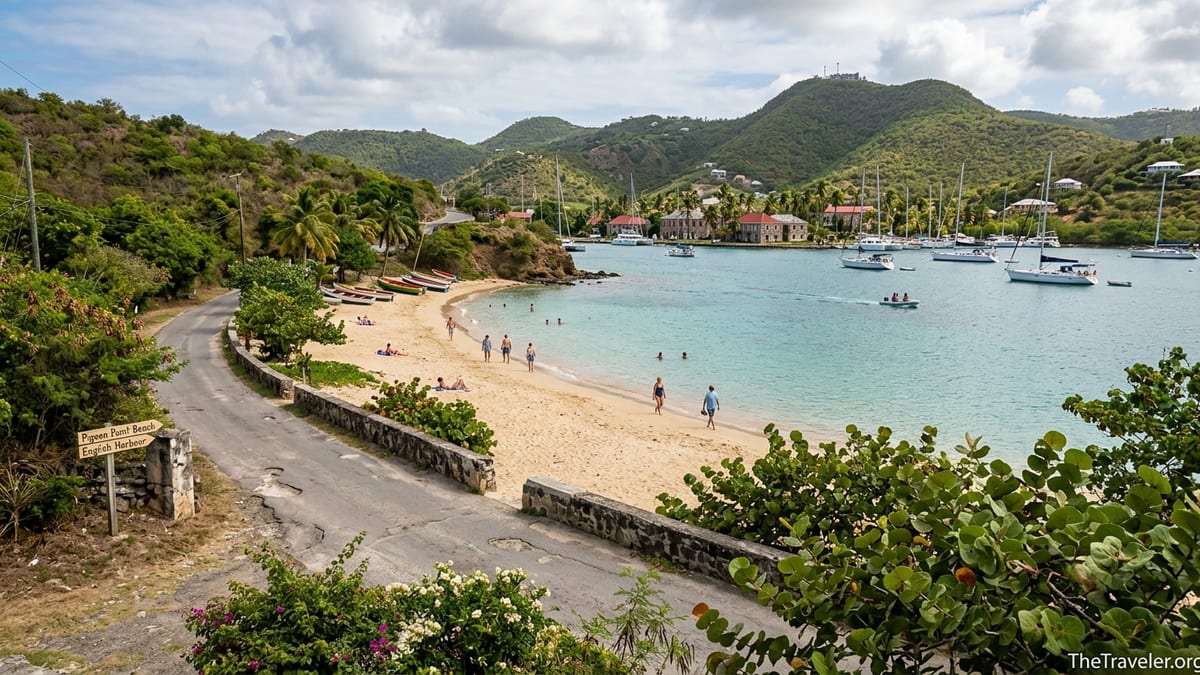
Understanding Where Pigeon Point Beach Is
Pigeon Point Beach is tucked into a sheltered bay on Antigua’s south coast, a short distance west of English Harbour village and east of Falmouth Harbour. It is part of St Paul parish, a scenic but more sparsely developed corner of the island compared with the resort clusters along the north and northwest coasts. The beach itself is reached by local roads that branch off the main route linking Falmouth and English Harbour.
From central St John’s and the cruise port, most mapping tools currently show a distance in the region of 17 to 20 kilometres to Pigeon Point, with normal driving times typically between about half an hour and three quarters of an hour depending on traffic and the precise starting and ending points. Heavy rain, cruise ship days and school traffic can all extend this. Travellers should avoid treating any quoted time as guaranteed and should always build in a buffer, especially if they must return to a ship or catch a flight.
Two main road corridors are generally used between St John’s and the south coast. One runs through the island’s hilly centre, while another passes closer to the eastern side before turning south. Which is quicker on any given day can depend on congestion, roadworks and driver preference. Because road surfaces and signage vary in quality, visitors should assume that journeys may feel slower than the distance alone might suggest.
From St John’s Cruise Port: Taxis, Excursions and Private Tours
St John’s cruise port is the primary arrival point for many short-stay visitors to Antigua, and it is entirely feasible to visit Pigeon Point Beach during a day in port. On busy days, organised ship excursions are widely offered that combine a visit to Nelson’s Dockyard in English Harbour with free time at a nearby beach. Some excursions specifically include Pigeon Point, while others use different beaches in the south. These excursions bring the advantages of guaranteed return to the ship if operated by the line and pre-arranged transport and timing.
For independent travellers, taxis are easy to find directly outside the cruise terminals, where licensed drivers typically wait in an organised rank. Official taxi fares in Antigua are set by the government and periodically updated, with guideline rates posted at or near the port and airport. In practice, drivers often refer to these charts but may also negotiate depending on group size and trip details. Recent examples discussed locally suggest that a private return taxi from St John’s to the English Harbour area for several hours of waiting time can fall in a broad range, often somewhere around the equivalent of several dozen US dollars per vehicle rather than per person, but exact figures vary and should be agreed in advance.
Because official taxi rate sheets can change, cruise passengers should look for the latest posted chart at the cruise pier or ask at the port information desk for current guidance. It is sensible to confirm whether the price quoted is one way or round trip, how long the driver will wait, and whether there are any additional waiting time charges. Many visitors arrange a round trip with an agreed pick-up time, allowing for the journey each way, a swim at Pigeon Point and perhaps a short visit to Nelson’s Dockyard. A conservative approach is to allow about one hour for transport in each direction plus at least two to three hours at the beach and dockyard, then add an extra safety buffer before the ship’s all-aboard time.
Pre-booked private tours and independent guides can be another option from St John’s. These often collect guests right outside the terminal and combine several south coast stops, including Nelson’s Dockyard, Shirley Heights viewpoints and a beach such as Pigeon Point. Prices are normally quoted per person with minimum numbers or as a flat rate for the vehicle. The advantage is a structured day with commentary and built-in time management, which can be reassuring for travellers who want more than a simple taxi transfer but do not wish to join a large bus excursion.
From VC Bird International Airport and Northern Resorts by Car
Independent travellers arriving by air, and resort guests staying around Dickenson Bay, Hodges Bay, Jolly Harbour or other northern and western beaches, often consider a day trip to Pigeon Point. The most flexible way to do this is by rental car. From VC Bird International Airport, typical driving routes use the main roads through St John’s and then south towards Liberta, Falmouth and English Harbour. Current mapping services suggest broad driving times from the airport to Pigeon Point in the region of 35 to 50 minutes in normal conditions, again depending on traffic and exact routing.
Renting a car in Antigua offers the freedom to combine Pigeon Point with other south coast sights. Visitors should be aware that driving is on the left, with right-hand drive vehicles. Road quality is mixed: main roads are generally paved but can have potholes, speed bumps and occasional narrow or winding stretches, especially near villages. Street lighting is limited away from built-up areas, which can make night driving more challenging for those unfamiliar with local conditions. Navigation apps usually show the route clearly, but offline backup or a paper map is sensible in case of poor mobile coverage.
Parking near Pigeon Point Beach and in English Harbour is currently reported by recent visitors as straightforward, with informal roadside or small lot parking that has typically been free. However, arrangements can change with local development, events or regulations. Drivers should follow local signage, avoid blocking access for residents or emergency vehicles and check with accommodation staff or local businesses for the latest information about any charges or restrictions before setting out.
For those who prefer not to drive, taxis and private transfers from VC Bird International Airport or northern resorts to the English Harbour area are widely available. Official taxi tariffs again provide a baseline, with fares to the south coast generally higher than short hops around St John’s due to the longer distance. Recent indicative patterns suggest that airport to English Harbour and return may cost in the broad range of a moderate three-figure sum in US dollars for a private vehicle depending on group size, but because reported examples vary, travellers should treat any figure as illustrative only. Most hotels and guesthouses can arrange reliable drivers or transfer services and provide up-to-date quotes shortly before travel.
Public Transport Options from Around the Island
Antigua’s public transport network relies largely on privately operated minibuses that run along numbered routes connecting St John’s with major villages and districts. These buses can be a low-cost way to reach the general English Harbour and Falmouth area but they do not typically run directly to the sand at Pigeon Point Beach. Instead, they terminate or pass through nearby communities, from which visitors can walk the remaining distance or take a short taxi hop if available.
Recent route information indicates that there are minibus services running between St John’s and the south-central parts of the island, including stops in or near Liberta, Falmouth and areas close to English Harbour. Departures are not always on a fixed timetable; buses often leave once they are reasonably full and operate mainly during daylight hours, with fewer services in the evening. Fares are usually paid in cash in Eastern Caribbean dollars and are relatively low compared with private taxis, but exact prices depend on distance and current local practice.
For travellers intent on using public transport to reach Pigeon Point, a realistic plan is to take a bus from St John’s main bus station or another village toward Falmouth or English Harbour, then walk from the drop-off point to the beach. Depending on where passengers are let off, this final stretch may involve around 15 to 25 minutes of walking along local roads. The walk is manageable for most reasonably fit visitors in daytime but can be hot due to sun exposure, and pavements may be limited. It is wise to carry water, wear suitable footwear and allow extra time.
There are important limitations to consider. Minibus schedules are irregular and can thin out in late afternoon, so this is not a good option for cruise passengers with a strict back-on-board time. Vehicles can be crowded at peak times, luggage space is limited and there is no guarantee of a quick departure. Independent travellers staying on the island for longer can treat the bus as a cultural experience and budget-friendly choice, but they should confirm current routes and typical operating hours locally, as route numbers and endpoints can change.
Local Access from English Harbour and Falmouth Harbour
Visitors already staying in or around English Harbour and Falmouth Harbour are best placed to enjoy Pigeon Point Beach without long transfers. The beach lies within walking distance of many guesthouses, small hotels, marinas and restaurants clustered around the harbours. Current maps and recent visitor reports indicate that the most common approach is on foot via paved local roads, heading from the dockyard or marina areas toward the small headland that shelters Pigeon Point Bay.
The walking routes are generally straightforward, though they may include short inclines and sections where pedestrians share the road with vehicles. Footpaths and pavements are not continuous in all stretches, so walkers should stay alert, especially on curves. In daylight, this is usually a pleasant and easy stroll for most visitors, commonly taking somewhere between 10 and 25 minutes depending on starting point, pace and heat. Carrying water and sun protection is advisable, particularly at midday.
After dark, conditions change. Street lighting varies and some segments can be dim, so many visitors prefer to use taxis in the evening, especially if returning to accommodation after dinner or drinks near the beach or in the dockyard. Local taxi services operate in the harbour area and can be called by restaurants, bars or hotels. For those who do decide to walk at night, travelling in a group, using a torch function on a phone and staying alert to traffic can improve comfort and safety. As always, travellers should follow standard precautions with valuables and personal security.
Rental cars and scooters are another way to shuttle between accommodation and Pigeon Point. The short driving distance means fuel use is minimal, but parking remains an important consideration. The same general principles apply as for day visitors from farther afield: check the latest local guidance on where parking is permitted, be respectful of residents’ access and bear in mind that parking demand can increase during popular events or peak dinner times in English Harbour.
Arriving by Yacht or Boat into Falmouth and English Harbour
Pigeon Point Beach is popular with yacht crews and cruising sailors thanks to its proximity to Falmouth Harbour’s marinas and anchorages. Boats anchored or berthed in Falmouth Harbour are typically only a short dinghy ride from the beach. Current local practice, as reported by recent visitors and sailors, indicates that tenders and dinghies can usually be landed at or near the ends of the beach, but exact landing points, no-wake zones and restrictions may be subject to local rules and environmental regulations that can change.
Skippers should check the latest guidance from harbour authorities, marina offices or local sailing organisations on where dinghies may be brought ashore, any sensitive sea grass or coral areas that must be avoided and whether there are designated dinghy docks preferred for beach access. Rules about leaving dinghies on the sand, securing outboards and locking fuel tanks can also differ from year to year or between marinas, so it is prudent to ask locally rather than rely solely on past experience.
Security is another consideration. While many sailors report an uneventful experience leaving dinghies near Pigeon Point and around the harbours, basic precautions such as locking the outboard, removing valuables and using a chain or cable lock for the tender are advisable. During the peak yachting season, the area can be busy with marine traffic, so operating dinghies slowly near swimmers and observing posted speed and anchoring restrictions is essential for safety and compliance.
Some visitors staying on land-based accommodation also arrange boat transfers or small-boat excursions that include a swimming stop off Pigeon Point. In these cases, the captain usually takes care of local rules and best landing practices. Travelers should still ask brief questions about where the boat will anchor, how they will get ashore and what time they need to be back on board, especially if they have onward commitments the same day.
Practical Timing, Safety and Choosing the Best Option
Whichever way you reach Pigeon Point Beach, planning and flexibility are key. Road conditions, cruise schedules, weather and occasional events such as regattas or festivals around English Harbour can all affect traffic and parking. Travellers should always check local news, hotel notices or with taxi dispatchers for any current roadworks or diversions that might lengthen journey times, and ask drivers or tour operators for their latest estimate based on that day’s conditions.
For cruise passengers docking in St John’s, the most reliable options are ship-organised excursions or clearly agreed private taxi or tour arrangements, with conservative time buffers on either side of the beach visit. Those who prioritise certainty about returning to the ship may prefer the cruise line’s own tours, while independent explorers who are comfortable managing their schedule can benefit from the flexibility of a private taxi or small-group tour, as long as they allow ample time for the return leg and unforeseen delays.
Resort guests and independent travellers staying elsewhere on the island will usually find that a rental car or pre-booked private transfer offers the best balance of cost, comfort and flexibility for a day at Pigeon Point and English Harbour. Self-drive travellers gain the freedom to stop at viewpoints, explore neighbouring beaches and linger over meals, while those who prefer not to drive can rely on hotel-arranged taxis or drivers who know the roads well. Travellers on tighter budgets or with a sense of adventure may incorporate public minibuses for part of the journey, but should avoid doing so under strict time pressure.
Visitors already based in English Harbour or Falmouth Harbour can treat Pigeon Point almost as an extended front yard. Walking in daylight remains the simplest and most enjoyable way to reach the beach, with short taxi hops a sensible choice after dark or when carrying gear. Sailors arriving by yacht or boat should seek up-to-date harbour guidance on dinghy landing and environmental rules. In all cases, confirming the latest local conditions and leaving generous margins for travel time will help ensure that getting to and from Pigeon Point Beach is a relaxed part of the Antiguan experience rather than a source of stress.