


Landing at Nice Côte d’Azur Airport is the start of one of Europe’s most glamorous transfers. Whether you are heading for a business meeting in Monte Carlo, a yacht in Port Hercule or a Grand Prix weekend, choosing the right route between the airport and Monaco can save you time, money and stress. From budget-friendly buses and coastal trains to fixed-rate taxis, chauffeured cars and seven-minute helicopter shuttles, here is how each option really works in practice.
Get the latest updates straight to your inbox!
Overview: How Far Is Nice Airport From Monaco and What To Expect
Nice Côte d’Azur Airport sits on the waterfront west of Nice, while Monaco hugs the cliffs 30 kilometers up the coast. In normal traffic, the road journey takes about 35 to 45 minutes. At peak times, including summer weekends and Monaco events like the Formula 1 Grand Prix or major conferences, the same trip can easily stretch past 60 minutes on the A8 motorway or coastal corniche roads.
Most visitors underestimate the combination of hills, tunnels and traffic between the airport and Monaco. Google Maps may show an optimistic 30-minute estimate, but transfers at 08:30 on a weekday or 18:00 on a July Friday can be considerably slower. This matters if you are catching a departing flight or arriving on a tight schedule for a meeting or cruise embarkation.
The good news is that there is a spectrum of transport options to fit different priorities. Travelers watching their budget can combine the airport tram with a regional train for a very inexpensive trip, while those for whom time is money often choose the seven-minute helicopter shuttle that links the airport directly with Monaco Heliport in Fontvieille. In between sit taxis, ride-style private transfers and a direct airport bus that many leisure visitors find to be the simplest solution.
All options can comfortably handle standard suitcases, but how easy they feel with luggage varies. Stepping into a pre-booked car outside the arrivals hall is very different from wheeling two large bags across tram platforms and station underpasses. Thinking about your luggage, mobility and tolerance for stairs and crowds is as important as comparing journey times and ticket prices.
Direct Express Bus: Easiest Public Route From Terminal to Monaco
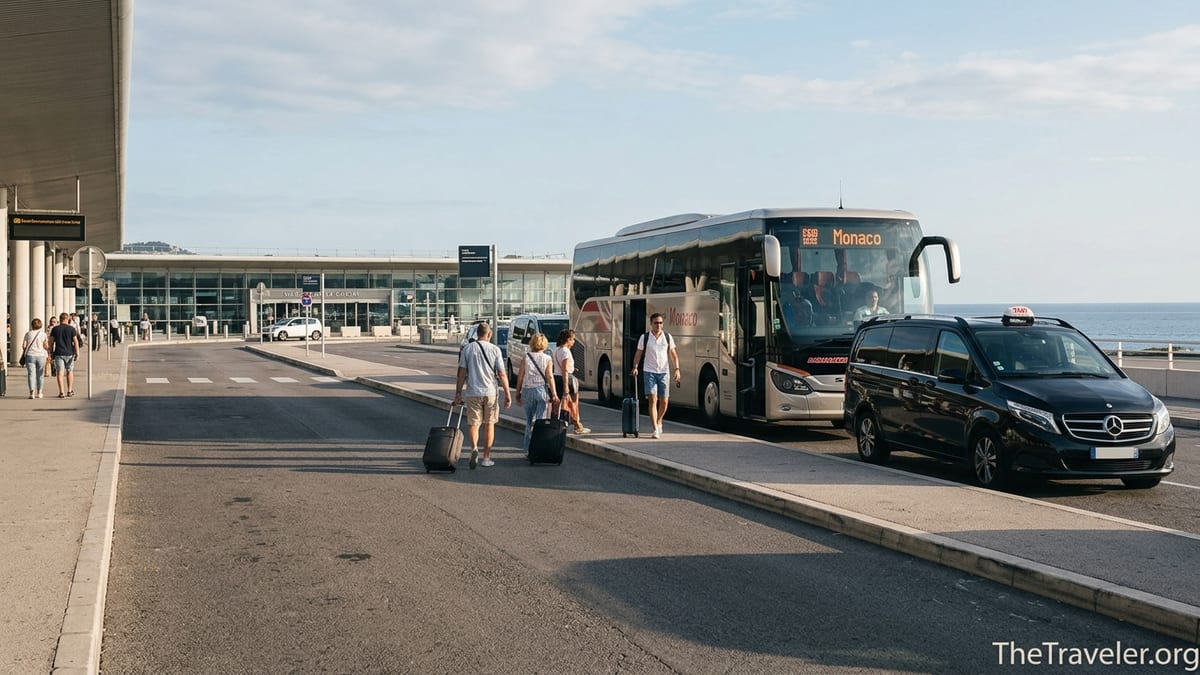
The dedicated airport bus between Nice Côte d’Azur and Monaco is designed for visitors who want a straightforward, no-changes journey. As of mid-2026, the long-standing Ligne 110 Nice–Monaco–Menton service continues to link both airport terminals with Monaco, running along the coast and using dedicated coach-style vehicles with luggage space underneath. Schedules vary by season, but departures are typically every 30 to 60 minutes during the day.
Travel time from the airport to Monaco is usually around 45 to 60 minutes, depending on traffic. Buses leave from clearly signed stops outside Terminal 1 and Terminal 2, so you do not need to navigate the tram system first. For many first-time visitors flying in from the US or UK, this directness is the main appeal: you roll your suitcase out of customs, buy a ticket from a machine or counter, and board the bus headed “Monaco.”
Ticket prices are higher than a standard local bus, but still far cheaper than a taxi or helicopter. Recent fares have been in the few tens of euros per person one way, with discounts sometimes available for returns or advance purchases via the regional transport apps or ticket offices. Because this is an airport service, drivers are accustomed to luggage; large suitcases go in the hold, while smaller bags can come onboard.
The drawbacks are crowding and flexibility. In summer or during events, buses can be full and may leave some passengers waiting for the next departure. If your flight arrives very early or late, gaps in the timetable can be significant, especially on Sundays and public holidays. The route also uses the main coastal corridor, so it is exposed to the same traffic that can slow taxis and private cars.
Train via Nice Saint-Augustin: Cheapest Route With Regular Departures
For cost-conscious travelers who do not mind a short walk or tram ride, the train is usually the best-value way to reach Monaco. Regional TER trains run along the coast between Nice and Ventimiglia, stopping at Monaco–Monaco-Monte-Carlo station. Fares from Nice to Monaco are typically in the single-digit euro range per person, even when bought on the day from ticket machines or through the SNCF Connect app.
Nice Saint-Augustin station is the closest rail stop to the airport, roughly a 5 to 10 minute walk from Terminal 1 through the Grand Arenas district. Some travelers prefer to take the airport tram one stop to the Grand Arenas / Nice Saint-Augustin area to avoid navigating road crossings. From there, frequent TER trains reach Monaco in about 25 to 30 minutes. Adding the walk or tram link, the total journey from the terminal to Monaco is usually 45 to 60 minutes door to door.
This route is particularly attractive for solo travelers and couples with light luggage. For example, a pair flying in for a weekend in Monte Carlo can spend under 20 euros total to get from the airport to Monaco, compared with around 95 euros for a taxi. They can also use the same TER trains to explore Villefranche-sur-Mer or Menton during their stay on a single set of low-cost tickets.
The main limitations are luggage handling and station layouts. Saint-Augustin is a compact station with basic facilities, and Monaco’s station is built into the cliff with tunnels, escalators and elevators that can be confusing for first-time visitors. If you are managing multiple large suitcases, a stroller or have limited mobility, negotiating platforms and tunnels can be tiring, especially in summer heat. Trains can also be crowded in peak commuter times and on event weekends, which may mean standing with your luggage.
Taxi: Fixed-Rate Door-to-Door Convenience
For many visitors, the simplest ground option remains the official airport taxi. Nice Côte d’Azur Airport publishes fixed fares for common destinations, and Monaco is on that list. As of 2026 guidance, the daytime flat rate from the airport to Monaco is around 95 euros, excluding potential modest supplements for nighttime or extra baggage as set by local regulations.
Taxi ranks are located directly outside both Terminal 1 and Terminal 2, usually at entrance A3. Licensed taxis display clear signage and a roof light, and airport staff often direct arriving passengers to the next available car in the queue. In normal traffic, the ride to Monaco takes around 35 to 45 minutes via the A8 motorway. Drivers are accustomed to hotel and residence drop-offs in Monte Carlo, La Condamine and Fontvieille, and they will typically ask for your exact address or hotel name.
For two or three travelers with luggage, the taxi fare is often competitive with booking multiple seats on the airport bus. A family of four might find that a single taxi, split per person, only costs slightly more than four bus tickets and delivers greater comfort and flexibility. Taxis offer door-to-door service, so there is no need to handle bags on and off public transport or navigate stations.
There are, however, a few practical points to bear in mind. Taxis can be in very high demand at peak arrival times, especially on Fridays and during major events in Monaco and Cannes, leading to queues at the rank. Late-night arrivals may find a smaller pool of cars and slightly higher regulated fares. Payment by card is widely accepted, but it is still wise to confirm with the driver before departure and to ensure that the meter or fixed airport tariff is clearly acknowledged.
Private Car and Chauffeur Services: Comfort and Predictable Pricing
Pre-booked private transfers sit between taxis and helicopters in terms of experience and price. A typical private car service from Nice Airport to Monaco, using a sedan or luxury van, often falls in the 110 to 200 euro range for the vehicle, depending on class, time of day and seasonal demand. Companies offer Mercedes E-Class or Tesla sedans for couples, and larger V-Class or similar vans for groups with luggage.
The key advantage is certainty. A professional driver meets you in the arrivals hall with a sign, tracks your flight for delays, assists with luggage and escorts you directly to a waiting vehicle in the nearby car park. For business travelers arriving on tight schedules or high-profile guests who value discretion, this removes the uncertainty of taxi queues or bus timetables. Families with young children often appreciate being able to pre-request child seats, which are not always guaranteed in standard taxis.
For groups, private transfers can represent better value than they first appear. A party of six traveling together in a van at, say, 180 euros total pays the equivalent of 30 euros per person, which is only modestly more than the combined cost of bus tickets and far lower than six seats on a helicopter shuttle. With hotel or villa drop-off included, there is no need to connect to local taxis within Monaco.
On the downside, private cars are equally subject to road congestion, and journey times can be unpredictable at rush hour. Most reputable operators allow for delays in their scheduling, but if you are catching a flight out of Nice at a busy time, it is wise to leave Monaco earlier than the bare minimum. Travelers should also book with established companies and confirm inclusions in writing, such as waiting time, night surcharges and cancellation policies.
Helicopter Shuttles: Seven Minutes of Riviera Luxury
For those who value time and experience over budget, the helicopter transfer is the Riviera classic. Several operators, including Monacair and Heli Air Monaco, run frequent shuttle flights between Nice Côte d’Azur Airport and Monaco Heliport. The flight time is about seven minutes, making it the fastest way by far to reach Monaco from the airport.
As of mid-2026, regular line fares generally start from around 195 euros per person one way on scheduled services. This usually includes transfer by minivan between the helicopter apron and airport terminals in Nice, as well as onward ground transport in Monaco from the heliport to major hotels or drop-off points. During busy periods, flights often depart every 15 to 30 minutes throughout the day, from early morning until early evening.
The experience itself is part of the appeal. After clearing customs at Nice, dedicated staff typically escort passengers to a lounge area and then to the helicopter pad near Terminal 2. Once airborne, the flight quickly climbs over the Baie des Anges, with views of the Promenade des Anglais, Cap Ferrat and the steep coastline before descending over the port and towers of Monaco to the heliport in Fontvieille. For travelers arriving for events or special occasions, it can be a memorable introduction to the principality.
Helicopter transfers handle normal checked luggage, but there are strict limits on total weight and number of bags per passenger. Larger or excess luggage may need to travel separately by road at additional cost. Weather conditions, particularly strong winds or low visibility, can also disrupt operations and cause delays or cancellations. For this reason, many travelers use helicopters when time savings are most valuable but keep sufficient buffer in their schedules or hold a backup plan by road.
Comparing Time, Cost and Luggage Convenience
When choosing between these routes, it helps to think in three dimensions: budget, time and luggage. A solo traveler with a backpack who arrives at midday on a Tuesday has very different needs from a family of four with two large suitcases each landing at 22:00 on a Saturday in August.
On price, the airport tram plus TER train via Nice Saint-Augustin is usually the clear winner. You can expect to pay a single-digit euro tram ticket combined with a low-cost regional train fare, keeping the total under 15 euros per person. The airport bus sits in the middle, with tickets in the tens of euros but no need to change. Taxis and private transfers move the cost into the high two-digit or low three-digit range per vehicle, while helicopters are firmly in the premium bracket at close to 200 euros per passenger or more.
On time, helicopters are unmatched at about seven minutes of flight plus boarding procedures. In good traffic, taxis and private cars can deliver a 35 to 45 minute door-to-door journey. The airport bus and train combinations typically fall around 45 to 60 minutes, sometimes longer in congested periods or if you have just missed a departure. The key is reliability: trains are generally punctual and independent of road traffic but can be subject to occasional strikes or timetable gaps, while roads can slow unexpectedly during accidents or heavy tourist peaks.
Luggage convenience can be decisive. If you are traveling with only cabin baggage, using the free airport tram to reach the Grand Arenas area and walking to Nice Saint-Augustin station is perfectly manageable, and the cost savings are significant. If you are juggling ski equipment in winter or several large suitcases for a long yacht charter, the simplicity of stepping into a taxi or pre-booked car at the terminal can quickly justify the extra expense. Helicopter shuttles provide assistance and onward van transfers, but weight limits and the need to separate bulky items can complicate matters.
Practical Scenarios: Which Option Fits Your Trip?
Consider a business traveler arriving on a morning flight from London with only a cabin bag and a meeting at 14:00 in Monte Carlo. If the landing time is 10:30 and budget is flexible, booking a helicopter for a 7 to 10 minute transfer plus a short van ride in Monaco easily ensures arrival at the hotel well before 12:00, leaving ample time to prepare. If the helicopter is not appealing or the weather is marginal, a pre-booked chauffeured sedan offers a predictable standby alternative.
Now take a family of four flying in from New York, landing in the afternoon with eight checked bags and a hotel reservation on Avenue Princesse Grace. In this case, a pre-booked van with child seats and guaranteed luggage space can make the arrival far smoother. The fixed cost, divided by four, may not be much higher per person than the airport bus when you factor in the comfort of door-to-door service and no need to manage children and luggage on public transport.
For a couple on a long weekend who want to keep costs under control, combining the airport tram and TER train can be the sweet spot. They can board the free tram from the terminal to the Grand Arenas area, walk to Nice Saint-Augustin station, and hop on a coastal train to Monaco, watching the sea views for a fraction of the cost of a taxi. On their return, they might choose a taxi if they have acquired extra luggage or want a more relaxed departure day.
Event travelers, especially during the Monaco Grand Prix, should plan transfers early. Hotel rates and helicopter seats can sell out months in advance, and traffic congestion can be severe. Many regular visitors choose a hybrid strategy: taking the train for inbound travel when schedules are flexible, and reserving a helicopter or private car for departure day to reduce the risk of missing flights.
The Takeaway
There is no single “best” way to travel between Nice Côte d’Azur Airport and Monaco; the ideal route depends on your budget, schedule and tolerance for navigating local transport. Helicopters deliver unmatched speed and a signature Riviera experience, but they carry premium pricing and some weather dependence. Taxis and private transfers strike a balance between comfort, predictability and cost, particularly for groups or travelers with significant luggage.
For many visitors, especially those on leisure trips without tight deadlines, the airport bus and the TER train via Nice Saint-Augustin provide reliable and economical alternatives that still bring you to Monaco in under an hour in most conditions. Whichever route you choose, factoring in realistic travel times, potential traffic, station layouts and baggage needs will help ensure that your first or last hour on the Côte d’Azur is as smooth as the rest of your stay.
FAQ
Q1. How long does it usually take to get from Nice Airport to Monaco? In normal conditions, expect about 35 to 45 minutes by taxi or private car, 45 to 60 minutes by bus or train, and around 7 minutes of actual flight time by helicopter, plus boarding and transfers.
Q2. What is the cheapest way to travel from Nice Airport to Monaco? The lowest-cost option is typically the airport tram combined with a regional TER train from Nice Saint-Augustin to Monaco, with total fares usually under 15 euros per person.
Q3. Is there a direct public bus from Nice Airport to Monaco? Yes. An express bus service connects both airport terminals with Monaco and onward to Menton, using coach-style vehicles with luggage storage and running roughly every 30 to 60 minutes during the day.
Q4. How much does a taxi from Nice Airport to Monaco cost? Official airport guidance sets a fixed daytime fare in the region of 95 euros for the journey to Monaco, with modest supplements possible for night-time or specific extras under local regulations.
Q5. Are helicopter transfers from Nice to Monaco worth the price? For travelers who value time and experience, helicopters can be worthwhile: they cut the journey to about seven minutes and often include lounge access and hotel transfers, but they are significantly more expensive than ground options.
Q6. Can I take the train directly from Nice Airport to Monaco? There is no rail station inside the airport, but you can walk or take the tram to nearby Nice Saint-Augustin station and board a TER train from there to Monaco–Monaco-Monte-Carlo.
Q7. Which option is best if I have a lot of luggage? Travelers with multiple large suitcases usually find taxis or pre-booked private cars most convenient, as these provide door-to-door service without managing bags on and off public transport or through station tunnels.
Q8. Do transfer options operate early in the morning and late at night? Taxis and pre-booked private cars are generally available around the clock, while bus, train and helicopter schedules are more limited and may have gaps very early or late, especially on Sundays and public holidays.
Q9. How reliable are trains between Nice and Monaco? TER trains along the coast are generally frequent and punctual, but services can be busy at peak times and occasionally affected by strikes or timetable changes, so it is wise to check schedules close to your travel date.
Q10. Should I book my transfer in advance? Advance booking is strongly recommended for helicopters and private cars, and is sensible for busy weekends or major events; for regular days, taxis, trains and buses can usually be used without prior reservations, though checking times in advance still helps planning.