


For most travelers, the South of France begins not with a glass of rosé in Provence or a stroll along the Promenade des Anglais, but with a jet bridge. Your choice of gateway airport sets the tone for the entire trip, and on this stretch of the Mediterranean coast two hubs compete for your boarding pass: Nice Côte d’Azur Airport (NCE) and Marseille Provence Airport (MRS). Each offers a different mix of flights, onward transport and nearby landscapes. Picking the right one can easily save you a half-day of transfers and a few hundred euros over a week-long stay.
Get the latest updates straight to your inbox!
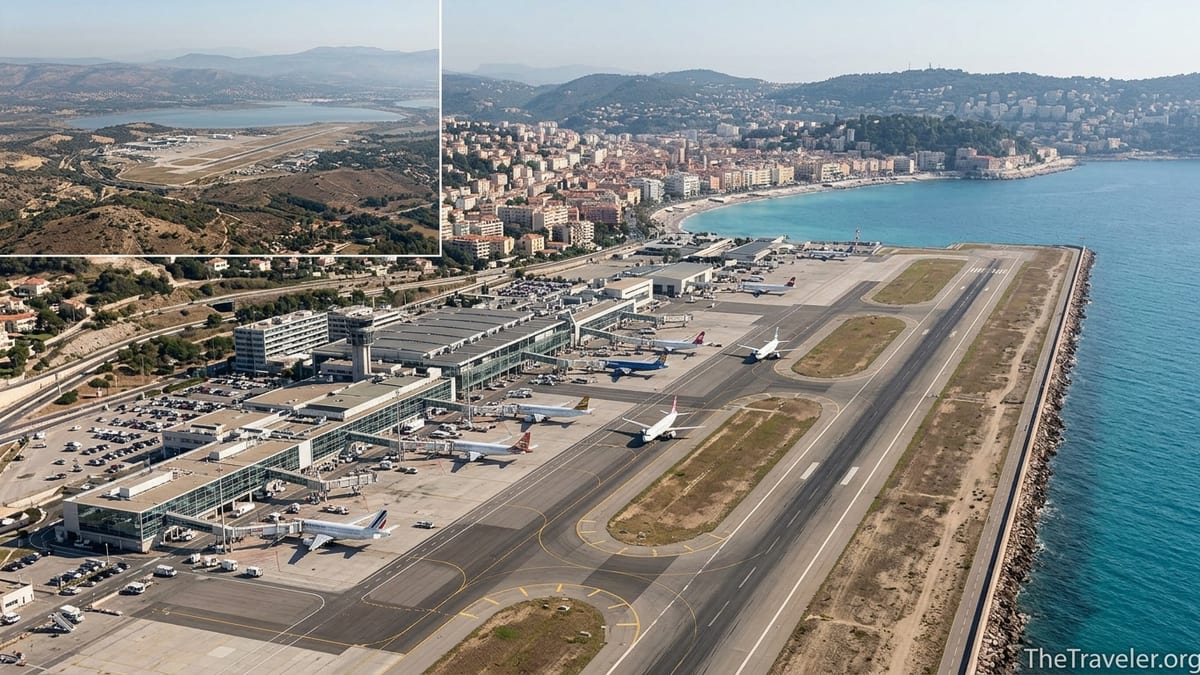
Two Gateways, Two Very Different Souths of France
Nice and Marseille are only about 200 kilometers apart on the map, but they serve very different versions of southern France. Nice Côte d’Azur is the primary international gateway to the Riviera, from Cannes and Antibes to Monaco and Menton. In 2024 it handled close to 15 million passengers, making it France’s busiest airport outside Paris and a major hub for European and transatlantic leisure traffic. You feel that as soon as you land: floor-to-ceiling windows over the sea, a high concentration of seasonal routes, and boarding gates filled with visitors heading to resort towns strung along the coast.
Marseille Provence Airport is smaller, with just over 10.8 million passengers in 2023, but it punches above its weight for low‑cost and domestic French routes. Located inland near the Étang de Berre lagoon, it is the most logical entry point for western Provence, the Luberon, the Camargue and the port city of Marseille itself. The vibe is more practical than glamorous: a workhorse airport where budget carriers and regional flights dominate, and where you are just as likely to be standing next to a business traveler from Lyon as a vacationer bound for Cassis.
This split in personalities matters. If your mental picture of the South of France is the glittering Côte d’Azur and quick hops by train between coastal towns, Nice is usually the better fit. If you are dreaming of hilltop villages, lavender fields and long drives between wineries, Marseille often gets you closer to where you actually want to be. Before you even look at individual flights, it is worth mapping your itinerary against each airport’s “natural” catchment area.
Flight Networks and Where You Can Actually Fly From
Availability of direct flights is often the deciding factor, especially for North American and long‑haul travelers. Nice has steadily built up its international network over the last decade and now offers seasonal nonstop services to cities like New York, Montreal, Atlanta, Dubai and several major European hubs. For a traveler from the United States, that can mean flying directly into the Riviera from New York in summer without having to change planes in Paris, London or Frankfurt. Those nonstops are especially valuable if you dislike tight European connections or are traveling with children and lots of luggage.
Marseille’s long‑haul options remain more modest and are focused primarily on North and West Africa and a handful of hubs such as Istanbul and Doha. From North America, you will almost always connect through Paris, Amsterdam, London or another European hub to reach Marseille. That is not necessarily a bad thing: fares into Marseille on carriers like Air France, KLM or British Airways are often competitive, and if you are comfortable with a connection anyway, the difference between landing in Nice or Marseille might be negligible from a flight‑time perspective.
Within Europe, the picture looks different. Both airports are well served by low‑cost airlines, but Marseille tends to attract more aggressively priced routes from secondary cities, particularly on carriers such as Ryanair and easyJet. A traveler from Manchester or Brussels, for example, may find more frequent sales into Marseille than into Nice, especially outside high summer. For someone based in Paris, Marseille is heavily connected by both air and rail; Air France operates frequent shuttles, and the city is also just about three hours by high‑speed TGV, so savvy travelers sometimes even fly to Paris and finish to Marseille by train.
Concrete example: a couple from Boston planning an early September trip might price out a nonstop Boston–Paris flight paired with a short domestic hop into Marseille to reach a rented farmhouse near Gordes. In contrast, a group from Toronto staying in Cannes could benefit from a summer nonstop into Nice or an easy one‑stop via Frankfurt that lands them practically on top of the Riviera.
Onward Transport: Trams, Trains, Buses and Taxis
Once you land, the ease of getting out of the airport quickly becomes more important than the logo on your boarding pass. Nice has invested heavily in public transport links. A modern tram line runs from both airport terminals to central Nice in roughly 25 minutes, with tickets priced in the low single‑digit euros. That makes it entirely realistic for a solo traveler or couple with carry‑on bags to be checking into a hotel off Place Masséna less than an hour after wheels‑down, spending more on an espresso in the Old Town than on their airport transfer.
From Nice, regional trains and buses fan out along the coast. The local TER train from Nice Saint‑Augustin station, a short tram hop or 10‑minute walk from the terminals, reaches Cannes in about 35 minutes for a fare of around 5 euros. Express buses along the coastal highway, ride‑shares and taxis add further options. A regulated taxi from Nice airport to Cannes costs in the region of 80 to 90 euros, while an Uber or similar ride‑share might hover around 50 to 60 euros depending on time of day. For groups of three or four with luggage, that door‑to‑door convenience often makes sense, but budget‑minded travelers will find the public transport network both economical and straightforward.
Marseille Provence Airport has a different but effective set‑up. Dedicated shuttle buses run every 10 to 15 minutes to Marseille Saint‑Charles station, the city’s main rail hub, in about 25 minutes, with a round‑trip ticket typically costing under 20 euros. There is also a small train station, Vitrolles Aéroport Marseille Provence, linked to the terminals by a short shuttle, offering frequent regional trains toward Marseille, Aix‑en‑Provence and beyond. Travelers heading straight into the Luberon or the Alpilles often opt to rent a car at the airport, where major agencies cluster in a purpose‑built zone; from there it is around 50 minutes to Aix‑en‑Provence and about 1 hour 15 minutes to Saint‑Rémy‑de‑Provence in normal traffic.
In practice, Nice wins on seamless rail and tram access, particularly if you plan to stay car‑free and ride trains between resort towns. Marseille is more car‑centric but extremely functional if you are comfortable driving. For example, a family flying into Marseille to spend a week in a gîte near Bonnieux can be on the A7 motorway in minutes and at their front door with groceries in the trunk before they would even have cleared the Nice urban area.
Driving Distances to Key Destinations
Where you are staying in the South of France is the single most important factor in choosing between these airports. Roughly speaking, Nice works best for the eastern Côte d’Azur, while Marseille is more logical for western Provence and the western Mediterranean coast. Looking at actual driving times makes this clear.
From Nice airport, central Nice is 15 to 20 minutes by car in light traffic. Cannes is usually 30 to 40 minutes, Antibes around 25 minutes, Monaco 35 to 45 minutes, and the Italian border at Menton under an hour. By contrast, getting from Nice to classic Provençal villages such as Gordes or Roussillon can easily take 2.5 to 3 hours of highway and smaller roads. That is perfectly feasible if you are taking a scenic road trip, but less appealing if your flight arrives late in the day and you would rather be sitting by a pool than navigating unfamiliar roundabouts at dusk.
Marseille puts you far closer to the heart of Provence. From the airport, central Marseille is about 25 minutes away, Aix‑en‑Provence about 30 minutes, Arles about 50 minutes, and Avignon around one hour. Luberon villages such as Bonnieux or Ménerbes are often 60 to 90 minutes away depending on traffic, while the Camargue’s wetlands and beaches lie around an hour’s drive to the southwest. On the other hand, heading from Marseille to Riviera towns such as Nice or Cannes means a drive of at least two hours, longer in summer congestion.
Imagine two itineraries in June. Traveler A spends four nights in Nice, two in Cannes and one in Monaco. For them, Nice airport minimizes transfers and makes it easy to use trains and trams instead of a car. Traveler B has rented a farmhouse near Saint‑Rémy‑de‑Provence for a week, with day trips to Arles, Les Baux and the Camargue. Flying into Marseille allows them to pick up a car, drive less than an hour to their base, and avoid the dense coastal traffic almost entirely. Seen through that lens, the debate is less “Nice versus Marseille” and more “Riviera holiday versus inland Provence escape.”
Costs on the Ground: Transfers, Car Hire and Daily Spending
Beyond airfare, the choice of airport subtly shapes what you will spend during your trip. The Côte d’Azur, with Nice as its primary gateway, is generally one of the pricier parts of France. Hotel rates, restaurant bills and even beach chair rentals in places like Cannes and Saint‑Jean‑Cap‑Ferrat can rise sharply from May through September. Airport transfers reflect that: while the tram in Nice is inexpensive, taxis and private cars to resort towns are not. A private transfer from Nice to Saint‑Tropez, for instance, can easily run into several hundred euros in high season, due both to distance and heavy traffic on the coastal roads.
Marseille and inland Provence, accessed most conveniently from Marseille Provence Airport, can feel gentler on the wallet once you are outside a few high‑demand pockets such as Aix‑en‑Provence in July. Parking in small towns is often free or inexpensive, restaurant menus of the day in villages might hover around 20 to 25 euros, and vacation rental prices drop as you move from postcard‑famous hill towns to less publicized but equally charming communities. A week‑long car rental collected at Marseille airport can sometimes be cheaper than an equivalent booking at Nice, although this varies by season and demand. For a couple planning to visit multiple villages and vineyards, that car becomes a cost‑effective alternative to stringing together taxis from a coastal base.
That said, Nice can work out surprisingly economical for travelers who stick to public transport and self‑cater a little. A solo traveler staying in an apartment in Nice’s Liberation neighborhood, shopping local markets and using the tram and regional trains, may spend less over a week than a couple driving and dining out nightly in inland Provence. The crucial point is that Nice airport aligns more naturally with a semi‑urban, rail‑based stay, while Marseille encourages a more dispersed, car‑dependent style of travel, with different budget implications.
Travel Experience at the Airports Themselves
Both Nice and Marseille have benefited from upgrades in recent years, but their feel remains distinct. Nice’s two main terminals sit spectacularly close to the Mediterranean, with aircraft often taking off and landing over bright turquoise water. Inside, you will find a broad range of duty‑free shops, fashion boutiques and cafés tailored to a leisure crowd. In peak summer, terminals can feel busy, especially during weekend turnover when villas and rentals change hands, but the layout is relatively intuitive, with clear separation between Schengen and non‑Schengen flights and multiple security lanes.
Marseille’s terminals are more utilitarian but have improved notably, with the opening of a modernized Terminal 1 area adding space and light. The passenger mix includes business travelers, local families and tourists heading to both beaches and countryside. Facilities include the expected duty‑free, regional food shops and chain cafés, but on a smaller scale than Nice. Security and passport control can be brisk outside peak periods, and queues ebb and flow with the cluster of low‑cost flights that tend to depart in banks. For many travelers, the key advantage is simply that everything is close together; it is difficult to get truly lost.
From a practical standpoint, Nice often offers more frequent lounge options, particularly useful if you are flying in a premium cabin or have status with an airline alliance. It also handles a larger volume of international long‑haul flights, which can mean longer queues at passport control at certain times of day. Marseille, by contrast, can feel calmer for domestic and regional arrivals but busier at popular holiday departure times when residents of Provence and Marseille head out to sun destinations.
If you are anxious about tight connections or traveling with young children, both airports are manageable, but Nice’s more extensive signage in multiple languages and its tram link make it slightly friendlier for first‑timers. Marseille’s smaller footprint, on the other hand, may appeal to those who dislike sprawling hubs and would rather walk a few steps than a few hundred meters between check‑in and security.
When Nice Makes More Sense vs When Marseille Wins
Putting everything together, patterns quickly emerge about which airport serves which type of trip better. You are generally better off landing in Nice if your itinerary is focused on the eastern Riviera: city breaks in Nice itself, beach holidays in Cannes or Antibes, conference travel to the Palais des Festivals, or casino‑tinged weekends in Monaco. Rail accessibility, the coastal TER line and the dense cluster of hotels, apartments and restaurants within tram reach all make Nice the stronger choice. A family staying in an apartment near Nice’s Port district, for instance, can arrive by tram, spend a week exploring Villefranche‑sur‑Mer, Menton and Monaco by train, and never once need to rent a car.
Marseille tends to win for itineraries centered on inland Provence, the Calanques and the western Mediterranean. Travelers booking a villa near L’Isle‑sur‑la‑Sorgue or Lourmarin, wine enthusiasts spending a week between Châteauneuf‑du‑Pape and the Côtes du Rhône, and bird‑watchers heading into the Camargue seldom benefit from landing at Nice. They would have a longer drive, higher tolls and potentially more coastal traffic to fight through. Starting and ending at Marseille keeps transfer times reasonable and offers easier access to major highways like the A7 and A54. Even for a mixed itinerary such as “three nights in Marseille, four nights in a Luberon village,” Marseille airport puts you close to both halves of the trip.
There are gray areas, of course. If you are splitting time evenly between, say, Cannes and the Luberon, you could reasonably pick either airport and accept a long initial or final transfer. In such cases, it often comes down to flight schedules and fares. Perhaps you find an excellent nonstop into Nice that lands in the morning, giving you time to pick up a rental car and still reach your farmhouse before dinner. Or maybe a discounted one‑stop ticket into Marseille frees up enough budget to add a night in a boutique hotel in Aix. Flexibility about arrival and departure points can pay off, particularly if you are comfortable driving one way and returning the car to a different airport.
The Takeaway
Nice Côte d’Azur and Marseille Provence are not interchangeable doors to the same destination. They are gateways to two overlapping but distinct versions of southern France. Nice aligns naturally with the Riviera: a ribbon of coastal towns connected by trams and trains, ideal for travelers who want sea views, promenades and relatively car‑free movement between resorts. Marseille opens into a broader canvas of Provence and the Mediterranean: limestone cliffs, market towns, vineyards and long country drives between stone villages and hilltop viewpoints.
If you picture yourself riding a tram from the airport to a café‑lined square in Nice, day‑tripping by train to Monaco and Antibes and ending sunsets on pebble beaches, Nice airport almost certainly makes more sense. If your dreams run to Saturday markets in Saint‑Rémy, hiking above Cassis, tasting rosé at vineyard estates and watching flamingos in the Camargue, Marseille is the smarter choice, even if it means a connection in Paris or another hub. Both airports work well for travelers who match their gateway to their ground plans; frustration usually comes when the two are misaligned.
In practical terms, start with a map, not a flight search engine. Mark the places you truly want to visit, estimate driving times from each airport and only then start comparing fares and schedules. With that simple discipline, the choice between Nice and Marseille becomes obvious more often than not. The right gateway will not just get you to the South of France; it will shape how easily, and how enjoyably, you can live out your own version of it.
FAQ
Q1. Is Nice or Marseille airport better for visiting the French Riviera?
Nice is generally better for the classic Riviera strip from Monaco to Cannes and Antibes, thanks to its tram link, coastal trains and shorter road transfers.
Q2. Which airport is closer to Provence villages like Gordes or Saint-Rémy-de-Provence?
Marseille Provence Airport is significantly closer to the Luberon and Alpilles areas, usually around one to one and a half hours’ drive instead of several hours from Nice.
Q3. Are flights usually cheaper into Nice or Marseille?
It depends on your departure city and season, but Marseille often has very competitive low-cost and domestic fares, while Nice can be better for some international and long-haul routes.
Q4. Do I need a car if I fly into Nice?
You can comfortably explore the main Riviera towns by tram, train and bus from Nice, though you may still want a car for more remote coastal villages or inland excursions.
Q5. Do I need a car if I fly into Marseille?
For most itineraries focused on Provence, the Luberon or the Camargue, renting a car at Marseille airport is highly recommended to reach villages and rural stays efficiently.
Q6. Which airport is easier to reach by public transport?
Nice has an edge thanks to its direct tram line into the city and easy connections to coastal trains, while Marseille relies more on shuttle buses and a small nearby rail station.
Q7. Is traffic around Nice or Marseille worse in summer?
Both see heavy summer traffic, but coastal routes around Nice and Cannes can be particularly congested, while around Marseille bottlenecks often occur near motorways and popular beach areas.
Q8. Which airport is better for a combined Marseille and Provence city-and-country trip?
Marseille airport is usually best, allowing quick access to central Marseille and straightforward drives to Aix-en-Provence, Arles and nearby villages.
Q9. Can I arrive at one airport and depart from the other?
Yes, many car hire companies allow one-way rentals, so you can, for example, arrive in Nice for a Riviera stay and fly home from Marseille after touring inland Provence.
Q10. If I find similar fares to both airports, how should I choose?
Let your itinerary decide: pick the airport that minimizes overall transfer time to your main bases, even if that means a slightly less convenient connection on the flight itself.